

I. Introduction
We are still studying the major prophet Jeremiah, and the year is approximately 609 BC. The evil King Jehoiakim is on the throne, and Jeremiah is in the temple courtyard proclaiming the truth of God.

I’m going to rephrase that in modern terms and then you’ll have a shortcut to where I think this lesson is leading us today.
We are still studying the Word of God, and the year is approximately 2023 AD. There may or may not be an evil king on the throne, but the world and the culture is sure making things ugly out there. And we are in the temple courtyard proclaiming the truth of God.
Now, in Jeremiah’s day, the people didn’t like the message. The religious leaders hated Jeremiah’s message, too, and they decided Jeremiah deserved death. Jeremiah continued to preach the Word, and Jeremiah’s preaching rang true among the people, and they remembered previous prophets had spoken words of truth and weren’t killed, so they released Jeremiah, though they continued to harass Jeremiah.
Jeremiah’s message was consistent. The empire of Babylon would come and bring forth judgment, destroying Jerusalem and taking the people of God captive into exile. The prediction came to pass. Now we pick up where Jeremiah is writing to the captives in Babylon and reminding them not to seek hope in the false prophets, but to seek God.
Although thousands were taken into exile, Jeremiah was part of the remnant left in Jerusalem. There was still a message to proclaim to the people of God even though they were not in their homes or even a familiar land. The journey and the message of Jeremiah continue to God’s people regardless of location and circumstances.
The next king, Zedekiah, began his reign. God told Jeremiah to fashion a yoke and wear it around his neck as an illustration to Zedekiah that the yoke of Babylon was on him and that the king should submit to Babylon rule. A false prophet, Hananiah, gave a false prophecy that the Lord would rescue Judah in the next two year. Jeremiah’s response was essentially, “well, let’s wait and see.” Hananiah then broke the yoke on Jeremiah’s neck, and the Lord said Hananiah would die for inciting rebellion against the Lord.
Our lesson today is the letter that Jeremiah wrote to those in captivity in Babylon. What should the captives do? How should they live? What do God’s people do when living in a land that is not their home? What do we do when living in this world that is not our home?
II. Purpose
First, find purpose in where you live. Jeremiah 29:1,
Now these are the words of the letter which Jeremiah the prophet sent from Jerusalem to the rest of the elders of the exile, the priests, the prophets and all the people whom Nebuchadnezzar had taken into exile from Jerusalem to Babylon.
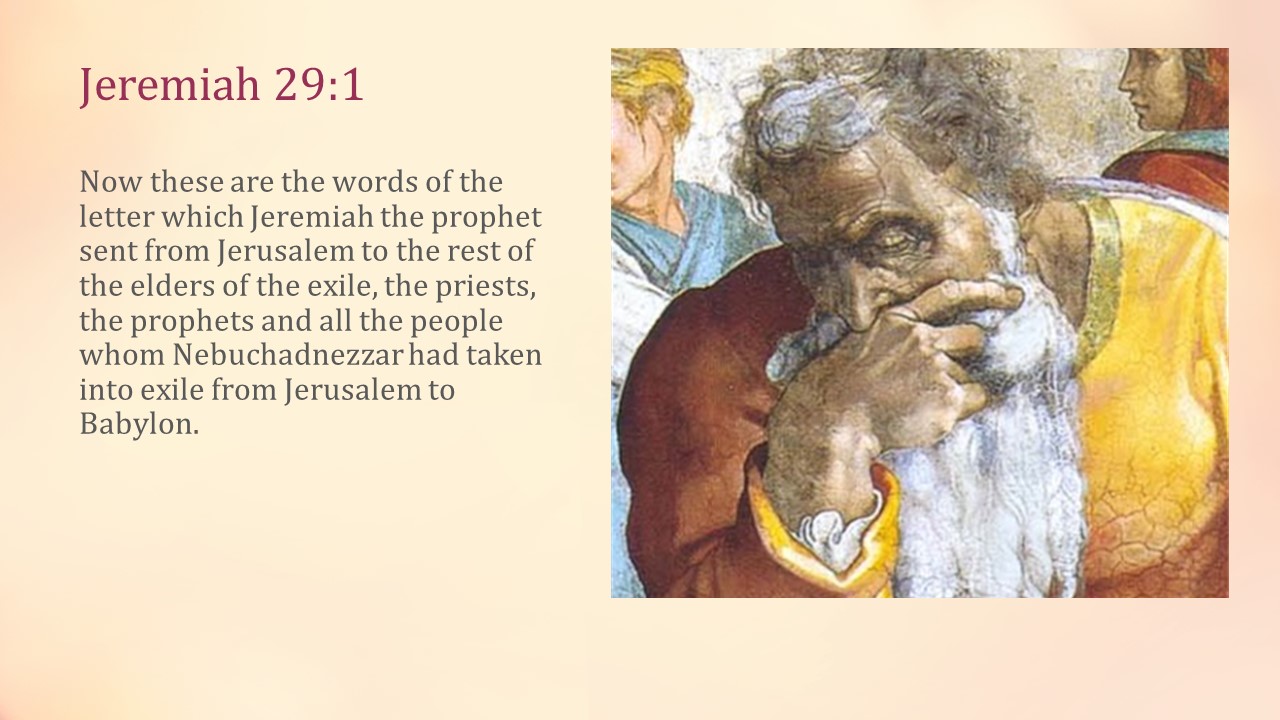
The stage is set clearly in verse 1, Jeremiah is in Jerusalem. The rest of the elders, priests, prophets, and all the people had been taken into exile. Jeremiah wanted to enlighten them and encourage them in their life in Babylon by writing a letter.
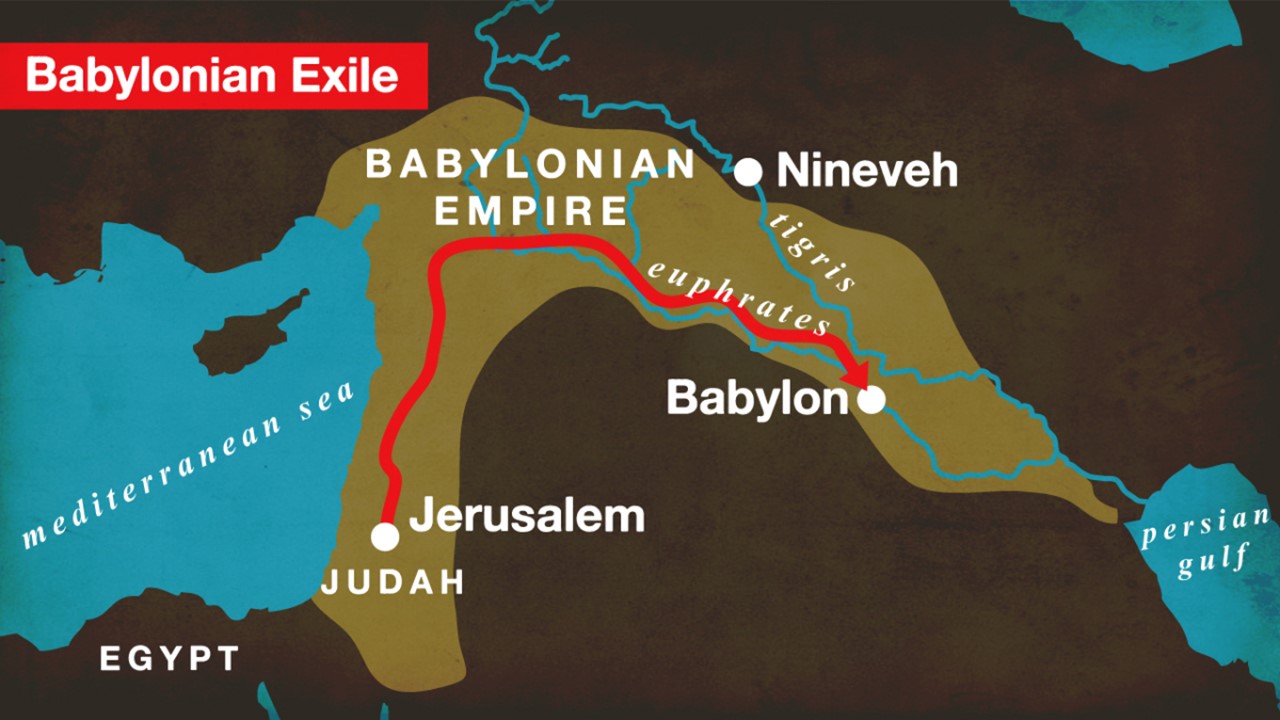
The distance between Jerusalem and Babylon was approximately 1670 miles, about the distance between Houston and New York City. The people were taken there by force; they did not choose to travel and live in Babylon. They were in exile from all they had known. They were living in a foreign land under the authority of a foreign king named Nebuchadnezzar. Jeremiah’s letter begins in verse 4,
“Thus says the Lord of hosts, the God of Israel, to all the exiles whom I have sent into exile from Jerusalem to Babylon:
Though this letter would ultimately give them hope, the opening line must have captured their attention. It was not Nebuchadnezzar’s plan to hold the people in exile. It was God’s plan. Nebuchadnezzar was just a tool. God had sent the people to Babylon to fulfill God’s will. Despite captivity, God was still and had always been in control.
Nothing that takes place on this earth surprises God. He either allows or causes all circumstances. Either way, God uses the circumstance for His purpose. We are encouraged by Romans 8:28,
We know that all things work together for the good of those who love God: those who are called according to His purpose.
Even when His people are in exile in a foreign land. Even when His people are hurting, lonely, angry, and in unfamiliar territory. God is sovereign. Jeremiah wanted to make sure they understood that, regardless of circumstances, God was, is, and always will be their God who is in control.
Jeremiah 29:5-6,
Build houses and live in them; plant gardens and eat their produce. Take wives and have sons and daughters; take wives for your sons, and give your daughters in marriage, that they may bear sons and daughters; multiply there, and do not decrease.

I remember all the way back in the 1980’s, people, including Christians, would say, “I don’t know if this is the right time to bring a child into the world.” After all, the Soviets had invaded Afghanistan, and polls at the time said 2 out of 3 people worried that some false alarm would nuclear Armageddon.
Jeremiah reminds us that God is always in control, so we should always continue to live our lives. God doesn’t say be homesick, be depressed about your circumstances, complain about everything. God doesn’t say put everything on hold until circumstances get better. God says to live our lives, that’s why He gave it to us.
The Judean people were in exile, far away from their home, but God says to live. They were living in a foreign land and eating foreign food under the authority of a foreign government, but God said to live.
In fact, God says to not just settle with living but thrive during exile. He tells them to use this difficult and dark time to grow physically, emotionally, and spiritually.
Although the people were in exile because of their own choices, God did not give up on them. God had a purpose for their lives, all the time. Look at what God asks them to do –
- Build houses. Create a plan to build, lay a foundation, move forward.
- Plant gardens. Tend crops, make a living, eat the harvest.
- Have children and grandchildren. Don’t give up, don’t go backward, move forward and grow families.
Even though we know this world is not our home, God wants us to realize His creation in us and He wants us to thrive, make plans, work and grow families. It’s where God put them, and it’s where God has put us.
How long shall we do this? The last verse of Jeremiah we just read said find wives and husbands for your sons and daughter so that they make have children. Three generations. Be patient with God’s plans, and while you are patient, thrive.
III. Peace
God also desires us to be at peace. Jeremiah 29:7,
But seek the welfare of the city where I have sent you into exile, and pray to the Lord on its behalf, for in its welfare you will find your welfare.
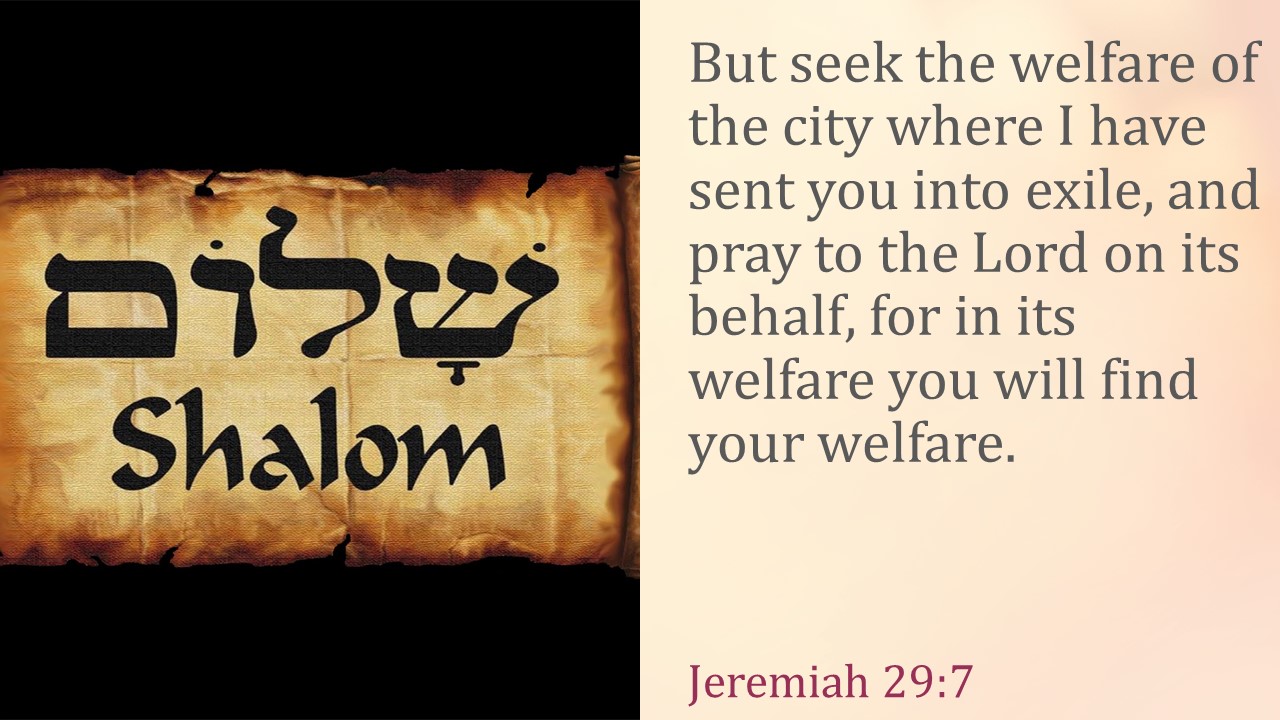
The people are in exile in Babylon, the home of their enemy. Yet God reminds them that He is the One who sent them into exile. God chose for them to be in this foreign land during this dark time. God still, and always, has a plan.
During their exile, God says to “seek the welfare of the city where I have sent you into exile and pray to the Lord on its behalf.” The word translated “welfare” is the Hebrew word “shalom.” It’s one of the few Hebrew words bible students know, and we usually translate it as “peace.” Shalom does mean peace, of course, but it’s so much more.
It’s not just peace, and it’s not just tranquility or the absence of conflict. Shalom represents a holistic well-being, harmony, wholeness, prosperity, and completeness in all aspects of life. It refers to flourishing and reconciliation with God, self, others, and all of His creation.
Jeremiah calls the people to actively pursue the shalom of the Babylonian society in which the Jewish exiles found themselves. Despite being in exile, God instructs them to engage with their surroundings, invest in the welfare of the city, and contribute to its betterment. The exiles are not to just passively wait for their return to their homeland but actively participate in the life of their community.
For Christians today, this verse and the concept of shalom provide a profound framework for engaging with the world. As followers of Christ, Jesus tells us in John 17:14-18 that we are called to be in the world, even though we are not of the world. We are to embody the values of God’s kingdom and actively work towards the welfare, well-being, and peace of the societies we inhabit.
Living out shalom means seeking justice, showing compassion, promoting reconciliation, and working towards the betterment of our communities. We are to be agents of change, addressing the brokenness in the people we encounter with the transformative power of God’s love and grace. We are called to be peacemakers, not only in our personal relationships but also in the society and the world.
Notice the last part of verse 7, “for in its welfare you will find your welfare.” In its shalom, you will find your shalom. In its peace, you will find your peace. In its completeness, you will find your completeness. In its well-being, you will find your well-being.
God is not saying, “wait it out” or “when you get back home in your comfort zone, then you will have shalom.” God is not even saying, “when things get back to normal, then you will have shalom.” God is saying, “whereever you are, in the circumstances you are in, you can have shalom.”
Your shalom begins when you seek shalom for those who are in authority, even if you do not agree with them. Your shalom begins when you pray for those around you amid the extraordinary circumstances of exile.
However, even while seeking shalom, there needs to be a full awareness of your surroundings to not fall victim to those who want to harm you. Jeremiah 29:8-9,
For thus says the Lord of hosts, the God of Israel: Do not let your prophets and your diviners who are among you deceive you, and do not listen to the dreams that they dream, for it is a lie that they are prophesying to you in my name; I did not send them, declares the Lord.
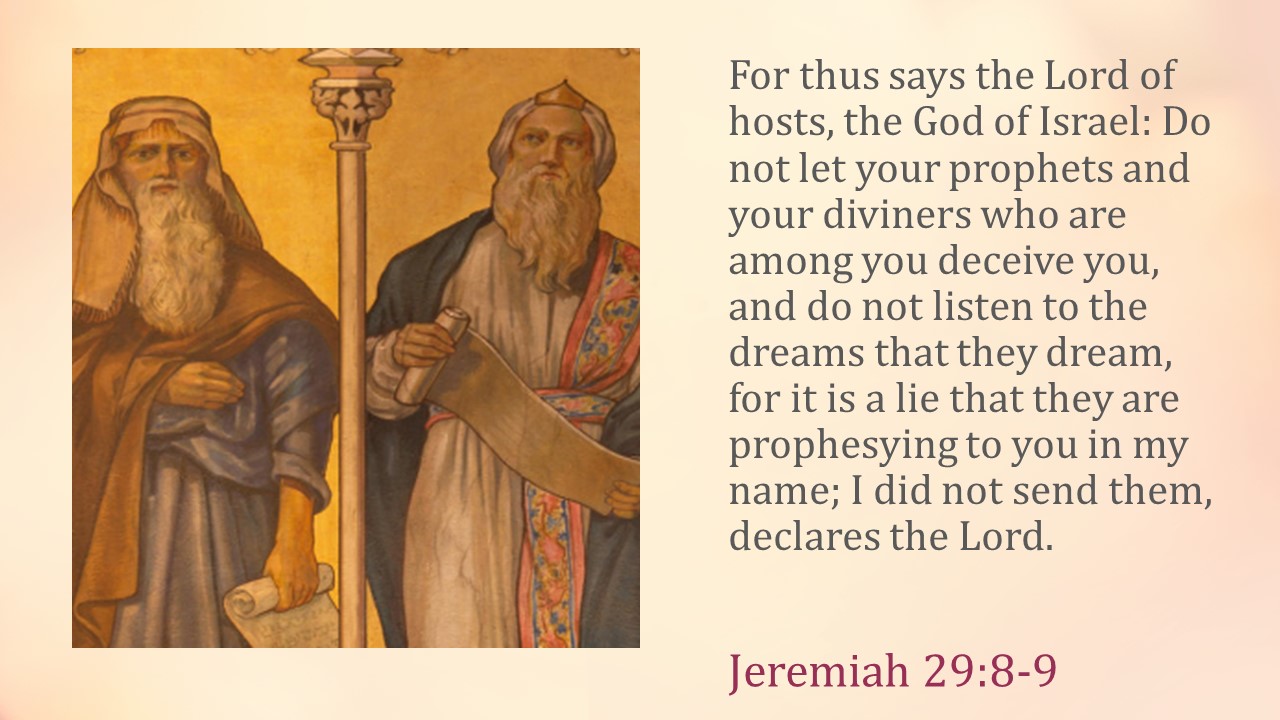
As we well know, some will take advantage of a bad situation. The people of God were in a vulnerable situation emotionally, physically, and spiritually. And there were those among them that sounded like prophets and mystics, pretending to be concerned. God warns His people through this letter to beware.
In the letter, God says to live, build, plant, multiply, seek, and pray for shalom. But now God says to beware of scammers, those who distort the truth in order to deceive. Even today, we are challenged to be good Bereans and study the scriptures because there are a great many non-Christian so-called “pastors” of churches that mislead people about God’s truth and just tell the people what their itching ears want to hear.
Then, Jeremiah 29:10,
“For thus says the Lord: When seventy years are completed for Babylon, I will visit you, and I will fulfill to you my promise and bring you back to this place.”
Good news and bad news. The good news was that exile was going to be temporary. The bad news was that it would be seventy years which is a really long temporary.
Jeremiah hinted earlier they’d be here a long time, through three generations. Seventy years is a long time. God is saying there would be those who would die in exile. There would also be a new generation born in exile.
What are these in exile supposed to do for 70 years? God already told them: Live! Build! Plant! Harvest! Multiply! They were not to give up in despair, but rather live and grow in their faith. In God’s plan, there was a purpose. They could have shalom during this good news/bad news moment.
In God’s timing, there would be relief from exile and a return to Jerusalem. But the harsh reality was that it would not happen quickly, and some would never see Jerusalem, their homes, again.
And then we come to Jeremiah 29:11, one of the most well-known verses from the book of Jeremiah.
For I know the plans I have for you, declares the Lord, plans for welfare and not for evil, to give you a future and a hope.
The people were in a state of distress and uncertainty, longing for deliverance and a return to their homeland. But they could rest knowing that God loved them and was in control.
The Hebrew word “shalom” reappears here, translated as “peace” or “welfare,” emphasizing their total well-being was in God’s hands. There is a promise of God’s peace and protection, even in the midst of challenging circumstances. Despite their exile, God assures them that He has their best interests at heart and will watch over them, protecting them from harm and danger.
God is sovereign and He knows the future. God assures the exiles that He has plans for them, plans for their welfare, and plans for their ultimate good. This reminds us that even in the midst of difficult and confusing times, God is in control, and nothing happens outside of His knowledge and purpose. Even though the Israelites were in a place they didn’t want to be, it was part of God’s larger plan for their spiritual growth and eventual restoration.
God’s promise of “hope and a future” serves as a source of encouragement and motivation for the exiles. It assures them that their current circumstances are not the end of the story. God’s plan extends beyond their present predicament, and He promises them a better future. This hope is not something they earn or achieve on their own, but it is a gracious gift from God, demonstrating His love and faithfulness towards His people.
When we look at this verse, we tend to jump to the words future and hope. But if we jump over the word “give” we miss the heart of God. Do not miss the grace of God in this verse with the word “give.”
This is not something that is earned or deserved. The people of God earned exile by their choices for generations in turning away from God towards false teachings and idols. But even during the darkness of exile, God shows them grace.
God has always been a giving God. That truth is apparent from Genesis to Revelation. In Genesis 3:21 God made clothing from the skins of animals to cover Adam and Eve in their nakedness and shame. It was a gift of grace. In Revelation 21:6,
“Then he said to me, “It is done! I am the Alpha and the Omega, the beginning and the end. I will freely give to the thirsty from the spring of the water of life.”’
And of course, John 3:16,
“For God so loved the world, that He gave His only Son, so that everyone who believes in Him will not perish, but have eternal life.”

For God’s people in exile during the days of Jeremiah, God wanted to give them the gift of a future and a hope. There is always a purpose for the plan of God.
While this verse was originally addressed to the exiled Israelites, its principles have enduring relevance for believers today and for eternity. Just as the exiles were called to trust in God’s plan even when it seemed difficult, we are also called to trust in God’s providence in our lives. We may not always understand the reasons behind our circumstances, but we can find comfort in knowing that God has a purpose for everything and is working all things together for our good.
The promise of hope and a future is not just for this life, but it extends into eternity for believers. Through faith in Jesus, we have the hope of eternal life, and the assurance that God will make all things new.
Though we often read verse 11 in isolation, God’s gift continues in verses 12-14 as God seeks a personal relationship with His people –
IV. Personal
Jeremiah 29:12-14,
Then you will call upon me and come and pray to me, and I will hear you. You will seek me and find me, when you seek me with all your heart. I will be found by you, declares the Lord, and I will restore your fortunes and gather you from all the nations and all the places where I have driven you, declares the Lord, and I will bring you back to the place from which I sent you into exile.
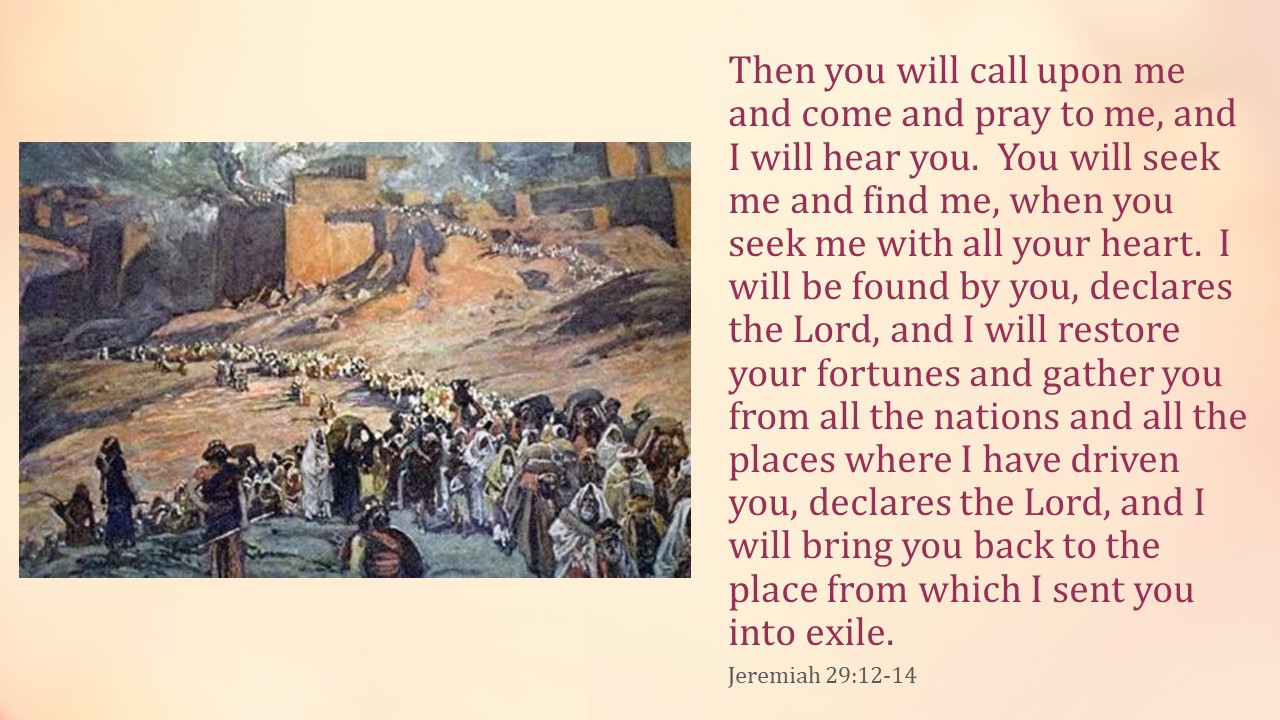
These verses are all about relationships. “You will” call upon Me, come to Me, pray to Me, and seek Me with all your heart. “I will” hear you, be found by you, restore you, gather you, and bring you back.
This relationship was to be a two-way street. From our perspective as the people of God, we are to be dependent on God regardless of the circumstances. We are to call out to God, come to God, pray to God even during the exiles of our life.
And then, at the end of verse 13, the phrase “when you seek me with all your heart” comes into play. There is no holding back. It is to truly seek God from the innermost part of your being in all circumstances of life. It does not matter whether the zip code was in Jerusalem, Babylon, Houston, Katy or Sugar Land. God’s people are to seek Him with all their hearts. Because the bottom line then and now is that God desires a relationship with His people.
In this relationship, God will fulfill His promise and plan. God will restore their fortunes in the city of Jerusalem. God will gather them from the various nations. God will bring them back to the place from which they had been taken. Home.
The story of God and His people is a story of relationship. It does not matter the location, God is there. David understood this truth when he wrote Psalm 139:7-8,
Where can I go from Your Spirit?
Or where can I flee from Your presence?
If I ascend to heaven, You are there;
If I make my bed in Sheol, behold, You are there.
Paul would say it like this in Romans 8:38-39,
For I am persuaded that neither death nor life, nor angels nor rulers, nor things present nor things to come, nor powers, 39 nor height nor depth, nor any other created thing will be able to separate us from the love of God that is in Christ Jesus our Lord.
V. Conclusion
There is a cliché that says, “The only constant is change.” We understand the meaning, which is that life is not stagnant; it is dynamic. There is an ebb and flow in all aspects of our lives. But when we hold a biblical worldview we understand that change is not the constant; God, who never changes, is the constant.
The God of Adam and Eve was the same God of Abraham, Isaac, Jacob, Moses, Gideon, Jeremiah, James, John, Peter, Paul, and you and me. God does not change. The letter which was written to those Jews in exile during the days of Jeremiah are just as meaningful and relevant to us today.
The gifts and promises of God were proclaimed then and are proclaimed now for our shalom, our future, and our hope. We are responsible for doing the same today in our city, which is not that different from Babylon. We are to build, plant, multiply, and seek shalom.
For these are the plans God has for you and me. Plans for shalom and not for evil, a gift from God for our future and hope.
To God be the glory. Amen.


 Chasing the Wind
Leave a comment