
I. Introduction
The last time I taught from the book of Jeremiah, Jeremiah had a word for the people of Judah, how they were to live while captive in a foreign land. The people were continue to live their lives, and thrive in the land, and I drew parallels between the Jewish people in captivity, and Christians today living in a world that is not our home. We are to live and thrive where God has placed us until we spend eternity with our Lord in our forever home.
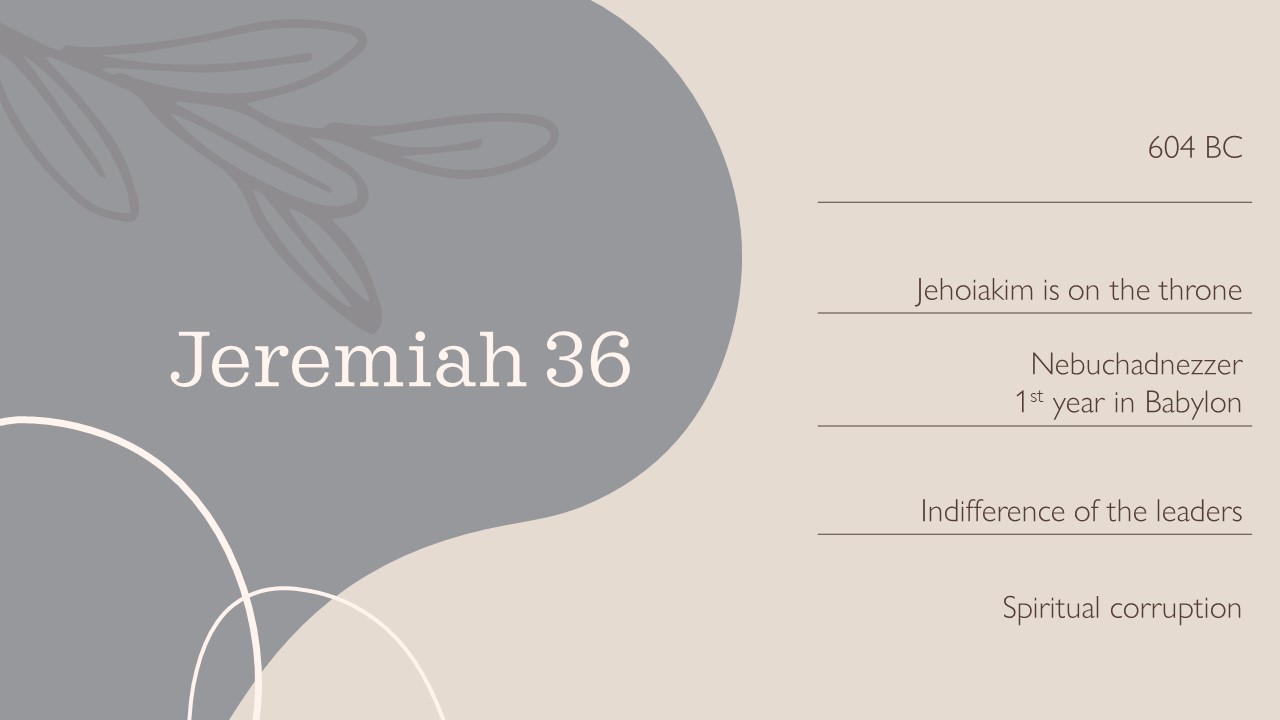
We are still studying the major prophet Jeremiah, and approximately four years have passed. It’s 604 BC. The evil King Jehoiakim is on the throne, and Jeremiah is in the temple courtyard proclaiming the truth of God.
Again, I’m going to rephrase that in modern terms and then you’ll have a shortcut to where I think this lesson is leading us today.
We are still studying the Word of God, and the year is approximately 2023 AD. There may or may not be an evil king on the throne, but the world and the culture is sure making things ugly out there. And we are in the temple courtyard proclaiming the truth of God.
Some things have changed since my last lesson. For one thing, Jeremiah’s prophecy is beginning. In Babylon, Nebuchadnezzar is now on the throne. Worse, in Judah, King Jehoiakim is on the throne, a ruler characterized by corruption over a a nation plagued by spiritual decline. The fourth year of Jehoiakim’s rule witnessed an all-time low in the spiritual climate of Jerusalem and Judah as a whole. In the face of this adversity, Jeremiah, the faithful prophet of God, encountered strong resistance from both the king and the people. They went to great lengths to censor and ban Jeremiah from entering the Temple and the assembly. Remarkably, while Judah celebrated what Jeremiah condemned, and cherished what he disdained, God’s unwavering pursuit of His people was far from over.
II. God’s Word Proclaimed
Let’s begin at Jeremiah 36:4-8 –
So Jeremiah summoned Baruch son of Neriah. At Jeremiah’s dictation, Baruch wrote on a scroll all the words the Lord had spoken to Jeremiah. Then Jeremiah commanded Baruch, “I am restricted; I cannot enter the temple of the Lord, so you must go and read from the scroll—which you wrote at my dictation—the words of the Lord in the hearing of the people at the temple of the Lord on a day of fasting. You must also read them in the hearing of all the Judeans who are coming from their cities. Perhaps their petition will come before the Lord, and each one will turn from his evil way, for the anger and fury that the Lord has pronounced against this people are great.” So Baruch son of Neriah did everything Jeremiah the prophet had commanded him. At the Lord’s temple he read the Lord’s words from the scroll.
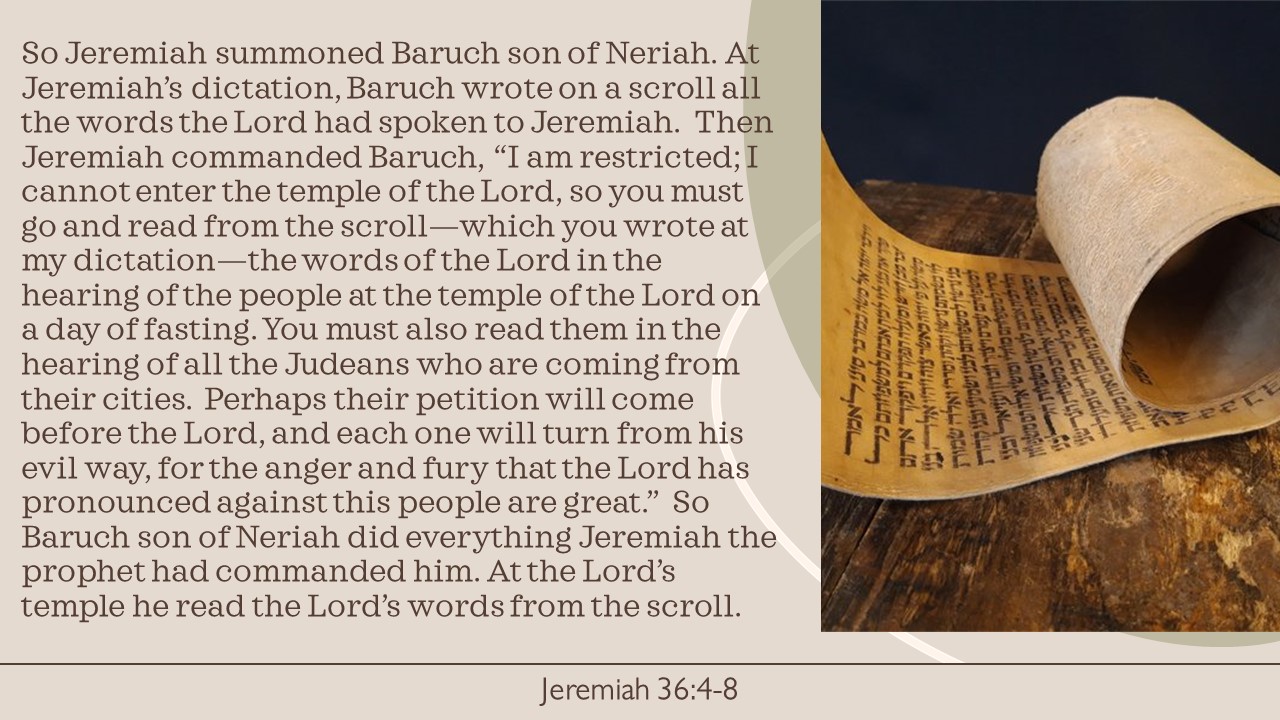
Refusing to be deterred by censorship, Jeremiah devised a new approach to deliver God’s Word to His people. Unable to speak freely due to the ban, he sought an intermediary to relay the divine message. That intermediary was Baruch, a skilled scribe and devoted follower of Jeremiah. By appointing Baruch as his mouthpiece, Jeremiah entrusted him with the task of standing in his place and fulfilling the work he had been forbidden to do.
III. Timeless and Timely
Jeremiah 36:9-10,
In the fifth year of Jehoiakim son of Josiah, king of Judah, in the ninth month, all the people of Jerusalem and all those coming in from Judah’s cities into Jerusalem proclaimed a fast before the Lord. Then at the Lord’s temple, in the chamber of Gemariah son of Shaphan the scribe, in the upper courtyard at the opening of the New Gate of the Lord’s temple, in the hearing of all the people, Baruch read Jeremiah’s words from the scroll.
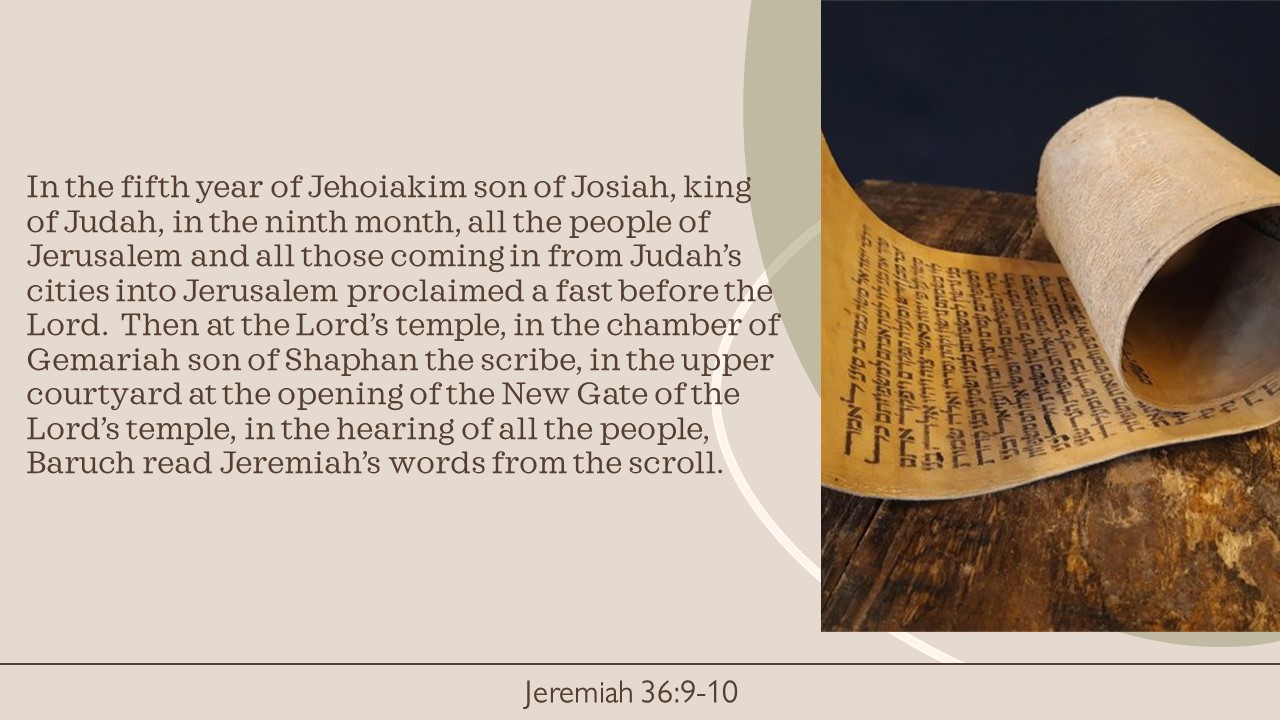
The context for Baruch’s delivery of Jeremiah’s message is established with a significant timestamp: “In the fifth year of Jehoiakim, son of Josiah, king of Judah, in the ninth month.” This peculiar reference indicates that approximately one year had passed since Baruch had first recorded Jeremiah’s words. The question arises: Why did Baruch wait for such an extended period, especially when the message was urgent? The answer becomes apparent in the following phrase of verse 9, which provides a clue to the most likely reason for the delay: “all the people in Jerusalem and all the people who came from the cities of Judah to Jerusalem proclaimed a fast before the LORD.”
It seems that Jeremiah had instructed Baruch to wait for just the right opportunity to deliver the message, ensuring it would have the greatest impact. This momentous occasion presented itself during a special fast before the Lord when people from all over Judah gathered in Jerusalem, converging around the Temple. By choosing this occasion, the hope was that the message would be audibly heard by a vast audience, and perhaps, due to the spiritual significance of the fast, it would be received more deeply by the people.
In essence, Baruch exercised patience and wisdom, waiting for the opportune time to share the divine message, strategically selecting a moment when the message could be embraced by the largest and most spiritually receptive audience.
Did the crowd receive the message? Scripture doesn’t say, but we do know one person heard. Jeremiah 36:11-13,
When Micaiah son of Gemariah, son of Shaphan, heard all the words of the Lord from the scroll, he went down to the scribe’s chamber in the king’s palace. All the officials were sitting there—Elishama the scribe, Delaiah son of Shemaiah, Elnathan son of Achbor, Gemariah son of Shaphan, Zedekiah son of Hananiah, and all the other officials. Micaiah reported to them all the words he had heard when Baruch read from the scroll in the hearing of the people.
Micaiah heard. Micaiah’s background and specifics remain largely unknown to us – his age, occupation, and spiritual journey all remain a mystery. However, we do have information about his esteemed lineage. His father, Gemariah, holds a prominent position as a high official in the King’s court, while his grandfather, Shaphan, gained fame for rediscovering the Book of the Law during King Josiah’s reign in 2 Kings 12:12-14.
Given the limited knowledge about Micaiah’s family, it is plausible that when he heard Baruch’s words, they struck a chord within him, resonating with the stories he had heard from his father and grandfather, Shaphan and Gemariah. The similarities between Baruch’s message and the rediscovered words from the past led Micaiah to recognize the generational significance of this new message and compelled him to act urgently. He immediately sought out his father, Gemariah, to make him aware of the importance of the situation.
Interestingly, while the people of Judah had gathered outside the Temple for the solemn occasion, fasting and attentively listening to God’s Word, the officials, including Gemariah, were conspicuously absent from the congregation. The verse reveals that “all of the officials” were casually lounging in the secretary’s chamber at the king’s house. Instead of actively participating in the event, they engaged in private conversations and likely remained seated, seemingly indifferent to the spiritual significance of the moment.
This stark contrast between the people and the officials demonstrates a troubling example set by the leaders. The officials’ disregard for the solemn gathering and the things of God paints a distressing picture. If the leaders themselves are careless and unconcerned about spiritual matters, how can they expect the people to be any different? These officials of Judah display an attitude of indifference and callousness toward the things of God, even amidst a solemn assembly for fasting and hearing God’s Word.
Regrettably, Micaiah knew exactly where to find his father, Gemariah – not at the temple, but in the scribe’s chamber. He discovered Gemariah and his friends gathered together in an aloof manner, and he dutifully conveyed the urgent message to them.
Their response is unusual, Jeremiah 36:14-19,
Then all the officials sent word to Baruch through Jehudi son of Nethaniah, son of Shelemiah, son of Cushi, saying, “Bring the scroll that you read in the hearing of the people, and come.” So Baruch son of Neriah took the scroll and went to them. They said to him, “Sit down and read it in our hearing.” So Baruch read it in their hearing.
When they had heard all the words, they turned to each other in fear and said to Baruch, “We must surely tell the king all these things.” Then they asked Baruch, “Tell us, how did you write all these words? At his dictation?”
Baruch said to them, “At his dictation. He recited all these words to me while I was writing on the scroll in ink.” The officials said to Baruch, “You and Jeremiah must hide and tell no one where you are.”
The officials, led by Jehudi, decide to summon Baruch to hear Jeremiah’s message directly. As they attentively listen to the words, an unexpected reaction overcomes them – fear and dread grip their hearts. Surprisingly, this seems to be the first time in twenty-three years that Jeremiah’s warnings have truly impacted them. This newfound realization compels them to fulfill their solemn duty of reporting the message to the king, not with the intention of causing trouble for Jeremiah but out of a sense of responsibility.
The reason behind this sudden change in their response remains uncertain. Sometimes, our hearts can be hardened, but by God’s grace, they can also be softened to receive His message when the time is right. As believers, there’s an essential lesson to glean from this: We should share the gospel and God’s truth with others as if it were the first time they are encountering it. We never know when, why, or how God might be working in their hearts and lives. The Word of God is timeless and perpetually relevant. Although Jeremiah had been preaching for twenty-two years, it was in the twenty-third year that the officials truly “heard” it and responded. It was timely for what God was doing in their lives and in the nation of Judah.
IV. Refuge and Shield
Then what happens? Jeremiah 36:20-23,
Then they came to the king at the courtyard, having deposited the scroll in the chamber of Elishama the scribe, and reported everything in the hearing of the king. The king sent Jehudi to get the scroll, and he took it from the chamber of Elishama the scribe. Jehudi then read it in the hearing of the king and all the officials who were standing by the king. Since it was the ninth month, the king was sitting in his winter quarters with a fire burning in front of him. As soon as Jehudi would read three or four columns, Jehoiakim would cut the scroll with a scribe’s knife and throw the columns into the blazing fire until the entire scroll was consumed by the fire in the brazier.

Elishama delivered Jeremiah’s words, which were spoken by Baruch, to the king and his companions. The response of the king and his court ranged from callous indifference to potential malice. They received the message of warning and judgment without any fear, conviction, or inclination towards repentance. Instead, they regarded the words with a sense of invincibility, treating them as insignificant. In a chilling act of defiance, the king mockingly cut the scroll with a “scribe’s knife,” the same instrument used by scribes to preserve and multiply God’s Word. The irony was profound, as the king was now using this very tool to mutilate God’s Word. His deliberate destruction of the scroll, slicing it piece by piece and throwing each fragment into the fire, demonstrated an intense hatred and anger towards God’s Word.
The reasons behind the king’s choice to destroy the scroll in this manner are not explicitly provided, leaving room for speculation. Perhaps he did so for practical reasons, ensuring the complete destruction of the message, or he might have engaged in this act for theatrical effect, showing disdain and mockery towards the message. Whatever the motive, Jehoiakim’s response stood in stark contrast to his father, King Josiah’s reaction to God’s Word. When Josiah heard the Word, he responded with humble repentance, tearing his clothes in 2 Kings 22:11. In contrast, Jehoiakim’s actions displayed reprehensible pride by tearing God’s Word itself.
We, too, face two possible responses to the Word of God: either tearing down God’s Word in an act of pride and self-authority or humbly tearing our hearts and submitting to its authority. While we may not literally cut up the Bible like King Jehoiakim, we engage in a similar act of censorship when we pick and choose which parts to follow, water down, ignore, neglect, or outright reject based on personal preferences or limited understanding. This highlights the importance of approaching the Bible with reverence, humility, and a willingness to embrace its entirety, trusting in God’s wisdom and guidance.
Jeremiah 36:24-26,
As they heard all these words, the king and all of his servants did not become terrified or tear their garments. Even though Elnathan, Delaiah, and Gemariah had urged the king not to burn the scroll, he would not listen to them. Then the king commanded Jerahmeel the king’s son, Seraiah son of Azriel, and Shelemiah son of Abdeel to seize Baruch the scribe and Jeremiah the prophet, but the Lord had hidden them.
King Jehoiakim did not just destroy God’s Word; he wanted to destroy the ones who brought it, also. He wanted to eliminate the source of the problem as much as possible. So, he sent three men as bounty-hunters to seize Jeremiah and Baruch. It was an early form of cancel culture.
But as the text says, the LORD hid them. When we trust in the LORD and obey His Word, we can have the assurance that we are placing ourselves underneath His protection and provision. His Word is our shield; our mighty refuge is God.
V. Eternal and Firm
Jeremiah 36:27-32 –
After the king had burned the scroll with the words Baruch had written at Jeremiah’s dictation, the word of the Lord came to Jeremiah: “Take another scroll, and once again write on it the very words that were on the original scroll that Jehoiakim king of Judah burned. You are to proclaim concerning Jehoiakim king of Judah: This is what the Lord says: You have burned the scroll, saying, ‘Why have you written on it: The king of Babylon will certainly come and destroy this land and cause it to be without man or beast?’ Therefore, this is what the Lord says concerning Jehoiakim king of Judah: He will have no one to sit on David’s throne, and his corpse will be thrown out to be exposed to the heat of day and the frost of night. I will punish him, his descendants, and his officers for their wrongdoing. I will bring on them, on the residents of Jerusalem, and on the men of Judah all the disaster, which I warned them about but they did not listen.”
Then Jeremiah took another scroll and gave it to Baruch son of Neriah, the scribe, and he wrote on it at Jeremiah’s dictation all the words of the scroll that Jehoiakim, Judah’s king, had burned in the fire. And many other words like them were added.
In the final passage of Jeremiah 36, we witness a remarkable miracle and a profound truth: God’s Word is indestructible. It must have been devastating for Baruch and Jeremiah to learn that King Jehoiakim had burned the entire scroll that they had invested so much effort, inspiration, and sacred dedication to create. The destruction of their work could have left them disheartened, but they recognized that this was not merely their labor, but God’s Word and His work.
In an extraordinary display of His power, God provided Jeremiah with all the words again, and Baruch faithfully recorded them once more, including the contents of the scroll that Jehoiakim had burned in the fire. What’s more, God added many similar words to the new scroll, surpassing the original in scope and impact. The message is clear: attempts to destroy, delete, or diminish God’s Word only lead to its clarity, greatness, and increased influence. As Isaiah 55:11 assures us, God’s Word accomplishes His purposes and never returns empty.
A compelling historical example of the enduring power of God’s Word can be seen in the case of the French philosopher Voltaire. He harbored deep animosity toward the Bible, vehemently opposing the Christian faith and expressing disdain for God’s Word. He even predicted the Bible’s disappearance within a century after his time. However, God’s irony prevailed, and just 50 years after Voltaire’s death, his former residence, where he had written against the Bible, was repurposed to store Bibles, gospel tracts, and Christian works by the Evangelical Society of Geneva. The printing machines that once produced Voltaire’s blasphemous writings were now used to print Bibles year-round.

Voltaire’s works came and went, but the Word of God endured, surpassing his influence exponentially in copies and global impact. What the enemy meant for evil, God turned to good. God’s Word replicated and multiplied, reaching countless hearts and minds, even in the very place where Voltaire had sought to destroy it.
The Scriptures affirm that God’s Word is eternal and unshakable. Regardless of cultural challenges, censorship, or opposition, we can have the utmost assurance that God’s Word will endure forever. It stands firm in the heavens, outlasting the transient things of this world, and nothing can hinder its timeless truth and influence.
VI. Conclusion
In Jeremiah 36, we have witnessed a powerful testament to the indomitable nature of God’s Word. Despite attempts by King Jehoiakim to destroy it, God’s message prevailed, and a new scroll was written, even surpassing the original in impact. This historic account echoes throughout the ages, reminding us of the timeless truth that the Word of God cannot be silenced.
The Bible’s history is riddled with attempts to censor its message, both in biblical times and throughout Christian history. The story of Jehoiakim burning the scroll is not isolated; it mirrors the animosity of figures like French philosopher Voltaire, who vehemently opposed the Bible, hoping for its extinction. Yet, as history has shown, the Word of God outlasts the efforts of its detractors.
Even today, corrupt authorities are attempting to erase the word of God. The Chinese Communist Party, unable to destroy all copies of the bible, is now publishing a bible version that is more authoritarian. For instance, when the Pharisees ask Jesus if they should stone the adulterous woman, in the Chinese bible the woman is guilty because she defied authority, so Jesus Himself stones the woman. God will not be mocked. Such a destruction of the true Word of God is an abomination.
Today, we find ourselves in a world marked by increasing contemporary censorship of Scripture. Cancel culture seeks to suppress, diminish, and eliminate God’s Word from public discourse. The modern-day persecution of the Church and God’s Word is evident in various forms, from restrictions on religious freedom to cultural pressures that seek to silence biblical truths.
Yet, the same God who preserved His Word through centuries of trials remains unchanging. Despite the challenges posed by cancel culture and the attempts to silence God’s message, the Word endures forever. It is not limited by the ever-changing opinions and trends of the world. Cancel culture may attempt to cancel the Church and God’s Word, but it cannot succeed.
As believers, we are called to stand firm in the face of opposition, trusting in the eternal power and relevance of God’s Word. Just as Jeremiah and Baruch faithfully recorded the message despite the threats, we must boldly share and preserve the truth of Scripture, undeterred by cultural pressures or the fear of persecution.

Let us be encouraged by the unwavering truth that cancel culture cannot cancel the Word of God which endures forever. Despite the shifting tides of society, God’s Word remains steadfast, guiding us, comforting us, and transforming lives. In the face of censorship and persecution, we hold fast to the unchanging message of hope, love, and redemption found in the Scriptures. May we, like Jeremiah and Baruch, remain faithful stewards of God’s Word, knowing that the power and authority of His message transcend all earthly attempts to silence it.
To God be the glory. Amen.

 Chasing the Wind
Leave a comment