

I. Introduction
Jesus performed a remarkable total of 37 documented miracles in the Bible, though we know He performed even more throughout His ministry. Of these, 22 are meticulously chronicled in the book of Mark.
The significance of these miracles extends far beyond mere displays of divine power. They serve multifaceted purposes, affirming Jesus’ divinity, fulfilling ancient prophecies regarding the Messiah, and offering spiritual lessons beyond their physical manifestations.
In one instance, when John the Baptist’s disciples questioned Jesus about His identity as the Messiah, He directed them to observe the evidence, Matthew 11:4-5:
“Go back to John and tell him what you have heard and seen – the blind see, the lame walk, the lepers are cured, the deaf hear, the dead are raised to life, and the Good News is being preached to the poor.”
This not only fulfilled the prophecy found in Isaiah but also exemplified the transformative power of Jesus’ ministry. Today, we will delve into the story of a leper miraculously healed by Jesus, to gain deeper insights into His extraordinary work.
Mark 1:40-45,
A man with leprosy came and knelt in front of Jesus, begging to be healed. “If you are willing, you can heal me and make me clean,” he said. Moved with compassion, Jesus reached out and touched him. “I am willing,” he said. “Be healed!” Instantly the leprosy disappeared, and the man was healed. Then Jesus sent him on his way with a stern warning: “Don’t tell anyone about this. Instead, go to the priest and let him examine you. Take along the offering required in the law of Moses for those who have been healed of leprosy. This will be a public testimony that you have been cleansed.” But the man went and spread the word, proclaiming to everyone what had happened. As a result, large crowds soon surrounded Jesus, and he couldn’t publicly enter a town anywhere. He had to stay out in the secluded places, but people from everywhere kept coming to him.
II. What We Learn from the Leper
The leper served as a walking illustration of the human condition. We see an illustration of the power of sin over us and the power of Jesus over that sin. And we know that we can come to Jesus just as we are. We don’t clean ourselves up first, we come to Him and He cleans us.
A. We come to Jesus just as we are
Just like the leper in this passage, each of us approaches Jesus in our raw and unvarnished state. Mark’s account introduces us to “a man with leprosy,” a character about whom we know little except for his affliction – leprosy. However, when Luke recounts the same incident, he describes the man as having “an advanced case of leprosy” (Luke 5:12). Some translations even depict him as being “covered in leprosy” or “full of leprosy.” This emphasizes the severity of his condition, making it unmistakably evident to anyone who saw him. He was in the advanced stages of this debilitating disease.
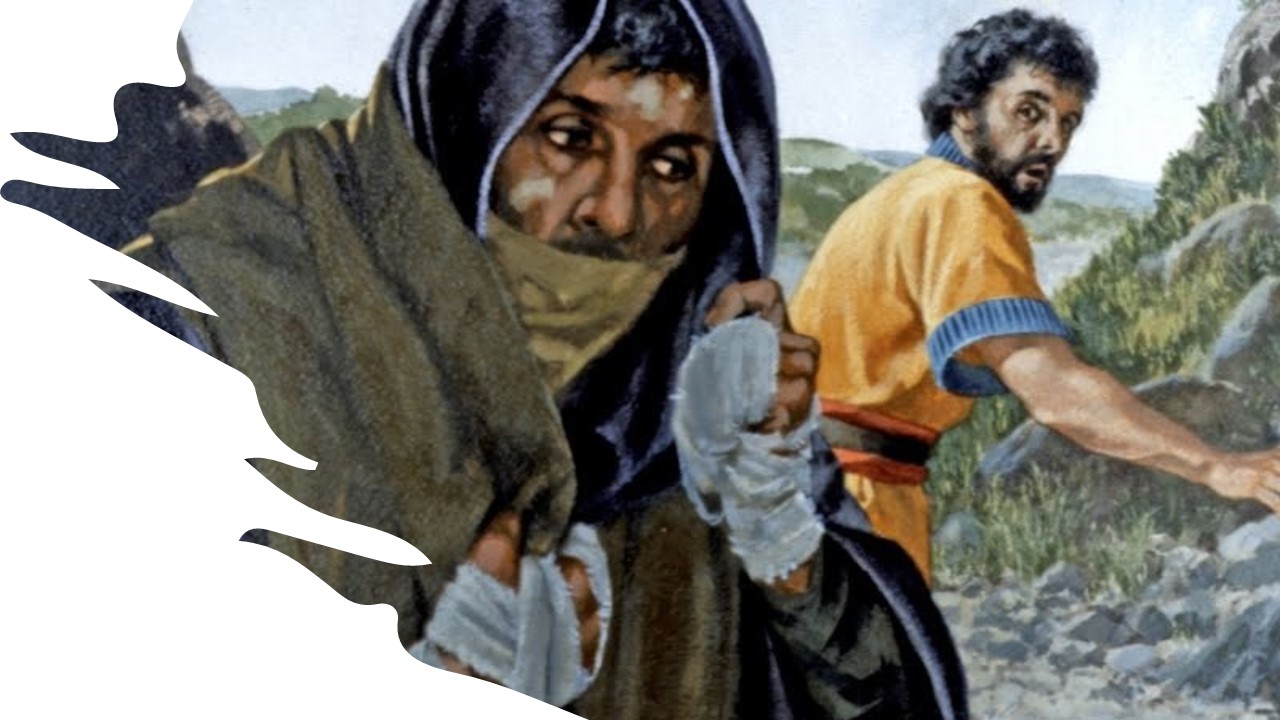
To truly appreciate the significance of the encounter between this man and Jesus, it’s essential to grasp the symbolic nature of leprosy. Leprosy serves as a poignant metaphor for the sinful condition that afflicts every individual.
Leprosy, as described in the Scriptures, was a devastating affliction that wreaked havoc on the body. It was not merely an inconvenience; it was a destructive force. Let’s delve into the grim reality of what this man with leprosy likely experienced.
The onset of leprosy was insidious. It began with feelings of fatigue, followed by the gradual onset of joint soreness. Then came a smattering of white spots on the skin. These patches evolved into hardened knots or bumps, changing in color from white to pink, and finally to brown, accompanied by a scaly texture. The proliferation of these grotesque protrusions soon covered his entire body.
His facial features underwent a grotesque transformation. The unsightly bumps that riddled his body emitted a repugnant odor. They affected his voice, causing it to become raspy, and his breath grew foul. Hair loss was inevitable, and any remaining strands turned a pallid white.
The insidious nature of leprosy extended beyond the surface, as it eroded bones and internal organs, rendering the afflicted susceptible to other ailments. As he walked, he left revolting spots where pus seeped from his feet.
His fingers and toes deteriorated, eventually falling off. In the advanced stages of leprosy, the consequences could be even more gruesome, resulting in the loss of a nose, a gaping hole in the cheek where flesh had rotted away, or the absence of limbs due to their decay.
Leprosy didn’t stop at physical devastation; it attacked the nervous system, rendering the person utterly insensitive to pain. Severe burns or injuries went unnoticed, as if the body had lost its ability to feel pain. A thorn embedded in the foot would be a mere inconvenience, as the leper remained oblivious to the harm.
If left untreated, a leper’s life expectancy was approximately nine years, marked by a gradual deterioration until they met their grim fate—a walking corpse. Some families even held a funeral upon a leper’s diagnosis before they were sent off to live in leper colonies.
Leprosy inflicted not only physical suffering but also intense social rejection. Leviticus 13 outlines the drastic measures taken when a person was diagnosed with leprosy. They were banished from their community, severed from family and friends, and forced to wear a cloth over their upper lip to prevent the spread of contamination. Whenever others approached, they had to cry out, “Unclean,” warning them to keep their distance. The plight of lepers was so dire that some people resorted to throwing stones to keep them at bay.
Lepers were required to stand at a considerable distance from others, sometimes up to 150 paces if the wind was strong. It was even unlawful to greet a leper on the street. They were considered untouchable, left isolated and alone unless they could find refuge in a leper colony.
And worse, leprosy had no cure. While the law in Leviticus 13 could diagnose and manage leprosy, it could not eradicate the disease. This is an illustration of the limitations of the law—it could define sin with precision but could not remove it from the sinner. In the Old Testament, leprosy was often seen as a divine punishment, and only the hand of God could offer a cure (Numbers 12:10; 2 Kings 5:1-2).
Leprosy robbed its victims of health and, as a consequence, stripped them of their names, occupations, habits, families, fellowship, and place within the worshiping community. They were marked by perpetual mourning, leaving their heads uncovered and their clothing torn as signs of their affliction (Leviticus 13:45-46).
Leprosy is an illustration of sin. There are many parallels between leprosy and sin.
Like leprosy, sin begins small. With leprosy it starts off with fatigue, tiredness, and little white dots. Isn’t that how sin is? It starts off seemingly small in your life. According to James it begins with a little thing called desire.

Like leprosy, sin causes numbness. As leprosy advances you become physically numb to pain. You will burn but you can’t feel the fire. You break your arm but you don’t feel it. You can’t feel the damage done to your body. Sin is exactly the same way. As your sin advances you don’t sense the damage you are doing to yourself, to your mind, your emotions, or your relationships. You become insensitive to truth, God, and others. We become numb to the things of God.
Like leprosy, sin causes separation. If you are diagnosed with leprosy then you are removed from family and friends. Sin does the same thing. How often has sin separated a husband and wife? Parent and child? Friends? Without a doubt sin causes us all to be separated from God before we are saved and cleansed of sin (Isaiah 59:2).
Like leprosy, sin cannot be removed by law or goodness. You can’t be good enough to remove sin. You can’t smear the cold cream of religion on sin and hope it goes away. Just by trying to keep the ten commandments and be good and go to church does not get rid of sin. If you are lost and in your sin, the only hope of a cure for is miracle… that miracle comes in the shape of Jesus.
Like leprosy, sin causes death. If the leper is not healed and cleansed he will die a leper. The Bible says the wages of sin is death (Rom. 3:23).
Like leprosy, sin leaves a person feeling worthless and hopeless. He is away from those he loves. He no longer can do what he enjoys. His career is over. His plans for the future are over. If sin goes far enough, your life can take on a useless appearance and worthless feel.
The bottom line is the leper represents all of us. Physically, he reminds us of how we are spiritually before God. This leper came to Jesus just as he is. Leprosy, sores, smell, disappointments, fear, desperation and all. You and I must do the same, we come to Jesus just as we are… sin and all. The leper did not try to hide his leprosy from Jesus, he took his leprosy to Jesus. Don’t try to hide your sin from Jesus, take your sin to Jesus.
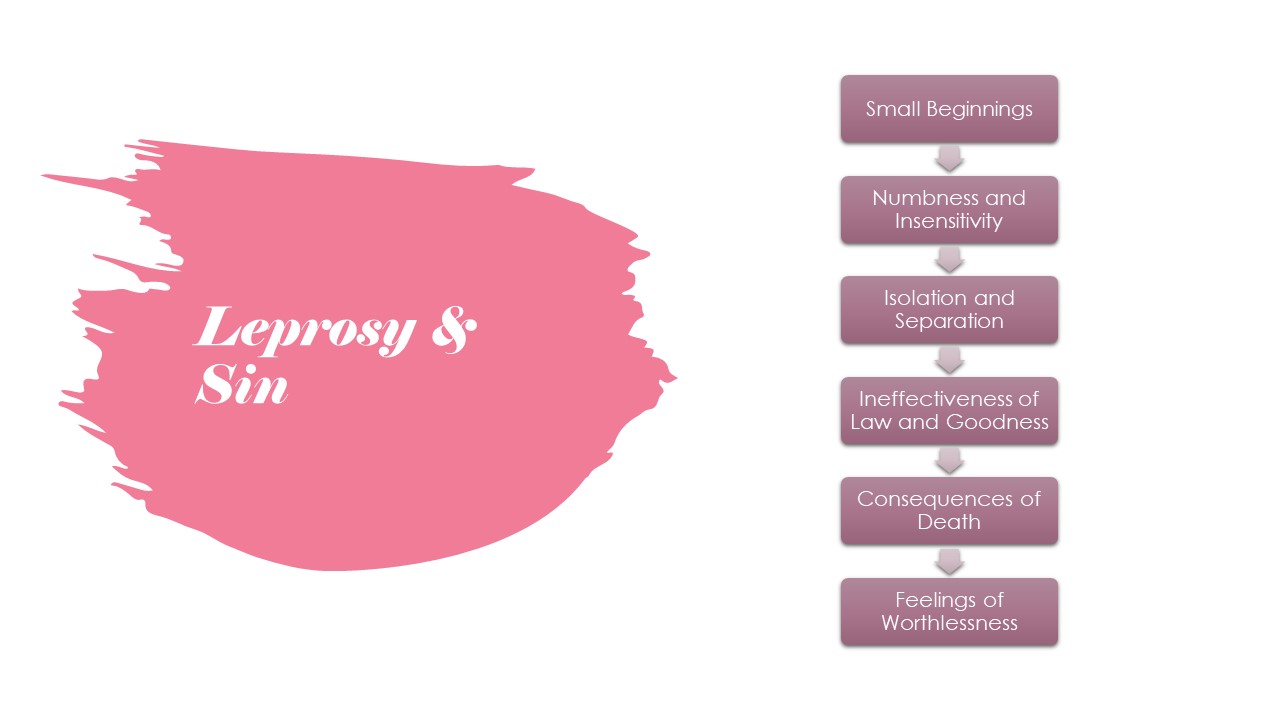
Leprosy serves as a poignant illustration of the nature of sin, revealing several striking parallels between the two.
1. **Sin’s Small Beginnings:** Similar to leprosy, sin often starts in our lives subtly. Leprosy begins with feelings of fatigue and the emergence of small white spots. Likewise, sin commences with seemingly minor desires, as mentioned by James. It’s these small desires that can eventually grow into significant sins.
2. **Numbness and Insensitivity:** Leprosy leads to physical numbness, making individuals unable to feel pain. Similarly, sin can cause spiritual numbness, making us oblivious to the damage it inflicts on our minds, emotions, and relationships. We become insensitive to God’s truth and the needs of others.
3. **Isolation and Separation:** Just as leprosy results in separation from family and friends, sin can also isolate us from our loved ones. Sin can fracture relationships, leading to separation between spouses, parents and children, and friends. Ultimately, it separates us from God, as stated in Isaiah 59:2.
4. **Ineffectiveness of Law and Goodness:** Neither the law nor personal goodness can remove sin. Trying to be virtuous or adhering to religious practices cannot eradicate sin. The cure for sin lies in a miraculous transformation, symbolized by Jesus.
5. **Consequences of Death:** Leprosy, if left untreated, leads to death. Similarly, sin carries the spiritual consequence of death, as mentioned in Romans 3:23. Sin separates us from God, the source of life.
6. **Feelings of Worthlessness:** Leprosy can leave a person feeling utterly worthless and hopeless. It robs them of their abilities, career, and plans for the future. Sin can produce a similar sense of despair, making life appear futile and devoid of purpose.
In essence, the leper in this story represents all of us. Physically, he mirrors our spiritual condition before God. He approached Jesus in his raw and unvarnished state, with all his leprosy, sores, odors, disappointments, fears, and desperation. Likewise, we are called to come to Jesus just as we are, with our sins and imperfections. There is no need to conceal our sins; instead, we should bring them to Jesus, who offers the cure and transformation we desperately need.
B. We come to Jesus with desperation
There are two essential aspects to consider when we approach Jesus, as exemplified in the story of the leper in Mark 1:35-45.
First, when we come to Jesus, we must do so just as we are, without pretense or hiding our flaws. The encounter with Jesus should be an authentic and unfiltered one.
Second, approaching Jesus should be an act of desperation, not taken lightly or casually. The leper’s approach to Jesus serves as a vivid illustration of this principle. His actions defied conventional norms and revealed the depth of his desperation. Imagine the astonishment of the onlookers as this outcast broke through the crowd to reach Jesus.
In times of desperation, we must be willing to take bold and courageous steps, just as the leper did. He risked ridicule, stoning, and even death to reach the Lord. Similarly, when we recognize the extent of our sinfulness and become weary of the sins in our lives, we may reach a point of desperation. It’s in this moment of desperation that we approach Jesus, not with superficial requests, but with a heart crying out for change, hope, forgiveness, and healing. This is the prayer of a desperate soul that implores, “Jesus, I need you. I need forgiveness. I need your help.”
C. We come to Jesus with humility
Take note of how the leper approached Jesus – with profound humility. According to Mark’s account, the man with leprosy came and knelt before Jesus. In Luke’s rendition, it’s described as him putting “his face to the ground” (Luke 5:12, NLT). This humble posture signifies a deep reverence and submission; he bowed before Jesus. Any semblance of arrogance or pride that this man may have once harbored had been completely stripped away.
Looking ahead, the Bible unequivocally proclaims in Philippians 2:10, “That at the name of Jesus every knee should bow, in heaven and on earth and under the earth, and every tongue confess that Jesus Christ is Lord, to the glory of God the Father” (vs. 10-11, NLT). I encourage you to embrace this posture of humility before Him now, rather than waiting for a later time.
D. We come to Jesus with respect
The encounter with the leper in Mark 1:35-45 teaches us valuable lessons about how we should approach Jesus:
First and foremost, we can approach Jesus just as we are, with all our flaws and imperfections. This is a fundamental aspect of coming to Him.
In addition to humility, it’s crucial to approach Jesus with respect. Luke’s account of the leper’s interaction with Jesus sheds light on this aspect. The man addressed Jesus as “Lord” (Luke 5:12) and began his plea with the words, “If you are willing….” This seemingly simple phrase carries significant meaning.
1. **Recognition of Jesus’ Sovereignty:** When the leper said, “if you are willing,” he was acknowledging that Jesus held the ultimate authority in the situation. It was an acknowledgment of Jesus’ sovereignty. The leper understood that healing was not an entitlement but a decision within the Lord’s purview. His approach was marked by humility and an awareness that Jesus had the final say.
2. **Faith in Jesus’ Ability:** The phrase “if you are willing” also reflected the leper’s faith and confidence in Jesus’ ability. The leper believed that Jesus could perform the healing he sought. He had heard of Jesus’ remarkable healing power, leaving no doubt in his mind about what Jesus was capable of achieving. The question for the leper wasn’t whether Jesus could heal him but rather, “Would Jesus choose to heal him?”
When we come to Jesus, it’s essential to approach Him with respect, not demands. As Romans 9:15 reminds us, God’s mercy is granted according to His sovereign will, and we cannot earn or demand it. Therefore, we should always approach Jesus with an attitude of humility and respect, recognizing His authority and placing our faith in His ability to respond to our needs in His perfect way and time.
E. We come to Jesus with confidence
From the leper’s encounter with Jesus in Mark 1:35-45, we glean essential lessons about how to approach Him:
Firstly, we come to Jesus just as we are, embracing our authentic selves with all our imperfections. This is a foundational aspect of approaching Him.
In addition to humility and respect, we approach Jesus with a sense of confidence. It’s worth underlining this point. Consider the leper’s profound statement, “If you are willing, you can heal me and make me clean.” Two critical aspects stand out:
1. **Faith and Confidence in Jesus’ Ability:** The leper wholeheartedly believed in Jesus’ capacity to bring about healing. He approached Jesus with unwavering faith and confidence in what Jesus could do. For the leper, there was no doubt that Jesus had the power to cleanse him. Do you share this same belief in Jesus’ ability to cleanse you of your sins? Do you trust that Jesus is more significant and more powerful than any burden or struggle you bring to Him? Just as the leper believed, you can too.
2. **Lack of Blame or Bitterness Toward God:** Notably, the leper did not hold God responsible for his condition. Any bitterness or anger he may have harbored had dissipated. There was no sense of entitlement in his approach to Jesus. He had moved beyond any resentment toward God.

In contemplating this, we can learn that, like the leper, we should come to Jesus with confidence in His transformative power and without laying blame on God for our circumstances. Instead of entitlement, we approach Him with gratitude for His mercy and grace.
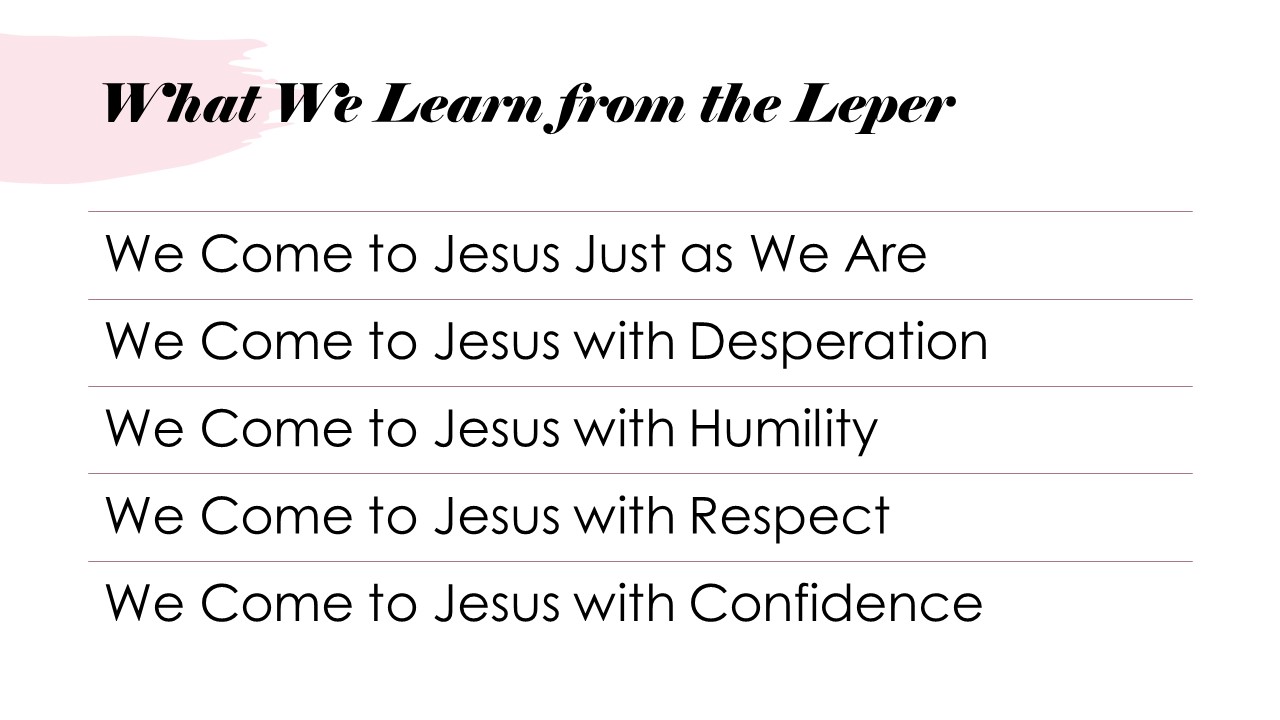
As we reflect on the leper’s encounter with Jesus, we discover a powerful blueprint for how we should approach our Savior. The leper’s approach serves as a mirror reflecting our own approach to Jesus:
1. **Coming as We Are:** Just as the leper came to Jesus in his unvarnished state, we too should approach Jesus without pretense, embracing our true selves.
2. **Humility in Our Hearts:** Like the leper, we come to Jesus with a heart marked by humility, recognizing our need for His mercy and grace.
3. **Respect for His Sovereignty:** Similar to the leper addressing Jesus as “Lord,” we approach Jesus with deep respect, acknowledging His sovereignty and lordship over our lives.
4. **Confidence in His Power:** As the leper approached Jesus with confidence in His transformative power, we come with unwavering trust in Jesus’ ability to cleanse, forgive, and heal us. We understand that He can work in us according to His will.
5. **Faith in His Love and Compassion:** Like the leper, we approach Jesus with faith, knowing that He loves us and is moved by compassion, even in the face of our sins and imperfections.
As you ponder these aspects of the leper’s approach, you may find yourself identifying with his journey, recognizing that, like him, you come to Jesus just as you are, humbly, respectfully, confidently, and in faith.
III. What We Learn About Jesus
Mark beautifully portrays Jesus’ compassion in the encounter with the leper. Jesus was “moved with compassion” (splanchnizomai), deeply empathizing with the man’s wretched condition. He felt the anguish of the leper’s isolation and suffering, mourning the losses the man had endured over the years. Jesus’ compassion wasn’t passive; it stirred Him to take decisive action to help the man. Throughout the Gospels, we witness Jesus being moved by compassion, consistently responding with assistance and healing. He is indeed a compassionate Lord.
Psalm 86:15 affirms, “But you, Lord, are a compassionate and gracious God” (CSB). Jesus’ care for you goes beyond measure. He is genuinely concerned for your life; it’s an integral part of His nature. When you follow Jesus, you are following a caring and loving God.
Mark narrates that “Jesus reached out and touched him.” Since the leper’s diagnosis, no one had dared to touch him. However, in a moment of profound vulnerability, as the leper lay face down, pleading for deliverance, Jesus reached out and healed him with a touch.
In the Bible, a touch carries profound symbolism. For instance, when people offered sacrifices to God, they would lay their hands on the animals, symbolically transferring their sins to the animals before the sacrifice. In touching the leper, Jesus was identifying with him, entering his world, and symbolically imparting His healing power. While observers may have thought Jesus was contaminating Himself, in truth, He was extending His transformative power to the leper. Jesus was willing to touch the rejected, the abandoned, and the forgotten. His touch conveyed a message of love and assistance, saying, “I accept you as you are, and I am here to help.”
So far, we’ve learned that Jesus cares for us, identifies with us, and touches us, but He also heals us. Mark records that as Jesus reached out and touched the man, He declared, “I am willing, be healed!” In an instant, the leprosy vanished, and the man was completely restored to health. The healing was not gradual; it was instantaneous and total. The man, once disfigured, defiled, and outcast, was now whole, cured, and ready to rejoin society.
This healing was not just a physical cure; it was a divine transformation. It encompassed not only the elimination of leprosy but the restoration of any disfigurements or losses the man had suffered. His response indicates his awareness of the complete healing, both in how he felt and in the visible transformation of his skin, limbs, and body. This was a divine healing, giving the man a brand new life in that very moment. It’s a profound illustration of what Jesus does when He touches a life; He grants instant renewal, making individuals “new creatures” through His incredible power (2 Cor. 5:17).
Furthermore, Jesus’ healing extends beyond the physical realm to the spiritual. He cleanses people from sin daily, healing their fears, worries, anxieties, and doubts. He grants them new hearts, fresh hope, transformed minds, and a new sense of purpose in life. In Jesus, there is healing for the body, the mind, and the soul.
IV. Conclusion
Always remember that Jesus deeply cares for you and loves you unconditionally. He has a divine plan specifically designed for your life, and a crucial aspect of that plan involves His touch, bringing cleansing and healing to your soul. All you need to do is call out to Him with sincerity and trust. Allow Jesus to work His transformative wonders in your life, for He alone possesses the power to make things new.

Once you’ve experienced His forgiveness and restoration, follow His guidance and instructions. Know that you are not aimless; you have a unique purpose in this world, a purpose that Jesus has intricately woven into the fabric of your being. Embrace it and walk in the light of His grace.
To God be the glory. Amen.

 Chasing the Wind
Leave a comment