I. Introduction: Contextual Background
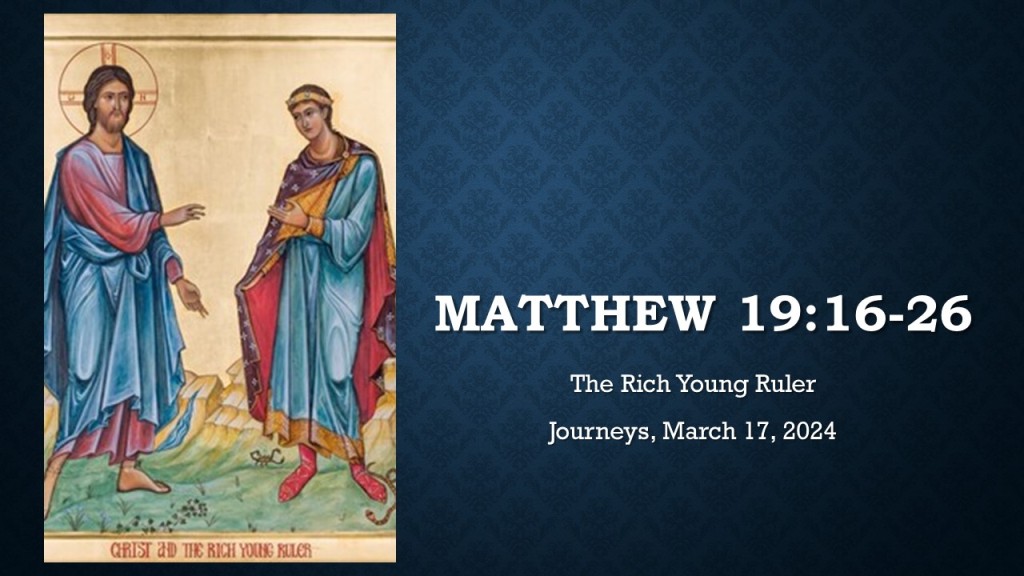
This next set of verses are challenging for disciples of Jesus, Matthew 19:16-26. We’re in the middle of the fourth discourse of Matthew, and this passage is in a pivotal part of Matthew’s Gospel where Jesus is teaching His disciples about the Kingdom of Heaven and what it means to truly follow Him.
Jesus encounters a young man often referred to as the “rich young ruler.” This interaction is not just a historical account; it’s a mirror reflecting the spiritual and ethical questions that touch the core of our discipleship. Following this, Jesus offers teachings that challenge our perceptions of wealth, success, and spiritual fulfillment. Jesus will focus our attention on our quest for eternal life and the paradoxical challenge of wealth. The question of material wealth and what it means to be a disciple is just as relevant today as they were two thousand years ago.
So, let’s begin with the socio-economic context of Judea in the 1st century.
II. Historical and Cultural Background
Ok, so maybe that’s not accurate for the time of Jesus. 🙂
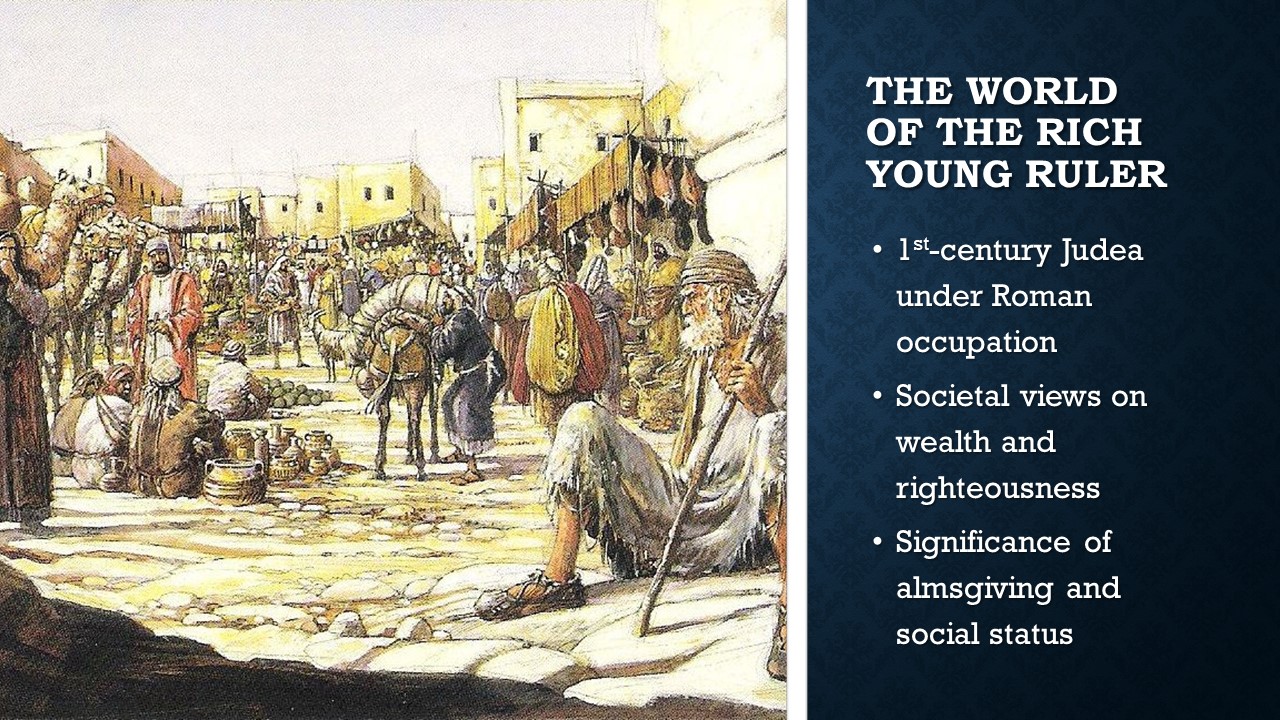
1st-century Judea was a time and place far removed from our own. The socio-economic landscape, religious beliefs, and societal norms of that era play a significant role in illuminating this story of the rich young ruler and Jesus’ teachings on wealth and the Kingdom of God.
In the 1st century, Judea was under Roman occupation. Every aspect of daily life, including economics, politics, and religion, were impacted. The Jewish people were living in anticipation of the Messiah, who they hoped would liberate them from Roman rule and restore the kingdom of Israel. The Jewish people believed that wealth was not merely a measure of material possession but was also intertwined with social status and perceived righteousness. Wealthy individuals were often seen as blessed by God, a belief rooted in interpretations of the Mosaic Law and the Prophets. These are the original “name it and claim it” religious types.
However, the distribution of wealth was highly uneven, with a small elite enjoying vast riches while the majority lived in poverty. This disparity was made worse by the Roman tax system, which placed a heavy burden on the peasantry. In such a setting, giving alms became an important religious practice, seen as a way to obtain righteousness and favor from God.
When Jesus speaks to the rich young ruler, He is addressing an individual who embodies the socio-economic and religious elite of Jewish society. This young man is not just wealthy; he is someone who has likely been taught to view his wealth as a sign of God’s favor and his observance of the law as a path to eternal life.
Furthermore, Jesus’ conversation and His subsequent teachings occur in a society where wealth is closely linked to power and religious piety. His challenge to sell all possessions and give to the poor cuts against the grain of contemporary Jewish thought, pushing the boundaries of what it means to live a life pleasing to God.
Understanding this backdrop is key to grasping the full weight of Jesus’ message. His teachings on wealth and the Kingdom of God were radical, presenting a stark contrast to the prevailing views of His time. By inviting the rich young ruler to prioritize spiritual wealth over material abundance, Jesus is not just offering a new religious principle; He is initiating a transformation in the understanding of righteousness, discipleship, and the nature of God’s Kingdom.
III. Exegesis of Matthew 19:16-22
Let’s begin with verse 16:
And someone came to Him and said, “Teacher, what good thing shall I do so that I may obtain eternal life?”

It’s an earnest question, “Teacher, what good thing must I do to get eternal life?” The Greek word for “good” here is “ἀγαθόν” (agathon), indicating not just moral goodness but also a sense of completeness or excellence. The man’s question reflects a common Jewish belief of the time—that eternal life could be earned through the observance of the law.
Matthew 17-19 –
And He said to him, “Why are you asking Me about what is good? There is only One who is good; but if you want to enter life, keep the commandments.” Then he said to Him, “Which ones?” And Jesus said, “You shall not commit murder; You shall not commit adultery; You shall not steal; You shall not give false testimony; Honor your father and mother; and You shall love your neighbor as yourself.”
Discussion question: What do you think Jesus meant when He said, “There is only One who is good?”
Jesus’ response redirects the focus from human actions to God’s goodness, challenging the premise that eternal life is simply a matter of performing good deeds. It’s not about what we do, it’s about what He did.
Jesus points the young man towards the commandments, emphasizing adherence to God’s law as foundational. However, Jesus’ selection and ordering of the commandments, focusing on those related to love of neighbor, hint at a deeper principle underlying the law. The commandments cited by Jesus encourage a life lived in harmony with others, grounded in love and mutual respect. This emphasis prefigures Jesus’ teaching that all the Law and the Prophets hang on the commandments to love God and love one’s neighbor.
Matthew 19:20-22 –
The young man said to Him, “All these I have kept; what am I still lacking?” Jesus said to him, “If you want to be complete, go and sell your possessions and give to the poor, and you will have treasure in heaven; and come, follow Me.” But when the young man heard this statement, he went away grieving; for he was one who owned much property.
The young man’s response, “All these I have kept,” reveals a sense of self-assurance in his religious observance. Yet, his following question, “What do I still lack?” suggests an underlying awareness of a deeper, unfulfilled spiritual need. Jesus’ instruction to sell his possessions and follow Him elevates the discussion from mere legal adherence to a call to radical discipleship.
In response to the young man’s question about what he still lacks, Jesus tells him, “If you want to be perfect (complete), go, sell your possessions and give to the poor, and you will have treasure in heaven. Then come, follow me.” The Greek word used here for “perfect” or “complete” is “τέλειος” (teleios), which signifies something that is complete, mature, or brought to its end.

The progression from “ἀγαθόν” (agathon) to “τέλειος” (teleios), or the progression from “good” to “perfect and complete” is significant. It’s insufficient to just be good or to follow the law or to do good things. There is a deeper realization that true goodness, completeness, or perfection involves wholehearted commitment to God and His kingdom. This involves not only obeying commandments but also letting go of earthly attachments that hinder one’s relationship with God and service to others.
Discussion question: How does this shift from “ἀγαθόν” (good) to “τέλειος” (complete) challenge us to consider our own journey toward spiritual completeness. Are there possessions, attitudes, or priorities that we need to let go of to follow Jesus more fully?
The young man leaves sad. Material wealth has a grip on the human heart. Letting go of his wealth proves too great a barrier. Everyone is given the same choice: choose the values of the Kingdom of God, or choose the values of the world.
Material possessions or worldly success may hinder our full commitment to Christ. Jesus’ call to the rich young ruler is a call to all of us to evaluate our priorities, to embrace a life of radical discipleship, and to find our true treasure in the Kingdom of God.
Luke 9:23-25 provides perspective on this cost:
And He was saying to them all, “If anyone wants to come after Me, he must deny himself, take up his cross daily, and follow Me. For whoever wants to save his life will lose it, but whoever loses his life for My sake, this is the one who will save it. For what good does it do a person if he gains the whole world, but loses or forfeits himself?
Paul’s reflections in Philippians 3:7-11 further illuminate the cost and joy of this discipleship. Paul considers everything he has lost because of Christ as “garbage,” compared to the surpassing worth of knowing Christ Jesus his Lord. For Paul, the loss of all things, including his status and credentials, is worth gaining Christ and being found in Him. This exchange reflects the essence of discipleship—a willing exchange of earthly gains for the incomparable riches of a relationship with Jesus.
This concept of the cost of discipleship’s cost does not negate the joy and fulfillment found in following Jesus. Instead, it frames discipleship as a journey of faith where true life, purpose, and joy are discovered in surrender to God’s will. The paradox that Jesus presents—of losing one’s life to find it—reveals that true life is found not in self-preservation or the accumulation of wealth but in self-giving love and obedience to Christ. In embracing the cost of discipleship, we find our identity and purpose not in what we own or achieve but in whom we follow.
In the kingdom of God, the definition of wealth transcends material possessions and financial status. Jesus’ teachings consistently challenge the conventional wisdom of what constitutes true value and success. In the Sermon on the Mount, Matthew 6:19-21, Jesus instructs,
“Do not store up for yourselves treasures on earth, where moth and rust destroy, and where thieves break in and steal. But store up for yourselves treasures in heaven, where neither moth nor rust destroys, and where thieves do not break in or steal; for where your treasure is, there your heart will be also.
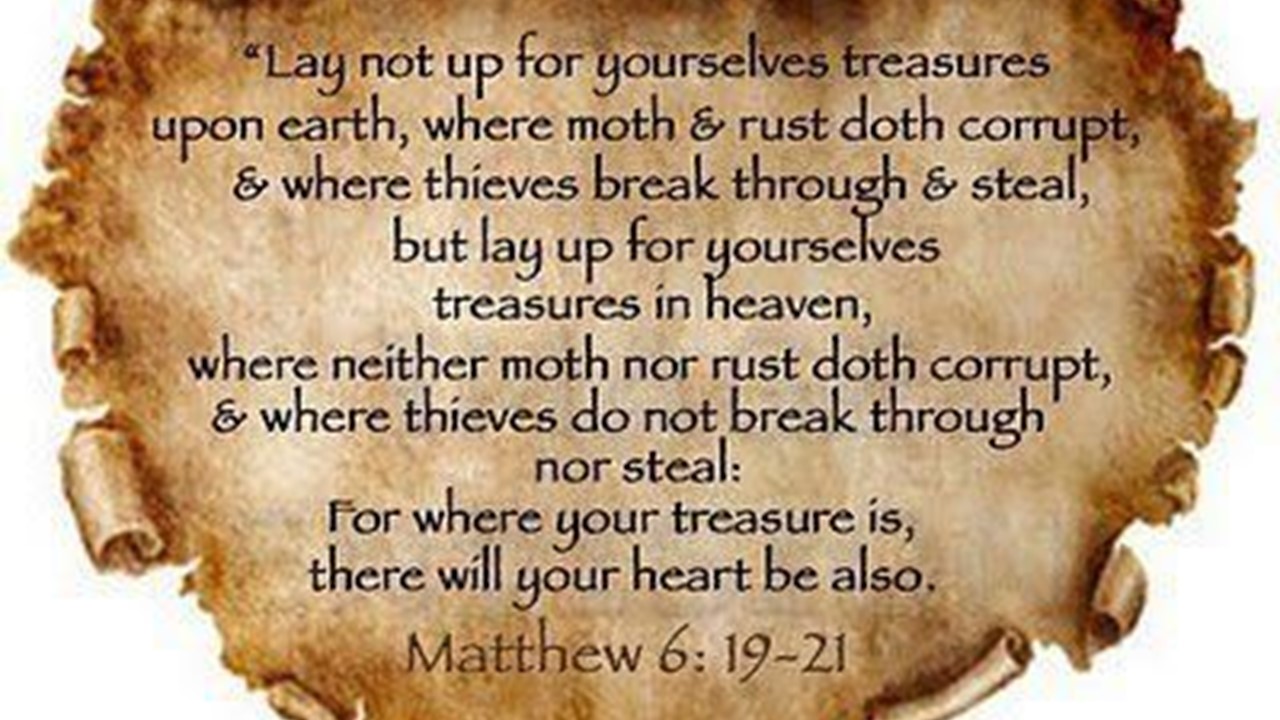
True wealth is not found in the accumulation of material goods but in the accumulation of spiritual virtues and actions that reflect the kingdom’s values – love, mercy, justice, and generosity. These treasures in heaven are imperishable, unlike earthly wealth, which is transient and susceptible to loss.
Jesus’ parable of the rich fool in Luke 12:15-21 further illuminates this theme. The rich man’s error was not in his wealth but in his belief that life’s essence and security could be found in his possessions. Jesus concludes this parable by warning against all kinds of greed, reminding us that a person’s life does not consist in the abundance of their possessions.
The challenge for the rich young ruler is to discern where our true treasure lies. In a culture that often equates financial prosperity with blessing and success, Jesus’ words are countercultural. They call us to invest in what is eternal: relationships with God and others, and in actions that reflect God’s love and justice. This redefinition of wealth challenges disciples to live with an eternal perspective, valuing what God values and investing our lives in pursuits that have lasting significance beyond our earthly existence.
By contrasting worldly wealth with spiritual riches, Jesus does not condemn the possession of material wealth per se but warns against the spiritual danger posed when wealth becomes an idol, replacing God as the ultimate source of security and identity. Seek ye first the kingdom of God and His righteousness, and by doing so, our lives will be rich in what matters most to God.
Discussion question: How do societal views today on wealth and success influence our spiritual lives today?
IV. Exegesis of Matthew 19:23-26
Matthew 19:23-24 –
And Jesus said to His disciples, “Truly I say to you, it will be hard for a rich person to enter the kingdom of heaven. And again I say to you, it is easier for a camel to go through the eye of a needle, than for a rich person to enter the kingdom of God.”
In Matthew 19:23-26, the narrative continues as Jesus addresses His disciples, expanding on the teachings prompted by His encounter with the rich young ruler. This portion of the scripture highlights the challenges of wealth in relation to entering the Kingdom of Heaven and underscores the power of God in achieving what is impossible for humans.
Jesus begins by stating, “Truly I tell you, it is hard for someone who is rich to enter the kingdom of heaven.” He then uses a vivid metaphor, “Again I tell you, it is easier for a camel to go through the eye of a needle than for someone who is rich to enter the kingdom of God.” The hyperbolic imagery of a camel passing through the eye of a needle emphasizes the extreme difficulty – or perceived impossibility – of a rich person entering God’s kingdom if their wealth is their priority. This teaching directly challenges the prevailing assumption of the time that wealth was a sign of God’s favor.
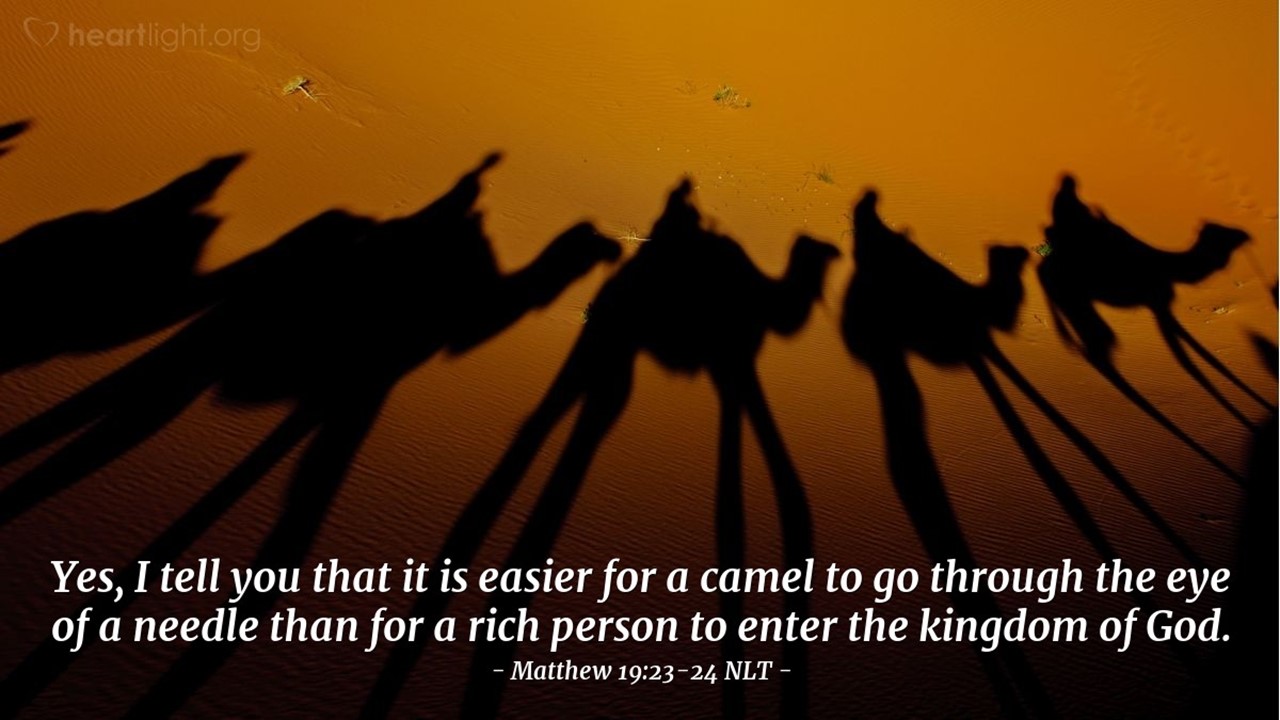
Camels were among the largest common animals in the Middle East, and the eye of a needle is one of the smallest openings, making the comparison strikingly vivid.
Some interpretations suggest that the “eye of the needle” referred to a small gate within a larger city gate, through which a camel could only pass if it was unloaded and stooped. However, this interpretation, though popular, has limited historical evidence to support it. The majority scholarly consensus views the phrase as a metaphorical expression rather than a reference to a specific physical location.
Discussion question: Is being wealthy a bad thing?
Verse 25:
When the disciples heard this, they were very astonished and said, “Then who can be saved?”
The disciples’ reaction to Jesus’ statement is one of astonishment, as they ask, “Who then can be saved?” Their response reflects the common Jewish belief that material prosperity was indicative of divine blessing and righteousness. The implication of Jesus’ teaching—that wealth could be a barrier to salvation—was counterintuitive and shocking to them, prompting a reevaluation of their understanding of righteousness and divine favor.
The metaphor underscores the spiritual principle that entrance into the Kingdom of Heaven is not about human effort, wealth, or status, but about humility, dependence on God, and the willingness to prioritize spiritual values over material possessions. The difficulty for the rich to enter the Kingdom is not an outright condemnation of wealth, but a warning against allowing it to dominate one’s life and obstruct one’s spiritual journey, as Jesus explains in the next verse.
Verse 26:
And looking at them, Jesus said to them, “With people this is impossible, but with God all things are possible.”
Jesus’ answer, “With man this is impossible, but with God all things are possible,” shifts the focus from human ability and merit to divine grace and power. This statement affirms that salvation and entry into the Kingdom of Heaven are not achievements that can be attained through human effort or possession but are ultimately dependent on God’s grace. It reassures the disciples (and readers) that while the standards of the Kingdom of Heaven may seem insurmountable, nothing is beyond the realm of possibility for God.
When Jesus says, “with God, all things are possible,” underscores a fundamental truth of the Gospel: salvation is not a human achievement but a gift of God’s grace.
Ephesians 2:8-9 offers a clear articulation of this concept:
For by grace you have been saved through faith; and this is not of yourselves, it is the gift of God; not a result of works, so that no one may boast.

Salvation is entirely a work of God’s grace, received through faith. It is not the result of human effort or obedience to the law, which could lead to boasting or a sense of earned righteousness. Instead, grace ensures that salvation remains a gift, and all glory is given to God.
The story of the rich young ruler illustrates the limitations of relying on one’s own righteousness or possessions for eternal life. Despite his adherence to the commandments, he sensed something lacking in his spiritual life, something that adherence to the law or wealth could not fulfill. Jesus’ invitation to sell all and follow Him was an invitation into a life defined by grace—a life where following Jesus and entering the Kingdom of Heaven are possible not through human merit but through surrender to God’s grace.
Grace does not negate the call to discipleship or obedience but frames them within the context of God’s loving initiative. It empowers believers to live out the Kingdom’s values, not as a means to earn salvation, but as a response to the grace they have received. This dynamic of grace and discipleship reflects a relationship rooted in love rather than obligation, transforming the believer’s life from the inside out.
The transition from discussing the specific challenge faced by the rich to addressing the broader theme of salvation highlights a critical theological point: entrance into the Kingdom of Heaven is not a matter of wealth, status, or adherence to the law, but is grounded in God’s gracious action and human reliance on that grace.
Jesus teaches that there is an inherent danger of allowing wealth to become a primary focus, as it can hinder one’s relationship with God and obstruct the path to the Kingdom of Heaven. Moreover, it underscores the necessity of divine intervention, why we need a savior because, try as we might, we will never succeed in fulfilling all the teachings of Jesus.
V. Discussion questions
Discussion question: What is the proper biblical perspective on the wealth that God has provided?
Discussion question: Besides wealth, what are other things that stand between “good enough” and “complete” that hinder discipleship?
Discussion question: Is it possible to give up all hindrances? Then what do we do?
VI. Conclusion
Matthew 19:16-26 covers significant ground between Jesus and the rich young ruler, teaching us biblical perspective on wealth, discipleship, and dependence on the Lord.
Jesus’ conversation with the young man extends far beyond a simple inquiry into eternal life, touching on the heart’s attachments and the true cost of following Him. Jesus asks us to consider what we might be holding onto that prevents us from fully embracing His call to discipleship. He points us toward a radical reorientation of our lives around the values of the Kingdom of Heaven, where treasure is not amassed on earth, but in acts of love, generosity, and service.
Moreover, Jesus’ teaching that “with God all things are possible” serves as a beacon of hope and a reminder of His promises. It reassures us that the challenges and sacrifices the Gospel demands of us are not insurmountable obstacles but opportunities for God to work within and through us, bringing about His purposes and drawing us closer to His heart.
Let’s continually ask ourselves, “With God, what is possible?”
To God be the Glory, amen.

 Chasing the Wind
Leave a comment