
I. Introduction – Faith Under Pressure
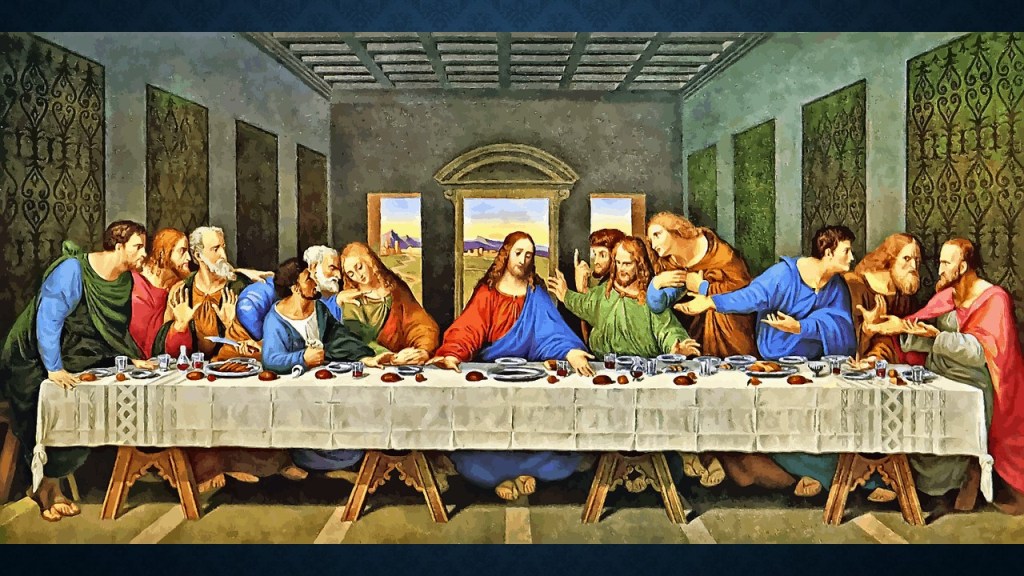
Last week in Matthew 26:1-25, we saw Jesus preparing for Passover and being anointed at Bethany. This week, the stakes are higher, and the threats against Jesus have intensified. This segment of Matthew 26 highlights key moments leading to Jesus’ crucifixion, and we can see examples of faith, failure, and redemption. These events emphasize the fulfillment of Old Testament prophecies and Jesus’ unwavering obedience to His Father’s will, despite impending suffering.

II. Matthew 26:26-30: The Institution of the Lord’s Supper
While they were eating, Jesus took some bread, and after a blessing, He broke it and gave it to the disciples, and said, “Take, eat; this is My body.” And when He had taken a cup and given thanks, He gave it to them, saying, “Drink from it, all of you; for this is My blood of the covenant, which is poured out for many for forgiveness of sins. But I say to you, I will not drink of this fruit of the vine from now on until that day when I drink it new with you in My Father’s kingdom.” After singing a hymn, they went out to the Mount of Olives.
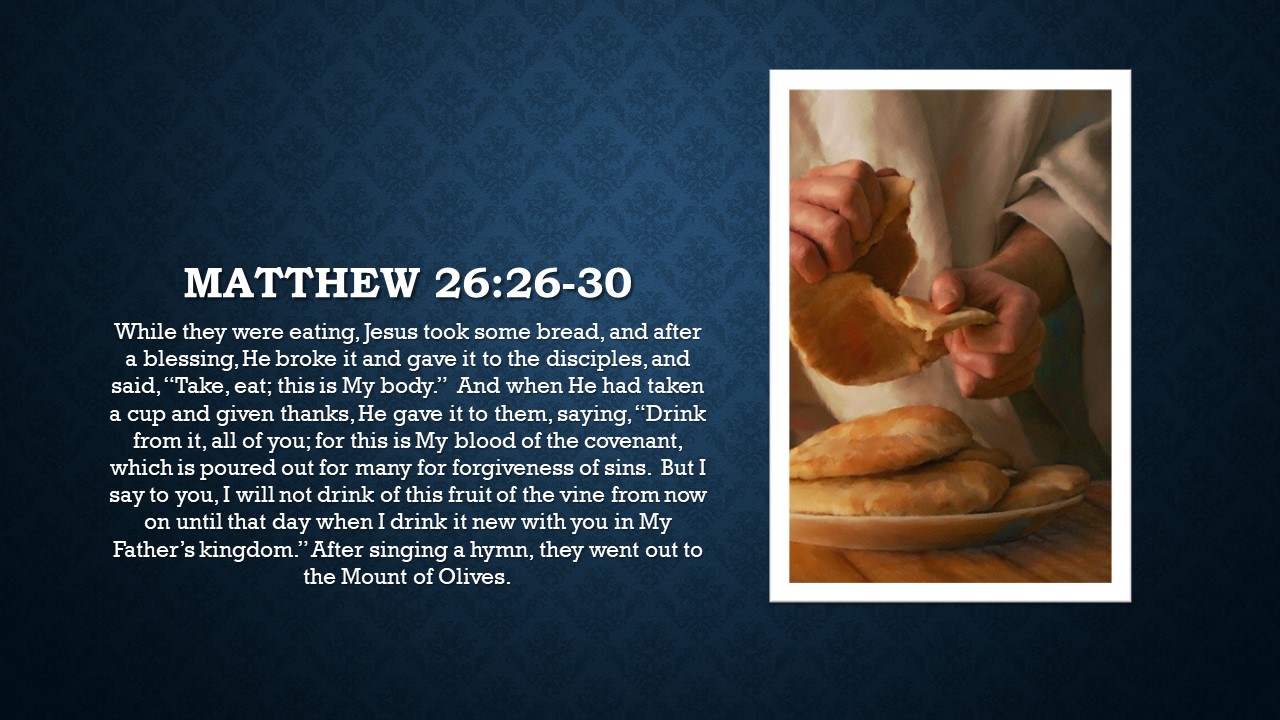
Lots of great phrases to look at here. The phrase “This is My body” (τοῦτό ἐστιν τὸ σῶμά μου) in Greek emphasizes a direct and present identification, establishing a symbolic link between the bread and Jesus’ physical body. The term “new covenant” (καινὴ διαθήκη) can also be translated as “testament” or “will,” indicating a binding agreement. The adjective “new” (καινὴ) highlights the renewal and fulfillment of God’s promises. The phrase “remission of sins” (εἰς ἄφεσιν ἁμαρτιῶν) means “forgiveness” or “release,” signifying liberation from the bondage of sin.

The Cup: Life and Wrath
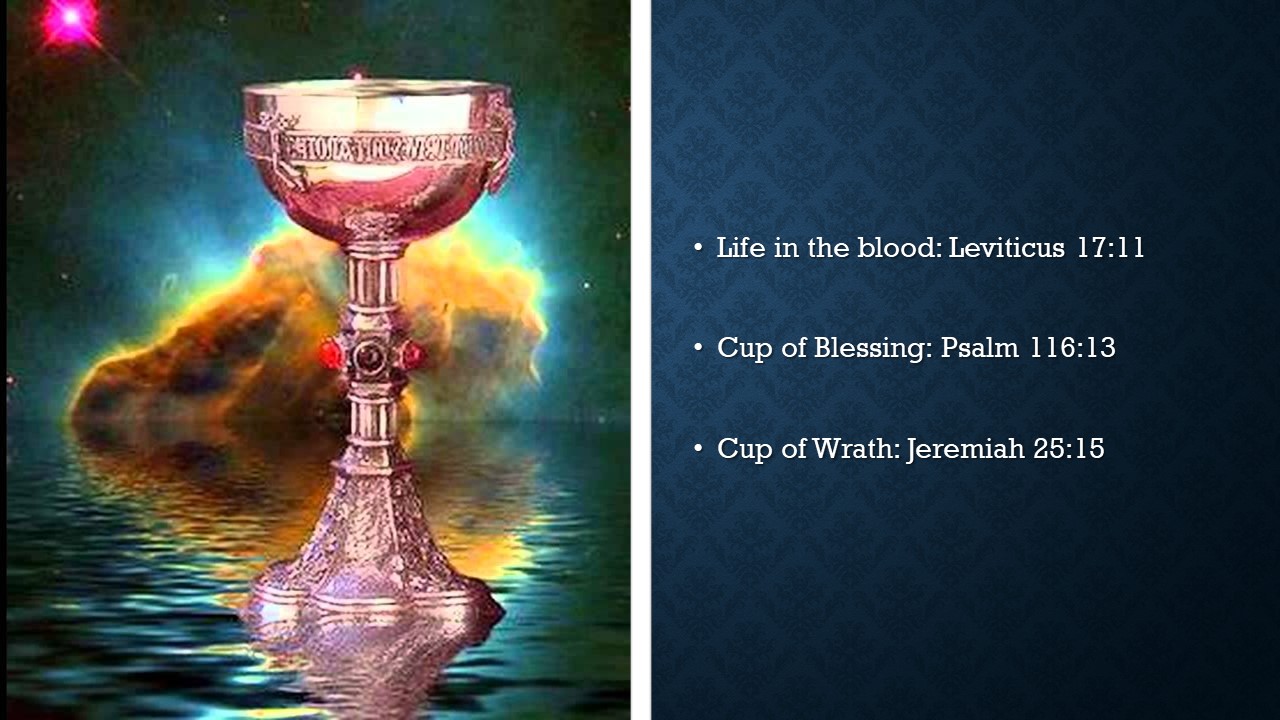
The cup that Jesus shares with His disciples holds deep symbolic significance. In ancient Hebrew culture, the cup often symbolized both blessing and judgment. Here, Jesus redefines it as a symbol of the New Covenant in His blood.
Life in the Blood: Leviticus 17:11 states, “For the life of the flesh is in the blood.” Blood symbolizes life, and by offering the cup, Jesus is symbolically offering His life to His disciples. This act signifies the pouring out of His life for the salvation of many.
Old Testament Examples:
Cup as Blessing: Psalm 116:13 says, “I will lift up the cup of salvation and call on the name of the Lord.” Here, the cup represents salvation and blessing, a reflection of God’s provision and grace.
Cup as Wrath: Conversely, the cup also symbolizes God’s judgment. In Jeremiah 25:15, God says, “Take from My hand this cup of the wine of wrath, and make all the nations to whom I send you drink it.” This imagery portrays the cup as a vessel of divine wrath and judgment against sin.
By referring to the cup during the Last Supper, Jesus integrates these dual themes. He is the source of life and blessing through His sacrificial death, but He also bears the wrath of God against sin on behalf of humanity.
The New Covenant:
The concept of the New Covenant is rooted in the Old Testament. In Jeremiah 31:31-34, God promises a new covenant with His people, different from the covenant made with their ancestors. This new covenant involves the internalization of God’s law and a direct, personal relationship with Him:
Jeremiah 31:34:
“No longer will they teach their neighbor, or say to one another, ‘Know the Lord,’ because they will all know me, from the least of them to the greatest,” declares the Lord. “For I will forgive their wickedness and will remember their sins no more.”
This promise of forgiveness and a personal relationship with God is fulfilled through Jesus’ sacrificial death and the establishment of the New Covenant in His blood.
When Jesus says, “I will not drink of the fruit of the vine from now on until that day when I drink it new with you in My Father’s kingdom” (Matthew 26:29, NASB), He is making a significant statement about the future and the fulfillment of God’s kingdom. He is referring to a future time when He will be reunited with His disciples in the fully realized kingdom of God, pointing to the eschatological hope of the Messianic banquet, a future celebratory feast in God’s kingdom. This promise emphasizes the future communal aspect of salvation history, where Jesus and His followers will celebrate together, assuring the disciples of their place in the eternal kingdom and the joy that awaits them.
Catholic and Protestant Views on the Eucharist:
Catholics believe in transubstantiation, the doctrine that the bread and wine used in the Eucharist become the actual body and blood of Christ. This belief is rooted in their interpretation of Jesus’ words at the Last Supper as being literal. Christ didn’t say the bread was “like” His body; He said it “was” His body. Protestants, on the other hand, interpret Jesus’ words as symbolic, believing that the bread and wine are symbols that represent His body and blood. Our understanding is based on the context of Jesus’ teachings, where He often used metaphors and symbols to convey spiritual truths. Additionally, the New Testament does not explicitly teach the doctrine of transubstantiation, and early church practices and writings do not support a literal transformation. Therefore, we partake in the Lord’s Supper as a memorial of Jesus’ sacrifice, focusing on the spiritual presence of Christ rather than a physical change in the elements.
We also discussed a disconnect in last week’s lesson; I had inferred from Matthew that the disciples all heard Jesus betray Him, while Pastor Dave indicated only John heard. You might be surprised that Pastor Dave is correct. His theology degree was the giveaway, I think.
The Gospel of John provides additional context to the events of the Last Supper. In John 13:21-30, Jesus announces the betrayal, and there is confusion among the disciples. John, reclining next to Jesus, asks Him privately who the betrayer is. Jesus identifies Judas by giving him a piece of bread, but the other disciples do not understand the significance of this action and think Judas is being sent on an errand related to the festival or to give something to the poor. This detail emphasizes the intimate and sorrowful nature of the Last Supper, highlighting Jesus’ foreknowledge and the disciples’ lack of understanding of the imminent betrayal.
Discussion Questions:
– What is the significance of Jesus instituting the Lord’s Supper during the Passover meal?
– Answer: It links His sacrifice to the Passover lamb, emphasizing deliverance from sin.
– How does the concept of the New Covenant shape our understanding of Jesus’ mission?
– Answer: It establishes a direct, personal relationship with God through Jesus’ sacrifice.
III. Matthew 26:31-35: Jesus Predicts Peter’s Denial
Then Jesus said to them, “You will all fall away because of Me this night, for it is written, ‘I will strike down the shepherd, and the sheep of the flock shall be scattered.’ But after I have been raised, I will go ahead of you to Galilee.” But Peter said to Him, “Even though all may fall away because of You, I will never fall away.” Jesus said to him, “Truly I say to you that this very night, before a rooster crows, you will deny Me three times.” Peter said to Him, “Even if I have to die with You, I will not deny You.” All the disciples said the same thing too.
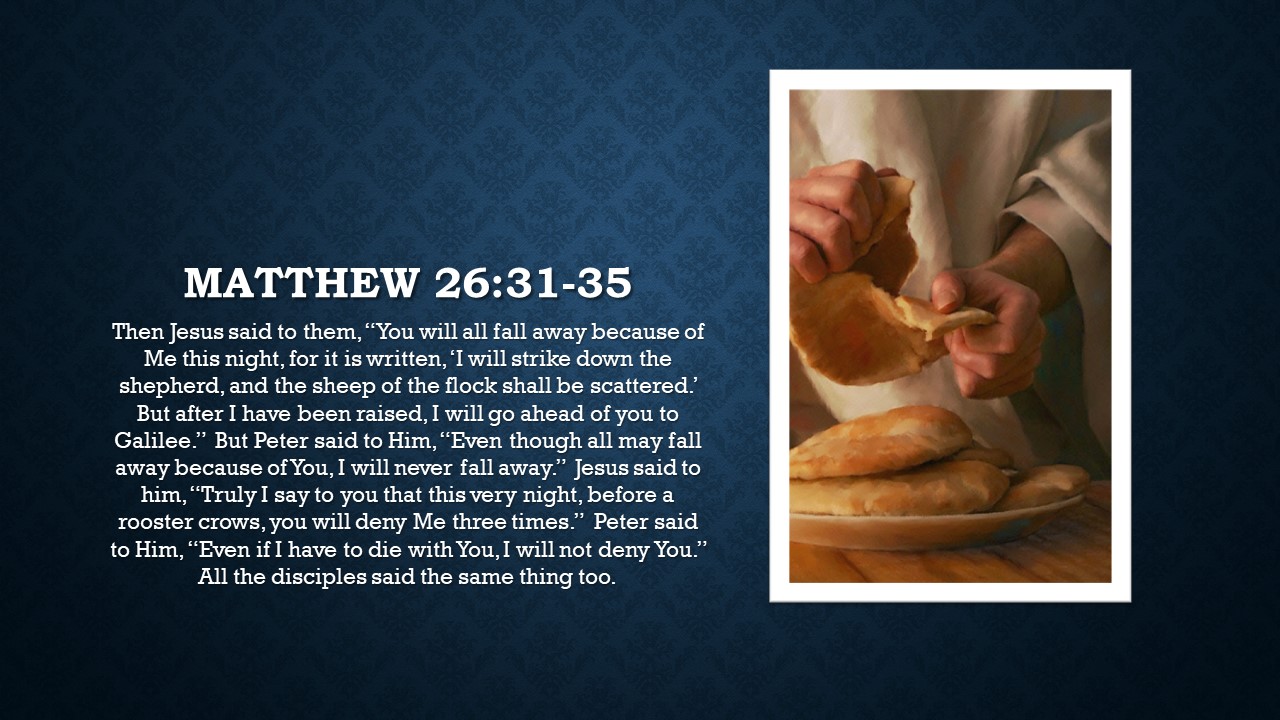
In verses 31-35, Jesus predicts that all His disciples will stumble because of Him that night, citing Zechariah 13:7, “Strike the Shepherd, and the sheep will be scattered.” Peter, with characteristic boldness, declares he will never be made to stumble, even if all others do. Jesus then foretells that Peter will deny Him three times before the rooster crows. Despite this, Peter insists he will die with Jesus rather than deny Him, and all the disciples echo this sentiment.
This passage highlights human weakness and the reality of fear and failure, even among Jesus’ closest followers. Zechariah 13:7 indicates the scattering of the disciples, showing the fulfillment of prophecy and the inevitability of their temporary desertion. Jesus is not just fulfilling this scripture; He tells the disciples that they, too, will fulfill it. The sheep that follow Jesus will abandon Him and scatter.
Peter’s pride in his belief in Jesus leads him to assert that he will never stumble, despite Jesus’ prophecy. This highlights the arrogance of believing he knows better than Jesus. Despite Peter’s vehement denial, Jesus’ love for him remains unwavering, as demonstrated when Jesus later asks Peter, ‘Do you love me?’ after His resurrection, showing that failure does not disqualify one from Jesus’ love.
Discussion Questions:
– Why is Peter’s denial significant in the context of this passage?
– Answer: It demonstrates the challenges of discipleship and the need for reliance on God’s strength.
– How does Jesus’ prediction of Peter’s denial reflect His foreknowledge and grace?
– Answer: It shows Jesus’ awareness of human frailty and His willingness to restore those who fail.
IV. Matthew 26:36-46: Jesus Prays in Gethsemane
Then Jesus came with them to a place called Gethsemane, and said to His disciples, “Sit here while I go over there and pray.” And He took with Him Peter and the two sons of Zebedee, and began to be grieved and distressed. Then He said to them, “My soul is deeply grieved, to the point of death; remain here and keep watch with Me.”
And He went a little beyond them, and fell on His face and prayed, saying, “My Father, if it is possible, let this cup pass from Me; yet not as I will, but as You will.” And He came to the disciples and found them sleeping, and said to Peter, “So, you men could not keep watch with Me for one hour? Keep watching and praying that you may not enter into temptation; the spirit is willing, but the flesh is weak.”

He went away again a second time and prayed, saying, “My Father, if this cannot pass away unless I drink it, Your will be done.” Again He came and found them sleeping, for their eyes were heavy. And He left them again, and went away and prayed a third time, saying the same thing once more. Then He came to the disciples and said to them, “Are you still sleeping and resting? Behold, the hour is at hand and the Son of Man is being betrayed into the hands of sinners. Get up, let us be going; behold, the one who betrays Me is at hand!”
In verses 36-46, Jesus takes Peter, James, and John to Gethsemane, asking them to watch and pray while He goes further to pray alone. He expresses His deep sorrow and anguish. Jesus prays three times, “O My Father, if it is possible, let this cup pass from Me; nevertheless, not as I will, but as You will.” Each time He returns, He finds His disciples sleeping and admonishes them to watch and pray to avoid temptation. He finally concludes, “Rise, let us be going. See, My betrayer is at hand.”
The “cup” symbolizes the impending suffering and wrath of God that Jesus must endure, consistent with Old Testament imagery like Isaiah 51:17 –
Rouse yourself! Rouse yourself! Arise, O Jerusalem,
You who have drunk from the Lord’s hand the cup of His anger;
The chalice of reeling you have drained to the dregs.
And Jeremiah 25:15 –
For thus the Lord, the God of Israel, says to me, “Take this cup of the wine of wrath from My hand and cause all the nations to whom I send you to drink it.
Gethsemane becomes a place of intense spiritual struggle, emphasizing Jesus’ humanity and obedience. The disciples’ inability to stay awake and pray reflects their lack of understanding and preparation for the coming trials.
Despite knowing Peter would deny Him, Jesus still took Peter to Gethsemane, showing that God knows our weaknesses and loves us anyway. Paul reflects on this in 2 Corinthians 12:9, where God says,
“My grace is sufficient for you, for My power is made perfect in weakness.”
Discussion Questions:
– What does Jesus’ prayer in Gethsemane reveal about His relationship with the Father?
– Answer: It shows His submission to the Father’s will and His struggle with the impending suffering.
– How does the disciples’ inability to stay awake and pray illustrate their spiritual state?
– Answer: It highlights their weakness and the need for vigilance in prayer.
V. Matthew 26:47-56: Jesus’ Arrest
While He was still speaking, behold, Judas, one of the twelve, came up accompanied by a large crowd with swords and clubs, who came from the chief priests and elders of the people. Now he who was betraying Him gave them a sign, saying, “Whomever I kiss, He is the one; seize Him.” Immediately Judas went to Jesus and said, “Hail, Rabbi!” and kissed Him. And Jesus said to him, “Friend, do what you have come for.” Then they came and laid hands on Jesus and seized Him.
And behold, one of those who were with Jesus reached and drew out his sword, and struck the slave of the high priest and cut off his ear. Then Jesus said to him, “Put your sword back into its place; for all those who take up the sword shall perish by the sword. Or do you think that I cannot appeal to My Father, and He will at once put at My disposal more than twelve legions of angels? How then will the Scriptures be fulfilled, which say that it must happen this way?”
At that time Jesus said to the crowds, “Have you come out with swords and clubs to arrest Me as you would against a robber? Every day I used to sit in the temple teaching and you did not seize Me. But all this has taken place to fulfill the Scriptures of the prophets.” Then all the disciples left Him and fled.
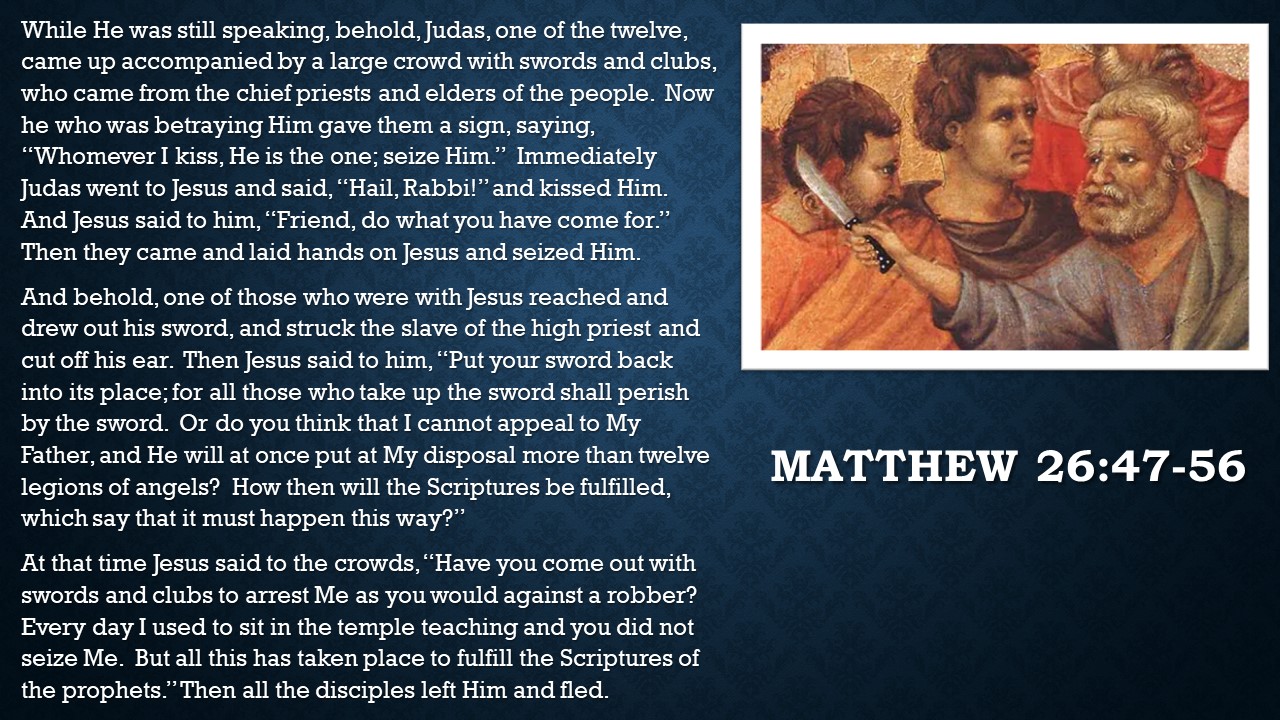
In verses 47-56, Judas arrives with a large crowd armed with swords and clubs, sent by the chief priests and elders. Judas identifies Jesus with a kiss, and Jesus addresses him as “Friend.” One of Jesus’ followers strikes the servant of the high priest, cutting off his ear. Jesus heals him and instructs His disciple to put away the sword, stating, “For all who take the sword will perish by the sword.” Jesus declares that He could call on more than twelve legions of angels, but the Scriptures must be fulfilled. The disciples all flee, fulfilling Jesus’ earlier prediction.
The term “Friend” is used here ironically, highlighting Judas’ betrayal.
The term “legions of angels” (λεγεῶνας ἀγγέλων) refers to a Roman military unit, indicating a vast number of angels ready to defend Jesus, yet He chooses submission to fulfill Scripture.
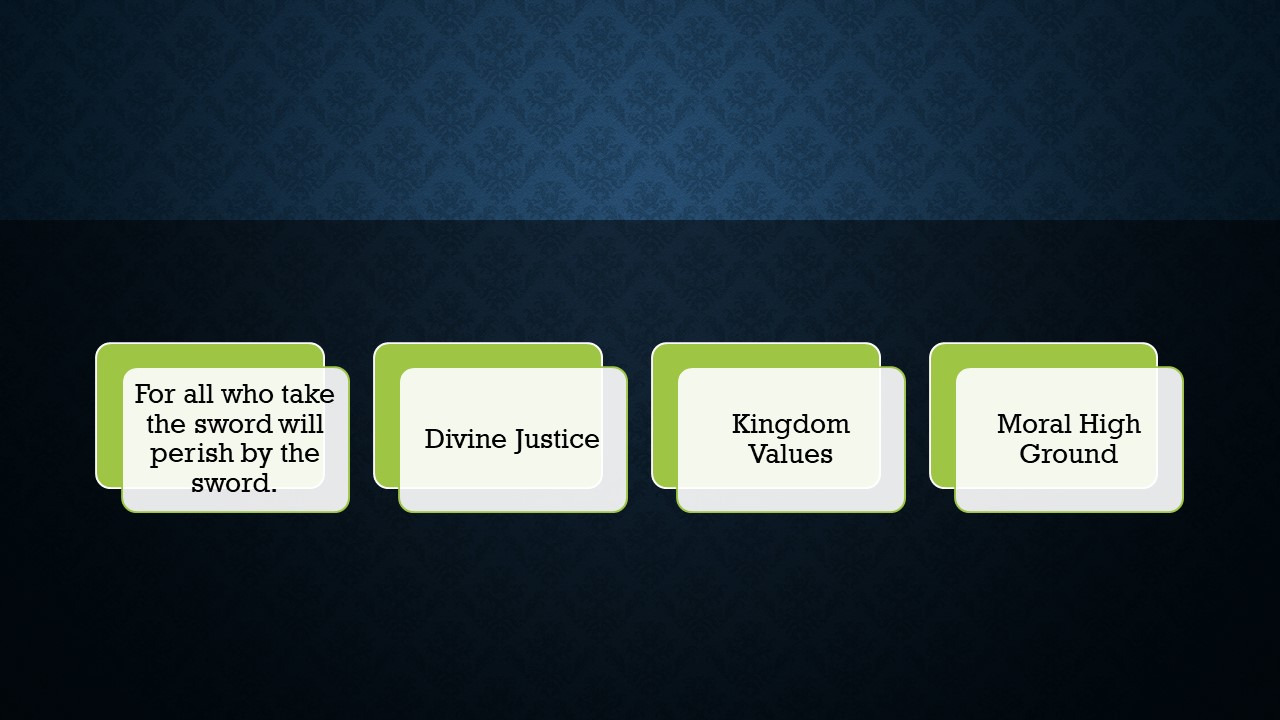
When Jesus says, “For all who take the sword will perish by the sword,” He is emphasizing the principle of non-violence and the futility of using force to achieve one’s ends. This statement reflects several key themes:
- Divine Justice: Jesus underscores the principle that those who resort to violence will ultimately face violence themselves. This echoes the biblical concept of “reaping what you sow” (Galatians 6:7) and emphasizes that God’s justice will prevail.
- Kingdom Values: Jesus’ kingdom is not established through violence or force but through love, sacrifice, and obedience to God’s will. His arrest and crucifixion are part of God’s redemptive plan, which must be fulfilled through non-violent means.
- Moral High Ground: By rejecting violence, Jesus demonstrates the moral high ground and the higher ethical standards of His followers. This non-violent response to aggression is a powerful witness to the nature of God’s kingdom.
Jesus’ response to Judas’ betrayal and His arrest reflects His mission and character. His commitment to fulfilling Scripture and His non-violent approach highlight His divine purpose. The disciples’ flight underscores human fear and the fulfillment of Zechariah 13:7.
The fulfillment of prophecies, such as Isaiah 53:7, is seen in Jesus’ silent acceptance of His fate:
He was oppressed and afflicted, yet He did not open His mouth.
This aligns with Matthew 26:63 that we’ll study next week, where Jesus remains silent before the high priest, demonstrating His role as the sacrificial Lamb of God.
Discussion Questions:
– How does Jesus’ response to Judas’ betrayal and His arresters reflect His mission and character?
– Answer: It shows His commitment to fulfilling Scripture and His non-violent approach.
– What can we learn from the disciples’ reaction to Jesus’ arrest?
– Answer: It highlights the human tendency to flee from danger and the importance of courage and faith in following Jesus.
VI. Conclusion
In this passage, Matthew 26:26-56, we see the institution of the Lord’s Supper, Jesus’ prediction of Peter’s denial, His agonizing prayer in Gethsemane, and His subsequent arrest. These events underscore the fulfillment of Old Testament prophecies and Jesus’ unwavering obedience to His Father’s will. The elements of bread and wine in the Lord’s Supper symbolize Jesus’ body and blood, establishing the New Covenant. Peter’s denial, despite his fervent declarations, highlights human frailty. In Gethsemane, Jesus’ profound sorrow and submission to God’s will demonstrate His humanity and divine mission. Finally, Jesus’ arrest and response to Judas’ betrayal reflect His commitment to fulfill Scripture and His peaceful resolve in the face of suffering.
Throughout this passage, we see a blend of prophecy, cultural context, and Jesus’ sovereign control over the unfolding events. We will continue our journey through Matthew 26 next week.
To God be the glory, Amen.

 Chasing the Wind
Leave a comment