

I. Introduction
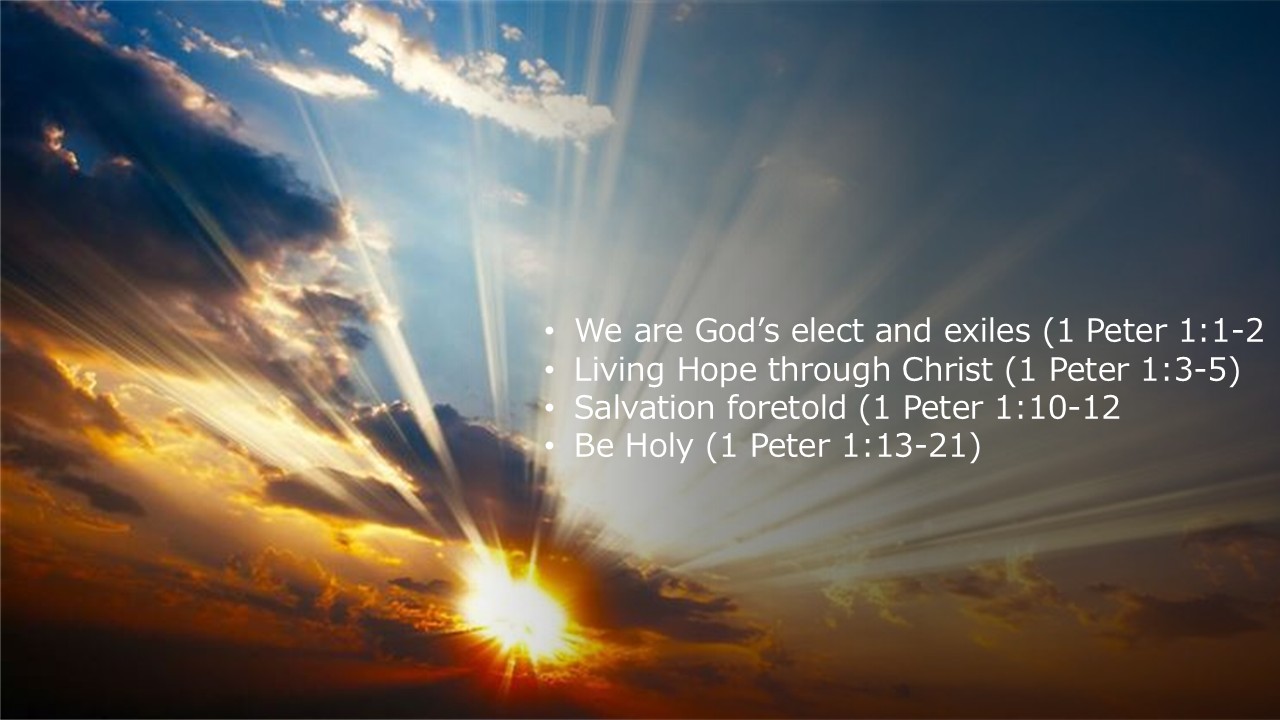
1 Peter 1:22–25 follows Peter’s opening in which he reminds us of our identity as God’s elect exiles (1 Peter 1:1-2) and praises God for our living hope through Christ’s resurrection (1 Peter 1:3-5). He then exhorts us to endure trials with faith (1 Peter 1:6-9) and reflects on the great salvation foretold by the prophets (1 Peter 1:10-12). This leads into his call to holiness (1 Peter 1:13-21), emphasizing reverence for God and redemption through Christ’s precious blood.
Now, Peter transitions from individual holiness to its communal expression, demonstrating that true sanctification is not merely personal and internal but also relational. A new birth in Christ produces a transformed heart, leading to a love that is not superficial but deep, sincere, and enduring.
Peter grounds this love in the reality of our new birth which comes through the “living and abiding word of God.” He contrasts the fleeting nature of human life with the eternal nature of Scripture, emphasizing that we should anchor our affections in eternal truth rather than transient worldly concerns. So let’s begin with 1 Peter 1:22a.
II. Purifying Souls by Obedience
“Having purified your souls by your obedience to the truth for a sincere brotherly love,”
Peter begins by emphasizing that our purification, our sanctification, is directly linked to obedience to the truth. Jesus instructed us the same in his prayer to the Father for His disciples in John 17:17,
“Sanctify them in the truth; your word is truth.”
Obedience to the truth is not merely about external actions; it signifies an inward transformation. Romans 6:17 says this obedience from the heart, stating,
“But thanks be to God, that you who were once slaves of sin have become obedient from the heart to the standard of teaching to which you were committed.”
This purification enables us to experience “sincere brotherly love”—a love free from pretense. The Christian life is marked by genuine relationships, where love is not just an ideal but a lived-out reality.
It is important to recognize that the Christian life is not merely a system of rules and regulations. While God’s law provides moral guidance, our faith is not defined by legalism but by a transformed heart. Jesus frequently rebuked the Pharisees for their rigid adherence to traditions while neglecting the greater matters of the law—justice, mercy, and faithfulness. Christianity is fundamentally about relationship—first with God and then with others.
However, this emphasis on relationship does not negate the necessity of obedience. Jesus Himself said in John 14:15,
“If you love me, you will keep my commandments.”
Obedience to God’s Word is not about earning favor but responding in love to the grace we have received. True obedience flows from a heart that has been changed, leading us to live in accordance with God’s will out of gratitude rather than obligation.
Discussion Question: How do we as believers balance freedom in Christ with obedience to the Word? What are some “rules” not grounded in scripture Christians sometimes insist on?
III. Loving One Another Earnestly
1 Peter 1:22b –
“Love one another earnestly from a pure heart.”
Peter’s command to “love one another earnestly” challenges us to go beyond superficial expressions of love. The Greek verb for “love” (agapēsate, ἀγαπήσατε) is in the imperative, highlighting that love is not optional—it is a command. The adverb “earnestly” (ektenōs, ἐκτενῶς) means “stretched to full capacity,” suggesting a persistent and self-sacrificial love that endures even in difficulty.
This term is used in Luke 22:44, describing Jesus’ fervent prayer in Gethsemane, reinforcing that love is often costly and requires commitment. Just as Christ’s love persevered through suffering, we are called to love with endurance and intentionality.
The phrase “from a pure heart” (katharas kardias, καθαρῐας καρδίας*) emphasizes that true love flows from a heart fully surrendered to God. In Matthew 5:8, Jesus says,
“Blessed are the pure in heart, for they shall see God.”
Purity of heart is not just moral uprightness, but undivided devotion to God. The Bible often refers to the heart as the center of thought, will, and emotion. Peter’s emphasis shows that love must not be superficial but rooted in a heart transformed by Christ.
How Can We Love Earnestly? We can practice –
- Forgiveness: Loving earnestly means forgiving repeatedly (Matthew 18:21-22).
- Sacrifice: Love requires time, energy, and resources. (1 John 3:16)
- Encouragement: Building others up with words of grace (Ephesians 4:29).
Discussion: What are some other ways we can show earnest love to one another? What are some of the difficulties in demonstrating love like this?
IV. The Eternal Word of God
1 Peter 1:23-25a,
“Since you have been born again, not of perishable seed but of imperishable, through the living and abiding word of God; for ‘All flesh is like grass and all its glory like the flower of grass. The grass withers, and the flower falls, but the word of the Lord remains forever.’”
The phrase “born again” (anagegennēmenoi, ἀναγεγεννημένοι) connects to 1 Peter 1:3, where Peter speaks of being “born again to a living hope.” This rebirth is not physical but spiritual, initiated by God.
The contrast between perishable seed (phthartēs, φθαρτῆς) and imperishable seed (aphthartēs, ἀφθάρτου) emphasizes the eternal nature of spiritual birth. In agriculture seed represented the origin of life. Human birth, like perishable seed, results in life that eventually fades. However, Peter points to the imperishable seed—God’s Word—as the source of a new, spiritual birth that never decays. Just as a seed contains the potential for life, the Word of God contains the power to bring about eternal transformation.
This metaphor is also used in John 12:24, where Jesus speaks of a grain of wheat falling to the ground and dying to produce much fruit, illustrating how spiritual life is cultivated through the divine seed of God’s truth. The seed Peter speaks of is not physical or corruptible but a supernatural, enduring force that ensures our regeneration and sustains our faith. Unlike human life, which fades, the new birth in Christ is eternal and unchanging.
This concept of new birth was a central part of Jesus’ conversation with Nicodemus in John 3:3-7. Nicodemus, a Pharisee and ruler of the Jews, struggled to understand Jesus’ teaching that one must be “born again” to enter the kingdom of God. Jesus explained that this birth is not of the flesh but of the Spirit in John 3:5 –
“Truly, truly, I say to you, unless one is born of water and the Spirit, he cannot enter the kingdom of God.”
Nicodemus initially viewed salvation through the lens of religious practice and lineage, but Jesus pointed him to the necessity of a radical transformation through the Spirit. This aligns with Peter’s teaching that the new birth is through the imperishable seed of God’s Word, not human effort or heritage. Our spiritual rebirth is entirely the work of God, making us new creations and ensuring our place in His eternal kingdom.
Peter describes the Word as “living” (zōntos, ζῶντος) and “abiding” (menontos, μένοντος), reinforcing its continual power to transform lives.
Peter quotes Isaiah 40:6–8, reminding us that:
- Human achievements are temporary.
- God’s Word remains forever.
Isaiah 40:6-8 is part of a passage where the prophet contrasts the frailty of humanity with the enduring nature of God’s word. The imagery of grass withering and flowers fading emphasizes that human strength, glory, and accomplishments are fleeting. This theme is echoed throughout Scripture, such as in James 4:14, which compares human life to a mist that appears for a little time and then vanishes.
The permanence of God’s word stands in contrast to the transient nature of human existence. Isaiah’s prophecy reassured Israel during a time of instability, reminding them that God’s promises and purposes endure beyond kingdoms and generations. Peter applies this to us, pointing us to the imperishable nature of our spiritual rebirth through the word of God. Just as God’s promises to Israel never failed, so too does the gospel remain unchanging and powerful to bring new life.
This passage also aligns with Jesus’ words in Matthew 24:35, where He declares, “Heaven and earth will pass away, but my words will not pass away.” The eternal nature of God’s word means that His promises of salvation and renewal will never fail, providing believers with lasting hope.
I was going to give an illustration about the Titanic being a symbol of Man’s temporal influence, then I thought of the tower of Babylon or maybe the twin towers from New York, but I can never get past man’s temporary nature without this example from Egypt.

This a statue, or what’s left of a statue, called Ozymandias. Originally, archaeologists believe it stood 62 feet or nearly 6 stories tall. This is all that’s left, and the poet Percy Shelly wrote a poem that ended like this –
And on the pedestal these words appear:
‘My name is Ozymandias, king of kings:
Look on my works, ye Mighty, and despair!’
Nothing beside remains. Round the decay
Of that colossal wreck, boundless and bare
The lone and level sands stretch far away.
Earthly works are no more than Ozymandias. Nothing remains. We are called to do more. We are called to eternal works.
Discussion: What other examples illustrate the temporary nature of human achievements compared to the eternal nature of God?
V. The Good News
1 Peter 1:25b,
“And this word is the good news that was preached to you.”
Peter concludes by affirming that the “word” he speaks of is the gospel—the good news of Jesus Christ. The good news is an eternal truth that transforms lives.
Paul reinforces this truth in Romans 1:16:
“For I am not ashamed of the gospel, for it is the power of God for salvation to everyone who believes.”
The gospel is God’s means of salvation, not just a temporary message but a lasting reality that brings new life.
Peter’s call to love is inseparable from our identity in Christ. Our new birth shapes how we live, think, and relate to others. This love we experience and the love we share is a commitment rooted in the eternal Word of God.
Peter concludes this section by clarifying that the eternal Word of God is the very message of the gospel. The phrase “the good news that was preached to you” is part of God’s eternal plan, now revealed and made known to us. The gospel is not only a message of salvation but also one of transformation, calling us to live in light of God’s eternal truth.
VI. Conclusion
1 Peter 1:22–25 challenges us to love one another earnestly and sincerely, grounded in the enduring Word of God. While human life is brief, God’s Word remains forever, offering a foundation for lasting relationships and meaningful lives.
As believers, we are called to invest in what is eternal—faith, hope, and love. And the greatest of these is love (1 Corinthians 13:13). This love is not a passing feeling but a reflection of the heart of God, a love that transforms and endures.
- We are sanctified by our obedience to the truth
- Our sanctification enable us to love one another earnestly
- God is eternal, man is temporal

To God be the glory. Amen.

 Chasing the Wind
Leave a comment