

I. Introduction
Be in the world, not of the world.
This phrase isn’t in the bible, but it is a concept expressed by a great many verses. In John 17:14-15, the night Jesus was betrayed, Jesus prays to the Father for all believers,
I have given them your word and the world has hated them, for they are not of the world any more than I am of the world. My prayer is not that you take them out of the world but that you protect them from the evil one.
But what does this look like in our lives today? How do we put this into practice?
II. We Are Strangers, 1 Peter 2:11-12
I’m going to talk about my travels for a bit. I have been blessed in a job that gave me the opportunity so see much of God’s creation. My first overseas trip was to Florence, Italy. I marveled at the Duomo, walked streets that were 2000 years old, the same streets ancient Romans walked in the days of Jesus. I saw amazing examples of Renaissance art.

But I am not Italian. I was a visitor.
In 1997, I moved to Singapore the day before Chinese New Year. It’s like moving to downtown Houston on Christmas Eve and wondering where all the people were. I visited a Christian church that was 99.9% Chinese, and somehow the people in the church noticed me. I gave my life to Christ there. I saw a beautiful modern city with streets that were safe to walk in and explored the complicated history of the influence of the Malaysian people and British imperialism.

But I am not Chinese. I was a visitor.
Several years ago, I spent almost a year in Scotland. I played golf on a links course where some of the oldest golf clubs reside. I ate haggis, nips, and tatties, and I enjoyed it. I saw musicians on street corners playing bagpipes. I almost bought a kilt. After nearly a year, I could almost understand what they were saying.

But I am not Scottish. I was a visitor.
If you’ve lived your whole life in Texas, then you’ve probably seen the Houston Museum of Natural Science and the Butterfly Museum and perhaps you’ve made the drive up towards Brenham in the spring to see the bluebonnets that bloom like no place else in the world. Perhaps you’ve stood on Galveston Beach and wondered how far the ocean stretched, or driven to San Antonio and marveled at the hundreds of miles of flat prairies as far as you can see.

I consider myself a Texan. I consider myself an American. I consider myself an inhabitant of this big blue marble that travels around a small yellow sun.
And yet, I am still a visitor. This is not my home.

We should be good guests, enjoy this world, appreciate its beauty, and admire God’s handiwork. But like good visitors, we take nothing from this trip with us. Like good visitors, we leave this place better than we found it. As Christians, we should leave behind a testimony of faith, kindness, and righteousness. But we will eventually leave it all behind.
There’s nothing wrong, and everything right, with appreciating everything God has provided for our stay. He is an amazing host. But if we have a limited, personal, selfish view of Christianity, we only look at the here and now. Will being a good Christian help me in my relationships? Will it bring me better health, a better job, success and prosperity? Will I feel better?
But if our focus is on this world and how Christianity provides a more fulfilling life, then we do not appreciate that we are visitors. We try to be permanent guests, we fear death instead of recognizing that our eternal life has already begun and eventually we move to a far, far better place. 1 Corinthians 15:19 says it this way:
If our hope in Christ is good for this life only and no more, then we deserve more pity than anyone else in all the world.
Recognizing that this world is not our home should change the way we live. Peter makes this clear in our passage today, 1 Peter 2 beginning in verse 11,
I appeal to you, my friends, as strangers and refugees in this world! Do not give in to bodily passions, which are always at war against the soul. Your conduct among the heathen should be so good that when they accuse you of being evildoers, they will have to recognize your good deeds and so praise God on the Day of his coming.
Peter describes worldly passions as being ‘at war’ against the soul. The Greek word στρατεύονται (strateuontai) implies an ongoing military campaign, a constant battle. This isn’t a minor skirmish; it’s a lifelong struggle. But as visitors here, we are called to resist and live for the eternal kingdom.

God has a purpose for our lives if we recognize we are visitors. We are ambassadors of Christ. This world offers beauty and wonder, but if we grab it and hold on to this world at all costs, we are to be pitied. These worldly possessions are always at war against the soul which is destined for a far better destination.
C.S. Lewis, in Mere Christianity, writes,
“If we find ourselves with a desire that nothing in this world can satisfy, the most probable explanation is that we were made for another world.”

In other word, our behaviors should reflect that we are not trying to be comfortable in this temporary home.
We live for that day, and our behavior should be exemplary. The pagan world will see our lives and mock us now, but God has a purpose.
If you are in a position where people mock you, don’t give up hope. Be aware that God is using you to demonstrate His love.
Discussion Question: Peter describes Christians as ‘strangers and refugees’ in this world. How does recognizing that we are temporary residents change our priorities and daily decisions?
III. Submission, Not Rebellion, 1 Peter 2:13-15
How, then, shall we live? We lead lives of quiet submission. We lead our lives in the freedom that Christ provides, but also in obedience to His teaching so the world sees Christ in us. Let’s continue to 1 Peter 2:13-15 –
Submit yourselves for the Lord’s sake to every human authority: whether to the emperor, as the supreme authority, or to governors, who are sent by him to punish those who do wrong and to commend those who do right. For it is God’s will that by doing good you should silence the ignorant talk of foolish people.
Submission. I don’t know about you, but submission goes against my grain. I want things my way, I want to go the way I want to go, and I don’t want anybody telling me what to do. Peter’s admonition, though is that we should submit ourselves.
What is submission? What does it mean to submit to another? Peter uses the Greek word hypotassō, and it’s a military term meaning “to arrange in a military fashion under the command of a leader.”
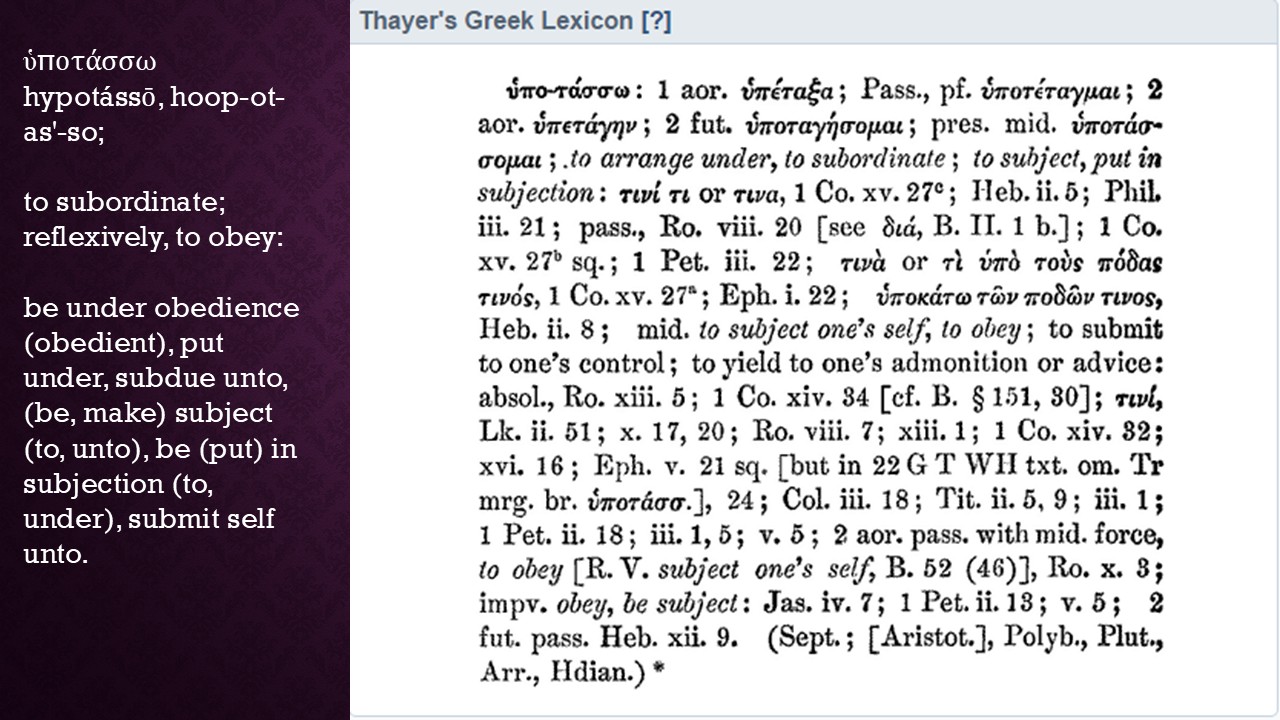
When it’s used in a non-military way, it means “a voluntary attitude of giving in, cooperating, assuming responsibility, and carrying a burden.” I think we give the word “submission” a bad rap because we think it means something worse.
Submission is | Opposite of Submission is | Too much submission is |
|
Acceptance |
Arrogance |
Wimpy |
|
Willing |
Resistance |
Cowardly |
|
Humble |
Pride |
Spinelessness |
|
Respect |
Conceit |
Slavery |

Submission is a voluntary action, not a surrendering or giving up, but a giving in and providing support to others. True Christian submission is an awesome display of the power of Christ living in us.
Peter is living as a subject of the Roman Empire. The Romans at this time were not especially kind to Christians; Christians who confessed Christ as their Lord were often punished or killed for treason for not obeying the Roman Emperor. The Romans were suspicious of early Christians, suspecting them of insurrection and planning to overthrow the empire. After all, they had their own king. So in a brutal repressive society, how do you reconcile that with the Christian teachings of freedom in Christ? Did this freedom allow rebellion? Peter points to the Lord Jesus Christ to see how we are to live.
Let’s start with verse 13,
“Submit yourselves for the Lord’s sake to every human authority.”
I know I rebel in a hundred little ways, I have a natural tendency toward passive aggressiveness. But here are ten simple words that we all might want to rebel against, but what does Peter call us to do? Submit ourselves. Why? Not for our sake, but to further the Lord’s work.
Not because those in authority can crush us, but because it is the Lord’s will (and we’ll get to more of this in a moment). To whom do we submit ourselves? To every human authority. God calls us to voluntarily and cheerfully submit to our legal authorities. We are to obey the law and to be good citizens. And we do this, not because the government is a huge bureaucracy that can throw us into jail, but because we are to be obedient to Christ.
While our governmental authority seems to be headed off a cliff away from God’s will, in reality, God creates governments to accomplish His will, whether that government is aware of it or not. Government over us keeps us out of anarchy. In Romans 13:1-7, Paul tells us:
Everyone must submit himself to the governing authorities, for there is no authority except that which God has established. The authorities that exist have been established by God. Consequently, he who rebels against the authority is rebelling against what God has instituted, and those who do so will bring judgment on themselves. For rulers hold no terror for those who do right, but for those who do wrong. Do you want to be free from fear of the one in authority? Then do what is right and he will commend you. For he is God’s servant to do you good. But if you do wrong, be afraid, for he does not bear the sword for nothing. He is God’s servant, an agent of wrath to bring punishment on the wrongdoer. Therefore, it is necessary to submit to the authorities, not only because of possible punishment but also because of conscience. This is also why you pay taxes, for the authorities are God’s servants, who give their full time to governing. Give everyone what you owe him: If you owe taxes, pay taxes; if revenue, then revenue; if respect, then respect; if honor, then honor.
Peter teaches us to submit to the government because the government is teaching us right from wrong. Submission to authority, cheerfully and willingly. Be good subjects of the Roman Empire. That doesn’t mean we can’t use legal, peaceful means of bringing change in our government. Certainly as good Christian witnesses we should seek to change those government laws that violate God’s laws; our Christian duty is to be agents of change in this world, but we are to do it within the framework of existing governmental laws.
Are there any exceptions to this rule? Absolutely. We must be careful to set aside our personal desires and goals; those goals are subject to government. But God’s goals supersedes those of government. Peter was faced with this exact circumstance in Acts 4:18-20. The Jewish leaders were disturbed that Peter and John were spreading the message of Christ and ordered them to stop, but Peter chose to obey God instead of man:
Then they called them in again and commanded them not to speak or teach at all in the name of Jesus. But Peter and John replied, “Judge for yourselves whether it is right in God’s sight to obey you rather than God. For we cannot help speaking about what we have seen and heard.”
So we are called to follow authority and show respect, but not at the expense of following God’s will.
1 Peter 2:15,
For it is God’s will that by doing good you should silence the ignorant talk of foolish men.
Like it or not, a government agent is an angel of wrath, to enforce right and wrong. When we submit to authority, Peter tells us that silences foolish people. When we’re argumentative and rebellious, we are poor examples of Christ.
IV. Living as Free People, 1 Peter 2:16-17
How, then, shall we live? We lead lives of quiet submission. We lead our lives in the freedom that Christ provides, but also in obedience to His teaching so the world sees Christ in us. Let’s continue to 1 Peter 2:16 –
Verse 16,
Live as free men, but do not use your freedom as a cover-up for evil; live as servants of God.
Jesus came to set His followers free, but this is not a freedom to do evil. In order to be free of sin, we voluntarily become slaves of God. Using our freedom to conceal evil actions is hypocritical. The world only grudgingly gives respect to Christians, and quickly condemns us when our hypocrisy shows. Expressing our freedom from sin means we obey every legal authority and not our own selfish, rebellious heart. We are to lead holy lives, set apart lives, and law abiding lives.
Verse 17,
Show proper respect to everyone: Love the brotherhood of believers, fear God, honor the king.
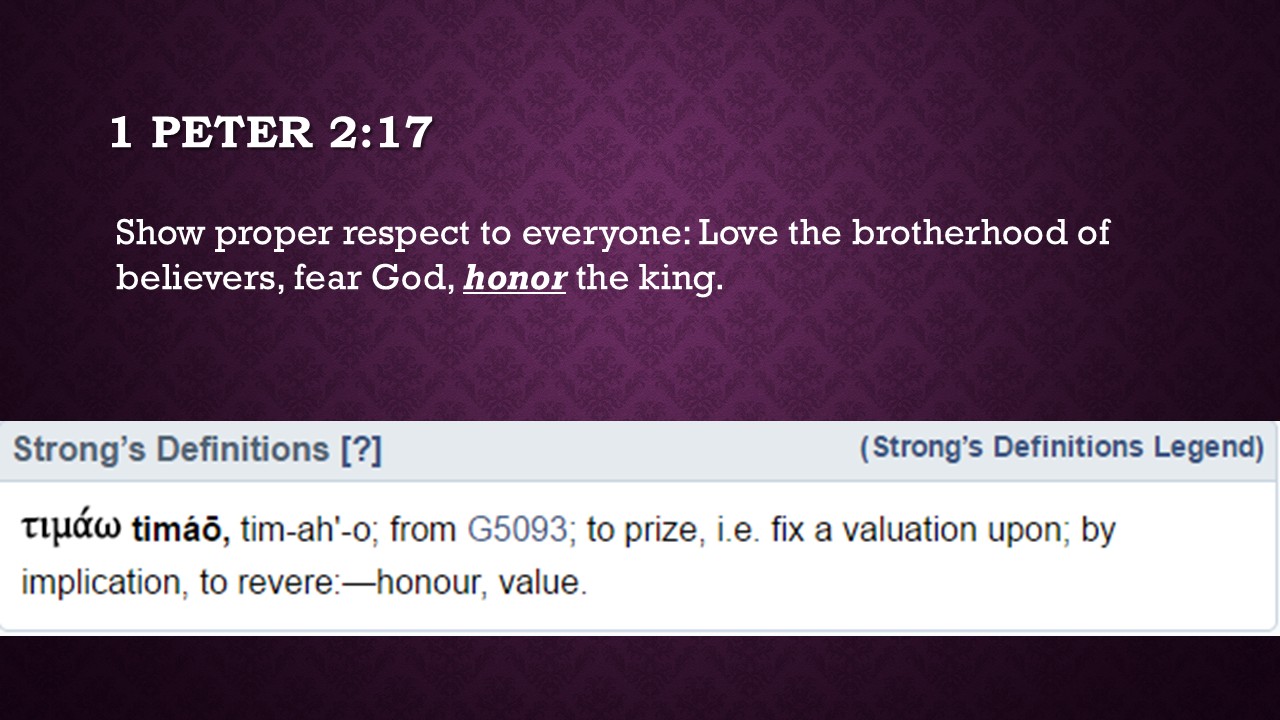
I find these distinctions interesting. We are to show “proper” respect to everyone, but proper respect isn’t equal respect. The word used here is timaō and it means to estimate the value or recognize the worth of that person. We show respect to “everyone” because after all, everyone is created in God’s image. They have intrinsic value as people.

To our brotherhood of believers, though, we show more than respect. We show love, the same kind of love Christ showed for us. The word used is agapaō, or agape love, and it means to welcome, to entertain, to be fond of, to love dearly, to be well pleased, to be content with. Christ showed agape love to us to model, and we are to show this agape love to our brothers and sisters. Submission in the church, and submission even within this bible class leads to the purest kind of love, where we are genuinely concerned about each other and set aside our own vain attitudes. We are not in competition with each other about who can be the best Christian. Or the worst Christian, for that matter.

And to God, we show “fear.” Not a scared kind of fear, the word used is phobeō and means to be awestruck, to treat with reverential obedience. Our God created the heavens and the earth and if He so wished He could smite us so hard we’d be smitten. We are thankful for the grace He shows us through Jesus that we don’t get the punishment we deserve; Jesus has already taken our place.

And to the king and to people in authority, we are to show honor. The word “timao” is used here again; it means to recognize the value of the person, to respect and honor.
Note that it says we are to fear the Lord but give honor to the king. Jesus made the same distinction in Matthew 22:21 when the Pharisees asked Him if it was right to pay taxes. Jesus replied,
Give to Caesar what is Caesar’s, and to God what is God’s.
We give our authorities respect and obedience, but to God we give reverence and worship.
V. Conclusion
We should be good visitors to this big blue marble. We should show the love that Christ showed to us, not because we deserved it, but because we don’t deserve it. And through our good behavior, we silence the foolish talk of the world. For we know Christ lives through us and in us and we can do all things through Christ our savior.

To God be the glory.

 Chasing the Wind
Leave a comment