

Enduring Trials for the Glory of Christ
How Suffering Purifies, Strengthens, and Prepares Us for Eternal Glory
I. Introduction
In 1 Peter 4:12–19, Peter speaks tenderly but urgently to Christians facing trials. Last week in 1 Peter 4:7-11, Peter had called believers to stay focused on prayer, love, hospitality, and service. Now, he turns directly to the reality that faithful Christian living inevitably brings suffering.
Peter reminds us that suffering is not a strange interruption. It’s a fiery trial designed to purify us, to allow us to share in Christ’s sufferings, and to glorify God.
We might think suffering is unfair, that if we’re doing everything right, things should go smoothly. But Peter—and indeed Jesus Himself—says otherwise.
Like Peter walking on water, as long as our eyes are on Christ, we can endure. It’s when we look at the wind and the waves that we begin to sink.
Peter calls us to stay focused—not to panic, not to withdraw, not to retaliate—but to trust our faithful Creator and continue doing good.
Today we’ll study this passage in four parts:
- Expect Suffering (4:12–13)
- Rejoice in Sharing Christ’s Sufferings (4:14–16)
- Suffering as Judgment (4:17–18)
- Trust God in Suffering (4:19)

II. Expect Suffering (1 Peter 4:12–13)
Verses 12–13:
Beloved, do not be surprised at the fiery trial when it comes upon you to test you, as though something strange were happening to you. But rejoice insofar as you share Christ’s sufferings, that you may also rejoice and be glad when His glory is revealed.

Peter begins with “Beloved”—a tender reminder that even in seasons of suffering, we are deeply loved by God. He then speaks plainly: do not be surprised when trials come. Suffering is not an interruption to the Christian life; it is part of God’s refining work. The Greek word Peter uses, pýrōsis, refers to the process of smelting or refining metal by fire. In metallurgy, intense heat is applied to precious metals to remove impurities—what is left is stronger, purer, and more valuable. Likewise, God allows trials to expose what is weak or impure in us so that our faith, like refined gold, may endure and shine more clearly for His glory.
Suffering tests and strengthens our faith, producing perseverance as James 1:2–4 teaches. James writes,
“Consider it all joy, my brothers and sisters, whenever you face trials of many kinds, because you know that the testing of your faith produces perseverance. Let perseverance finish its work so that you may be mature and complete, not lacking anything.”

Trials are not merely obstacles—they are instruments God uses to shape us into maturity. Without testing, faith atrophies. But with testing, faith grows stronger, deeper, and more resilient.
Imagine driving down a highway, 65 mph, and deciding to let go of the steering wheel, thinking, “I’m good; I don’t need to steer anymore.” It sounds ridiculous, well, because it is. In the same way, we can’t cruise through Christian life without vigilance. God constantly directs our path and we must pay attention.

Peter’s warning was urgent. Within a few years, under Emperor Nero, Christians would be brutally persecuted—falsely blamed for the burning of Rome and subjected to horrific deaths, including being torn apart by wild dogs or burned alive as human torches during Nero’s garden festivities.

Peter calls us to rejoice because suffering links us to Christ. Paul echoes this in Romans 8:17,
“If indeed we share in His sufferings in order that we may also share in His glory.”
Jesus Himself prepared His followers for this reality:
“You will be hated by everyone because of My name, but the one who endures to the end will be saved” (Matthew 10:22),
and
“In this world you will have trouble. But take heart! I have overcome the world” (John 16:33).

The example of Peter walking on water is vivid: picture the crashing waves, the fierce wind, Peter’s first hesitant steps—and how he stood miraculously as long as his eyes stayed on Jesus. The moment he looked at the storm instead of the Savior, he began to sink. The same is true for us in suffering. Keep your eyes on Christ.
In our modern world, it is easy to slip into “comfortable Christianity”—expecting that life will be smooth, successful, and socially accepted. But Peter reminds us: turbulence is part of the Christian journey. We must not be surprised when the culture rejects us, or when hardships come. Instead, we fix our eyes on eternity.
Trials are not punishment; they are evidence of God’s refining love. He disciplines His children not to harm them, but to shape them into Christlikeness. Our fiery trials are evidence that God is refining us as true children.
Trials shout that eternity is real, and that God is drawing us closer.
Discussion Question:
Peter says not to be surprised by suffering. Do you feel suffering is unfair? How would your daily walk with Christ look different if you truly expected trials?

III. Rejoice in Sharing Christ’s Sufferings (1 Peter 4:14–16)
As Peter continues, he moves from the expectation of suffering to the blessing that comes from sharing in Christ’s sufferings.
Verse 14:
If you are insulted for the name of Christ, you are blessed, because the Spirit of glory and of God rests upon you.

Peter now turns to another reality of Christian life: suffering for Christ is not only expected but blessed. When we are insulted or mistreated for the name of Christ, it is a mark of honor, not shame, because God’s Spirit rests upon us.
In the Beatitudes, Jesus also said,
“Blessed are you when others revile you and persecute you” (Matthew 5:11).
But then in 1 Peter 4:15, Peter quickly clarifies: not all suffering is noble:
But let none of you suffer as a murderer or a thief or an evildoer or as a meddler.
If we suffer because we’ve sinned—whether crimes like murder or subtler sins like meddling in others’ affairs—it’s not suffering for Christ. It’s deserved consequence.
Even ordinary gossip or interfering can bring social hostility. Peter says, don’t mistake deserved suffering for Christian persecution.
Verse 16:
Yet if anyone suffers as a Christian, let him not be ashamed, but let him glorify God in that name.

The term “Christian” (Greek: Χριστιανός) was originally an insult. Peter urges believers not to shrink from the name, but to bear it proudly—even when it costs everything.
You may remember Cassie Bernall, a seventeen-year-old student at Columbine High School and in my opinion a Christian martyr. During the Columbine school shooting on April 20, 1999, one of the gunmen asked Cassie if she believed in God. She answered “Yes” and was immediately shot and killed. Though later investigations questioned some specifics of the exact exchange, what remains undeniable is that Cassie was a young Christian who had recently recommitted her life to Christ, and her death became a symbol of courageous, unashamed faith for an entire generation.

Her story reminds us: suffering for the name of Christ, even unto death, glorifies God powerfully. It sends a message far beyond the moment—echoing to others who must choose between compromise and faithfulness.
Even in a world full of darkness, God’s love and hope grow stronger in us. Suffering for Christ is not merely something we endure; it is an active participation in His life and mission. As Paul writes in Philippians 3:10,
“That I may know Him and the power of His resurrection, and may share His sufferings, becoming like Him in His death.”
Suffering draws us into deeper fellowship with Christ Himself.

Moreover, our faithfulness through suffering becomes a testimony not only to the world but to the heavenly realms. As Ephesians 3:10 reminds us, God’s wisdom is made known “to the rulers and authorities in the heavenly places” through the church. Every act of endurance glorifies God beyond what we can see.
Discussion Question:
Have you ever felt insulted or excluded because of your faith? How might your response to mistreatment become a way to honor Christ and show His love?

IV. Suffering as Judgment (1 Peter 4:17–18)
Verse 17:
For it is time for judgment to begin at the household of God; and if it begins with us, what will be the outcome for those who do not obey the gospel of God?

Peter reminds us that God’s purifying work starts with His own people. “Judgment” here isn’t condemnation—it is refining discipline meant to prepare us for glory. Hebrews 12:5–11 gives us a powerful picture of this loving discipline:
“My son, do not regard lightly the discipline of the Lord, nor be weary when reproved by Him. For the Lord disciplines the one He loves, and chastises every son whom He receives.”
Endure hardship as discipline; God is treating you as His children. For what children are not disciplined by their father?
…No discipline seems pleasant at the time, but painful. Later on, however, it produces a harvest of righteousness and peace for those who have been trained by it.”
God’s discipline is not rejection—it is confirmation that we truly belong to Him. Through trials, He is shaping us into the image of Christ, training us in holiness, and preparing us to bear fruit that lasts. It is a severe mercy, but it is mercy nonetheless.
Peter’s teaching is consistent with the pattern we see throughout Scripture. In Ezekiel 9, judgment began not with the pagan nations but at the sanctuary—the house of God itself. God’s principle remains: He starts by purifying His own people.
Judgment means two different things depending on our standing with God:
- For unbelievers, it leads to condemnation and separation.
- For believers, it is a loving discipline. As 1 Corinthians 11:32 says, “But when we are judged by the Lord, we are disciplined so that we may not be condemned along with the world.”
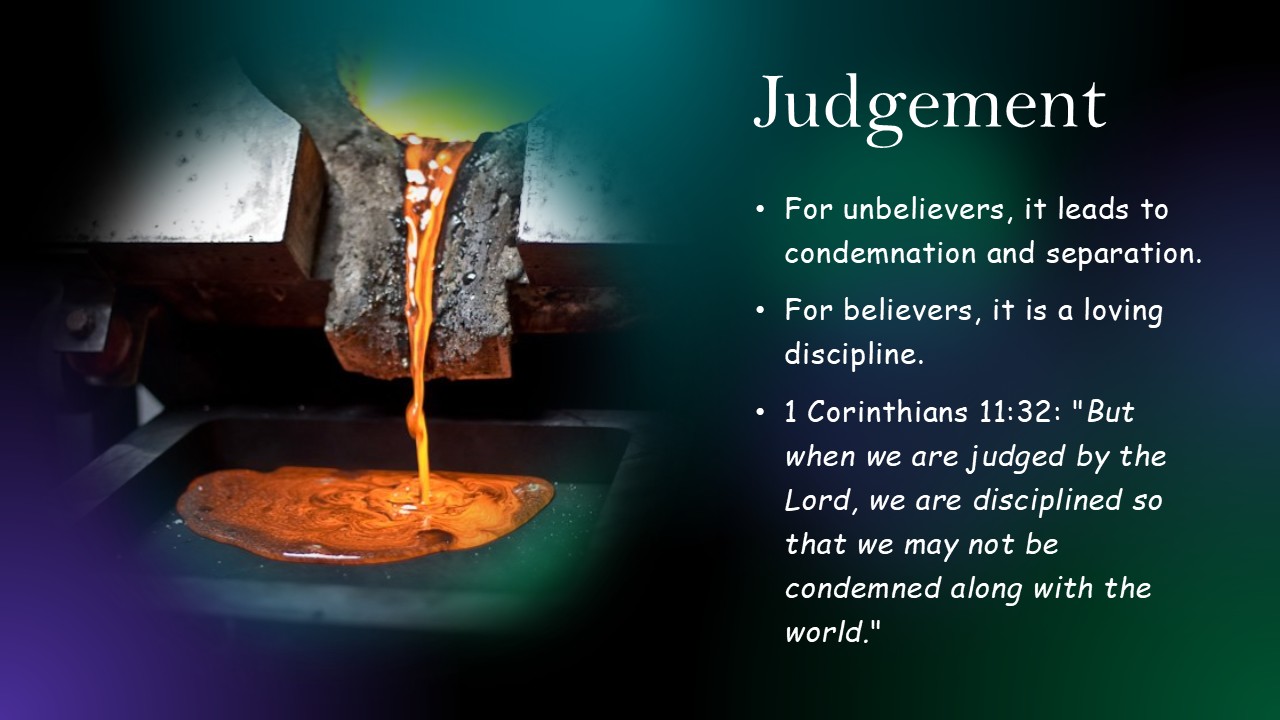
God’s refining discipline is a sign of His ownership and His love.
Consider the work of a silversmith. In the refining process—just as Peter describes with the word pýrōsis—intense heat is used to melt away impurities from precious metals. The silversmith must keep watch, ensuring the metal stays in the fire long enough for the dross to be removed, but not so long that it is damaged. The refining is complete when the silversmith can see his reflection in the silver. In the same way, God allows fiery trials to refine us until He sees His reflection in us—stronger, purer, and more fit for His purpose.
Verse 18:
And “If the righteous is scarcely saved, what will become of the ungodly and the sinner?”

Peter quotes Proverbs 11:31 to emphasize the seriousness of salvation. “Scarcely” does not suggest uncertainty about salvation but highlights its costly nature—secured by Christ’s suffering and verified through our faithful endurance.
If salvation for believers requires such refinement, what hope is there for those who reject the gospel?
God’s refining judgment is meant to awaken us to deeper joy and holiness. Sometimes we think: “Bring the Rapture now! Get me out of this corrupt world!” But God has us here for a reason—to glorify Him, to witness, to endure. He doesn’t make mistakes about where He places us.
When God disciplines us through suffering, it is not punishment but purifying love. This refining reminds us that we belong to Him, and that His goal is not to harm us but to shape us into the image of Christ.
Discussion Question:
If God uses suffering to refine His people, how should that affect the way we view our own hardships? How might it change the way we view those who don’t yet know Him?

V. Trust God in Suffering (1 Peter 4:19)
Verse 19:
Therefore let those who suffer according to God’s will entrust their souls to a faithful Creator while doing good.

Peter wraps up with this call: Entrust your soul to your faithful Creator. The Greek word used here, παρατίθεσθαι (paratithesthai), means to place something of great value into the care of another for protection. In the ancient world, it often referred to entrusting property, a deposit, or even a person—such as a child or a servant—into someone’s hands for safekeeping. It conveyed a full transfer of responsibility based on trust and relationship.
Peter is urging believers not simply to resign themselves to suffering but to actively commit their lives—heart, soul, and future—to the One who both created them and remains utterly faithful. This is the same word Jesus used on the cross when He said, “Father, into Your hands I commit my spirit” (Luke 23:46). It is an act of total surrender, not to fate, but to a God who is both Sovereign and Good.
Even when the world is dark, we do not give up. We keep doing good until the Lord calls us home. Christian suffering is unique in that it often carries both grief and joy at the same time. As Peter says elsewhere (1 Peter 1:6), “you have been grieved by various trials” yet “rejoice with joy that is inexpressible and filled with glory.” Only in Christ can sorrow and rejoicing coexist, producing endurance seasoned by hope.
Discussion Question:
When you’ve gone through overwhelming seasons, what helped you trust God in the midst of them? What does it mean to actually “entrust your soul” to Him?
VI. Summary
Peter closes this section with a sober but hopeful view of Christian suffering. Trials are not interruptions to our faith; they are integral to it. Suffering refines us, identifies us with Christ, and strengthens our witness to a watching world.
Throughout these verses, Peter urges us to:
- Expect suffering as part of God’s refining work.
- Rejoice when we share in Christ’s sufferings, because His Spirit rests upon us.
- Examine ourselves, ensuring we suffer for righteousness, not for wrongdoing.
- Understand that judgment begins with God’s own household, leading to holiness rather than condemnation.
- Trust our faithful Creator, continuing to do good even when it is costly.

Each fiery trial we face reminds us that our hope is not in this world but in the eternal glory that Christ will reveal. Suffering sharpens our longing for that day when Christ will wipe every tear from our eyes (Revelation 21:4). Until that day, we walk through hardships with eyes fixed on Jesus—living faithfully, loving boldly, and shining His light into the dark places of this world.
Stay focused on God. Live like there’s no tomorrow—because someday you’ll be right.
To God be the Glory.

 Chasing the Wind
Leave a comment