
I. Introduction – Why do We Pray?
Psalm 23 is perhaps the most well-known and beloved passage in the entire Bible. Its words have brought comfort and hope to countless believers through generations, providing peace in times of distress and assurance amid uncertainty.
This week, well-known Christian leader and author Charlie Kirk was assassinated. The sorrow is fresh. It’s one more reminder of the brokenness in our world and the grief that so many carry. I offer this Psalm as both comfort and acknowledgment: even in our grief, God sees our pain and offers warm reassurance.
I’ve been to memorial services—too many lately—where Psalm 23 was read. It’s remarkable how, even when we are overwhelmed by sorrow, God ministers to our hearts through His Word.
One of the questions I explored while preparing this lesson is, “Why do we pray?” We know intellectually that God isn’t a magic genie granting us three wishes, yet in the midst of our trials, we often approach Him as if He were.
Let’s consider Matthew 6 briefly. In the verses leading up to the Lord’s Prayer, Jesus provides much instruction about prayer, notably in verse 8:
“For your Father knows the things you have need of before you ask Him.”
Similarly, Romans 8:26 tells us:
“In the same way the Spirit also helps in our weakness, because we do not know what to pray for as we should, but the Spirit Himself intercedes for us with unspoken groanings.”
Sometimes, I imagine the Holy Spirit’s groan accompanied by a eyeroll: “Michael never gets this prayer quite right; I’ll have to fix it for him—again.” Of course, the Holy Spirit is always patient, kind and loving, so maybe there isn’t an eyeroll.
Since God, in His perfection, already knows our needs and even corrects our prayers through His Spirit, why do we pray at all? Jesus modeled this perfectly in Gethsemane, praying, “Not my will but yours be done” (Luke 22:42), demonstrating prayer as the alignment of our desires with God’s. Do we believe our prayers can somehow alter God’s perfect will?
When we approach prayer as a way to change God, we miss prayer’s most powerful purpose. Prayer doesn’t change God—it changes us. Prayer aligns our hearts with God’s will, His plan, and His desires. Our goal in prayer should never be to craft persuasive arguments aimed at convincing God to act. Instead, our aim should be to align ourselves so closely with His will that our prayers naturally reflect His desires. When we are aligned with God’s will, covered by the blood of Jesus Christ, we stand righteous before God. And James 5:16 affirms that “the prayer of a righteous person is powerful and effective,” not because of our own strength or righteousness, but solely because of His power and grace.
II. Prayer through difficult times
When we are seeking the very face of God through our prayers, God is pleased with us. In the Old Testament, the incense burned on the altar represented the prayers of the people, God tells us the prayers are a pleasing aroma. David wrote a Psalm, essentially a prayer about prayers, where he wrote in Psalm 141:2 –
Let my prayer be set before You as incense, the lifting up of my hands as the evening sacrifice.

It’s important that we pray; if we look at the rest of James 5:13-18, James gives a lot of insight into the purpose of our prayers.
Is anyone among you suffering? He should pray. Is anyone cheerful? He should sing praises. Is anyone among you sick? He should call for the elders of the church, and they should pray over him after anointing him with olive oil in the name of the Lord. The prayer of faith will save the sick person, and the Lord will restore him to health; if he has committed sins, he will be forgiven. Therefore, confess your sins to one another and pray for one another, so that you may be healed. The urgent request of a righteous person is very powerful in its effect. Elijah was a man with a nature like ours; yet he prayed earnestly that it would not rain, and for three years and six months it did not rain on the land. Then he prayed again, and the sky gave rain and the land produced its fruit.
We’re not telling God anything that He doesn’t know. But God wants us to acknowledge Him in all our ways, through good times and bad, through times of plenty and times of famine.
When Jesus gave us the Lord’s Prayer, the prayer was given as a “model” prayer. It was never intended to be mere words, quoted over and over; the same chapter two verses earlier, Jesus cautioned us not to let prayer become “meaningless repetition.” Instead, God wants is to open our heart, go into our closet and have a private conversation. Just God and me. What do we ask for if God already knows? The New Testament has many verses that tell us what God wants us to pray for.
- Continuous and Consistent Prayer:
- Ephesians 6:18: “Pray at all times in the Spirit with every prayer and request.”
- 1 Thessalonians 5:17: “Pray without ceasing.”
- Prayer for Wisdom and Understanding:
- Colossians 1:9: “Pray for spiritual wisdom and understanding.”
- James 1:5: “If any of you lacks wisdom, let him ask God, who gives generously to all without reproach.”
- Prayer for Witnessing and Conduct:
- Ephesians 6:19: “Pray for opportunities to witness.”
- Hebrews 13:18: “Pray for good conduct.”
- Intercessory Prayer and Community:
- James 5:13-14: “Pray for those who are sick or suffering.”
- James 5:16; 1 John 5:16: “Pray for one another.”
- Prayer in Difficult Circumstances:
- Romans 12:14: “Pray for those who persecute you.”
- Philippians 4:6-7: “Do not be anxious about anything, but in every situation, by prayer and petition, with thanksgiving, present your requests to God. And the peace of God, which transcends all understanding, will guard your hearts and your minds in Christ Jesus.”
- Prayers for Personal Motives and Health:
- James 4:3: “Pray with right motives.”
- 3 John 2: “Pray for good health.”
- Confidence in Prayer:
- James 1:6: “Pray without doubting.”
- 1 John 5:15-16: “Pray knowing God is listening.”
So we should be honest. We should pray what is on our hearts. And above all, we pray that it is not our will, but Thy will be done.
Discussion: Why do you think God desires us to pray even when He already knows our needs? How has prayer changed your perspective during difficult times?
III. Pray in Life
Because if we’re honest, we don’t always like it when we don’t get our way. The verses we just covered describe noble and scriptural reasons to pray—but what about when God says “no”? What about when God is silent?
Sometimes God says no when we pray about our finances. Sometimes He says no when we pray about our health. And some of the toughest moments come when we pray about life itself—especially when we are asking for healing or deliverance for someone we love.
In Genesis 5, the descendants of Adam are listed. At the age of 130, Adam had a son, Seth, and Adam then lived until the age of 930. Seth had a son Enosh at 105 and lived to 912. Enosh lived to 905; his son Kenan fathered Mahalel at 70, and so on. Eventually, Noah was born—and he was 500 years old when he fathered Shem, Ham, and Japheth.
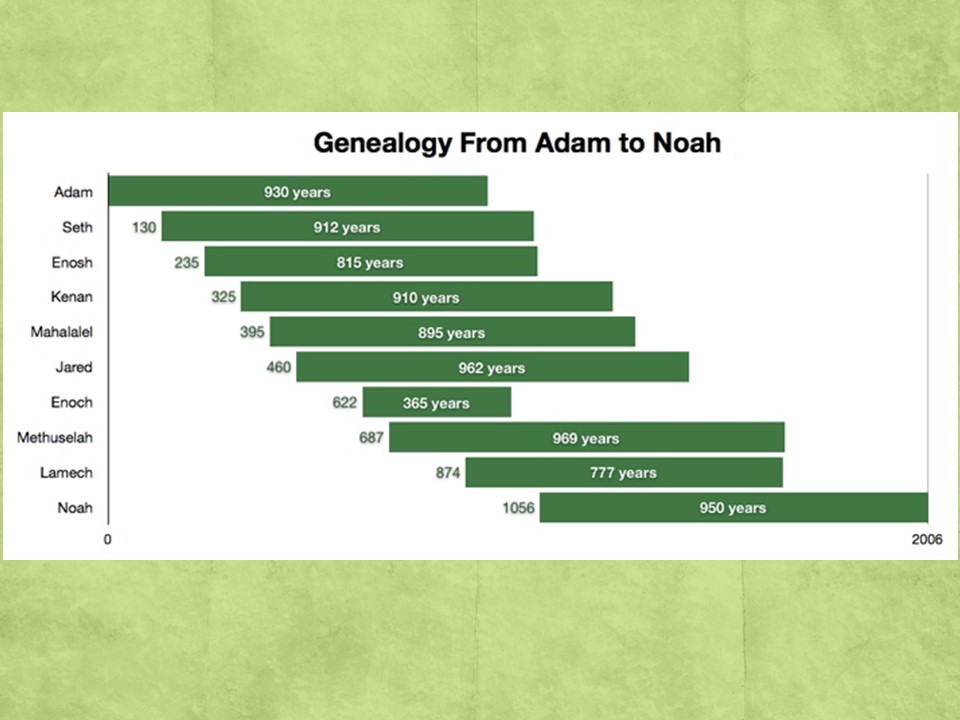
So why don’t we live until the ripe old age of 900 anymore? Why do we die?
The length of our lives have been impacted by our sin nature. In the Garden of Eden, Adam and Eve at the fruit from the Knowledge of Good and Evil. And knowledge of Evil taints us; what we have seen cannot be unseen. Part of the fall of man included this judgement from God in Genesis 3:22 –
“The Lord God said, ‘Since man has become like one of Us, knowing good and evil, he must not reach out, take from the tree of life, eat, and live forever.’”
We no longer live forever because our sin separates us from God’s perfect design. Paul reinforces this in Romans 6:23:
“For the wages of sin is death, but the gift of God is eternal life in Christ Jesus our Lord.”
And Noah, at 500 years old, lived in such an evil, wicked world, that God brought forth a flood to kill all the evil. After Noah, the Lord said in Genesis 6:3,
“And the Lord said, ‘My Spirit will not remain with mankind forever, because they are corrupt. Their days will be 120 years.’”
Some interpret this “120 years” as a new lifespan limit for humanity. Others understand it as a reference to the time period remaining before the judgment of the flood. Regardless of interpretation, the broader point remains: death is a consequence of sin, and life is temporary.
It seems to me that God has a purpose for death. We have a deadline sometime in our life to accept the sacrifice of His son. We don’t know when that deadline is, but it is surely less than 120 years. And this limit is because of our own sin nature. We are limited in days because of God’s mercy and protection from this fallen world.
So when my mother was moved to hospice, I didn’t know what to pray. Do I pray for more time to enjoy her company for a while longer? Do I pray for her release from pain? We loved her so much none of us wanted to see her suffer, yet we loved her so much we didn’t want to see her go.
And it was at this point, this fork in the road between two conflicting prayers of life and death I found myself, marked with tears of grief either way. And I know that God answers some prayers the way we hope about health and life and death, but eventually death comes to us all, and we are marked for eternity by the choices we make.
I’m thankful the Holy Spirit intercedes with groans. And eyerolls. I know that God provides peace that surpasses all understanding, but I couldn’t figure out how to get from grief to peace. I needed God’s guidance, I needed God’s comfort, and I realized the fork in the road wasn’t between life and death. When I prayed for God’s will to be done, I realized the third option was not life, not death, but life everlasting.
Peace came when I remembered that Jesus Christ has conquered death. Because He lives, we who trust in Him will live also. One day I will see my mother again in heaven. I will see Charlie Kirk again. I will see the Apostle Paul again in eternal life where there is no pain, and every tear will be wiped away.
Eternal life is the great hope of every believer. Our Shepherd not only sees us in our sorrow—He leads us through it, and He promises a future without suffering. That is the God who sees (El Roi) and the Shepherd who saves.
Discussion: When faced with grief or loss, how does the promise of eternal life through Christ shape the way we pray? How does Romans 6:23 influence your view of life’s fragility?
IV. Psalm 23, The Lord is My Shepherd
This life offers many challenges, and when we are younger, I think we believe we can win them all. But age and experience teaches us that we cannot win over all our enemies, we cannot live without the impact of illness, we do not always feel blessed by abundance and opportunity, and grief and sadness will come to all of us.
Kind David had a full life. We’re familiar with his childhood, full of braggadocio and power. His faith was so pure that God enable David to bring down the giant Goliath with just a stone.

But his life had challenges, especially as he got older. Despite David’s loyalty to King Saul, Saul kept trying to kill him. David lived in caves for a while because David wouldn’t harm Saul, yet Saul would try to kill him. Later, once David was king, his whole family had serious issues that dwarf what you or I face. David’s oldest son Ammon raped his half-sister Tamar. Tamar’s brother Absalom was David’s favorite, but Absalom was outraged that King David did nothing, so Absalom ordered the king’s servants to murder Amnon. Absalom lived in exile and eventually organized a rebellion against his own father, King David. In 2 Samuel 18:33, David cried out in heartbreak and grief, “O my son Absalom—if only I had died in your place! O Absalom my son, my son!”
We’re not sure when David wrote Psalm 23, but no doubt David had already experienced grief and heartache few can bear. It’s only 6 verses, but they’re powerful verses.
Psalm 23,
The Lord is my shepherd;
I shall not want.
He makes me to lie down in green pastures;
He leads me beside the still waters.

He restores my soul;
He leads me in the paths of righteousness
For His name’s sake.

Yea, though I walk through the valley of the shadow of death,
I will fear no evil;
For You are with me;
Your rod and Your staff, they comfort me.

You prepare a table before me in the presence of my enemies;
You anoint my head with oil;
My cup runs over.

Surely goodness and mercy shall follow me
All the days of my life;

And I will dwell in the house of the Lord
Forever.
Such a beautiful prayer. It speaks not just of our life now but our confidence in a life everlasting with our Lord Jesus Christ.
Let’s look at Psalm 23 in a little more depth. We’ll start, one word at a time.
The Lord is my Shepherd.
The Lord. Every word in the bible is important. Jesus is Lord. We sing songs about Jesus being our friend and our savior, and those are true, but he is also Lord. The Lord’s name is Yahweh, sovereign, almighty, delivering Lord God. When we seek comfort, begin by acknowledging that He alone is Lord of all.
Is. Jesus is my shepherd right now. Yes, he was there in the past, and yes, He will be there in the future, but Jesus is the great I AM. He is here now within our midst.
My. Jesus is personal. He’s not a figurine hung on a cross in the front of a church. He is not an abstract idea of goodness, He is not simply a long dead teacher or morals. He is Mine, and I am His.
Shepherd. Jesus is our shepherd, and we are His sheep. What’s interesting about sheep is they are 4D.

- Dumb
- Dirty
- Defenseless
- Dependent
They are dumb; if there was a school for farm animals, sheep would be dropouts. If there is a wire fence, they will get their necks caught in it, not just today, but tomorrow, too. Their wool smells like you’d imagine a wool coat would smell if you left it in the rain, they have no ability to defend themselves, they have terrible eyesight, they are fearful skittish creatures that are prone to wander and get lost. No wonder we need a shepherd who will provide for us, protect us, guide us, and wash us clean as snow.
The LORD is my shepherd; I shall not want.
Don’t get confused; David isn’t saying, “I don’t want a shepherd.” The word “want” here means “needs.” If the Lord is my Shepherd, then there is nothing else I need. The Lord Jesus is all sufficient, and I place my trust in Him. There may be trials of all sorts ahead for us, but the Lord uses everything for good, and I will trust in the Lord to provide everything I need for the day he has given me. Everything will be ok.
He makes me to lie down in green pastures;
He leads me beside the still waters.
He restores my soul;
When our bodies are tired, we put them to bed. A nice comfy bed and a soft fluffy pillow, and we rest. The Lord does this for our soul, if we only let him. If we follow the Lord, our soul can be still and know that He is God. When we rest in Him and leave our troubles with Him, He restores our soul.
He leads me in the paths of righteousness
For His name’s sake.
God’s word is a lamp for my feet, a light on my path. He teaches me to be righteous so that I may bring Him glory. I cannot do this on my own, but I can do all things through Christ who strengthens me. If I am following my Lord’s direction and letting Him guide my path, then the Lord receives the glory due to Him.
Yea, though I walk through the valley of the shadow of death,
This world is not the valley of life. This world is the valley of the shadow of death. Death comes to us all, no more than 120 years and for most of us a lot less. My hope alone is in Him so that one day I may walk in new life.
I will fear no evil;
For You are with me.
David has changed pronouns; in the first three verses, David talks to God in the third person and refers to him as “he.”
But when you are surrounded by evil, God is not a distant third party. We can talk to Him directly. David talks directly to God, saying, I have nothing to fear for my hope is in you. You surround me, you comfort me, you love me. And if you are for me, then who can be against me?
Discussion: Psalm 23 shifts from speaking about God (“He”) to speaking directly to Him (“You”) in the valley of the shadow of death. Why do you think David makes that shift? How does personalizing God’s presence in hardship change how we experience suffering?
Your rod and Your staff, they comfort me.

The Hebrew word here translated “rod” can also be translated as rod, scepter, and weapon. It is not a “walking stick.” A shepherd’s rod is about two and a half feet long with heavy pieces of iron embedded on the end, like a mace. The rod is the shepherd’s primary offensive weapon for protecting the flock from enemies, whether the threats are wild animals or human thieves. When used as a weapon, it is intimidating and deadly.
The rod and staff mentioned in Psalm 23:4 represents God’s defense and His divine guidance. His rod is used to drive off our enemy, Satan and his minions. God’s staff is used as guidance to us, to lift us back on the pathway after we fall. The Lord protects me from my enemies, and rescues me from my own mistakes.
You prepare a table before me in the presence of my enemies;
You anoint my head with oil;
My cup runs over.
God provides everything I need, despite the efforts of Satan to undo me. In fact, God provides an abundance for me so that my cup runneth over and I can provide blessings to others. Even though he is my Lord and my Savior, God treats me as an adopted son and an honored guest.
Surely goodness and mercy shall follow me
All the days of my life;
If you trust in the Lord, then no matter how far you stray, the Lord follows you with goodness and mercy. The Hebrew word used for “follow” is the same word used when Pharaoh “followed” Israel across the Red Sea. It doesn’t mean goodness and mercy follows from a distance. God is actively pursuing us daily.
And I will dwell in the house of the Lord

Forever.
It’s interesting to me that this Psalm is part of a Messianic trilogy with Psalms 22 and 24.
|
Psalm |
Verse |
Time / |
Theme |
|
Psalm 22 / The Good Shepherd |
John 10:11 I am the good shepherd. The good shepherd lays down his life for the sheep. |
The Saviours Cross |
His past death for His people |
|
Psalm 23 / Great Shepherd |
Hebrews 13:20-21 May the God of peace, who through the blood of the eternal covenant brought back from the dead our Lord Jesus, that great Shepherd of the sheep, equip you with everything good for doing his will, and may he work in us what is pleasing to him… |
The Shepherds Crook |
His present care and provision for His people |
|
Psalm 24 / Chief Shepherd |
1 Peter 5:4 And when the Chief Shepherd appears, you will receive the crown of glory that will never fade away. |
The Kings crown |
His future return for His people as the King of Glory! |
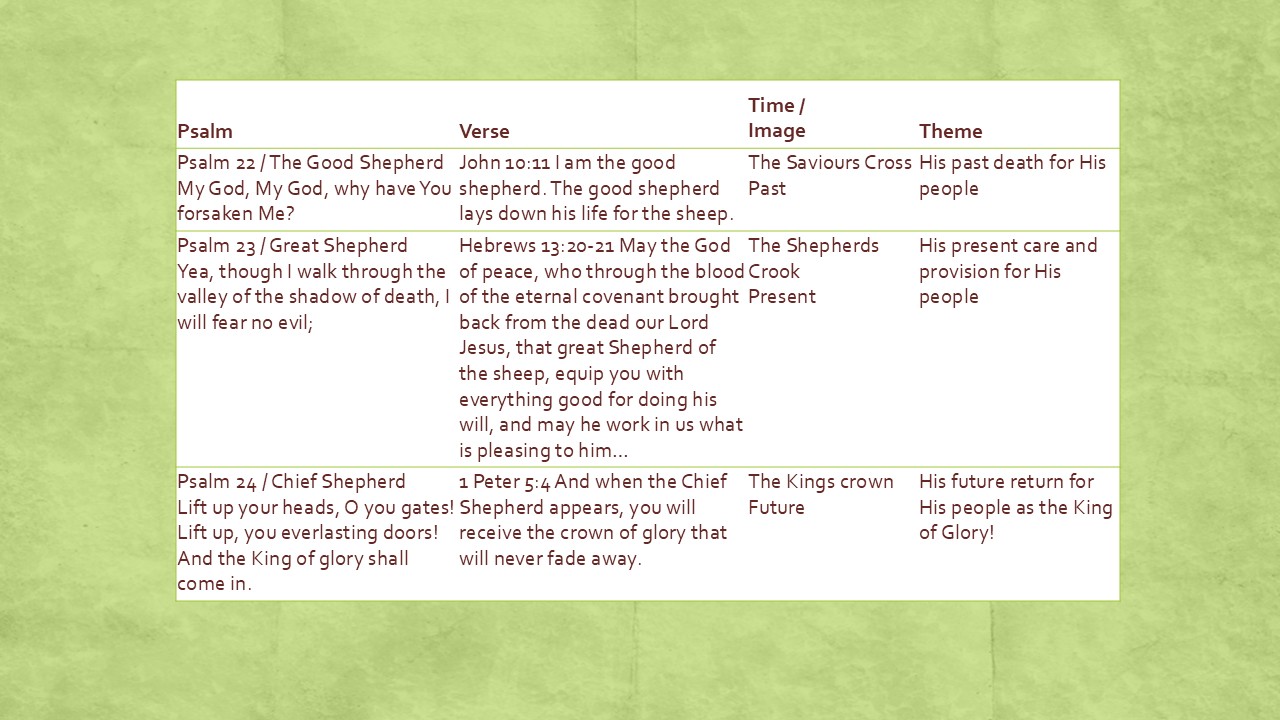
Psalm 22 speaks of the Good Shepherd who lays down His life for the sheep (John 10:11), Psalm 23 of the Great Shepherd who cares for His sheep (Hebrews 13:20-21), and Psalm 24 of the Chief Shepherd who returns in glory (1 Peter 5:4).
This trilogy reflects the cross, the crook, and the crown:
- The Cross (Psalm 22) – His past death for our sins paves the way for our salvation. Jesus, the Good Shepherd, laid down His life for the sheep.
- The Crook (Psalm 23) – His present care is always with us. The Great Shepherd walks beside us, restoring and guiding even in the darkest valleys.
- The Crown (Psalm 24) – His future return will be as both Shepherd and King. The Chief Shepherd will appear in glory and reward His flock.
Past, present, and future. His past death paves the way for our future. His present care is always with us. And Amen—His future return will be as both Shepherd and King.
Our Shepherd sees us. He leads us. And He will bring us safely home.
V. Conclusion
God knows our lives. He knows us before we are born, He knows us through our final destination. He actively pursued us and rescues us. And while goodness and mercy may actively follow me, one day I am going to slow down enough so that he catches me, and I will dwell in the house of the Lord forever.
Forever is a very long time. It’s far longer than the 120 years allotted to us. Our prayers bring us in line with the spirit of the Living God who comforts us and provides for all our needs; he is our shepherd, and there is nothing we shall want. I know that my mother dwells in the house of the Lord, and one day, I too, will dwell there, for Jesus promises there are many rooms in His mansion, and one day he will come back for me. No eye has seen, no ear has heard, no mind has conceived what God has prepared for those who love Him.
Until that day, we walk with confidence, knowing that our Shepherd sees us (El Roi), leads us, protects us, and will never abandon us.
Discussion: David says, “Surely goodness and mercy shall follow me.” How do you see God’s goodness and mercy actively pursuing you in your daily life? How does knowing God is “El Roi,” the God who sees you, affect your walk with Him?
I’ll leave you with these two verses from our hope and future in the book of Revelation.
Revelation 7:17,
for the Lamb who is in the midst of the throne will shepherd them and lead them to living fountains of waters. And God will wipe away every tear from their eyes.”
Revelation 21:4,
And God will wipe away every tear from their eyes; there shall be no more death, nor sorrow, nor crying. There shall be no more pain, for the former things have passed away.”
The Lord is my Shepherd and I shall not want. His rod and staff, they comfort me.
To God be the glory. Amen.

 Chasing the Wind
Leave a comment