I. Introduction
Psalm 62 is not written from a place of comfort, but from the middle of one of the most turbulent seasons in David’s life. The historical setting is Absalom’s rebellion, recorded in 2 Samuel 15–18. By this point, David is no longer the young shepherd-king who defeated Goliath or the newly enthroned ruler of Israel. He is older, seasoned by both victories and failures, and deeply aware of the consequences of sin. Years earlier, after his affair with Bathsheba and the arranged death of her husband Uriah, the prophet Nathan had confronted him with those unforgettable words:
“You are the man!” (2 Samuel 12:7).

David repented, and God forgave him, yet the Lord also declared that the sword would never depart from his household (2 Samuel 12:10–12). This was not a revocation of God’s grace, but a sober reminder that while sin’s guilt can be removed, its earthly consequences often remain.
Those consequences have now ripened into a bitter harvest. One of David’s own sons, Absalom, has mounted a calculated coup. Winning the hearts of Israel through charm, promises, and political maneuvering, Absalom declared himself king in Hebron. The conspiracy grew so strong that David, unwilling to spill the blood of his own son, abandoned Jerusalem. He crossed the Kidron Valley and climbed the Mount of Olives barefoot and weeping, retreating into the wilderness to avoid a civil war in the streets of his beloved city. It is a scene of humiliation, heartbreak, and human weakness.
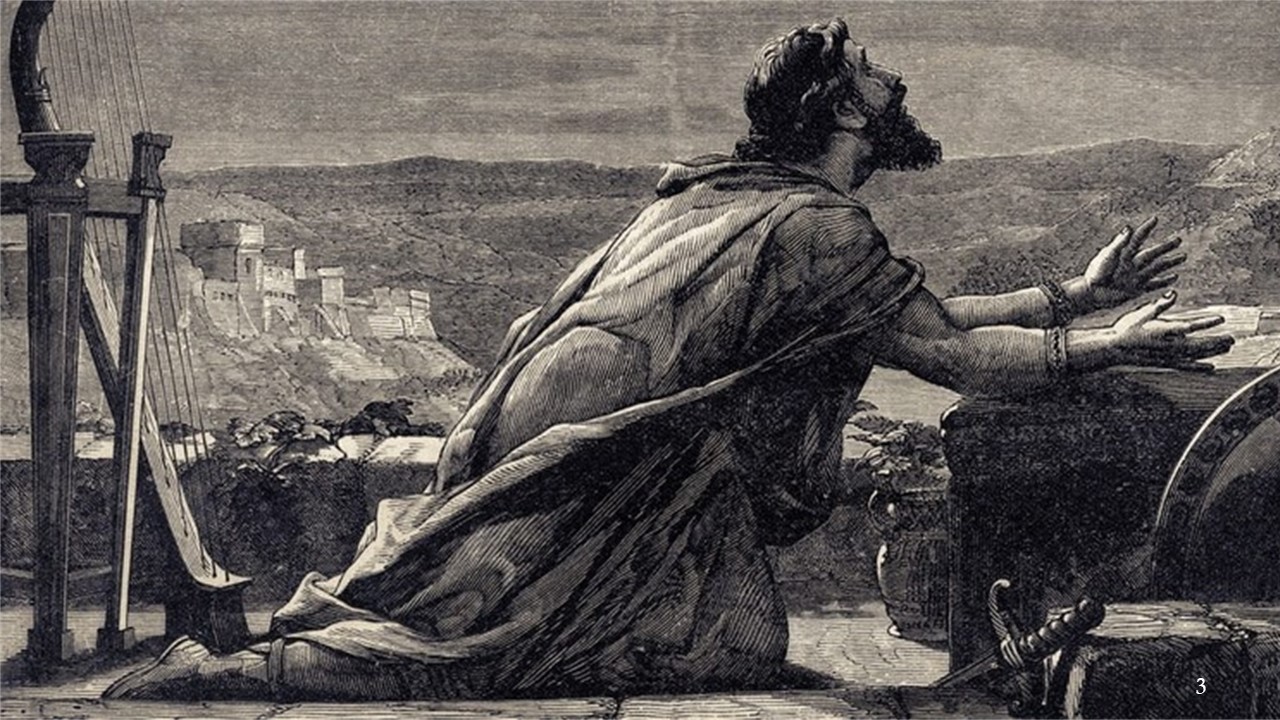
It is in this crucible of betrayal, displacement, and uncertainty that David writes Psalm 62. The psalm is both a testimony and an exhortation. In it, David does not dwell on military strategy or political survival, but on God’s sufficiency. He anchors his security not in loyal troops, fortified walls, or diplomatic advantage, but in the Lord alone. Six times in the psalm, he begins with the Hebrew word ’ak—translated “alone” or “only” (vv. 1, 2, 4, 5, 6, 9)—as if to drive home the point that all other sources of safety are illusions beside the steadfastness of God.

Psalm 62 opens with calm but unshakable confidence, rooted in God’s character and faithfulness. David’s circumstances are dire, but his focus reminds us that our ultimate security is not tied to our present stability, but to the One who never changes—the God who is both our rock and our salvation.
II. Psalm 62:1-2, Security in God Alone
My soul finds rest in God alone;
my salvation comes from him.
He alone is my rock and my salvation;
he is my fortress, I will never be shaken.
David begins with both personal testimony and a firm resolve. His word for “rest” (dûmiyyâh) speaks of silent stillness before God—a posture of settled trust rather than frantic activity. It is a peace that comes not from the absence of danger, but from the presence of God. The “salvation” David mentions refers first to deliverance from immediate danger—Absalom’s rebellion—but points forward to the ultimate salvation God provides through Christ.
David uses three vivid images to describe God’s security:
- God is my Rock — A rock represents stability and permanence. It is a symbol of something that does not move when everything else around it shifts. In the ancient world, a large rock or rocky outcrop provided shelter from enemies and storms alike. For David, calling God his rock meant God was the unchanging foundation of his life—dependable when people waver and circumstances crumble.
- God is my Salvation — This is not merely an abstract theological term, but the reality that God is the One who rescues. In David’s moment, this meant physical deliverance from those seeking his life. Yet the word also carries the weight of God’s ultimate rescue from sin, death, and judgment—fulfilled perfectly in Jesus Christ.
- God is my Fortress — A fortress was a fortified, elevated position, often carved into rock, where enemies could not easily attack. In calling God his fortress, David pictures Him as a secure refuge that the enemy cannot breach, a place of safety where he can rest without fear.

In hard times, the first instruction is simple: Turn to the Lord. When we see Him as our rock, salvation, and fortress, we stop looking elsewhere for peace. Our circumstances may remain challenging, but our anchor holds firm.
Discussion Question:
When life shakes us, what does it look like to “find rest” in God alone instead of in people, possessions, or personal abilities?
III. Psalm 62:3-4, Security that Withstands Attacks
How long will you assault a man?
Would all of you throw him down—
this leaning wall, this tottering fence?

They fully intend to topple him
from his lofty place;
they take delight in lies.
With their mouths they bless,
but in their hearts they curse.

Selah
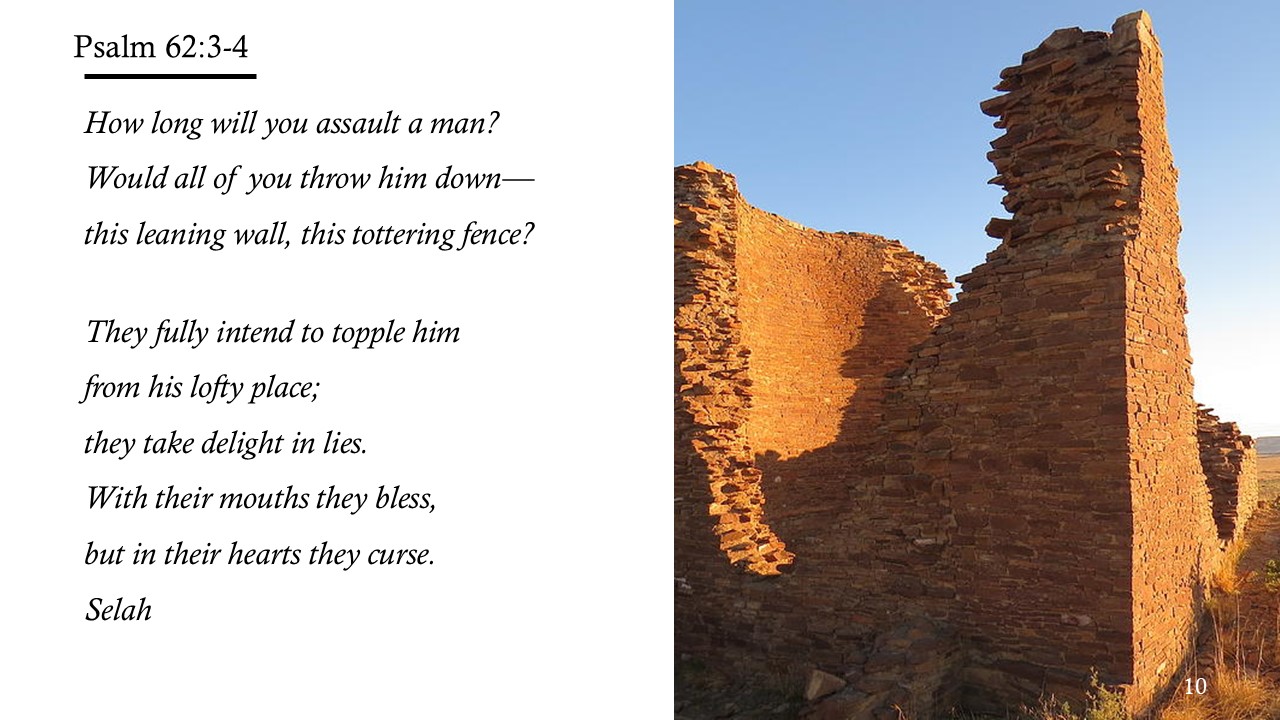
Here David shifts from affirming God’s security to describing the relentless attacks he faces. The phrase “How long” reveals that this is not a brief skirmish but an ongoing, drawn-out campaign against him. He likens himself to a “leaning wall” or a “tottering fence”—structures that appear ready to collapse with the slightest push. This imagery conveys vulnerability and the weight of constant pressure.
His enemies’ tactics are layered: open hostility combined with deception. Outwardly, they speak words of blessing, but inwardly, they curse. Their ultimate aim is to “topple” him from his “lofty place,” not simply to wound, but to destroy his position, reputation, and influence.
The believer’s life is often marked by similar spiritual and emotional assaults. Satan’s strategies—loss, betrayal, false accusations, and relentless pressure—are designed to undermine trust in God. Our instinct is often to respond by constructing our own defenses: forming alliances, gathering resources, or relying on personal reputation. Yet these human strategies are brittle. David’s repetition of “alone” serves as a reminder that every defense apart from God is temporary, but the security we find in Him is unshakable.
Discussion Question:
Why is it so easy to seek protection in human strategies rather than resting in God when we feel under attack?
If our security is based on our circumstances, in people, in ourselves, in wealth or relationship, our security is fragile. But David repeats himself – we do not find security in anything but God and God alone. Yet even as David acknowledges his fragility, he does not stay in despair. He speaks to his own soul and exhorts others to rest in God.
Verse 5-8 –
IV. Psalm 62:5-8, Security in God Alone, Still
Find rest, O my soul, in God alone;
my hope comes from him.

He alone is my rock and my salvation;
he is my fortress, I will not be shaken.

My salvation and my honor depend on God ;
he is my mighty rock, my refuge.

Trust in him at all times, O people;
pour out your hearts to him,
for God is our refuge.

Selah
Here David shifts from describing the threats against him to exhorting himself and others to steadfast trust. The repetition of “find rest in God” reminds us that trust is not a one-time decision but a continual posture. Just as fear can resurface in waves, faith must be renewed day by day.
David reaffirms the imagery from earlier verses—God as rock, salvation, fortress—and adds the title “refuge,” a place of safety where the pursued can breathe again. The phrase “my salvation and my honor depend on God” acknowledges that both deliverance and dignity are in God’s hands, not our own ability to defend or justify ourselves.
From these verses flow two key instructions for all who face uncertainty:
- Trust in the Lord — not sporadically, but “at all times.” Trust must be active in both joy and sorrow, in plenty and in want. Our circumstances change, but God’s faithfulness does not.
- Talk to the Lord — “Pour out your hearts to him.” The Hebrew expression means to spill out completely, as one empties a vessel. This is not guarded, calculated speech but open and unreserved honesty before God. Prayer in this form is less about polished words and more about genuine surrender.

Charles Spurgeon’s words capture the essence:
“If we cannot believe God when circumstances seem to be against us, we do not believe Him at all.”
Our trust is proven not in ease but in adversity.
Discussion Question:
Verse 8 tells us to “pour out your hearts” to God. What keeps us from doing this honestly, and how might we overcome those barriers?
V. Psalm 62:8-10, Security Nowhere Else
Lowborn men are but a breath,
the highborn are but a lie;
if weighed on a balance, they are nothing;
together they are only a breath.

Do not trust in extortion
or take pride in stolen goods;
though your riches increase,
do not set your heart on them.
David now turns to the insufficiency of every alternative to God. First, he warns against trusting in people. Whether “lowborn” or “highborn,” they are described as hebel—a breath, a vapor—fleeting and insubstantial. Titles, status, and human promises cannot bear the weight of our hope.
Second, he warns against trusting in possessions. Wealth gained through extortion or theft is obviously corrupt, but even honestly earned riches are unstable foundations. They can vanish overnight, eroded by economic downturns, disasters, or simple decay. The danger is not merely in possessing wealth but in setting our hearts on it—allowing it to become our functional security.
Psalm 44:6 says,
“I will not trust in my bow, neither shall my sword save me.”
Psalm 20:7 declares,
“Some trust in chariots and some in horses, but we trust in the name of the Lord our God.”
And in the exact middle of the bible is Psalm 118:8,
"It is better to trust in the Lord than to put confidence in man."

The conclusion is clear: any security apart from God is temporary and fragile. True security rests in Him alone.
Jesus, of course, knew all this. There is no security anywhere but God. Matthew 6:19, “Do not store up for yourselves treasures on earth, where moth and rust destroy, where thieves break in and steal.” Instead, we can trust in God because of who He is. He is unique, one of a kind.
Discussion Question:
How can we enjoy God’s good gifts (like relationships and possessions) without turning them into our source of security?
Let’s look at the final two verses of Psalm 62.
VI. Psalm 62:11-12, Security in God Because He is Unique
One thing God has spoken,
two things have I heard:
that you, O God, are strong,

and that you, O Lord, are loving.
Surely you will reward each person
according to what he has done.
David concludes the psalm with a reflection on God’s character and authority, capturing the essence of why trust in Him alone is justified. The phrase “One thing God has spoken, two things I have heard” is a Hebrew idiom for emphasis. It suggests that what follows is not only certain but deeply impressed upon the listener’s heart and mind.
First, David declares that God is strong. This is not abstract power, but the kind of strength that can protect, provide, and deliver. In the face of human frailty—like a leaning wall or a tottering fence—God’s strength is the foundation that cannot be moved.
Second, David affirms that God is loving. The Hebrew word here points to steadfast, covenantal love—a loyal, committed love that does not fluctuate with our performance or circumstances. This love ensures that God’s strength is never harsh or capricious; His power is always exercised for the good of His people.
Finally, David points to God’s justice: “Surely you will reward each person according to what he has done.” This truth provides both warning and comfort. It assures the righteous that God sees their faithfulness and will vindicate them, and it warns the wicked that their deeds will not go unanswered. Power without love could lead to tyranny; love without power could lead to ineffectiveness. But when combined with perfect justice, God’s character is the ultimate foundation for our security.
Together, these three attributes—unlimited power, unfailing love, and perfect justice—form a complete picture of why God alone is worthy of ultimate trust. Power without love can crush; love without power can fail; justice without both can be cold and impersonal. But in God, they exist in perfect harmony.

Discussion Question:
Which aspect of God’s character—His power, His love, or His justice—most strengthens your trust in Him right now, and why?
VII. Conclusion
God knows we have fears and concerns about our security. He is training us for something better, something that requires us to learn to trust in Him. If God is so powerful, why is it that we are scared? Is God really in control? These are the very question we ask ourselves, yet God wants us to know, even when we don’t see Him at work. It’s precisely at those times God is at work in us.
David’s confidence in Psalm 62 is not born from ease but from experience. God had been his rock, salvation, fortress, and refuge in past troubles, and would remain so in present danger. The repetition of “alone” challenges us to strip away every competing source of trust.
C.S. Lewis said in Mere Christianity,
“Imagine yourself as a living house. God comes in to rebuild that house. At first, perhaps, you can understand what He is doing. He is getting the drains right and stopping the leaks in the roof and so on; you knew that those jobs needed doing and so you are not surprised. But presently He starts knocking the house about in a way that hurts abominably and does not seem to make any sense. What on earth is He up to? The explanation is that He is building quite a different house from the one you thought of – throwing out a new wing here, putting on an extra floor there, running up towers, making courtyards. You thought you were being made into a decent little cottage: but He is building a palace. He intends to come and live in it Himself.”

Just as David was being reshaped through trial, so too God is shaping us into something greater.
The lesson of Psalm 62 is simple but not easy:
Turn to the Lord. Trust in the Lord. Talk to the Lord. Rest in Him alone.
To God Be the Glory

 Chasing the Wind
Leave a comment