
I. Introduction
I want you to think back—remember yourself at a young age. Who or what did you want to be when you grew up? Maybe it was a firefighter, a teacher, an athlete, or even the president. What was it about that person or role that captured your imagination—the respect they received, the sense of adventure, the chance to make a difference? Do you ever still wonder what it would be like if you had become that person?
Psalm 128 shifts our perspective on what it means to “grow up.” It reminds us that true success in life isn’t measured by titles, wealth, or recognition. Instead, it comes from living in reverence for the Lord and walking in His ways. The psalm gives us a picture of blessing—not the shallow kind the world chases, but a blessing that touches our work, our families, our communities, and even future generations.
II. Psalm 128
Before we unpack this psalm, let’s hear the whole thing, it’s only 6 verses long. Psalm 128 is one of the “Songs of Ascents,” the collection of psalms sung by pilgrims as they journeyed to Jerusalem for worship. These songs often focus on God’s protection, His provision, and the blessings of walking in His ways.
1 Blessed are all who fear the LORD,
       who walk in his ways.

 2 You will eat the fruit of your labor;
       blessings and prosperity will be yours.

 3 Your wife will be like a fruitful vine
       within your house;
       your sons will be like olive shoots
       around your table.

 4 Thus is the man blessed
       who fears the LORD.

 5 May the LORD bless you from Zion
       all the days of your life;
       may you see the prosperity of Jerusalem,

 6 and may you live to see your children's children.
       Peace be upon Israel.

When you read through this psalm, you can almost see how the blessing spreads like ripples in a pond. It begins with the individual who fears the Lord, then extends to the home, then to the community, and finally to the whole nation. And notice how down-to-earth the imagery is—work, food, family, and peace. God’s blessing isn’t abstract or distant; it touches the ordinary parts of life, the very places where we live each day.
III. Blessed are all who fear the Lord
The psalm begins with this statement: “Blessed are all who fear the LORD, who walk in his ways.”
Blessed. The Hebrew word for this can be translated as “happy,” and it’s but it’s not the kind of happiness our culture usually talks about. Does God want us to be happy? Of course He does, what loving parent doesn’t want to see their children experience joy? The world teaches us that it’s our happiness that’s most important, and we should seek happiness. We should chase what we want. Buy this and it will make you happy. Drink that and it will make you happy. Take a vacation or take a pill, whatever makes you happy. If your spouse or your family or your friend makes you unhappy, you should leave them, because it’s your happiness that’s most important.
But Scripture turns that upside down. Happiness isn’t something we chase; it’s the fruit of walking with the Lord. God doesn’t tell us to seek our own happiness as a goal. Rather, happiness is a reward for living His way.
I can tell you this – the times in my life I spent seeking happiness, I didn’t find it. I found a whole range of other emotions – shame, depression, unhappiness. I have not found true happiness in any place other than living righteously by the word of God. And believe me, I’ve looked in enough other places to know that happiness isn’t something you can seek.
Discussion: This verse says this happiness is available to all who fear the Lord. Are you happy? If a follower of Christ says there is no happiness in their life, what advice could you offer?
But then, how do we handle mourning? Mourning is certainly not happiness. In the last few years, I’ve lost first my stepfather, my mother, my sister-in-law, then my father. Times of mourning are not times of joy.
Yet James 4:9 says “Grieve, mourn and wail. Change your laughter to mourning and your joy to gloom.” Ecclesiastes 3:1,4 says, “To everything there is a season, and a time to every purpose under the heaven: A time to weep, and a time to laugh; a time to mourn, and a time to dance.” And Romans 12:15 says, “Rejoice with those who rejoice; mourn with those who mourn.”

So is it wrong to mourn and weep? Not at all. Weeping, mourning, sadness are an integral part of our lives, and it’s healthy to weep and cry. In John 11:35, when Jesus arrived at the tomb of Lazarus, Jesus wept.
But the good news is this: ultimate comfort and happiness come through Christ. Matthew 5:4 says, “Blessed are those who mourn, for they will be comforted.”
This blessing of happiness isn’t reserved for a select few, but it is available to everybody. I don’t know about you, but I’m comforted by the fact that others struggle with life just as I do, that I haven’t been singled out somehow for mistreatment. As people, there are very few statements we can make that apply to everyone. Sometimes I hear, “Take all things in moderation,” and I always think, “whoa, *all* things? Let’s not go overboard here.”
Romans 3:23 was an integral part of my Christian walk because I once felt that I had made so many mistakes that somehow I was damaged goods, that I understood if God no longer wanted me. But Romans 3:23 says “All have sinned and fall short of the glory of God.” I realized that my feelings were not unique and recognizing that I’m a sinner was important to understanding God’s grace.
Same thing here; God says that all those who fear Him are happy. Fear and happiness aren’t usually two things that go together in my head. “Hey I saw Friday the 13th Part 30 last night and scared me so bad I’m happy.” So even though scripture says “fear,” what does scripture mean by “fear?” How can we be happy if we’re fearful?
There’s a passage in the book, The Chronicles of Narnia, that illustrates this very well. Mrs. Beaver is describing Aslan, the Christ figure in the book.
“If there’s anyone who can appear before Aslan without their knees knocking, they’re either braver than most or else just silly,” said Mrs. Beaver.
“Then he isn’t safe?” said Lucy.
“Safe?” said Mr. Beaver. “Don’t you hear what Mrs. Beaver tells you? Who said anything about safe? Course he isn’t safe. But he’s good.”

A healthy respect of fear for the Lord recognizes the awesome power of the Lord. But the Bible is clear, though, that we can approach God in His love and mercy. The fear of the Lord is the recognition that God has the ability and the right to punish us for our transgressions. Fortunately for us, the mercy of the Lord saves those who place their faith in Him; in Luke 1:50, Mary says, “His mercy extends to those who fear Him, from generation to generation.” God has every right to judge, but in Christ He extends mercy to those who fear Him.
So we’ve read, “Blessed are all who fear the Lord.” We’ve understand it to mean that the Lord grants happiness to those who acknowledge Him in all they do. Let’s bring it to a very personal level. What does it mean to me? What does God want specifically from you and from me?
G.K. Chesterton, the English author, once wrote, “We fear men so much, because we fear God so little. One fear cures another. When man’s terror scares you, turn your thoughts to the wrath of God.” Psalm 128 reminds me that my fear of God should extend to all areas of my life, not just to bible study or church, but to my family and my office and anywhere I may go. G.K. Chesterton also once wrote, “Just going to church doesn’t make you a Christian any more than standing in your garage makes you a car.”

That’s why this psalm begins with the fear of the Lord. It’s the foundation for a life of blessing—and it’s the starting point for all the ripples that follow.
IV. You will eat the fruit of your labor
Verse 2 of Psalm 128 describes this happiness that God provides. “You will eat the fruit of your labor.” Now, that doesn’t mean “eat organic food” — it’s a picture of enjoying the results of the work God gives you.
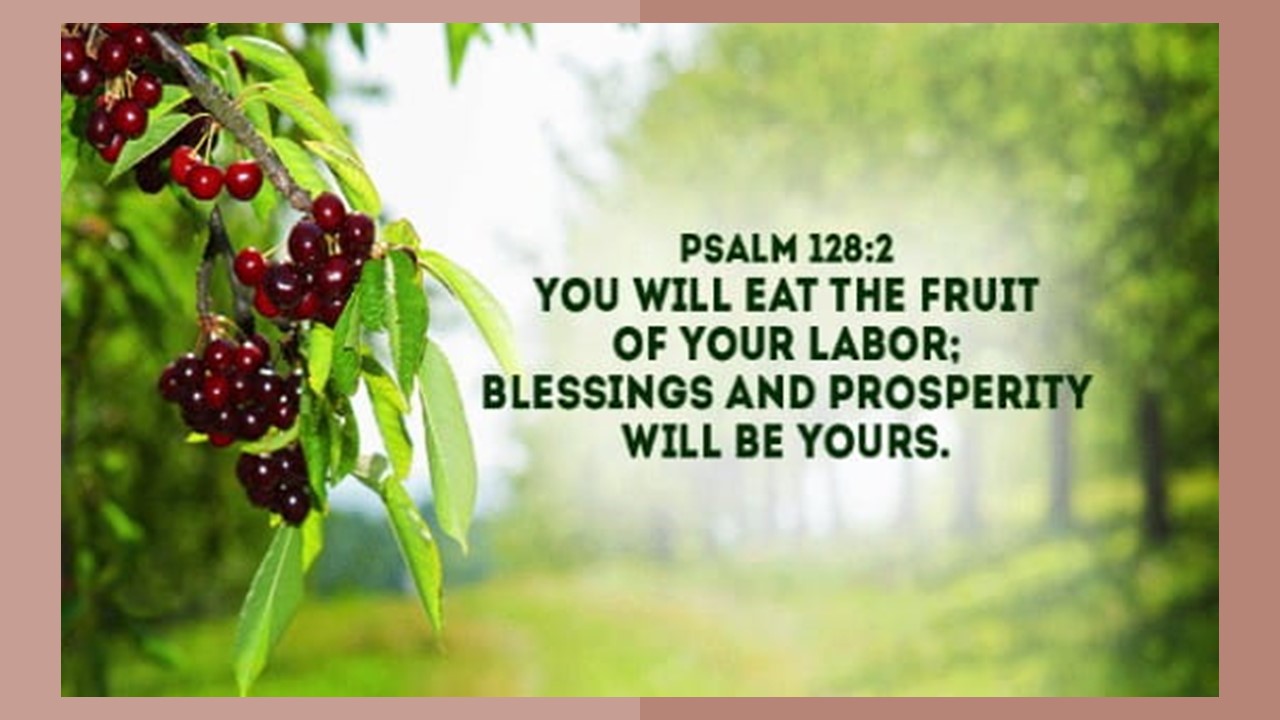
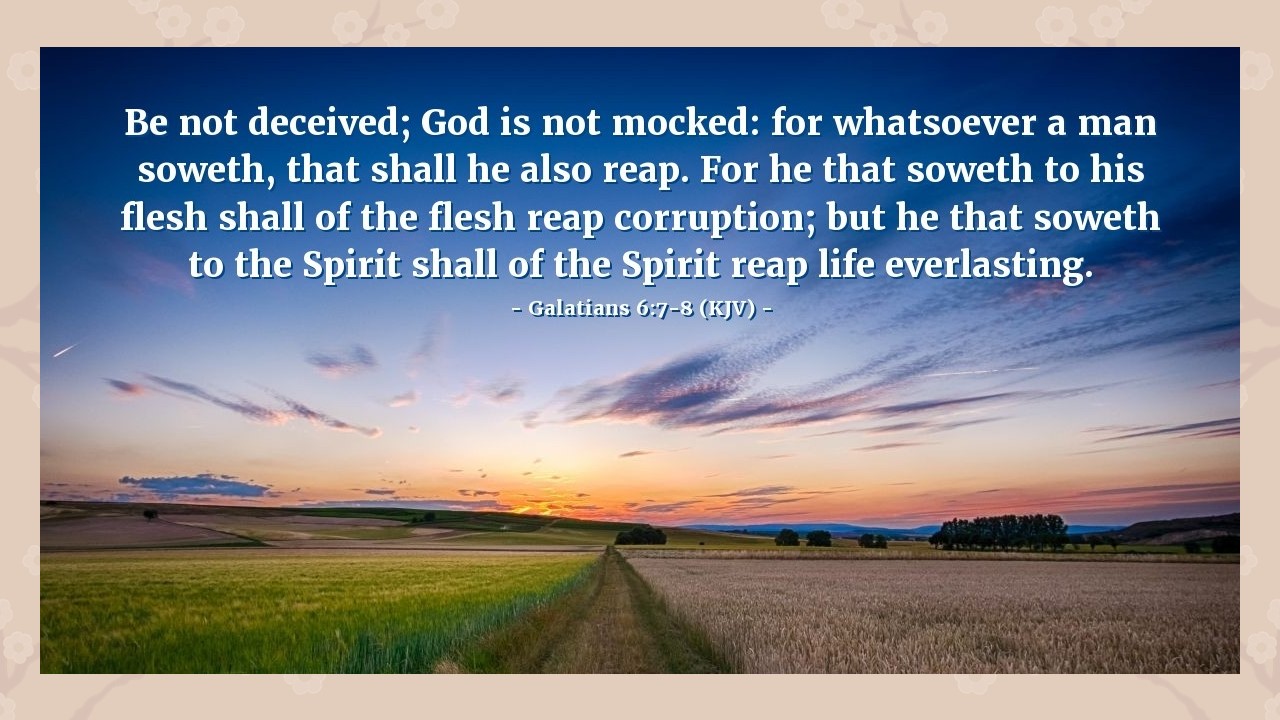
The psalmist is explaining why those who fear the Lord are blessed: their lives bear good fruit. It’s a positive reinforcement of Galatians 6:7-8 –
Do not be deceived: God cannot be mocked. A man reaps what he sows. The one who sows to please his sinful nature, from that nature will reap destruction; the one who sows to please the Spirit, from the Spirit will reap eternal life.
I wish we had time to study all the nuances of reaping and sowing. I found a great article called The Seven Laws of the Harvest http://bible.org/article/seven-laws-harvest that discusses reaping and sowing from a biblical view. Here’s the list of the Seven Laws:
- Law #1, we reap only what has been sown. The sower may be us, it may be others before us, it may be God who has sown on our behalf. We reap the good that others have sown, we reap the bad, too.
- Law #2, We reap the same in kind as we sow. If you sow watermelon seeds, you reap watermelon seeds. If you sow selfishness, you reap selfishness. If you sow anger, you reap anger.
- Law #3, we reap in a different season than we sow. Many believers sow wild oats all week and then on Sunday pray for crop failure. What we sow, we reap in the future.
- Law #4, we reap more than we sow. Seeds bring forth entire crops.
- Law #5, we reap in proportion to what we sow. If we sow sparingly, we reap sparingly. Abundant seed grows abundant crops.
- Law #6, we reap the full harvest of good only if we persevere. Evil comes to harvest on it’s own.
- Law #7, we can’t do anything about last year’s harvest, but we can about this year’s.

Sowing and reaping is a spiritual law, just as real as gravity. Farmers know this—if you plant corn, you don’t get pumpkins. If you plant anger, you’ll reap anger. If you sow kindness, you’ll reap kindness. What we plant in life will always come back after its own kind.
Sometimes, though, we forget there are two sides to this principle. Psalm 128 shows the positive: blessing and joy come when we sow in obedience to God. But Hosea 8:7 shows the other side:
“They sow the wind, and they shall reap the whirlwind.”
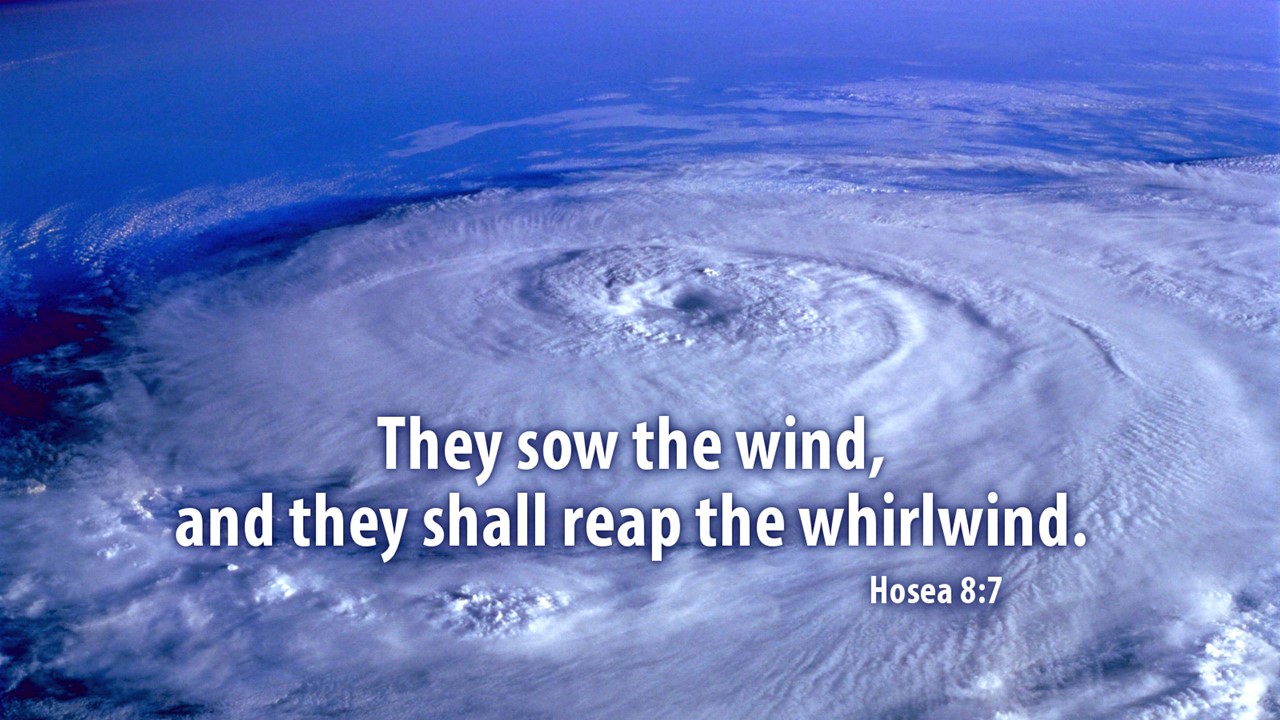
Israel had turned away from God, sowing false religion and self-centered living, and the result was destruction and loss. Psalm 128 and Hosea stand like two roads before us—one leads to blessing, the other to the whirlwind.
There’s also a generational angle. In Genesis 49, Jacob blessed his sons, but their futures reflected what they had already sown. Reuben’s instability, Simeon and Levi’s cruelty, Judah’s leadership—all were tied to past choices. Psalm 128 shows the opposite: when a man fears the Lord, his children and even his grandchildren are blessed. The seeds we plant today are not only for us—they become the harvest of those who come after us.
We usually think of reaping and sowing from a negative sense, but Psalm 128:2 says our happiness comes from reaping the good seed that’s been planted.
Ephesians 5:15-17 puts it this way,
“Therefore be careful how you walk, not as unwise men, but as wise, 16 making the most of your time, because the days are evil. So then do not be foolish, but understand what the will of the Lord is.”
We reap only what has been sown; either from what we have sown or what those before us have sown. The biggest positive is that we are reaping what God has sown on our behalf, the blessings of salvation and grace and Jesus Christ and all the believers in this world that have passed the message of the gospel to us over the ages. Likewise, the choices we make today will have far reaching consequences. If we are sowing good seed of sharing the Word and loving our neighbors, we will reap the benefits of those choices.
It’s important to realize there is no middle ground. Our time is a gift given to us by the Lord, and we sow with every minute. Are we using those minutes wisely? With every passing minute we are sowing. And if we choose to ignore the world around us, focus on our own pleasures, our own hobbies, our own entertainment, those are minutes not sown productively. In my own life, I’ve learned something of this principle. I like time alone occasionally. But time alone is not sowing seeds. Psalm 128 specifically talks to fathers and husbands to spend appropriate time with family. By myself, I enjoy reading the news, financial websites, and playing games. But I must always be mindful that the most productive seed I personally can sow revolves around my wife, around my family, around my church, around my job. Watching a funny video on Youtube sows no productive seeds. We are either sowing, or we’re letting the seeds go unsown.
And reaping productive seeds in accordance with God’s will brings blessings and happiness, happiness that eludes us if we’re seeking it for our own pleasure. Think of the choices we face daily:
- I can read a novel and be entertained. Or I can read Scripture and God speaks to me. Which sows the better seed?
- I can play a video game and amuse myself. Or I can play a board game with my spouse and strengthen our relationship. Which sows the better seed?
Every choice is sowing. And those who sow generously into the things of God will reap generously in His blessing. Paul says it clearly in 2 Corinthians 9:6–8:
Remember this: Whoever sows sparingly will also reap sparingly, and whoever sows generously will also reap generously. Each man should give what he has decided in his heart to give, not reluctantly or under compulsion, for God loves a cheerful giver. And God is able to make all grace abound to you, so that in all things at all times, having all that you need, you will abound in every good work.
So ask yourself: what are you reaping right now?
Discussion: What joys in your life can you trace back to good seed that was sown in the past? And what seed are you sowing today that will shape the harvest of tomorrow?
V. Conclusion
When we were children, we dreamed about what we wanted to be when we grew up. Some of those dreams were playful, others were serious, but all of them were shaped by what we thought would make life meaningful. Maybe we wanted adventure, or respect, or success. Maybe we thought if we reached a certain place in life, we’d finally be happy.
Psalm 128 reminds us that true meaning and blessing aren’t found in titles, wealth, or recognition. Those things fade, and they often disappoint. Real blessing comes from fearing the Lord and walking in His ways. That’s what it means to “grow up in the Lord.” It’s not about climbing the ladder of success—it’s about seeking Him first. Jesus put it this way in Matthew 6:33:
“But seek first the kingdom of God and his righteousness, and all these things will be added to you.”

And notice the ripple effect. The blessing begins with the one who fears the Lord, then flows into family, into work, into community, and into future generations. That’s a legacy the world can’t give. Genesis 49 shows us the opposite—Jacob’s sons reaped consequences from past choices, and those choices shaped entire tribes. Psalm 128 shows a better path: those who fear the Lord pass down blessing to their children and their children’s children.
So let me ask again—now that you’re grown, who do you want to be when you grow up in the Lord? What kind of person do you want your children and grandchildren to remember? What kind of seeds are you sowing today that will shape the harvest of tomorrow?
The psalm begins with a promise and ends with peace:
1 Blessed are all who fear the LORD,
       who walk in his ways.
 2 You will eat the fruit of your labor;
       blessings and prosperity will be yours.
That’s not just wishful thinking—it’s God’s Word, His design for those who walk with Him.
To God be the Glory, Amen.

 Chasing the Wind
Leave a comment