I. Jeremiah the Prophet
It’s a new year—time to change the page on the calendar… unless, like me, you use a digital calendar. Then you don’t change the page; you press a button. Either way, it feels like a fresh start. But Scripture reminds us that “new” isn’t mainly about the calendar. The Bible’s idea of “new” isn’t reinvention—it’s renewal. God meets us at the start of a year the same way He meets us at the start of a day: with mercy, purpose, and direction. Lamentations 3:22–23 tells us that God’s mercies “are new every morning.”
So we begin with Jeremiah 1 and the life of the prophet Jeremiah. God’s sovereignty is a theme that not only spans the pages of Jeremiah’s life but also our own lives. It reassures us that amidst the changes and chances of this fleeting world, God’s steady hand is at work.
In Jeremiah 1:5, we hear the Lord’s proclamation,
“Before I formed you in the womb I knew you, before you were born I set you apart.”
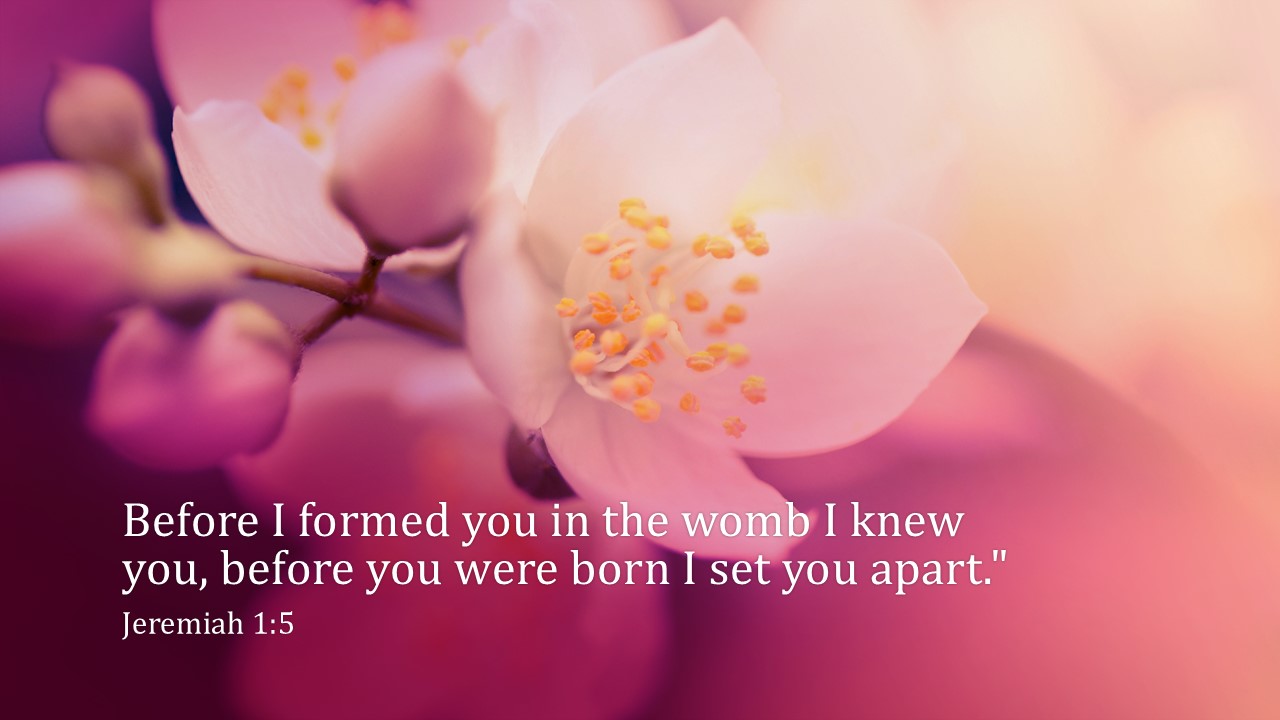
Here lies our foundation for the year ahead. Each of us, like Jeremiah, is known by God. Each moment of our future has been seen by Him. As we stand on the brink of the new year, we can know that we are not adrift in the currents of time but are held securely in the gaze of the One who is the same yesterday, today, and forever.
So our big idea for today is: A new year is a great time to reset—but the real reset starts with God: His call, His Word, and His presence. If we get that right, everything else falls into place.
The sovereignty of God intersects with our personal stories – yours, mine, everybody’s – and the Almighty is both the author of history and the writer of each of our days. As Jeremiah’s life illustrates the highs and lows of walking in alignment with God’s will, we will find today that if we trust in the Lord daily, He will better equip us to navigate the year ahead with a renewed sense of purpose under His sovereign guidance.
So, a new study, a new year, and renewed hearts, let’s see how God will reveal His plans for us in Jeremiah 1, as individuals and as a community bound together by His will.
Question: When you think about a “fresh start” this year, which part of our big idea do you most want to lean into—God’s call, God’s Word, or God’s presence? Why?
- Jeremiah the Prophet (Jeremiah 1:1-3)
The book of Jeremiah itself is long. By word count, it’s the longest book in the Bible, and it’s arranged quite oddly by today’s standard. It doesn’t proceed chronologically through time, it jumps forward and back often. Instead, it proceeds morally – in other words, there’s a moral progression throughout the book. As Jeremiah tells his moral story, he sprinkles it with historical perspectives from the history of the Jewish people.
I don’t think Jeremiah is as well-known as the other prophets. I wouldn’t consider him the greatest of the prophets. I’d probably give that title to Isaiah. It’s not the most difficult of the prophets to understand; I’d probably give that title to Ezekiel with his wheel-in-a-wheel imagery. But I would consider Jeremiah the most heroic of the prophets. Let’s begin with Jeremiah 1:1-3 –
The words of Jeremiah, the son of Hilkiah, one of the priests living in Anathoth in the territory of Benjamin. The word of the Lord came to him in the thirteenth year of the reign of Josiah son of Amon, king of Judah. It also came throughout the days of Jehoiakim son of Josiah, king of Judah, until the fifth month of the eleventh year of Zedekiah son of Josiah, king of Judah, when the people of Jerusalem went into exile.
So we know Jeremiah lived between the fall of Assyria and the rise of the Babylonian Empire. His ministry began during the 13th year of the reign of King Josiah (627 or 626BC) and continued until after the fall of Jerusalem when he was taken hostage and forced into exile in Egypt. Jeremiah was a preacher’s kid, born to a high priest in a town where only priests lived.
His father’s name was Hilkiah, a very common name at that time. Scholars aren’t sure which Hilkiah this is, but there was a high priest in the days of Josiah named Hilkiah.
In Second Kings, the high priest Hilkiah was rummaging around in the rooms of the temple one day, and buried underneath all the old records and money boxes was a scroll, the law of Moses. The nation had fallen so far that the Law had actually been lost and forgotten. Then Hilkiah brought it to the king Josiah, and Josiah began to clean up the nation, removing the abominations.
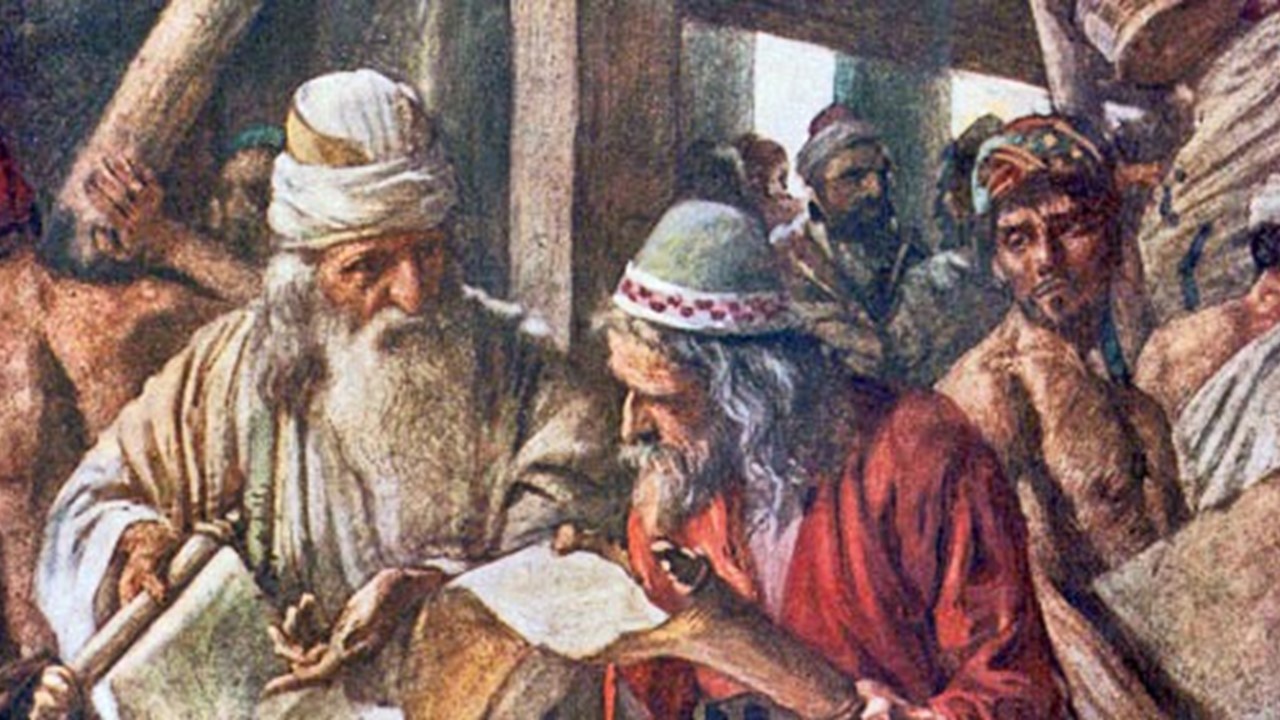
This high priest, Hilkiah, may have been Jeremiah’s father. Some scholars think he was; others disagree. But at any rate Jeremiah began his ministry under Josiah the king, in the days when Josiah was trying desperately to set the kingdom right, tearing down idols and restoring the worship of Jehovah, and causing the new-found Law to be read to the people, that they might hear the words of God.
Josiah’s reforms were temporary. As soon as the king Josiah died everything deteriorated again. Jeremiah lived to see Jehoahaz, Josiah’s son, rule for three months, and then be captured by Egypt and carried away in exile. He watched Assyria’s might, up to the north, being crushed by the power of Babylon. And later Egypt itself was humbled at the Battle of Carchemish, one of the strategic battles of all time, in 605 B.C. Jeremiah saw the total domination of the world by Babylon, under Nebuchadnezzar, and at last the invasion of his own beloved land of Judah by the Babylonian armies, the surrounding of Jerusalem, the siege of the city, its overthrow, and the carrying away into Babylonian captivity of the people of Judah.
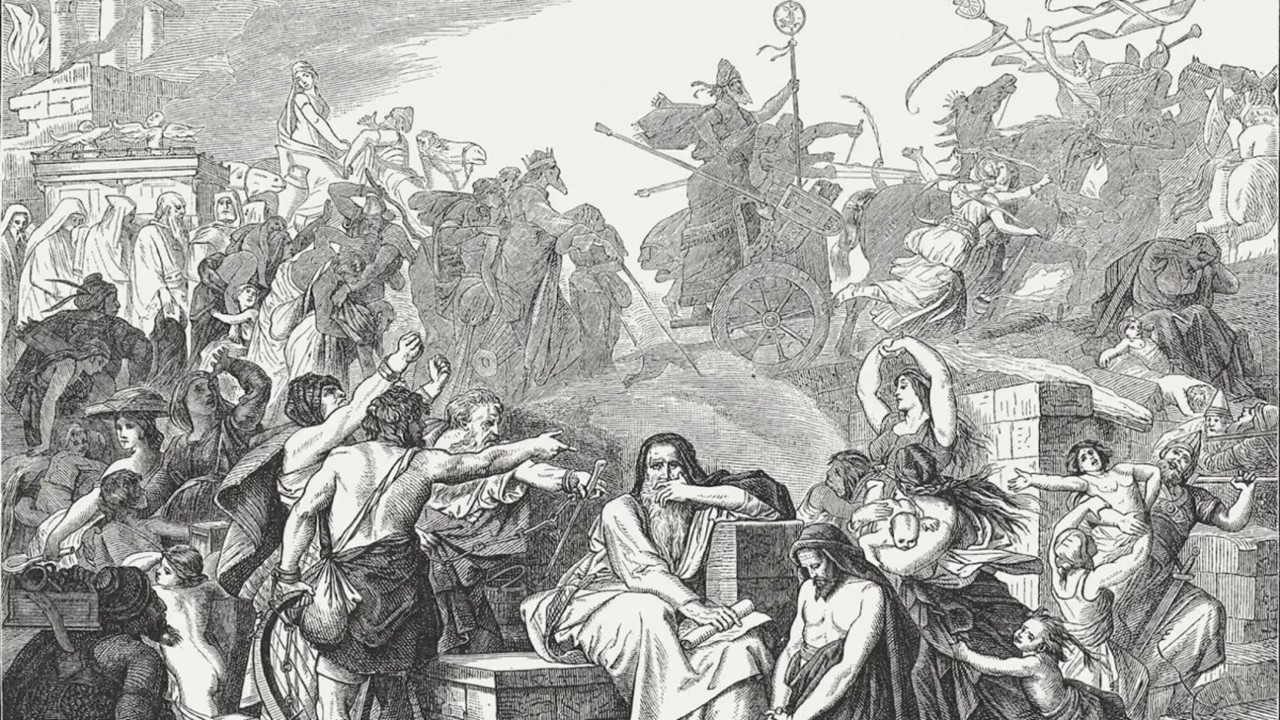
Jeremiah was left in a desolated land, a land utterly ravaged by war. Then, betrayed by politicians, he was taken as a captive to Egypt where he died unknown, unhonored, unsung. Tradition tells us he was stoned to death by the very Jews whom he trusted as brothers.
On the Sistine Chapel, Michelangelo painted seven prophets, and here is a closeup of Jeremiah. In Philip Graham Ryken’s book on Jeremiah, Ryken described the painting this way –

He (Michelangelo) presented him in a posture of despair. He looks like a man who has wept so long he has no tears left to shed. His face is turned to one side, like a man who has been battered by many blows. His shoulders are hunched forward, weighted down by the sins of Judah. His eyes also are cast down, as if he can no longer bear to see God’s people suffer. His hand covers his mouth. Perhaps he has nothing left to say.”
Beginning as a young man, Jeremiah preached throughout Judah for forty-two years, trying urgently to waken the nation to the impending dangers of their actions and beliefs. He urged them to repent so as to avert the impending judgment of God. And throughout this forty-two year period, Jeremiah never witnessed even the slightest glimmer of encouragement. The nation relentlessly continued toward self-destruction, and there was no indication the people heard any of his warnings.
But Jeremiah was steadfast. He was resolute. He had a task assigned to him by God. Despite personal anguish, struggles, heartaches, difficulties, and perilous situations, he faithfully carried out his calling. In doing so, Jeremiah gave us a remarkable testimony to the immense power and sovereignty of God over nations and His control of historical events.
What about the people of Jerusalem that didn’t listen? Throughout the Book of Jeremiah, God’s love for Jerusalem never wavered. In the midst of rebellion, idolatry, and unfaithfulness, Jeremiah delivered messages of warning and judgment. But he also delivered messages of repentance, redemption, restoration, and a future filled with hope. In the middle of their darkest moments, God promised to rebuild Jerusalem and to bring His people back to their land, to establish a new covenant that would transcend their failures.
In other words, the book of Jeremiah is a book of encouragement for you and me. It tells us how to find God’s plan for our lives, act on those plans, and reassure us that God is in control of us and all of history. It is a message of hope.
So how did Jeremiah accomplish all this? Well, he didn’t. Not on his own, anyway. Jeremiah was just a man, but a man faithful to the call of God. Jeremiah was called by God, and Jeremiah answered. But God doesn’t just call a man. When God does the calling, God does the preparing. When God does the preparing, God provides the power. It is all of God.
New Year Framework: This is how Jeremiah 1 helps us step into the year:
- Look Back: God has always known you.
- Look In: You may feel inadequate.
- Look Up: God promises His presence will always be with you.
- Look Forward: God will always fulfill His promises for you.
- Step Out: Obey—don’t be dismayed.
Let’s begin with God’s preparation in Jeremiah 1:4-5 –
III. God Does the Preparing
The word of the Lord came to me:
I chose you before I formed you in the womb;
I set you apart before you were born.
I appointed you a prophet to the nations.
The very first thing God told Jeremiah as a youth was to let Jeremiah know that, “God loves you and has a wonderful plan for you.” This is the preparation of God. And the remarkable thing is that this preparation began long before Jeremiah was even conceived. In other words, God said, “I started getting you ready, and the world ready for you, long before you were born. I worked through your father and your mother, your grandfathers and grandmothers, your great-grandfathers and great-grandmothers. For generations back I have been preparing you.”
This doesn’t just apply to Jeremiah the prophet. It applies to you and me and everyone. God has a plan.
Ever heard the saying, “When God made him, he broke the mold.” That is true, but not for just famous people like George Washington. Sure, after George, God broke the mold, and there has never been another like him. But God never made another one like you, and He never will. God never made anyone else who can fill the place you can fill and do the things you can do. A miracle of God’s creation and plan that out of the billions of people, there are no duplicates. There is not another you. Each person is unique, prepared by God for the time in which he is to live.
That is the word which came to Jeremiah, to strengthen him. “Look,” God said, “I have prepared you for this very hour,” as he has prepared you and me for this time, for this world, for this hour of human history.
Question: How does it encourage you (or challenge you) to hear God say, “I knew you before you were born”? What does that change about how you see the year ahead?
And then, there is not only the preparation of God, but in Verses 6-8, the provision of God:
IV. God Does the Provisioning
But I protested, “Oh no, Lord, God! Look, I don’t know how to speak since I am only a youth.”
Then the Lord said to me:
Do not say, “I am only a youth,”
for you will go to everyone I send you to
and speak whatever I tell you.
Do not be afraid of anyone,
for I will be with you to deliver you.
This is the Lord’s declaration.
Jeremiah believes he is inadequate. God must get tired of our excuses, but He was patient with Jeremiah. God is patient with you and me. God didn’t ask Jeremiah to be God. He just asked Jeremiah to be the Jeremiah God created. God assured Jeremiah that He would be with him, deliver him, and give him the message he was to proclaim. God did not call Jeremiah because of his ability or giftedness; all God desired was Jeremiah’s obedience and availability.
This is the New Year “reset” right here: the year doesn’t begin with what you can do. It begins with what God promises. He promises “I will be with you.”
Question: Jeremiah says, “I am only a youth.” What are some “I’m only…” or “I can’t…” excuses believers today tend to give God—and why do you think we fall back on them?
God has provided everything Jeremiah needs, beginning in verse 9 –
V. God Does the Power
Then the Lord reached out His hand, touched my mouth, and told me:
I have now filled your mouth with My words.
See, I have appointed you today
over nations and kingdoms
to uproot and tear down,
to destroy and demolish,
to build and plant.
As with Isaiah, God touched Jeremiah’s mouth. Isaiah started this same way. God touched his mouth with the coals from the altar and gave him power in speaking. Jeremiah’s words, then, become the key to his power, for it is the living, burning, shattering, building, mighty power of the word of God.
I think this is why our current culture distresses me so much. They begin with redefining words and then accuse good people based on their new definitions. They’ve stolen the rainbow which is a symbol of God’s promises. For decades we practiced being a color-blind society; now that is considered racist. The culture says men can become women. They say evil is good and good is evil.
But God has given us His word, and God’s Word will not be mocked. Scripture tells us that there is no slave or free in Christ, that He created man and woman, and that Christ alone is good. God has given us His word, like He gave His word to Jeremiah.
We have great power when we are in Christ and rely on His word. James says that the prayer of a righteous man releases great power. When we proclaim the truth of God, that word has power.
So Jeremiah was set in the midst of death and destruction, but God said he would plant a hope and a healing. His word was to “pluck up and to break down, to destroy and to overthrow,” and that is often how God works. Whether in a nation or in a man’s heart, God destroys that which hinders us from having a close relationship with Him.
Symbols of the Ministry (Jeremiah 1:11–16)
The Almond Branch (Jeremiah 1:11–12)
The closing section of this chapter depicts the ministry of this young man in the land. It falls into three major divisions, beginning with Verse 11. First there are certain symbols of what would be accomplished through this young man’s ministry:
Then the word of the Lord came to me, asking, “What do you see, Jeremiah?”
I replied, “I see a branch of an almond tree.”
The Lord said to me, “You have seen correctly, for I watch over My word to accomplish it.”
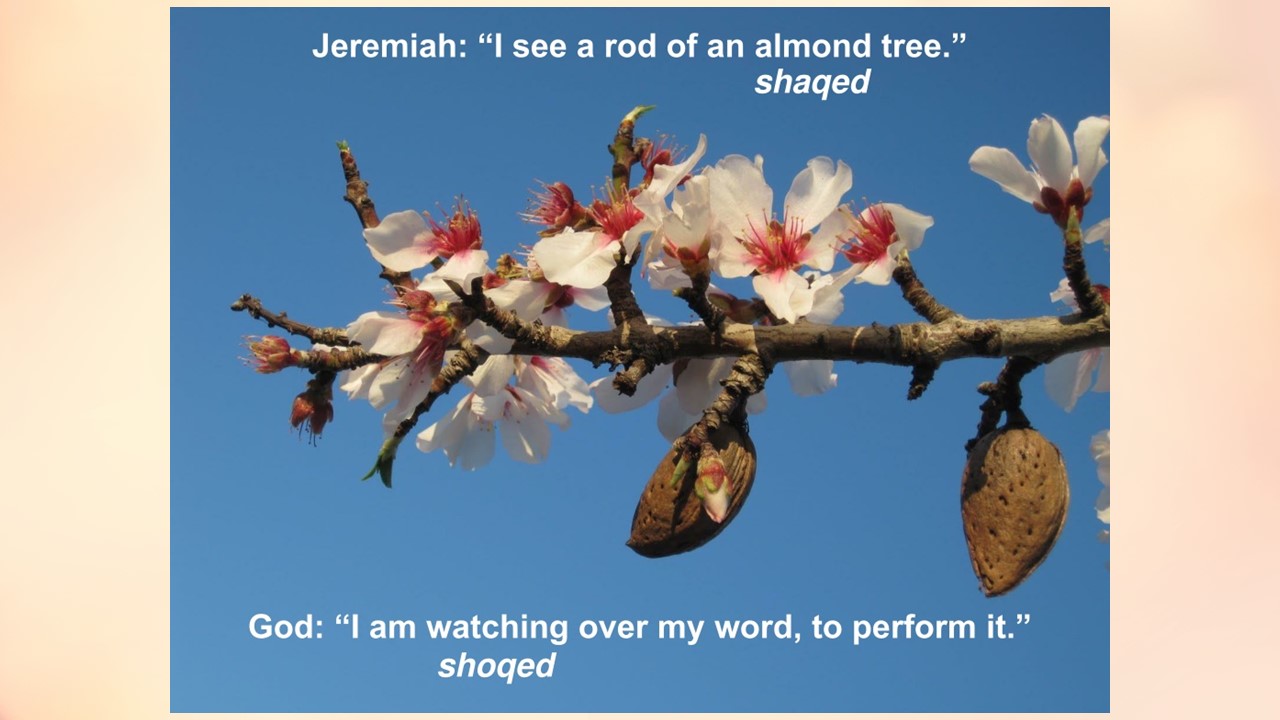
There is a little play on words here, in the Hebrew. The Jews called the almond tree “the watcher” (shaqed) because it was the first tree to blossom in the spring. They saw it as watching for the return of the sun and the warming of the earth, and therefore the first to herald the coming of springtime. And God said to Jeremiah, “You have seen well, for that is what I am doing; I am watching (shoqed) over my word to perform it.”
New Year anchor: God isn’t guessing about this year. God watches over His Word to accomplish it.
This is a picture of health and healing. Throughout this prophecy there are wonderful passages which deal with the way God was planning to heal this land. Jeremiah was sent to buy a piece of property while the city was being taken by the enemy. In the midst of all this destruction he was to buy this property, get the title deed, and have it sealed and witnessed, as a testimony to the fact that God intended to restore the land, and that property would be of value yet.
The Boiling Pot (Jeremiah 1:13–16)
There is another symbol:
Again the word of the Lord came to me inquiring, “What do you see?”
And I replied, “I see a boiling pot, its lip tilted from the north to the south.”
Then the Lord said to me, “Disaster will be poured out from the north on all who live in the land…
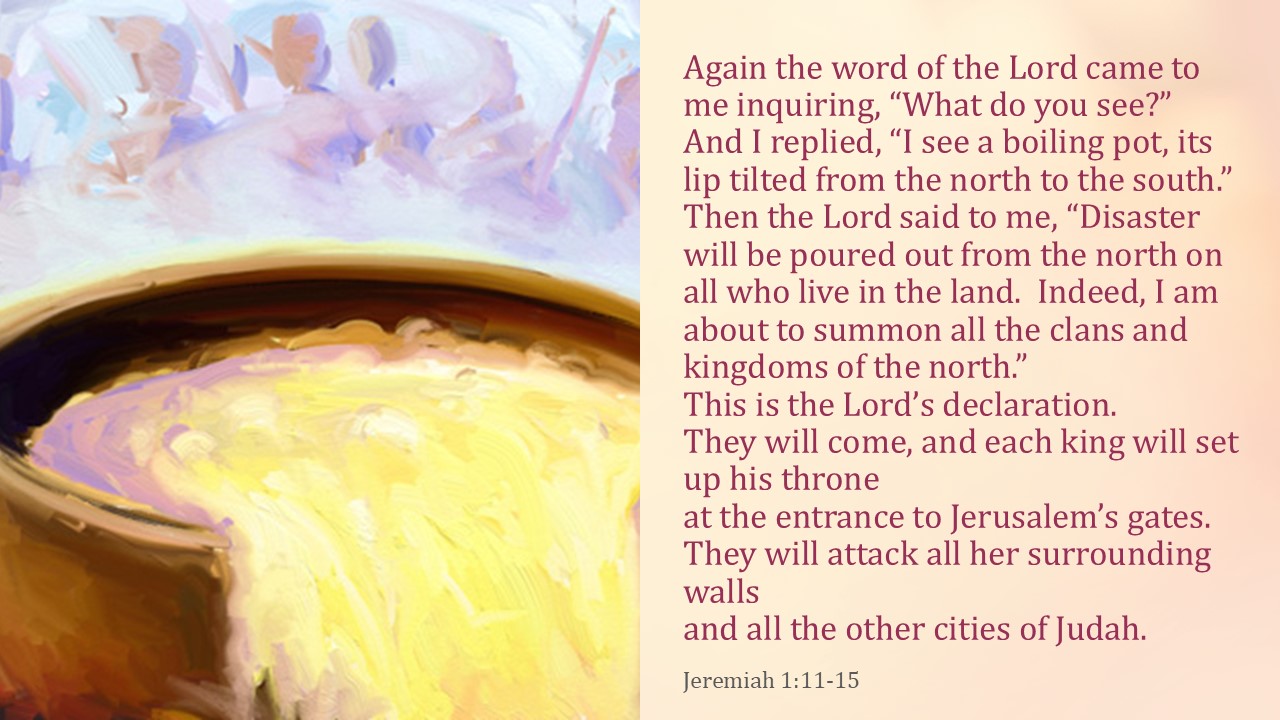
He saw a pot boiling, driven streaming by the north wind to the south. God said, “I’m going to bring a boiling pot of nations down from the north against Jerusalem.” This was the picture of judgment. And it was to come from the north. Egypt in the south was the greatest power on earth at this time, but God says He will use Babylon from the north to bring judgment.
Then, second, he announces the cause of that judgment, Verse 16:
“And I will utter my judgments against them, for all their wickedness in forsaking me; they have burned incense to other gods, and worshipped the works of their own hands.”
This is why a nation dies. It forsakes the one true God, and begins to worship false gods. And men worship their own creation, claim they can turn women into men and men into women. The rise of humanism is evidence of our moral decay.
This is what was happening in Israel. In the very first prophecy of Jeremiah to Judah, 2:13, Jeremiah says,
“…for my people have committed two evils;
they have forsaken me,
the fountain of living waters,
and hewed out cisterns for themselves,
broken cisterns,
that can hold no water.”
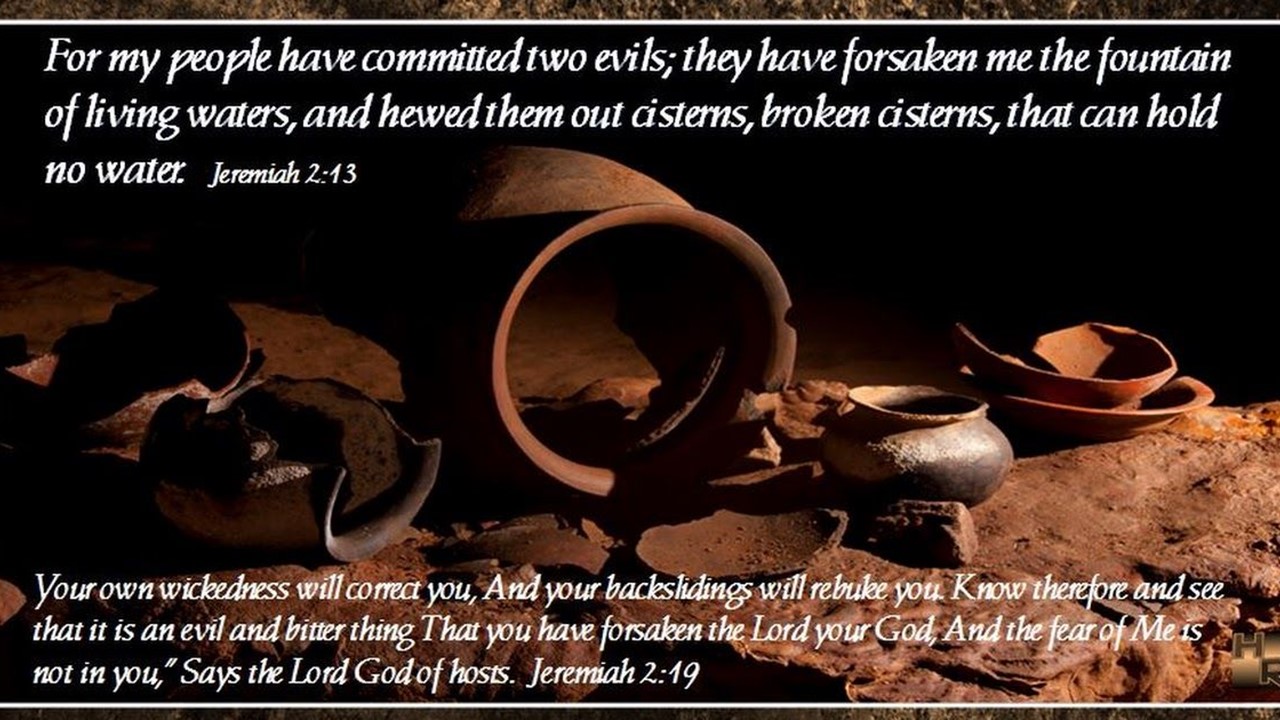
God paints a picture of the futility of man and his own works. A valley with a stream running through it, cool, clean, living water. The people have been drinking from that water, but then they turn away from it. Instead, up on the barren, rocky hillsides, they hew out cisterns to catch the water as it runs off down the mountainside with its dirt and its leaves and bugs and dead mice. The cisterns leak. They do not hold the water. So, at great expense, the people are constantly building cisterns which break in the drought and let the water run out. And they are left with nothing to drink, while the stream of living water runs fresh in the valley below.
I think that’s what our society is doing now. People turn from the God who is able to bring the joy and peace and love into a life, and start seeking it in all kinds of dead human philosophy, in failing friendships, in momentary pleasures — these broken cisterns that can hold no water. This is when a nation, a home, an individual, begins to die.
Question: Where do you see people today turning to “broken cisterns” instead of the living water God offers—and what might it look like, very practically, to choose the “living water” more often this year?
God’s Final Charge (Jeremiah 1:17–19)
And in the midst of it, the final promise to Jeremiah is,
“But you, gird up your loins; arise, and say to them everything I command you. Do not be dismayed by them, lest I dismay you before them. And I, behold, I make you this day a fortified city, an iron pillar, and bronze walls, against the whole land, against the kings of Judah, its princes, its priests, and the people of the land. They will fight against you; but they shall not prevail against you, for I am with you, says the Lord, to deliver you.”
All the people of the land, and its kings and priests, would all be against Jeremiah for speaking the truth. But God said, “Don’t you worry, you shall stand. I’ll make you a stone, an iron, and a bronze against them. Nothing will shake you.” And the amazing thing is that Jeremiah was thrown into prison, isolated, rejected, insulted, and finally exiled into Egypt, never once failing to share the good news God had given him to say.
This is the New Year moment: the new year will bring changes you can’t plan for. Jeremiah didn’t get clarity about outcomes—he got clarity about obedience. God didn’t give him a comfortable forecast; He gave him His presence and His Word. That is enough to step into the year.
VI. Conclusion
Just as God had a specific plan for Jeremiah, He also has a unique plan for each one of us. Jeremiah’s story reminds us that God intimately knows and understands the challenges we face, and He has a purpose for us within those circumstances. Just as God appointed Jeremiah as a prophet, He has appointed each of us for a specific role in His grand design.
I heard it put this way recently, and it rings true to me: wherever you are in this life, Christ calls you to be Christ in that situation. Whether you are a stressed out mom or battling health issues or being rejected by others, how would Christ act if He was in your shoes? The more I think about those WWJD bracelets from the 70’s, “What Would Jesus Do” is amazingly simple and accurate theology.
Like Jeremiah, we may encounter resistance, doubt, and difficulty in embracing God’s plan for our lives. But God equipped Jeremiah with the necessary strength, wisdom, and courage, and God equips us, too. We have the power of the Holy Spirit, we are empowered to fulfill our calling and contribute to God’s redemptive work in the world.
God’s plan for Jeremiah demonstrates His faithfulness and His unwavering commitment to His people. No matter how dire our circumstances may seem, God remains faithful to His promises. Just as He had plans to prosper and not harm Jerusalem, He has plans to prosper and not harm us, plans to give us hope and a future.
A simple “year-aim” for us: this year, our aim is not a better version of ourselves; it’s a life more yielded to the Lord—so that His Word shapes our choices.
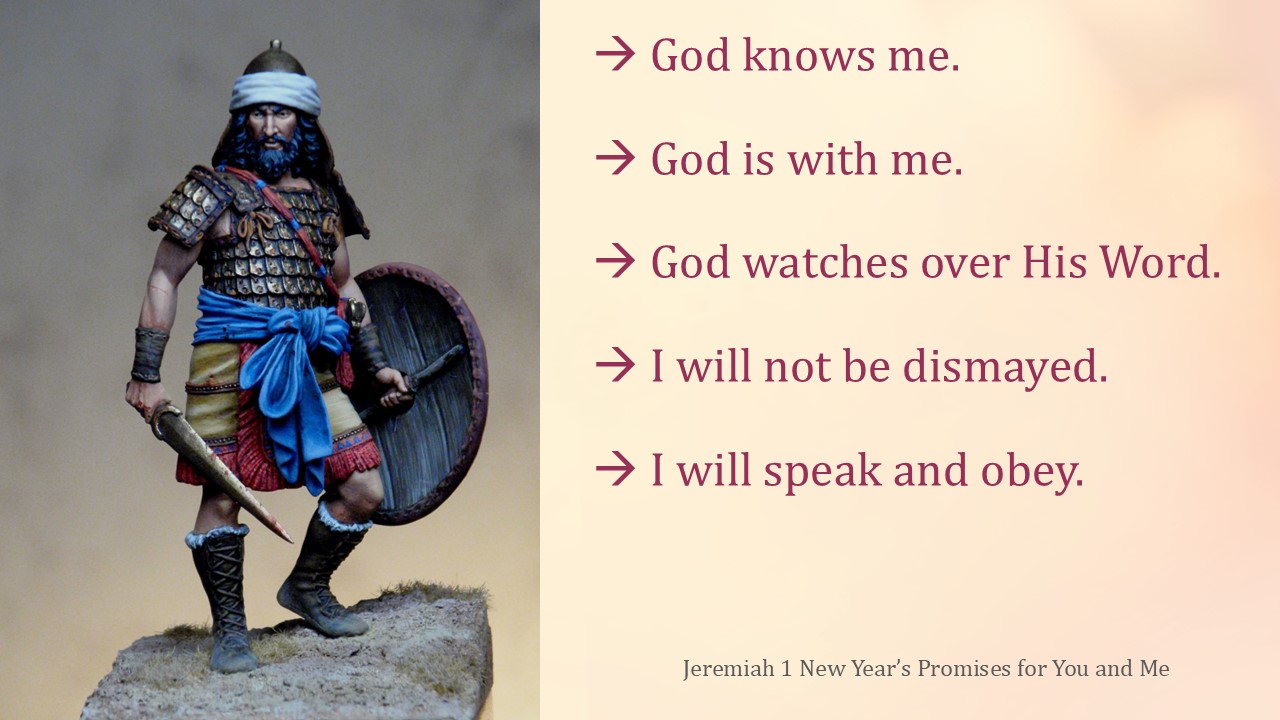
And before we close, here’s a simple one-minute commitment you can carry into the year. Pick one phrase from Jeremiah 1 and make it yours for this year:
- “God knows me.”
- “God is with me.”
- “God watches over His Word.”
- “I will not be dismayed.”
- “I will speak and obey.”
God has called you. God has prepared you. God has provided you with everything you need. So gird up your loins and be about the Lord’s work today.
To God be the glory. Amen.

 Chasing the Wind
Leave a comment