
I. Introduction
We all arrived safely at the office today. Raise your hand if you’re not here.
We don’t always stop to think about it, but even something as ordinary as getting to work safely is evidence of God’s care. Scripture reminds us that our steps are ordered by the Lord, and His protection is constantly at work—often quietly, often unnoticed.

God protects us from the big things—events on the world stage far beyond our control—and He protects us in the small things, closer to home. Some dangers are obvious; others we only recognize in hindsight. Either way, His hand is still there.

Psalm 141 is a prayer from David to the Lord for divine protection. What makes this psalm especially meaningful is that David doesn’t only ask God to protect him from enemies or external threats. He asks God to guard his words, his heart, and his choices. In other words, David understands that God’s protection works from the inside out.
This psalm shows us that God’s protection isn’t limited to what surrounds us. It also reaches inward—guarding our words, our hearts, and our choices.
Discussion Question: Where do you most clearly see God’s protection in your everyday life—at work, at home, or in the ordinary routines you might otherwise overlook?
II. We Need His Protection
Psalm 141:1-2,
O Lord, I call upon You; hasten to me!
Give ear to my voice when I call to You!
May my prayer be counted as incense before You;
The lifting up of my hands as the evening offering.
It is right to give the Lord the praise He deserves, for the Lord alone can answer prayers. We know that the Lord answers prayers, and we also know that the Lord works on His own timetable. When David says, “hasten to me,” does he think the Lord is somehow far away?
No, not at all. David is keenly aware that the Lord is always near. His urgency isn’t impatience—it’s confidence that God hears and that God can act.
I know we do not always feel like the Lord is near. Sometimes it seems as though He is far away, but I once heard that if you’re ever feeling the Lord is far away, it’s not because He left you. It’s because you left Him, and maybe it’s time to turn around and go back to the place where you left Him.
David’s prayer is for the Lord to act quickly, to answer his prayer now. When we pray to the Lord, it’s okay to ask Him to speed things up a little, to answer our prayers quickly. Too often we dismiss our own prayers by saying, “if it is the Lord’s will.” And while that is true, sometimes we say that not out of humility, but because we’re unsure God will act.
The Lord hears the pleas of the heartbroken who turn to Him, and we are free to ask boldly. Whether the Lord answers quickly or on a timetable we cannot see, it is still right to praise Him.
David asks the Lord to consider his heartfelt prayers as incense, as an evening sacrifice. Incense was offered daily in the temple as a continual act of worship. While offerings of tithes or service are sacrifices, nothing is as pleasing to the Lord as turning our hearts toward Him and seeking His will.
Discussion Question: Do you pray with urgency, as David did, or do you tend to hold back? Why?
III. Protection from Within
David goes on in verse 3-4,
Set a guard, O Lord, over my mouth;
Keep watch over the door of my lips.
Do not incline my heart to any evil thing,
To practice deeds of wickedness
With men who do iniquity;
And do not let me eat of their delicacies.
You know, we often cry out to the Lord to save us, but often we are our own worst enemies. We eat too much, and then ask the Lord to help with our weight. We sit in front of the television night after night, then ask the Lord to grant us the health that normally comes from exercising. We say hurtful things to someone, then ask the Lord to repair our relationships. We need the Lord’s protection from ourselves so that we do not corrupt ourselves.
First, David asks the Lord to keep watch over the door of his lips. Have you ever said something you regret? Ever? I know—it surprises me too.
I remember a story about someone accidentally saying a cuss word in front of their grandmother. They were immediately shocked and embarrassed that it came out of their mouth. The grandmother didn’t scold them. She simply said, “Well, if that came out of you, it must have been inside you.”
That’s a sobering thought. In this world, our flesh does not always obey the will of the Spirit. We sin and go against the will of God, and our tongues are often the worst offenders. No wonder David prays for the Lord’s help to guard his mouth.
James 3 gives us a vivid picture of how powerful the tongue is, even though it is small. James 3:3-5,
Now if we put the bits into the horses’ mouths so that they will obey us, we direct their entire body as well. Look at the ships also, though they are so great and are driven by strong winds, are still directed by a very small rudder wherever the inclination of the pilot desires. So also the tongue is a small part of the body, and yet it boasts of great things.
We want our heart to be right with God, and God sees our inner beings first, but what we say, what comes out of our mouth, reflects who we are. What we say reflects exactly who we are in Christ and where we are in our spiritual growth. It’s more important than service or tithing or teaching. Jesus says it this way in Matthew 15:18,
But the things that proceed out of the mouth come from the heart, and those defile the man.
If you ever catch yourself gossiping, slandering somebody behind their backs, saying crude or vulgar things, remember this: If it came out of you, it must have been inside you.
In the Psalm, David goes on to pray that the Lord will not only seal his lips, but also seal his heart. He repeats this request because guarding the mouth without guarding the heart is impossible.
Do not incline my heart to any evil thing,
To practice deeds of wickedness
With men who do iniquity;
And do not let me eat of their delicacies.
And then David admits something we all know: sin is appealing. He calls them “delicacies.” Sin is fun. It must have an appeal to it, or people wouldn’t be drawn to the bondage of sin.
Let’s look for a second at what we call the Seven Deadly Sins. This list has its roots in Proverbs 16, then refined by monks in the 4th Century, and finally listed in the form we know now in 590 AD by Pope Gregory I. Scripture doesn’t give us a formal list like this, but it clearly addresses each of these patterns of sin. The Seven Deadly Sins are:
- Lust
- Gluttony
- Greed
- Sloth
- Wrath
- Envy
- Pride
Each of these seven deadly sins takes a gift from God and perverts it into a sinful desire. Which of the Seven Deadly Sins am I tormented with? Why, all seven of them, of course. The only one I haven’t committed yet this morning is “sloth,” but that’s only because I haven’t gotten around to it.
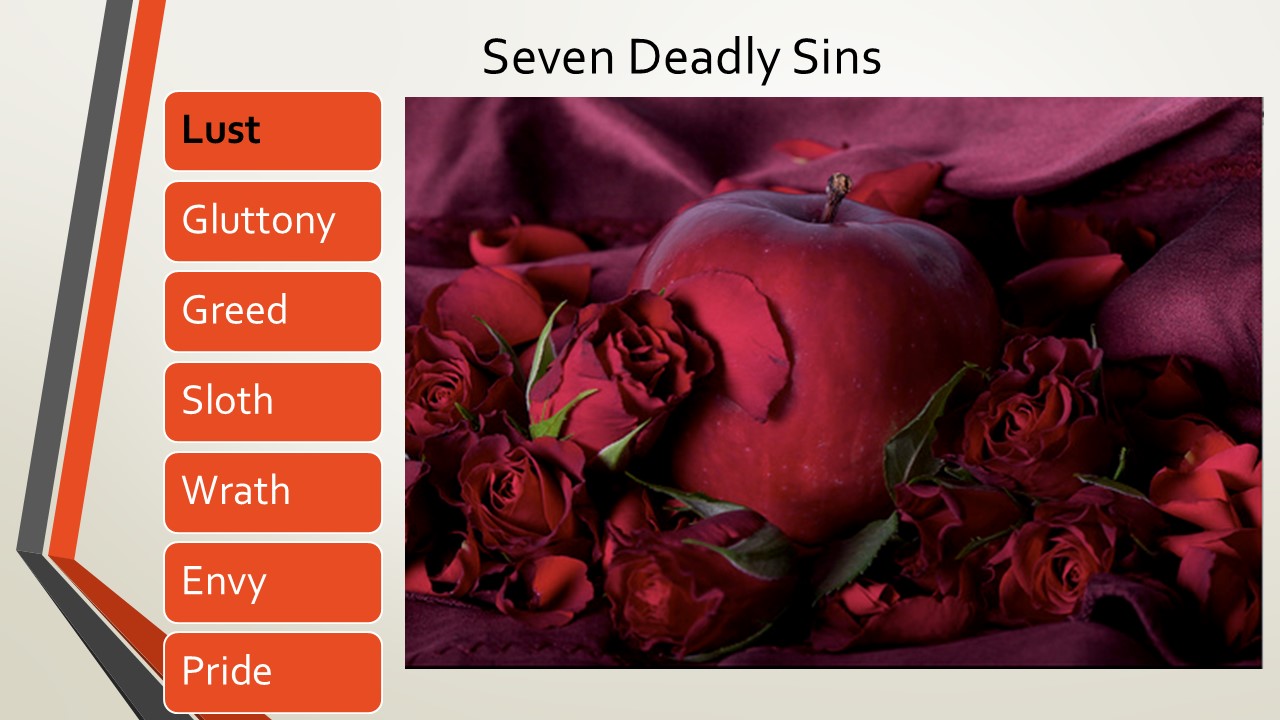
Lust: God provides beauty to demonstrate His majesty, and it is right to desire the good things that God desires. But lust converts the enjoyment of beauty into a primal urge of disobedience. It is considered the easiest sin that can be done within one’s own mind. According to Henry Edward Manning, an English Cardinal of the Roman Catholic Church in the 1800’s, the impurity of lust transforms one into “a slave of the devil.”
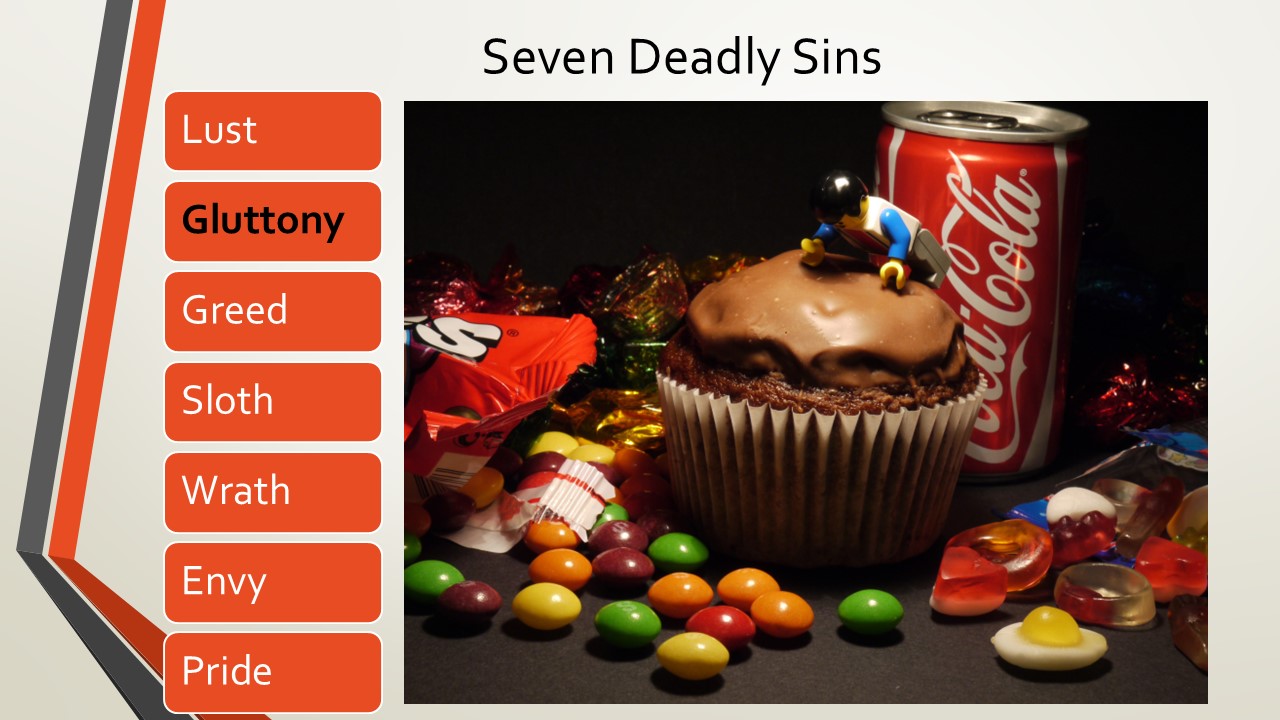
Gluttony: God provides food for nourishment, to fuel our bodies in service to Him. And Christ calls us not to live for ourselves alone, but to love and serve one another. But gluttony worships the created food and not the Creator of the food, and places our own wants above the needs of others.
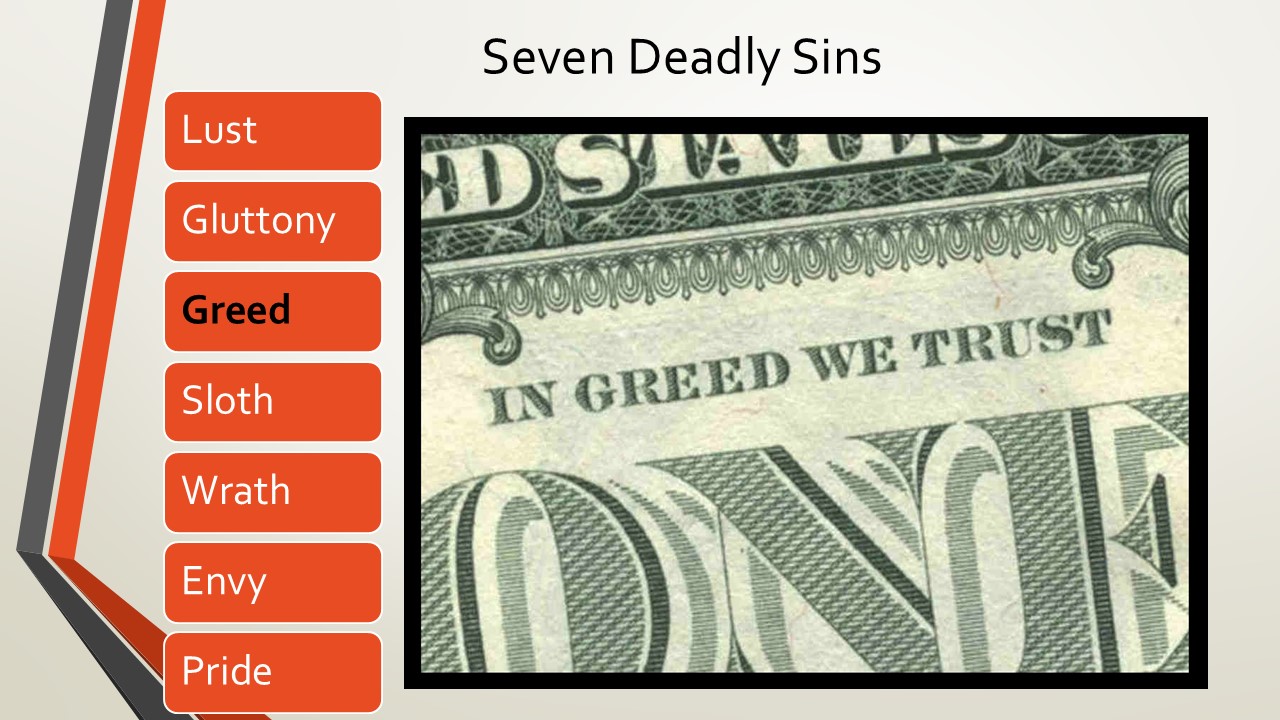
Greed: God promises to provide for all of our needs, and remind us that our security is in Him and that we should trust Him to provide for us. But who hasn’t fantasized about winning the lottery? Greed says I do not need to depend on God, I can rely on the world to provide all my needs.
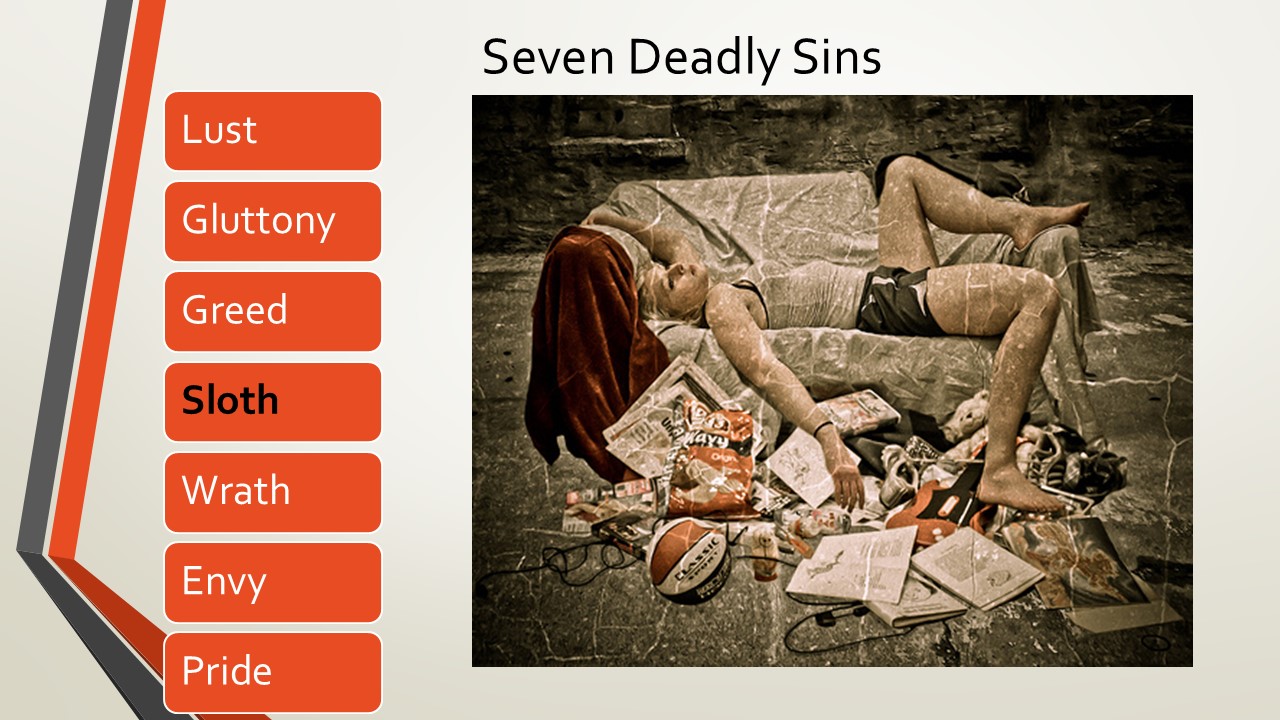
Sloth: The Lord wants us to be diligent, to be His hands and feet for the church, but not rely on our strength. We are to rely on the Spirit within us. If we pervert that virtue, though, we let God do everything without participating at all. The word “sloth” is originally from a Latin term that means “without care” and demonstrates a laziness in mental, spiritual, and physical states.
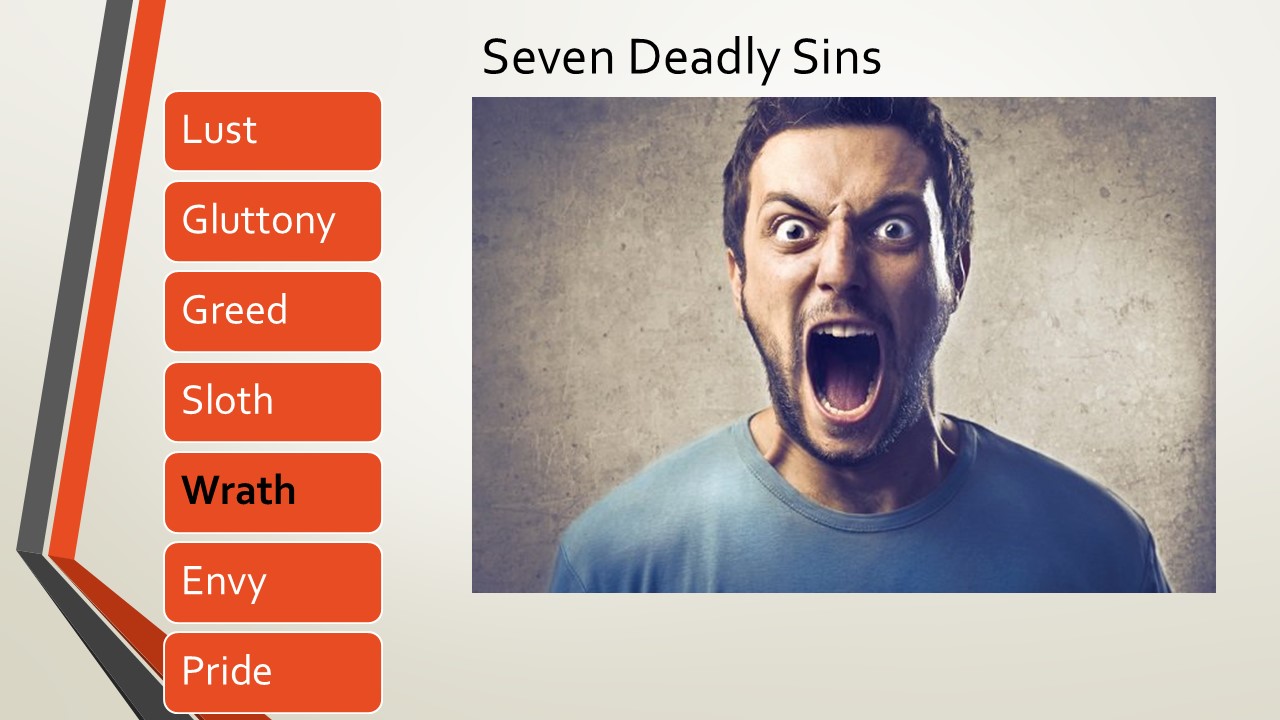
Wrath: Jesus set an example of righteous anger when He overturned the tables of the moneychangers at the temple. The moneychangers were taking what was meant for God and profiting from it. But when we are angry, it is rarely righteous. We get angry because we didn’t get our way. In many ways, it is the opposite of love. Wrath is hate.
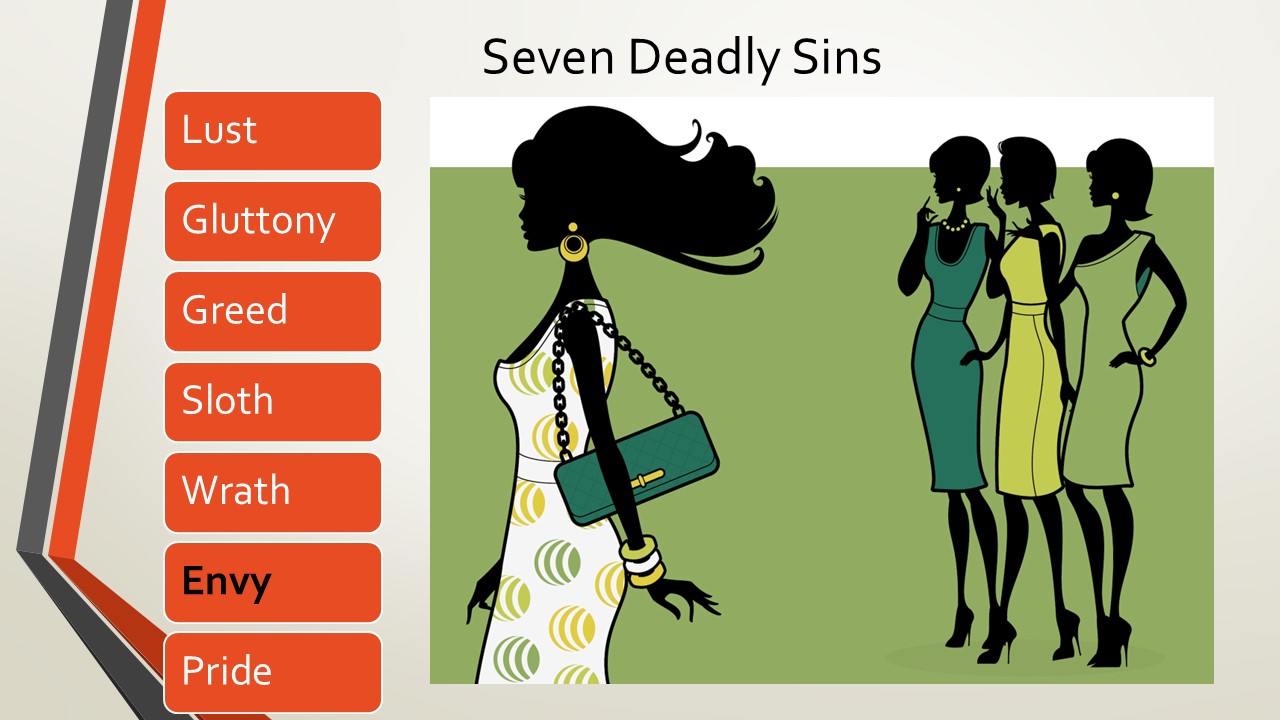
Envy: God calls us to be compassionate toward others, and to be satisfied with the lot God has provided to us. But envy says, it isn’t enough for me if somebody else has more. I want what they have. Envy is probably the second sin in the bible, as Cain slew Able, envious of the Lord’s favor.
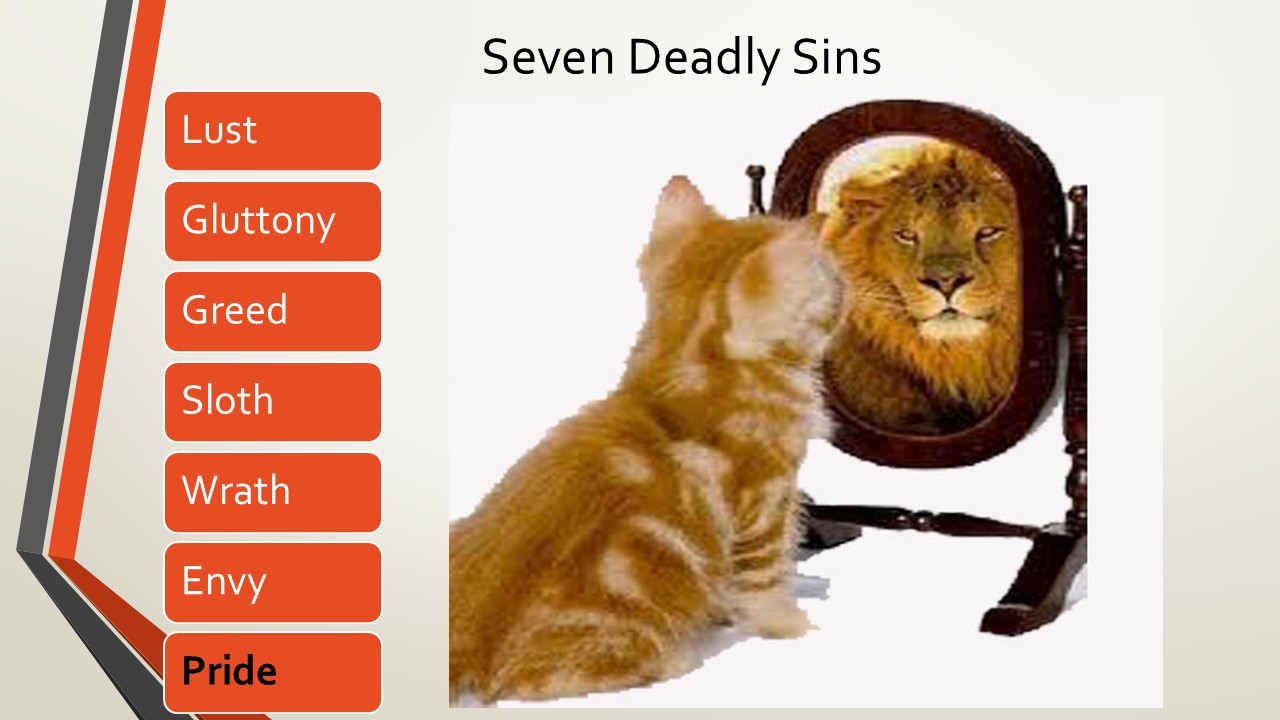
Pride: The father of all sins. Christ demonstrated what it meant to serve with humility, even though as Lord of the Universe all things will bow before Him. Yet Christ humbly washed the feet of His disciples. Pride says I am too important to be humble. Pride says I need not bow before God when it is I who deserves praise.
Protect me, Lord from myself. I am full of sin and malice and evil thoughts, and the only way to overcome these seven deadly sins is to continually fill myself with the Holy Spirit so there is no room for anything except Your will.
The Seven Deadly Sins are everywhere. Even on Gilligan’s Island.
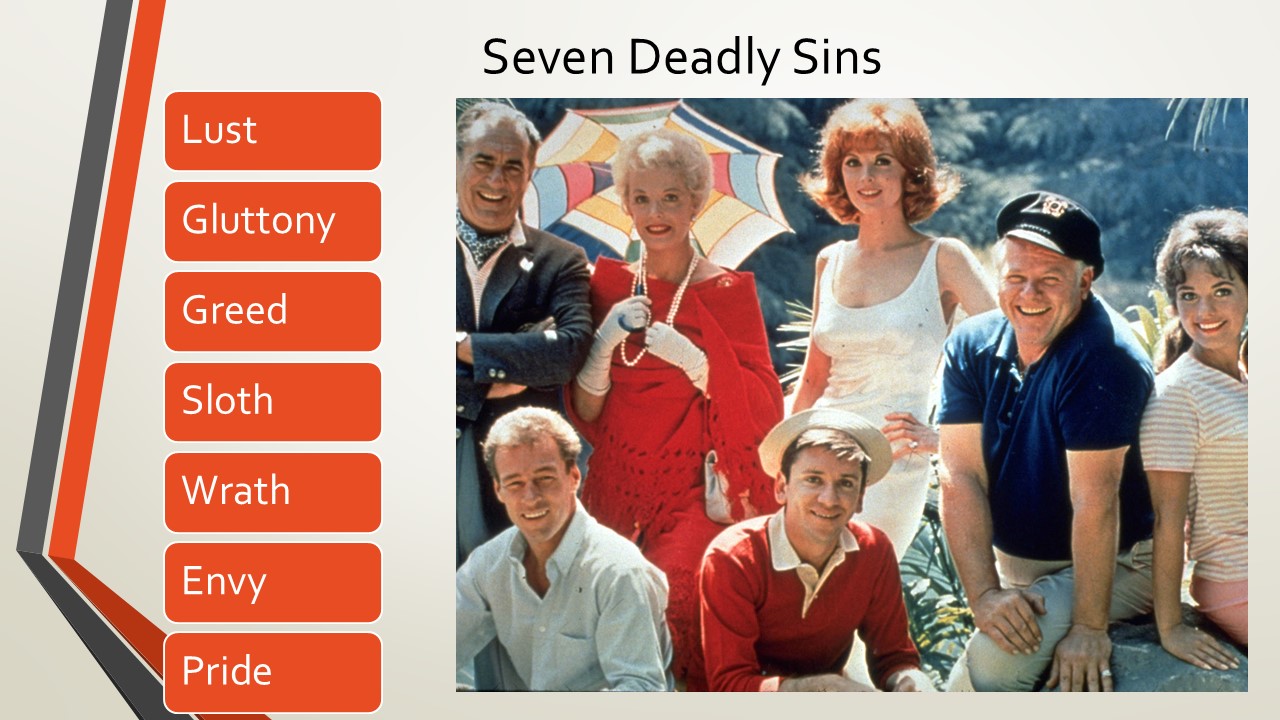
- The Skipper: Wrath. I thought he might be gluttony, but the skipper solved every problem with anger.
- Gilligan: Gluttony. Ate everything he could and would do things he knew wasn’t right for a coconut cream pie.
- Ginger: She was constantly using her sex to try to manipulate others.
- MaryAnn: Envy, always wanted what Ginger had.
- Thurston: Greed. Everything was about the money.
- Howell: Sloth. I never saw her lift a finger to do anything, ever.
- Professor: Pride. His intellect made him better than everyone else on the island.
Another theological insight from Gilligan’s Island is that you can sing Amazing Grace to the theme song. Just sayin’.
It’s funny when we see sin in a sitcom—but it’s sobering when we see where it ultimately leads.
Ultimately, regardless of who we hurt in this life, who we fail, the tasks we botch or refuse completely, there is one judge, the Creator, our Father in Heaven. Some sins are against others or against ourselves, but all sins are against our Father and He alone has the authority and ability to judge us for what we have done and what we haven’t done.
I know that if there was a possibility that I could lose my salvation, I would have done it already a dozen times or more.
Ever heard this silly prayer?
Dear Lord,
So far I've done all right.
I haven't gossiped,
Haven’t lost my temper,
Haven’t been greedy, grumpy, nasty, selfish, or overindulgent.
I'm really glad about that.

But in a few minutes, God,
I'm going to get out of bed.
And from then on,
I'm going to need a lot more help.
The Lord protects me from myself; my salvation is secure, my security is in Him.
Discussion Question: Which do you find harder to fight—sin that comes from the heart (like envy or pride) or sin that comes out of the mouth (like gossip or anger)?
IV. Protection from Without
What were we studying? Oh yes, Psalm 141. So after David prays to the Lord to respond quickly and to protect him from his own sinful self, David then prays for protection from external enemies.
Let’s continue with Psalm 141, verse 5:
Let the righteous smite me in kindness and reprove me;
It is oil upon the head;
Do not let my head refuse it,
David isn’t asking to be harmed—he’s saying that loving correction from godly people is a gift, not an attack. When my sinful self has taken control of my life, I am thankful I have Christian friends and family that will “smite me in kindness.”
David welcomes the correction of the righteous. That’s humility—better to be reproved by a godly friend than to be flattered by the wicked. Proverbs 27:6 reminds us,
“Faithful are the wounds of a friend.”
This is probably one of the most important functions of the church, to strengthen one another in Christ. I have a secular job as an engineer, and it’s in a diverse group of people, those with faith, some without, many with a different faith. I’m blessed that I work with so many Christians, but it’s not the same as church.
I like what it says in 1 Corinthians 14:26,
What is the outcome then, brethren? When you assemble, each one has a psalm, has a teaching, has a revelation, has a tongue, has an interpretation. Let all things be done for edification.
Each one of us has a role that only we can fulfill. And when you fulfill your role and I fulfill my role, we build each other up so that the world outside may not tear us down.
Psalm 141, verse 5-6,
For still my prayer is against their wicked deeds.
Their judges are thrown down by the sides of the rock,
And they hear my words, for they are pleasant.
There is no doubt that David was praying for his enemies to be dashed against cliffs. Unlike David, though, Christians have the Holy Spirit living within us, and Jesus tells us we are to love our enemies.
But let’s keep in mind that we reap what we sew. Those that are hostile to the love of God often find themselves at rock bottom before they will consider that a superior God rules the universe. I know someone who considers themselves a Christian, but you cannot tell from their lifestyle. I used to be just like them.
And I know—and David gives me an example here—that it’s okay for us to pray for their difficulties if that difficulty eventually leads toward God’s will. I don’t pray for them to be thrown against a cliff, of course, but I sometimes pray that their dependence on others will fail them so they learn to depend on the God they say they trust.
You can tell David loves his enemies; he wished for their failure, but he also wished they will heed his pleasant words for them to do what is right.
Verse 7,
As when one plows and breaks open the earth,
Our bones have been scattered at the mouth of Sheol.
David is describing the inevitable end of a life lived apart from God. Those who reject God ultimately come to nothing—bones scattered at the edge of death.. Jesus says something similar in Matthew 7:13-14,
Enter through the narrow gate; for the gate is wide and the way is broad that leads to destruction, and there are many who enter through it. For the gate is small and the way is narrow that leads to life, and there are few who find it.
Before we become believers, we are lost and don’t even know it, rudderless ships headed to destruction. Among those that do not consider Jesus as their Savior, I see a great many destructive philosophies and odd beliefs. One distant relative of mine believes we are descended from aliens and when she mediates she can sometimes see alien being projecting their auras into our plane of existence. Another relative believes we are constantly reincarnated after death, and our next life depends on the good or bad we do in this life. In other words, whether he makes good choices or bad choices, eventually he’s going to get a do-over. And friends that don’t want to talk about it at all, that this life will just simply end, and we “check out.”
There are many ways to end up at David’s “mouth of Sheol,” and only one way to eternal life. No one comes to the Father except through the Son. And that is why in verse 8, David says,
For my eyes are toward You, O God, the Lord;
In You I take refuge; do not leave me defenseless.
David focuses his eyes on the one true God who is in control of all things. With a focus on God, we have comfort that we do not worry about what the world may do to us. When we contrast verse 7 with verse 8, we see the fate of the nonbeliever is destruction, but the fate of the believer is eternal safety and refuge from all evil.
Verse 7 is saying that the bones of those who ignore God will eventually rot to nothing because they have ignored Him. In the meantime, I (David) am trusting in His guidance.
That last line, “do not leave me defenseless,” is from the NASB, but I’m not sure it’s a good translation here. The Hebrew phrase literally translated asks God not to taking his soul, strip it naked, and abandon it. I think the King James translation, “leave not my soul destitute,” is more accurate.
Verses 9-10,
Keep me from the jaws of the trap which they have set for me,
And from the snares of those who do iniquity.
Let the wicked fall into their own nets,
While I pass by safely.
And this brings us back to our trip to church this morning. Genesis 3 tells us that, as a result of the fall of Adam, the land we dwell is cursed. When we look at the horrible things that happen in this world, it’s easy to become frightened. Terrorists in cars plowing through pedestrians. Diseases that send people to hospitals. North Korea still wants to use nuclear weapons Guam. I think that avoiding nuclear war in part depends on strong, dependable, and trustworthy world leaders like Kim Jon Un and Donald Trump. That’ll keep you up at night.
Discussion Question: Why do you think David valued correction from the righteous as much as protection from his enemies?
V. Conclusion
Psalm 141 shows us that God protects us in three ways: from ourselves, from the world, and through His sustaining presence.
God protects us from the sinful choices we make. He guards our lips, our hearts, and our desires. He also protects us from the evil that comes from the world around us—traps, snares, and enemies we cannot always see. And through it all, He remains our refuge.
Paul later echoes this same idea when he tells believers to put on the full armor of God, in Ephesians 6:10–13,
Finally, be strong in the Lord and in his mighty power. Put on the full armor of God, so that you can take your stand against the devil’s schemes. For our struggle is not against flesh and blood, but against the rulers, against the authorities, against the powers of this dark world and against the spiritual forces of evil in the heavenly realms. Therefore put on the full armor of God, so that when the day of evil comes, you may be able to stand your ground, and after you have done everything, to stand.
Proverbs 18:10 reminds us where that protection is found:
“The name of the LORD is a strong tower;
the righteous run to it and are safe.”
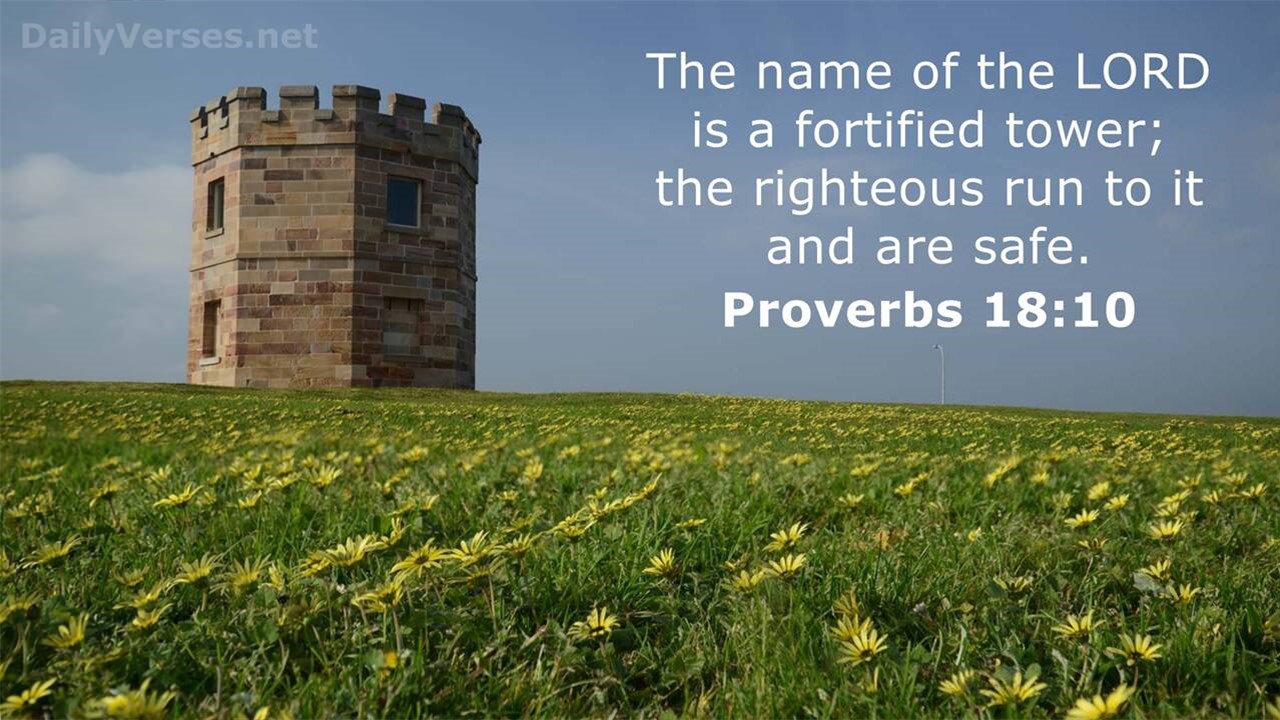
The Lord’s protection always surrounds us, and it always indwells us. In the Lord we find refuge. In the Lord we find life.
To God be the glory. Amen.

 Chasing the Wind
Leave a comment