
I. Icebreaker — Stories of Reconciliation
Before we turn to Nehemiah, let me connect us to where we’ve been the past couple of weeks.

Two weeks ago, Tommy used home renovation shows—things like Property Brothers—to help us think about rebuilding. That fit Nehemiah well, because Nehemiah quite literally asks the king for permission to rebuild Jerusalem. Walls, gates, rubble turned into something usable again.

Last week, Steve used movie clips about truth as we walked through Nehemiah 8—moments like “You can’t handle the truth.” God’s Word was read, explained, and understood. The people didn’t just hear Scripture; they were confronted by it.
This week, Nehemiah takes us one step further. Once the wall is rebuilt and once the truth has been heard, something still remains. Rebuilding and truth alone are not the end of the story. What follows is reconciliation.
I like action movies, but they can be somewhat mindless. “What was the movie about?” “I don’t remember, but something blew up.” There’s a reason those films don’t usually win Oscars. The meaningful movies are usually different. They’re about something broken being restored — a relationship, a misunderstanding, a sense of belonging. Reconciliation is what makes the story feel complete.
And we know—instinctively—that reconciliation is not free. In good stories, truth has to be spoken. Pride has to be lowered. Forgiveness has to be extended. And someone absorbs a cost. That’s why reconciliation feels weighty. That’s why it feels real.
Icebreaker Question:
Can you think of a movie where reconciliation is central to the story? What makes the ending feel right or satisfying?
Two that come to mind for me are It’s a Wonderful Life and The Wizard of Oz. Both end with reconciliation.
Nehemiah 9 and 12 show us that same movement — from truth to humility to restored joy. Israel does not skip to the celebration. They face God honestly first, because reconciliation with God begins there.
I.A. It’s a Wonderful Life

In the final scene of It’s a Wonderful Life, George Bailey is standing in his own living room, surrounded by people who have come to help him. His circumstances haven’t really changed. He still has financial trouble. He still lives in the same house. He still has the same job. What has changed is his understanding of his life.
Throughout the movie, George measures his life by what he didn’t get—travel, success, recognition. He interprets obedience as loss and faithfulness as regret. What he needed wasn’t a new future. He needed the truth about his past.
When Clarence shows him what the world would have looked like without his life, George finally sees meaning where he once saw failure. Nothing about his life is rewritten. It is re-understood.
That is very close to what happens in Nehemiah 9. Israel retells its story honestly—not selectively. They acknowledge rebellion and consequence, but they also acknowledge God’s patience and covenant faithfulness. The prayer doesn’t change history; it reframes it in light of who God has always been.
Nehemiah 9 is Israel’s Clarence moment—not pretending the past didn’t happen, but finally seeing what God has been doing all along.
I.B. The Wizard of Oz

In The Wizard of Oz, the entire story feels like a search for somewhere better. Everything suggests fulfillment lies “over the rainbow.”
But in the final scene, Dorothy wakes up at home. She hasn’t gained power or answers she didn’t already have. What she gains is clarity. Her famous line isn’t about adventure; it’s about reconciliation: “There’s no place like home.”
The reconciliation is internal before it’s external. Dorothy sees home rightly—and only then does the story feel complete.
That parallels Nehemiah 12. The people don’t dedicate the wall because it’s impressive. They dedicate it because it represents restored belonging. Jerusalem is not just a city again—it’s home. And before they celebrate, they purify themselves, acknowledging that restored joy requires restored relationship.
After the work is done and the truth has been heard, Israel finally stops to ask whether their hearts are reconciled to God.
II. Introduction — When the Work Is Finished but the Heart Is Not
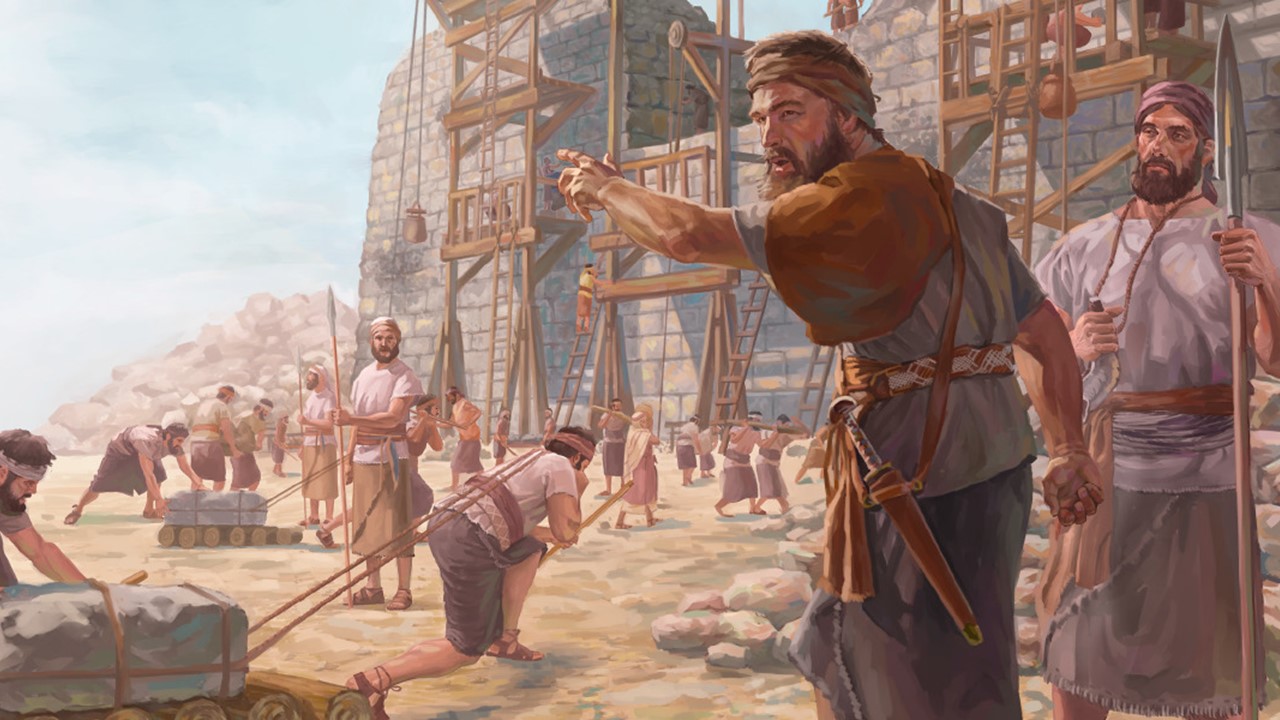
By the time we reach Nehemiah 9, something remarkable has already happened. The wall around Jerusalem has been rebuilt in just fifty-two days, thanks to Chip and Joanna. What generations thought was impossible has been accomplished. The city is secure. The threat from enemies has been pushed back. Structurally, Jerusalem is whole again.
This matters historically. Jerusalem had fallen in 586 BC. The exile lasted roughly seventy years. Many of the people standing in Nehemiah 9 are not the ones who saw the city fall—they are the children and grandchildren of exiles. For them, Jerusalem has always been a story of loss and shame.
In the ancient world, walls were not decorative. A city without walls was exposed—militarily, economically, and politically. It was also disgraced. A broken wall communicated vulnerability and defeat. Rebuilding the wall was the reversal of reproach. It restored dignity, identity, and security.
But Nehemiah understands something crucial: a rebuilt wall does not mean a restored people.
Scripture never confuses infrastructure with intimacy. A city can be fortified while hearts remain fractured. It would have been very easy at this point to declare victory, cut a ribbon, and move on. Instead, the leaders slow things down.
And what follows is one of the most theologically rich prayers in the Old Testament.
Nehemiah 9 and Nehemiah 12 together show us what real spiritual renewal looks like—not emotional hype, not surface-level change, but a deep, God-centered movement from confession, to cleansing, to joyful worship.
Reconciliation with God always has a direction, and Nehemiah shows us what that direction looks like. It begins inward, with humility before Him, and it ends outward, with joyful praise that cannot stay hidden.
III. Nehemiah 9:1–3 — The Seriousness of True Repentance
The chapter opens quietly, almost somberly:
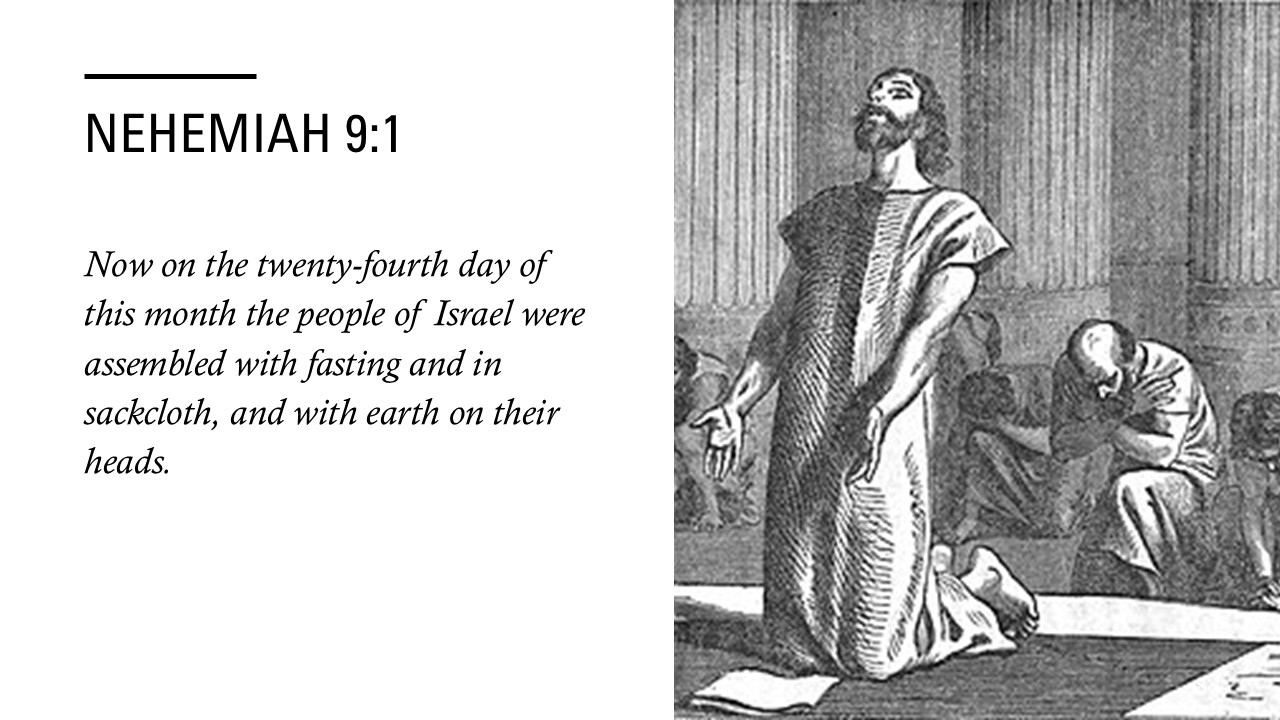
Now on the twenty-fourth day of this month the people of Israel were assembled with fasting and in sackcloth, and with earth on their heads.
In the ancient world, fasting, sackcloth, and dust were outward expressions of inward humility. The people are intentionally placing themselves low before God. They are expressing their sorrow.
This gathering happens right after the wall is finished and after the Law has been publicly read in chapter 8. God’s Word has done its work. It has exposed sin. It has reminded the people who they are and who God is. They were forced to “handle the truth.”
This is still the seventh month, following the Feast of Booths—a celebration designed to remind Israel of God’s provision during the wilderness years. But the celebration gives way to confession.
Verse 3 tells us how the day unfolds:
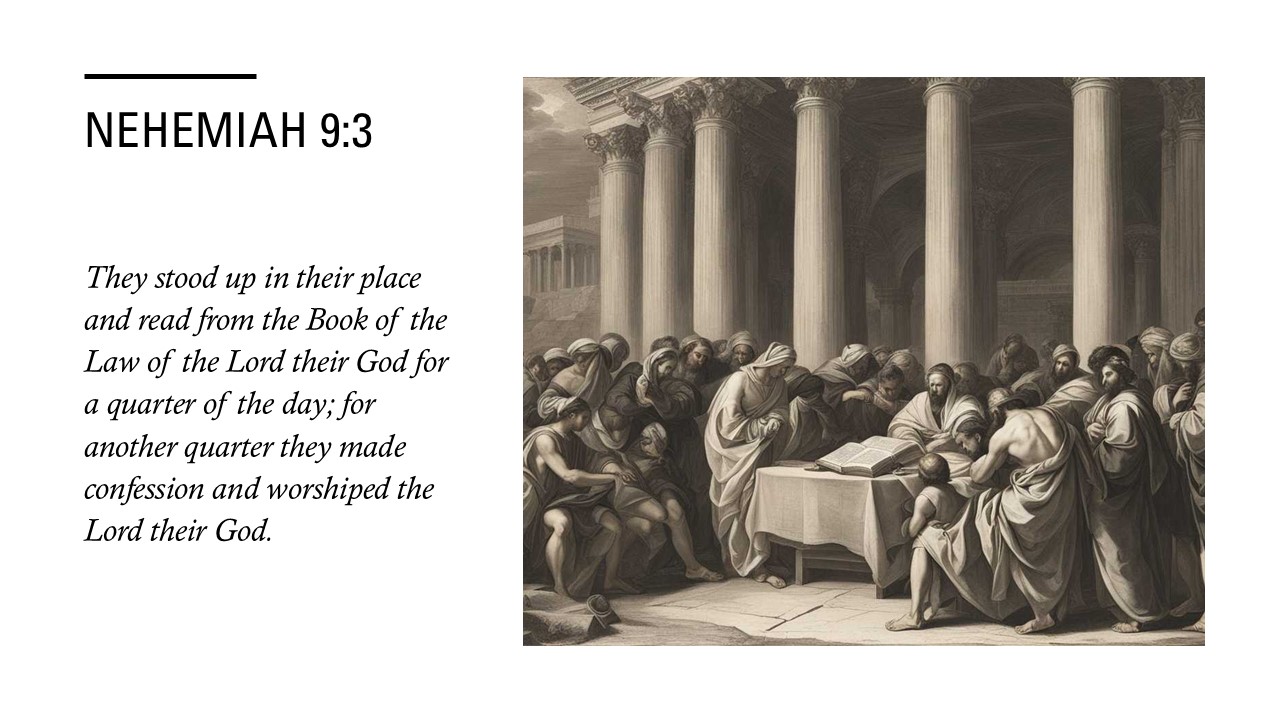
They stood up in their place and read from the Book of the Law of the Lord their God for a quarter of the day; for another quarter they made confession and worshiped the Lord their God.
This wasn’t a half-hour bible study. This “quarter of the day” works out to something like three hours, real time spent under Scripture, confession, and worship. They gave a large portion of the day to God, because the time spent seeking reconciliation was important. They weren’t rushing through it or trying to squeeze it between other priorities.
Notice the rhythm:
- Scripture first
- Confession next
- Worship flowing out of both
That order matters.
They don’t begin with feelings. They don’t begin with self-examination. They begin with God’s Word. Scripture defines reality. Scripture exposes sin. Scripture reminds them who God is before they say a word in response.
Confession without Scripture easily becomes vague. It turns into general regret. But when confession follows the Word, it becomes specific. It becomes informed. It becomes agreement with God.
There is also a corporate dimension here that we can’t miss. Israel owns its shared history and covenant responsibility. Verse 2 adds an important detail:
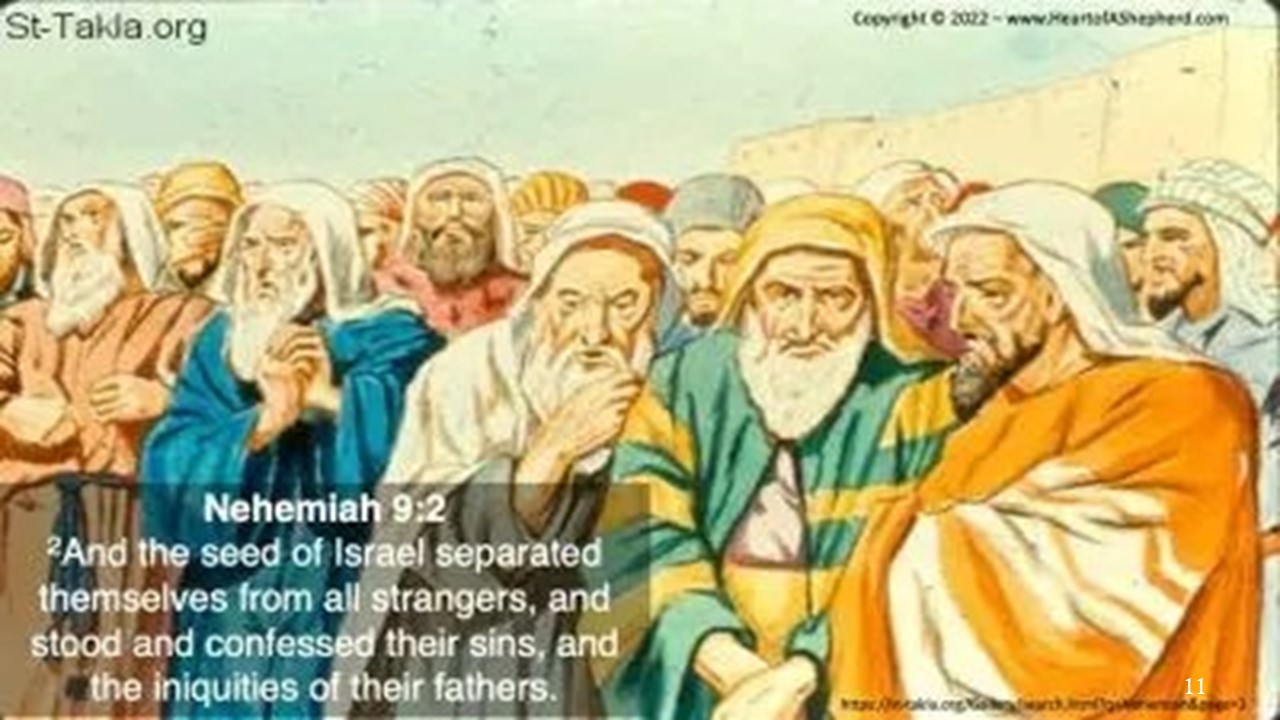
Those of Israelite descent had separated themselves from all foreigners. They stood in their places and confessed their sins and the sins of their ancestors.
The issue is not ethnicity; it is covenant faithfulness. Israel had blended worship of the Lord with surrounding practices. They had allowed compromise to creep in over generations. This moment represents a deliberate rejection of that mixture, not a rejection of people.
And notice something else — they confess “their sins and the sins of their fathers.” They are not blaming previous generations. They are acknowledging patterns.
Sin rarely appears out of nowhere. It often runs in families. It runs in cultures. It runs in churches. Habits form. Compromises settle in. Over time, what once would have shocked us becomes normal.
Mature repentance tells the truth about what we inherited and what we chose.
They are not saying, “That was our parents’ fault.”
They are saying, “We see the pattern — and it stops here.”
That kind of honesty is uncomfortable. But it’s also freeing. Because once you see the pattern clearly, you can break it.
Discussion Question:
Why do you think Scripture reading comes before confession instead of after it?
IV. Nehemiah 9:4–6 — Confession That Begins With God
After hours of Scripture and confession, something shifts.
They don’t stay bowed in regret. Confession moves forward into prayer. They lift their eyes.
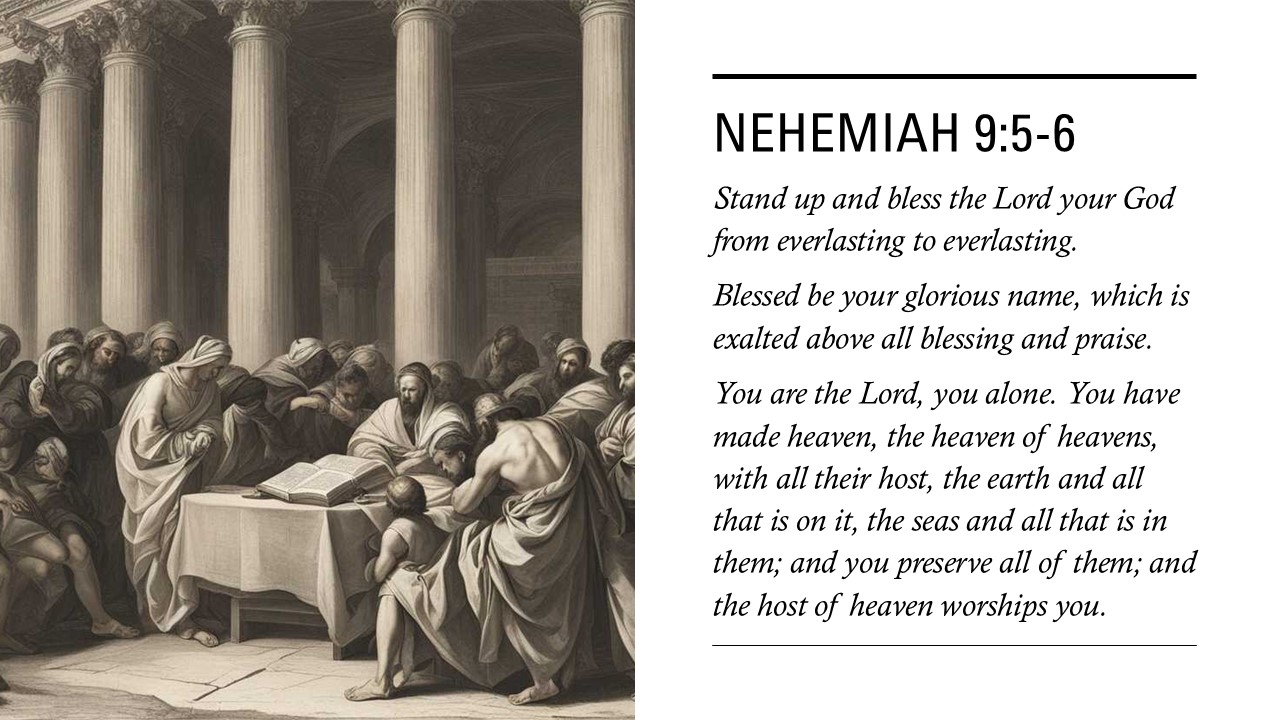
At that point, the Levites step forward and lead the assembly:
Stand up and bless the Lord your God from everlasting to everlasting.
Blessed be your glorious name, which is exalted above all blessing and praise.
You are the Lord, you alone. You have made heaven, the heaven of heavens, with all their host, the earth and all that is on it, the seas and all that is in them; and you preserve all of them; and the host of heaven worships you.
They don’t begin with, “We really messed up.”
They begin with, “You are the Lord.”
God is eternal — from everlasting to everlasting.
He is Creator — of heaven, earth, sea, everything.
He is Sustainer — He preserves all of it.
He is incomparable — worshiped even by the hosts of heaven.
That matters, because if you start with yourself, confession can crush you. If you start with God, confession steadies you.
Before they say anything more about their sin, they remind themselves who God is. The One they sinned against is also the One who preserves, who rules, who remains faithful.
That’s why confession here does not spiral into despair. It turns into worship.
If confession feels unbearable, maybe it’s because we’re staring at ourselves too long and not looking at God long enough.
Discussion Question:
How does starting confession with worship change the way repentance feels and functions?
V. Nehemiah 9:7–31 — Remembering the Story God Wrote
What follows is one of the longest prayers in Scripture. Rather than working through it verse by verse, it helps to see what the people are doing: They are retelling their entire history — out loud — before God. Not to inform Him of something He doesn’t know. But to align themselves with what is true.
If you wanted a Cliff Notes version of the Old Testament, this prayer would come close.
The prayer moves deliberately through Israel’s history.
- God chose Abram and made a covenant
- God delivered Israel from Egypt
- God sustained them in the wilderness
- God gave them the land
- God sent prophets when they rebelled
Over and over, the same pattern appears:
- God acts in faithfulness
- The people respond in disobedience
- God responds in mercy
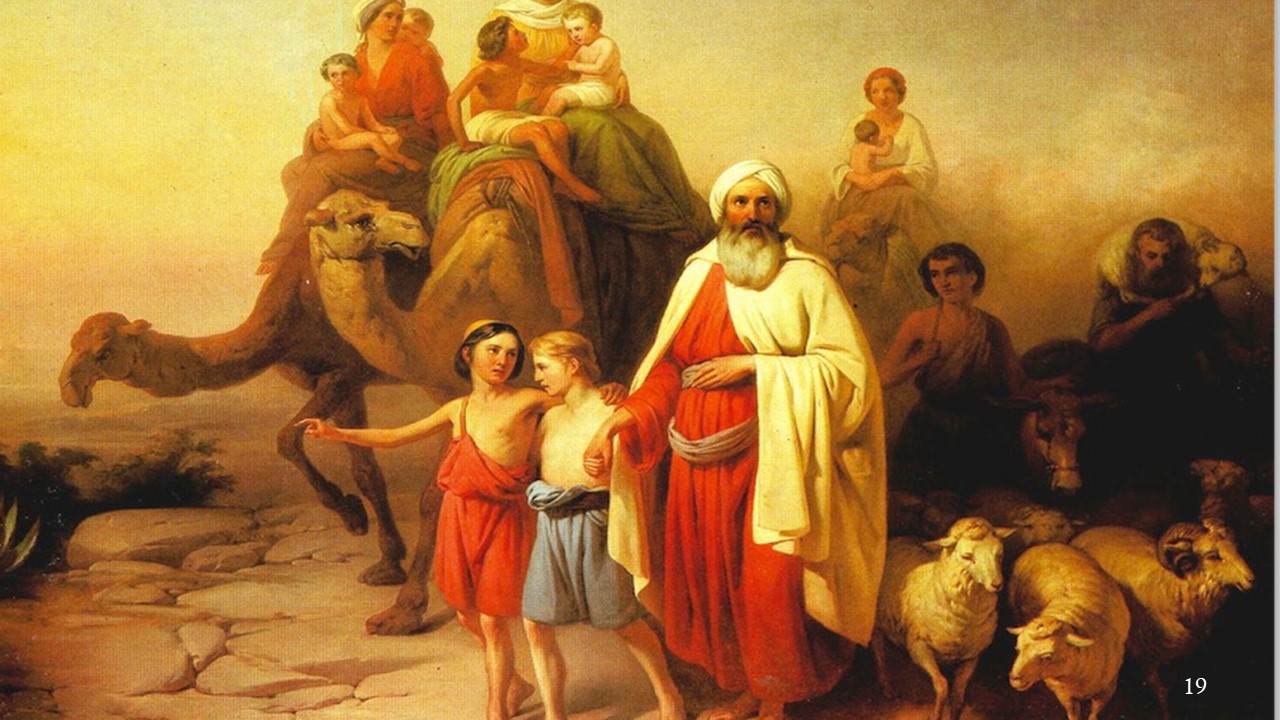
That’s the rhythm, the ebb and flow, of Israel’s history. The prayer begins with Abraham. Israel’s relationship with God did not begin with performance. It began with grace. God chose Abram. God made promises. God kept them. Israel’s story starts with God’s initiative, not their obedience.

Then comes Egypt and the Exodus. God saw their affliction. God heard their cries. God acted. He intervened in real history for real people.
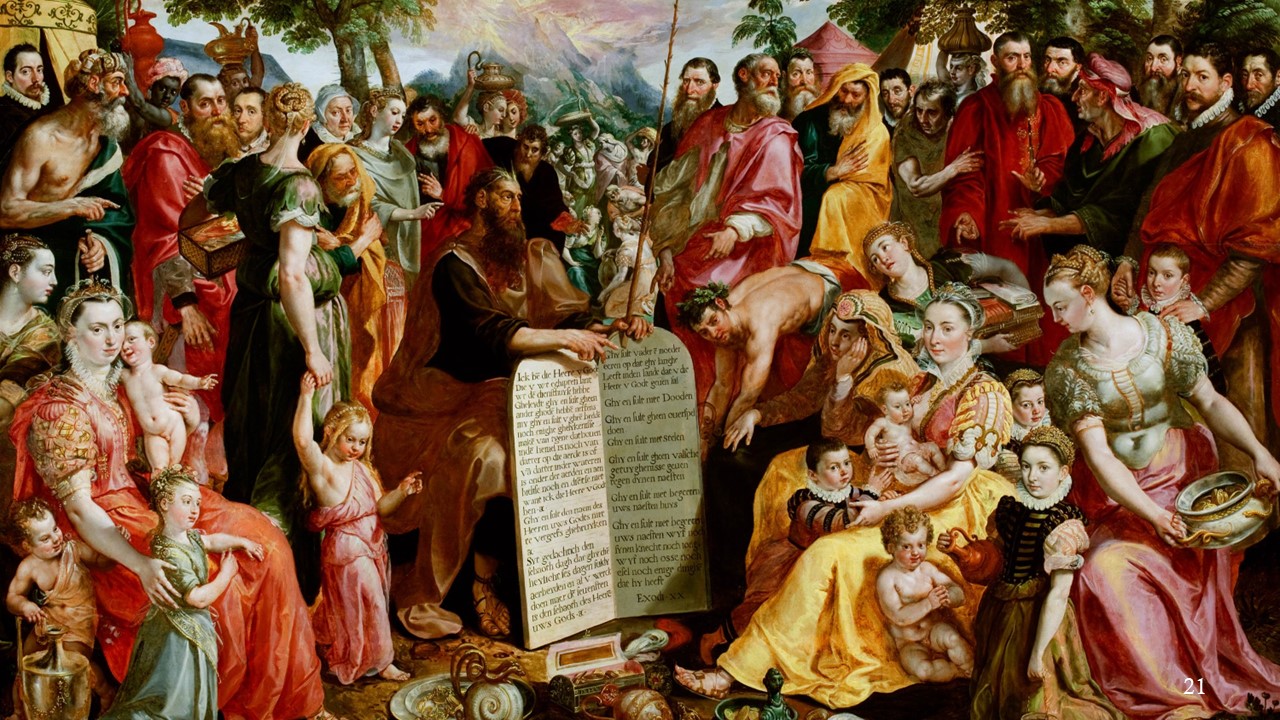
At Sinai, God gave His Law — described in Nehemiah’s prayer as good and right. Confession is not vague emotion. It is agreement with God that His ways are good and that departing from them has consequences.
Then the prayer turns painfully honest.
Even in the wilderness — surrounded by provision, guidance, and protection — they rebelled. They grew stiff-necked. They refused to listen. And yet God did not abandon them. He continued to lead. He continued to provide. He remained patient.
When they entered the land, a new danger appeared.

Prosperity.
They lived in cities they did not build. They ate from vineyards they did not plant. They enjoyed blessings they did not earn. And slowly, gratitude turned into self-sufficiency.
Through the judges and the kings, the cycle repeated:
Sin. Warning. Hardness. Discipline. Crying out. Deliverance.
Again and again, God responded with mercy rather than abandonment.
Verse 17 captures the heart of the prayer:

“But you are a God ready to forgive, gracious and merciful, slow to anger and abounding in steadfast love.”
The Hebrew word translated steadfast love (ḥesed) refers to covenant loyalty—God’s refusal to abandon His promises even when His people fail. When Scripture says God is “ready to forgive,” it does not mean God must be persuaded. It means mercy flows naturally from who He is.
Our culture talks a lot about love. But this isn’t sentimental love. It’s not romance, mood, or emotional intensity. It’s covenant love. Loyal love. Love that keeps its promises when the other party fails. Love that absorbs cost and remains faithful.
That’s the kind of love God says defines Him.
And because that is who God is, forgiveness does not mean pretending the past never happened.
Israel understands that.
Forgiveness does not erase memory. Israel does not say, “God forgave us, so the past no longer matters.” They rehearse it carefully. They tell the truth about it. Forgiveness is not denial; it is clarity.
Think of reconciliation with someone you trust — a spouse, a close friend, a child. Forgiveness restores the relationship, but it doesn’t pretend the failure never happened. In fact, forgiveness usually makes you wiser, not forgetful. Love remains, but maturity grows.
That’s exactly what Israel is doing here. They are forgiven, but they are not pretending nothing happened. They remember rightly so they can live wisely.
This prayer is not a performance. It is confession shaped by memory.
And maturity often looks like telling the truth about your story without rewriting it.
Discussion Question:
Why is remembering past failure essential to spiritual growth rather than a threat to it?
VI. Nehemiah 9:32–37 — Forgiven, Yet Still Accountable
As the prayer closes, the focus shifts to the present. Well, not today’s present, the past present. You know what I mean. After recounting generations of God’s faithfulness and Israel’s repeated failure, the people finally speak about where they stand now.
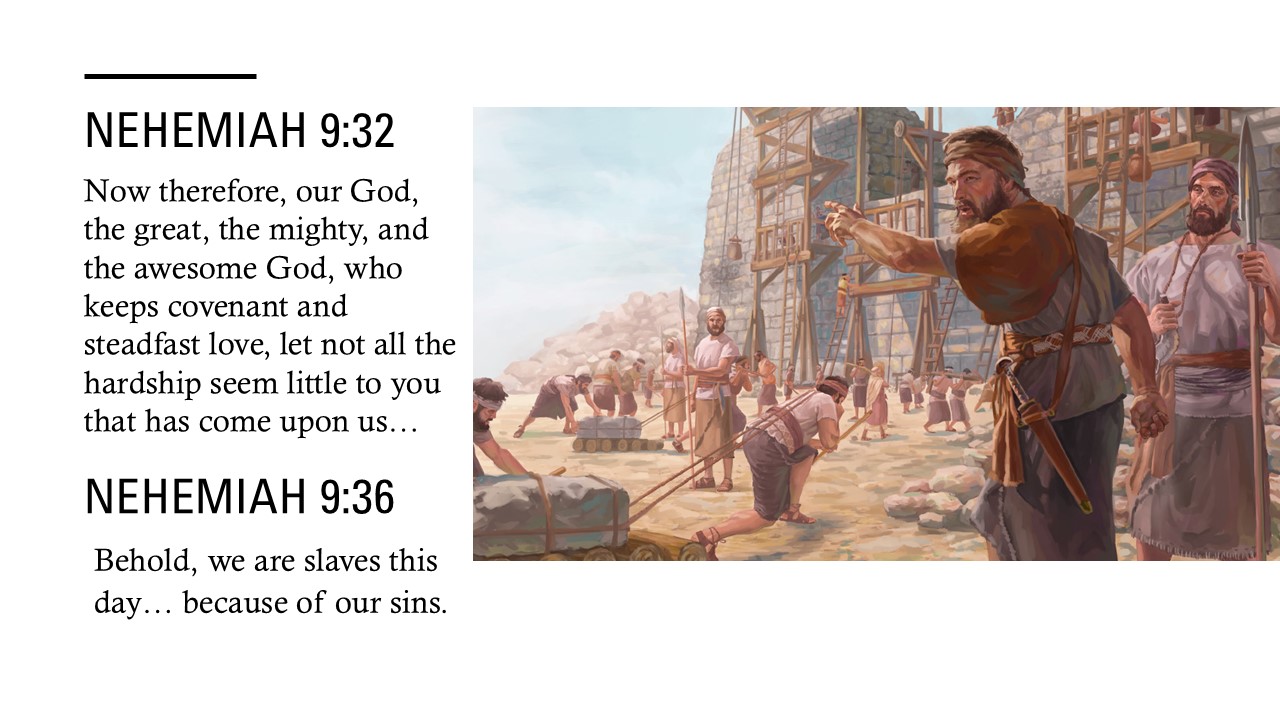
“Now therefore, our God, the great, the mighty, and the awesome God, who keeps covenant and steadfast love, let not all the hardship seem little to you that has come upon us…”
What strikes me here is how calmly Israel says this. There’s no panic, no argument, no attempt to soften the truth. They simply acknowledge where they are.
They are back in the land — but not fully free.
Verse 36 states it plainly:
“Behold, we are slaves this day… because of our sins.”
That is a striking admission. Jerusalem has a wall. The city is functioning again. And yet Israel remains under foreign rule, paying tribute to kings who are not their own. Forgiveness has not erased consequences. God has been faithful, but their choices still matter.
What is just as important is what Israel does not say. They do not accuse God of injustice. They do not suggest He overreacted. They do not argue that forgiveness should have canceled the outcome. Instead, they say plainly that God has been righteous in everything that has come upon them.
Grace restores relationship; wisdom reshapes how you move forward.
Grace is not the denial of consequences. Grace is the restoration of relationship in the midst of consequences. God forgives fully, and God governs wisely.
This is where we see the bigger picture. Israel is forgiven, but they still feel the weight of consequence. That tension doesn’t get fully resolved in Nehemiah. It waits for Christ.
At the cross, both guilt and consequence are dealt with completely. Sin is forgiven. Justice is satisfied. The relationship is restored once for all.
This is why repentance here is not about negotiating better circumstances. Israel is not asking God to undo the last seventy years. They are realigning themselves with God’s righteousness, even while life remains complicated.
Israel’s prayer ends not with despair, but with humility. They do not demand relief; they entrust themselves to God’s covenant mercy. And that posture prepares them for what comes next — not more confession, but renewed commitment and joyful worship.
VII. Nehemiah 12:27–30 — Cleansing Before Celebration
With Nehemiah 12, the narrative finally moves from prayer to action. Confession has been made. Truth has been spoken. The people are ready to celebrate — but they do not rush into it.
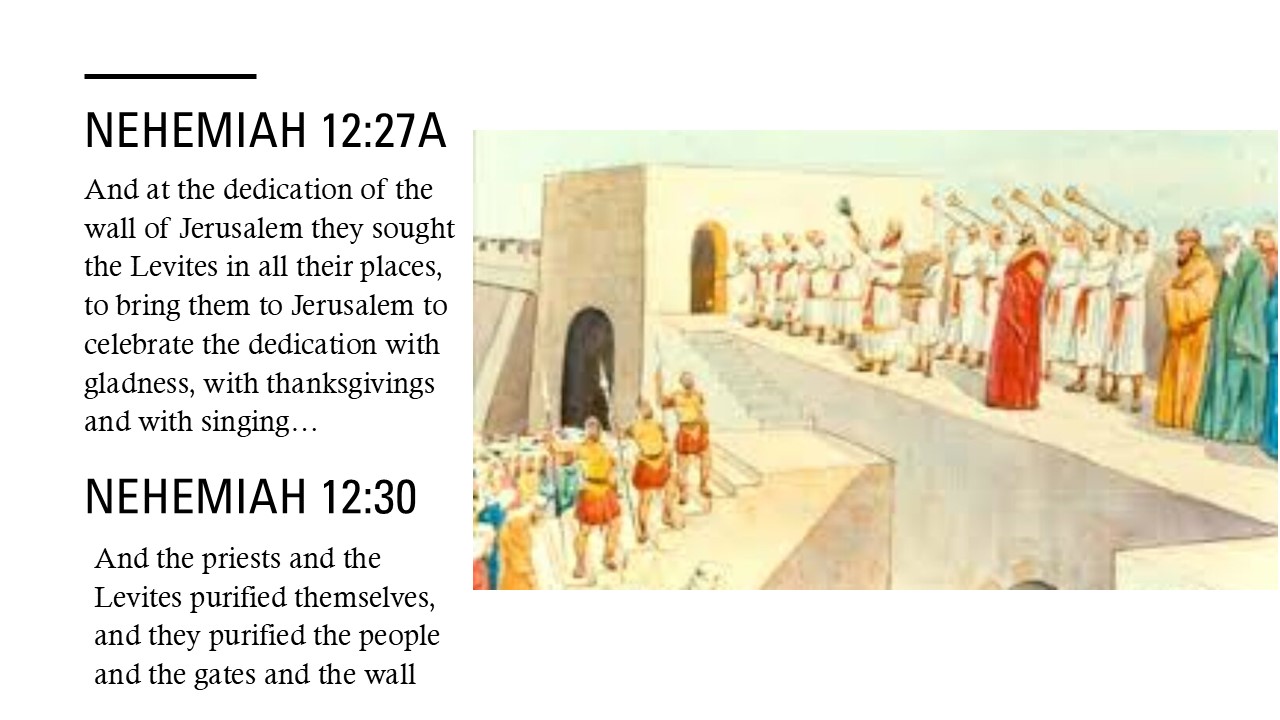
The dedication of the wall is planned intentionally:
“And at the dedication of the wall of Jerusalem they sought the Levites in all their places, to bring them to Jerusalem to celebrate the dedication with gladness, with thanksgivings and with singing…”
Music enters the story. Singers are gathered. Instruments are prepared. Joy is clearly coming. But before the music starts, Nehemiah slows us down and points out something essential:
“And the priests and the Levites purified themselves, and they purified the people and the gates and the wall.”
Purification precedes celebration.
In the Old Testament, purification does not mean moral perfection. It means being set apart for God’s purposes. Notice the order: leaders first, then the people, then even the physical structures. Worship begins with reverence, not emotion.
This reflects a deep biblical distinction between what is common and what is holy. Holy does not mean strange; it means devoted. The dedication of the wall declares, “This belongs to the Lord.”
They are not scrubbing bricks for cleanliness. They are consecrating the wall as a visible testimony that what God has restored now belongs to Him. This is not a civic ceremony with a prayer attached. It is worship.
This moment teaches us something countercultural. Joy in worship is not diminished by reverence—it is strengthened by it. Celebration that follows repentance has depth. Gratitude that follows cleansing has weight.
Preparation for worship is not about ritual; it is about readiness. Hearts aligned with God experience joy more fully.
VIII. Nehemiah 12:31–43 — Joy That Cannot Be Contained
With the people purified and the wall dedicated, the celebration finally begins.
And what a scene it is.
Two large choirs climb up onto the wall itself and start walking in opposite directions around the city. Think about that. The very wall that once symbolized shame and vulnerability now becomes the stage for worship.
The wall isn’t just standing — it’s singing.
As they move, Nehemiah names the people involved. Singers. Priests. Gatekeepers. Families. Regular people. The kind of names we’re tempted to skip over.
But that’s the point.
Renewal isn’t carried by a few visible leaders. It’s sustained by faithful, ordinary obedience.
This isn’t chaos. It’s not hype. It’s organized, deliberate worship. Gratitude guided by truth.
Sacrifices are offered, and Nehemiah says, “God made them rejoice with great joy.”
That phrase matters.
This joy isn’t forced. It isn’t whipped up. It’s given.
Joy here is not the substitute for reconciliation — it’s the result of it.
Remember how we said the best stories are the ones where something broken is restored?
Nehemiah gives us that closing line:
“The joy of Jerusalem was heard far away.”
That’s not exaggeration. That’s the point. This wasn’t quiet, private satisfaction. This was visible, audible, undeniable joy.
Earlier in the book, Jerusalem was known for disgrace. The walls were broken. The gates were burned. The city was vulnerable. Now it’s known for joy.
What changed? Not just the wall. The people. Joy that flows from repentance and restored relationship carries weight. It travels. It testifies.
They don’t organize an outreach strategy. They don’t try to market their renewal. They simply worship — and the sound carries.
There’s a difference between joy rooted in circumstances and joy rooted in obedience.
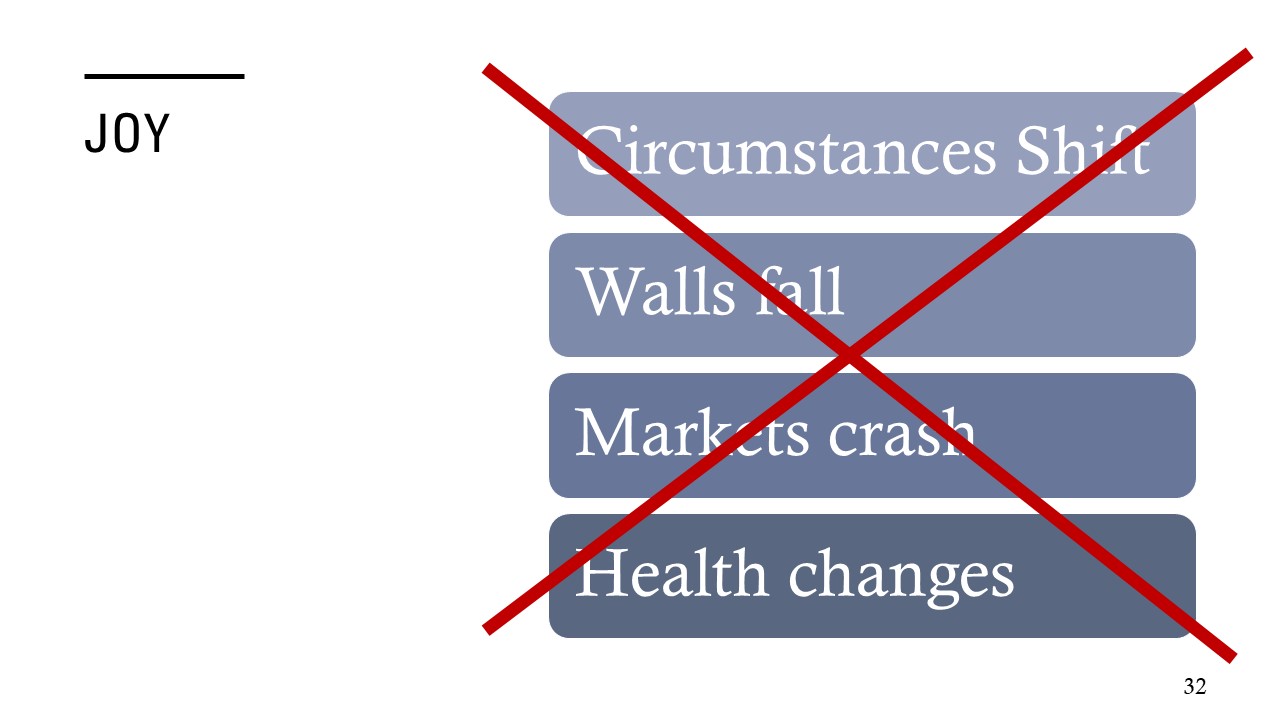
Circumstances shift. Walls fall. Markets crash. Health changes.
Obedience anchors.

Circumstance-based joy is fragile. Reconciled joy endures.
That’s why this joy could be heard far away. It wasn’t hype. It wasn’t denial. It wasn’t distraction.
It was the sound of a people who had faced the truth, confessed their sin, remembered their story, and anchored themselves again in the steadfast love of God.
And when that happens, worship cannot stay quiet.
Discussion Question:
How does joy that flows from obedience differ from joy based on circumstances?
IX. Conclusion — The Shape of Real Renewal
Nehemiah 9 and 12 show us the shape of genuine spiritual renewal.
It does not begin with rebuilding.
It does not begin with celebration.
It begins with truth.
God’s Word is read and understood.
Sin is confessed honestly.
History is remembered accurately.
God is acknowledged for who He actually is.
What Israel needed was not a new story, but a true one. They did not escape their past; they told it honestly. They did not deny failure; they confessed it. And they did not stay in regret; they moved forward into worship.
That order matters.
Reconciliation with God is never achieved by pretending, minimizing, or rushing past repentance. It comes through humility, clarity, and trust in God’s covenant mercy. Only then does joy emerge—not as emotional intensity, but as a steady response to grace.
When the people celebrate in Nehemiah 12, the joy is real because the reconciliation is real. The wall is dedicated, yes—but more importantly, the people are restored. Their worship is loud not because they are trying to convince themselves, but because they have been convinced of God’s faithfulness.
And the result?
“The joy of Jerusalem was heard far away.”
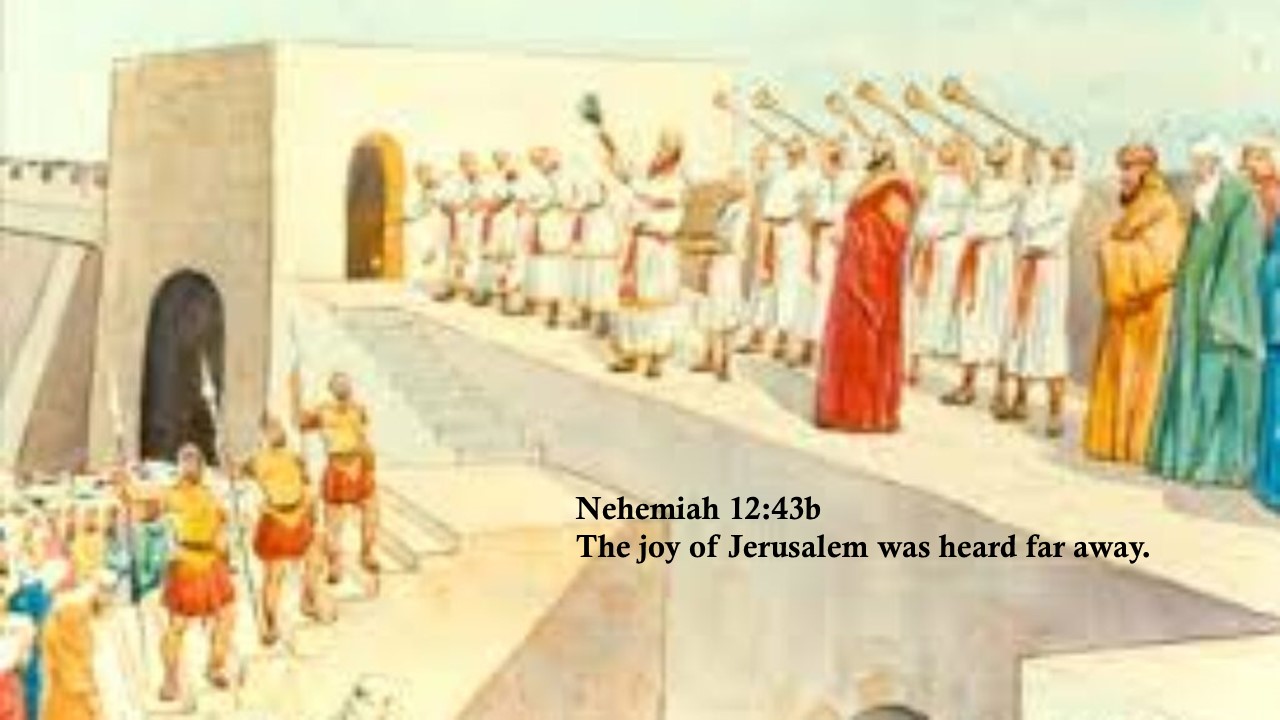
That is what happens when God’s people are reconciled to Him. Not perfect. Not pain-free. But honest. Humbled. Forgiven. Grateful.
Worship becomes witness.
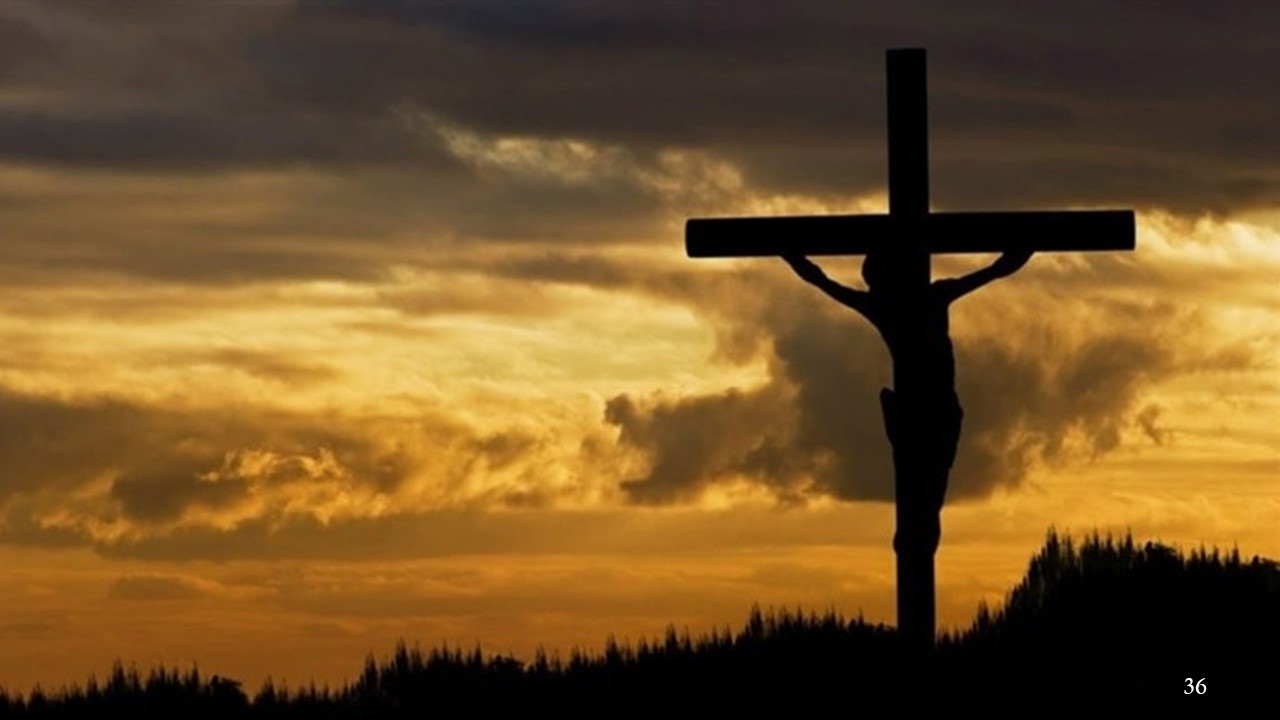
For us, that joy rests on something even greater. Israel looked back at covenant mercy. We look to a finished cross. Christ has borne the guilt. Justice has been satisfied. The relationship has been restored.
So we come the same way Israel did—through truth, through confession, through grace.
And we leave the same way they did: with worship that cannot stay quiet.
Because grace is real.
And God is faithful.
To God be the Glory.

 Chasing the Wind
Leave a comment