
I. Introduction to the Olivet Discourse
I’m trying an addition to the lesson by adding an outline and an objective, probably influenced by a high school English teacher from 1978 who taught me to write term papers. Thank you, Mrs. What’s Your Name.
So here’s our objective for today –
Explore the signs that precede Christ’s return and the importance of understanding biblical prophecy in the context of Jewish expectations and Christian readiness.
And an outline we’ll follow as we study Matthew 24:
- Olivet Discourse
- Signs of the Beginning of Sorrows
- Birth Pains
- The Great Tribulation
We’ll begin, of course, at the beginning, the Olivet Discourse –
- Context and Setting
- Olivet Discourse
- Parousia (Second Coming)
a. Context and setting
Matthew 24:1-2,
Jesus left the temple area and was going on His way when His disciples came up to point out the temple buildings to Him. “Do you see all these things?” he asked. “Truly I tell you, not one stone here will be left on another; every one will be thrown down.”
Jesus responds to His disciples’ comments about the temple with a startling prophecy about its complete destruction. This prediction not only forecasts the physical destruction of the temple in 70 A.D. but also symbolizes the end of an era and the fulfillment of prophecy. This statement sets the tone for the forthcoming discourse, highlighting that earthly structures are transient, but His kingdom is everlasting.
Discussion Question: How does the destruction of the temple and Jesus’ prophecy about impermanence challenge our understanding of what is truly enduring in our own lives and communities today?
b. Olivet Discourse
Matthew 24:3,
As Jesus was sitting on the Mount of Olives, the disciples came to him privately. ‘Tell us,’ they said, ‘when will this happen, and what will be the sign of your coming and of the end of the age?’
Why do scholars call this the “Olivet Discourse”? One theory, is because we study the whole thing instead of just part of it. That’s why it’s called the “All of it” Discourse instead of the “Some of it” Discourse. It’s not a good theory though.
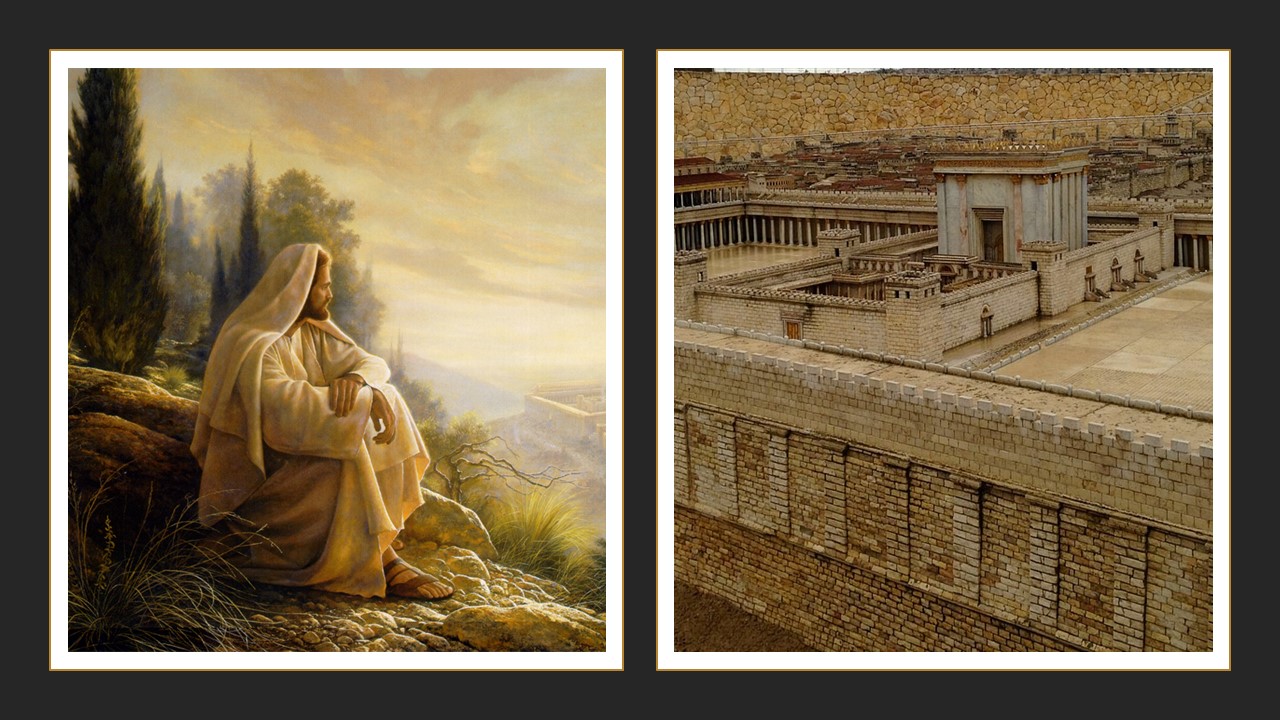
A better theory is that because Jesus, having just prophesied the temple’s destruction, sits on the Mount of Olives directly across from the temple grounds. This location is deeply intertwined with His teachings about the end times. The Mount of Olives is noted in prophetic scriptures, particularly in Jewish eschatology, as a significant location for messianic events.
Zechariah 14:4,
‘On that day his feet shall stand on the Mount of Olives that lies before Jerusalem on the east, and the Mount of Olives shall be split in two from east to west by a very wide valley, so that one half of the Mount shall move northward, and the other half southward.’
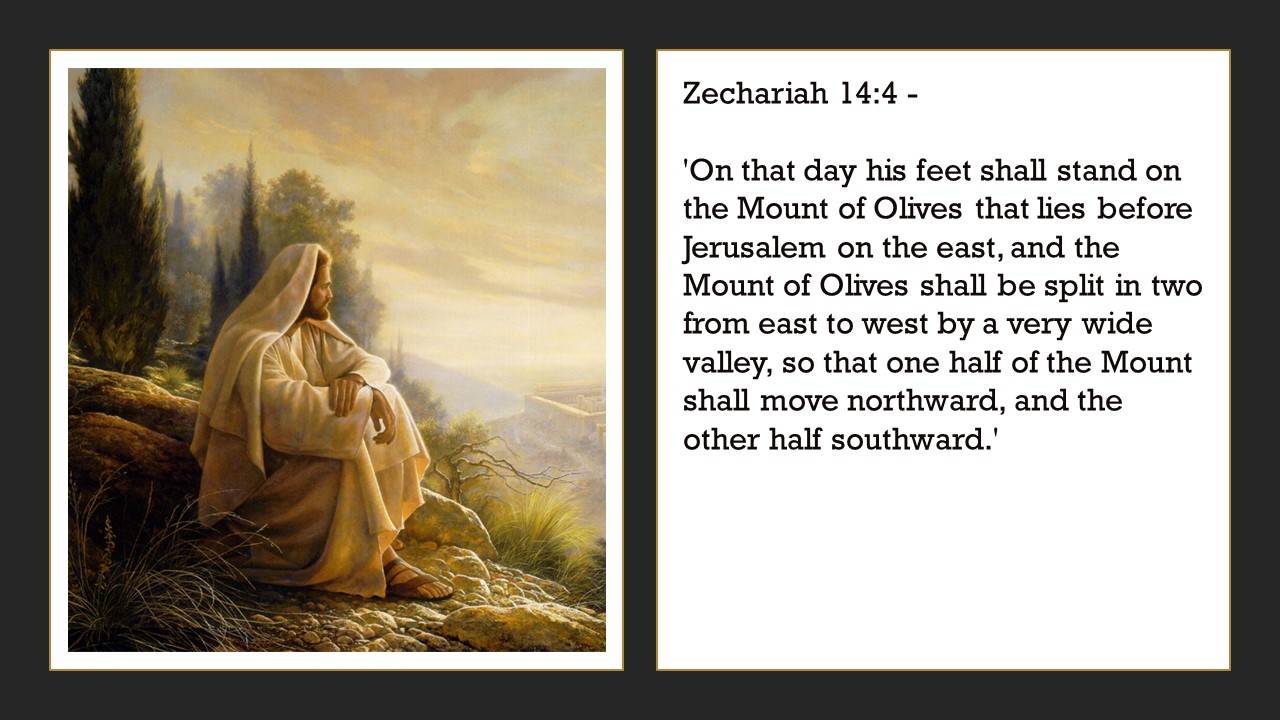
The Lord will initiate the final events of the end times from the Mount of Olives. It serves as a visual reinforcement of His teachings, with the temple in view, symbolizing the old order that will pass away, and the Mount of Olives representing the fulfillment of God’s plans for the end times. When referring to Jesus’ teachings in Matthew 24 and 25 as the ‘Olivet Discourse,’ we acknowledge the significance of His choice of location. This discourse is firmly anchored to a physical place where future events will unfold.
c. Parousia (Second Coming)
The Greek term ‘Parousia’ (παρουσία), used by Jesus in the New Testament, translates to ‘coming’ or ‘presence’ and specifically refers to the Second Coming of Christ. It signifies not just an arrival but the establishment of His presence, marking a pivotal moment in history.
In the Olivet Discourse, Jesus employs ‘Parousia’ to indicate not only His physical return but also the full manifestation of His kingdom on earth—an act of divine intervention that will transform the global order and fulfill the scriptural promises of justice and restoration.
Matthew 24 is commonly interpreted as a discussion of the Second Coming of Christ rather than the Rapture for several key reasons:
- Jesus primarily addresses His Jewish disciples, pointing to tribulation signs specific to Israel, such as “the time of Jacob’s trouble” (Jeremiah 30:7). This is seen as a period for fulfilling God’s promises to Israel.
- The events Jesus describes, including wars, famines, and the abomination of desolation, are public and global, visible to all humanity. This contrasts with the Rapture, depicted in 1 Thessalonians 4:17 as a sudden event where believers meet Christ in the air, largely unseen by the world.
- Matthew 24 emphasizes visible signs and the need for readiness and endurance through tribulation, leading up to Christ’s glorious return, which is observable rather than secretive.
- The narrative concludes with the gathering of the elect “from the four winds, from one end of heaven to the other,” post-tribulation. This assembly aligns with the traditional narrative of the Second Coming, where Christ reunites with His faithful on Earth, rather than a pre-tribulation Rapture.
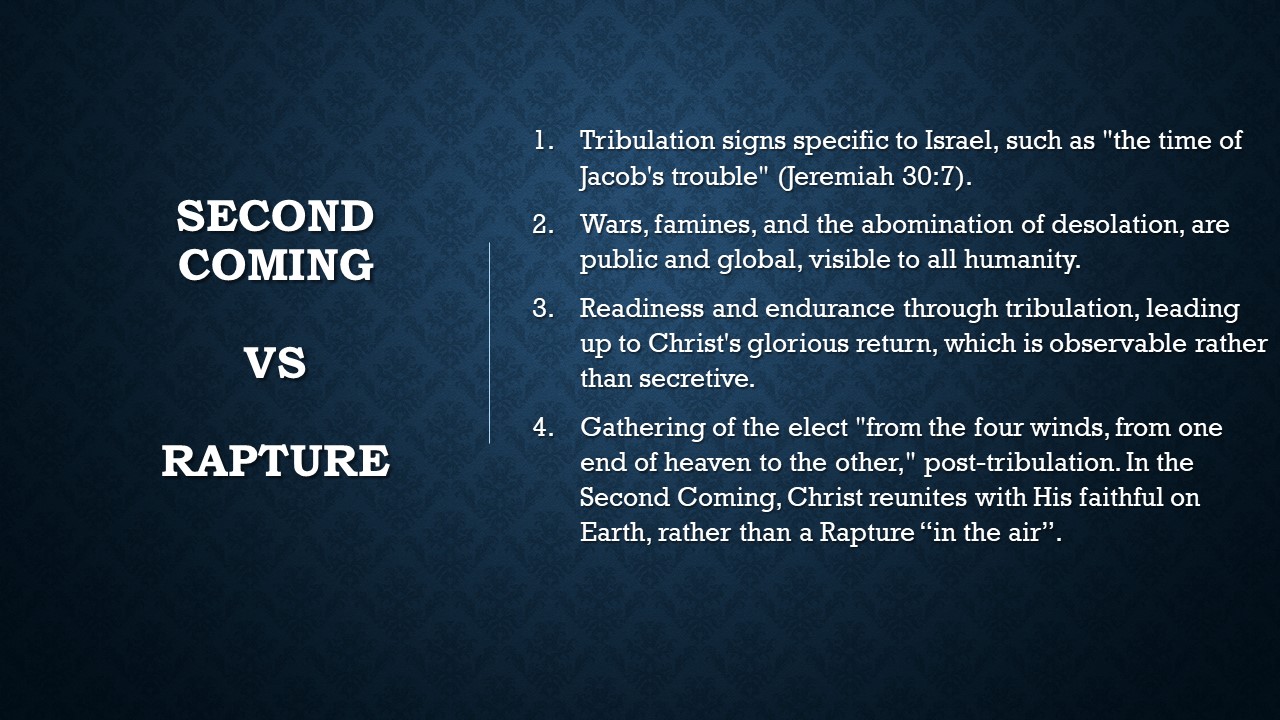
Given these factors, many scholars and theologians argue that Matthew 24 is more aligned with descriptions of the Second Coming rather than a pre-tribulation Rapture event.
Discussion Question: How does understanding Matthew 24 as a description of the Second Coming rather than the Rapture change our approach to interpreting the events and warnings Jesus provides?
II. Signs of the Beginning of Sorrows
a. Deceptions, wars, famines, earthquakes
Matthew 24:4-7:
Jesus answered: ‘Watch out that no one deceives you. For many will come in my name, claiming, ‘I am the Messiah,’ and will deceive many. You will hear of wars and rumors of wars, but see to it that you are not alarmed. Such things must happen, but the end is still to come. Nation will rise against nation, and kingdom against kingdom. There will be famines and earthquakes in various places.’
In this passage, Jesus details signs of the approaching end times: deceptions, wars, famines, and earthquakes, all with deep roots in the first-century experiences of His audience and significant prophetic implications:
- Deceptions: Jesus warns against false messiahs who exploit the Jewish expectation of a savior. He urges vigilance and fidelity to His teachings, highlighting the ongoing challenge posed by such deceivers throughout history, not just in the first century. This deception is a crucial sign for the disciples to remain alert and committed to the truth to avoid being led astray.
- Wars: Jesus discusses the prevalence of wars and rumors of wars, reflecting the constant political and military unrest characteristic of the Roman Empire. He advises His followers not to be alarmed by these events, emphasizing that they do not directly indicate the immediate onset of the end times.
- Famines and Earthquakes: These phenomena are often consequences of war, poor governance, or natural disasters and result in significant human suffering. Earthquakes, in particular, were sometimes viewed as divine signals. Jesus points to famines and earthquakes as signs of both physical and cosmic upheaval, signaling the creation’s response to the unfolding end times.
By contextualizing these signs within the experiences of His first-century audience, Jesus makes the reality of future tribulations immediate and understandable, emphasizing these are not mere predictions but real indicators of escalating events leading to the culmination of this age.
Discussion Question: How do these signs relate to today’s global events?
b. Old Testament parallels and prophecies
Jesus not only describes signs of the impending end times in Matthew 24 but also connects them to several Old Testament prophecies, reinforcing the continuity of His message with Hebrew Scriptures.
- Deceptions and False Messiahs: The warnings against deceivers are deeply rooted in the Old Testament. For example, Deuteronomy 13:1-3 cautions the Israelites against false prophets who perform signs and wonders to lead them astray. This connection emphasizes the enduring challenge of discerning true from false teachings and remaining faithful to God’s commandments.
- Wars and Rumors of Wars: The theme of war is prevalent throughout the Old Testament, often symbolizing both social and divine judgment. Isaiah 19:2, for instance, vividly describes internal conflicts within Egypt as a metaphor for broader cosmic and spiritual upheavals, reflecting the ongoing strife depicted in Jesus’ prophecy.
- Famines and Earthquakes: Famines are frequently depicted as divine responses to Israel’s disobedience or as part of the trials faced by the people. The famine during Elijah’s time (1 Kings 18) highlights the severe consequences of national apostasy. Similarly, earthquakes are portrayed in passages like Isaiah 29:6 and Amos 8:8 as demonstrations of God’s formidable power and judgment.
By linking these signs to Old Testament prophecies, Jesus not only asserts His prophetic authority but also situates His teachings within the broader narrative of God’s dealings with humanity. His disciples, familiar with these scriptures, would recognize these signs as indicators of significant transitions in God’s plan, underscoring the need for readiness and spiritual vigilance.
III. Birth Pains and the Gospel’s Proclamation
a. Birth pains, persecution, apostasy, and the importance of endurance
Matthew 24:8-14 –
But all these things are merely the beginning of birth pains. Then they will hand you over to tribulation and kill you, and you will be hated by all nations because of My name. And at that time many will fall away, and they will betray one another and hate one another. And many false prophets will rise up and mislead many people. And because lawlessness is increased, most people’s love will become cold. But the one who endures to the end is the one who will be saved. This gospel of the kingdom shall be preached in the whole world as a testimony to all the nations, and then the end will come.
- Beginning of Birth Pains: Jesus likens the early signs of wars, famines, and earthquakes to “birth pains,” a metaphor suggesting escalating intensity and frequency, setting the stage for His return. This imagery captures the sense of increasing adversity leading up to the climactic events of Christ’s return.
- Tribulation and Martyrdom: Followers of Christ are warned to expect severe persecution, including death and universal hatred. This direct prophecy emphasizes the profound commitment required and the broad scope of the hostility believers will face.
- Apostasy and Deception: Jesus predicts a significant falling away from the faith, exacerbated by false prophets. The increase in lawlessness and the cooling of many people’s love highlight the moral decline of the period.
- Endurance and Salvation: Despite these challenges, Jesus underscores the vital importance of enduring to the end, linking perseverance directly with salvation. This emphasis on steadfast faith and moral integrity is portrayed as crucial for overcoming adversity.
- Global Proclamation of the Gospel: Contrasting the grim depiction of persecution, Jesus offers a message of hope: the gospel will be proclaimed worldwide, signaling the approach of the end. This worldwide evangelism is depicted as both a sign and a necessity for the fulfillment of God’s redemptive plan.
Discussion Question: In what ways does the call to endurance challenge modern believers?
b. “Abomination of Desolation”
Matthew 24:15-20
Therefore when you see the abomination of desolation which was spoken of through Daniel the prophet, standing in the holy place—let the reader understand — then those who are in Judea must flee to the mountains. Whoever is on the housetop must not go down to get things out of his house. And whoever is in the field must not turn back to get his cloak. But woe to those women who are pregnant, and to those who are nursing babies in those days! Moreover, pray that when you flee, it will not be in the winter, or on a Sabbath.
- Historical and Prophetic Context: The term ‘abomination of desolation’ is a significant marker first mentioned in the book of Daniel (Daniel 9:27, 11:31, and 12:11). It refers to an act of sacrilege that leads to severe desolation. Historically, this prophecy was foreshadowed when Antiochus IV Epiphanes desecrated the Second Temple in 167 BC by erecting an altar to Zeus inside it and sacrificing swine, which was an abomination to the Jewish faith.
- Jesus’ Prophecy: Jesus points to this future event as a pivotal sign of the end times, emphasizing its severity and the need for immediate action. The direct instructions to flee highlight the urgency and the life-threatening implications of witnessing the abomination of desolation.
- Importance of Jewish Temple Worship: The desecration of the Temple, central to Jewish faith and the locus of God’s covenantal presence, marks not just a religious violation but signaling changes in God’s dealings with humanity.
- Scriptural References and Eschatological Significance: Daniel 9:27: Describes the abomination as part of a covenant broken, leading to desolation.
And he will confirm a covenant with the many for one week, but in the middle of the week he will put a stop to sacrifice and grain offering; and on the wing of abominations will come the one who makes desolate, until a complete destruction, one that is decreed, gushes forth on the one who makes desolate.”
Daniel 12:1: This reference to a time of distress ties into the events surrounding the abomination, suggesting a period of unparalleled trouble for the Jewish people.
Now at that time Michael, the great prince who stands guard over the sons of your people, will arise. And there will be a time of distress such as never occurred since there was a nation until that time; and at that time your people, everyone who is found written in the book, will be rescued.
- Practical Implications and Instructions: Jesus’ urgent call for those in Judea to flee underscores the practical steps needed to avoid catastrophe, reflecting the broader eschatological theme that those witnessing the event are on the precipice of great tribulation, leading up to Christ’s return.
Discussion Question: How does the prophecy of the abomination of desolation inform our understanding of future events?
IV. The Great Tribulation
a. Severity and Uniqueness
Matthew 24:21-22,
For then there will be a great tribulation, such as has not occurred since the beginning of the world until now, nor ever will again. And if those days had not been cut short, no life would have been saved; but for the sake of the elect those days will be cut short.
- Severity and Uniqueness: Jesus highlights the unprecedented severity of the forthcoming tribulation, a period of intense suffering and widespread devastation unlike anything previously experienced. This tribulation is marked by events so severe they threaten the very existence of life on earth.
- Divine Intervention: The shortening of these days for the sake of the elect points to a direct divine intervention. This action reflects God’s continued commitment to His chosen people, ensuring their survival in the midst of unparalleled chaos.
- Eschatological Focus: This period of great tribulation serves as a crucial juncture in eschatological prophecy, representing the climax of the end-time events that will culminate in Christ’s return.
b. Cosmic Disturbances as Prophetic Signs
Matthew 24:23-31,
Then if anyone says to you, ‘Behold, here is the Christ,’ or ‘He is over here,’ do not believe him. For false christs and false prophets will arise and will provide great signs and wonders, so as to mislead, if possible, even the elect. Behold, I have told you in advance. So if they say to you, ‘Behold, He is in the wilderness,’ do not go out; or, ‘Behold, He is in the inner rooms,’ do not believe them. For just as the lightning comes from the east and flashes as far as the west, so will the coming of the Son of Man be. Wherever the corpse is, there the vultures will gather.
But immediately after the tribulation of those days the sun will be darkened, and the moon will not give its light, and the stars will fall from the sky, and the powers of the heavens will be shaken. And then the sign of the Son of Man will appear in the sky, and then all the tribes of the earth will mourn, and they will see the Son of Man coming on the clouds of the sky with power and great glory. And He will send forth His angels with a great trumpet blast, and they will gather together His elect from the four winds, from one end of the sky to the other.
- Biblical and Prophetic Context: The cosmic disturbances—darkening of the sun and moon, falling stars, and the shaking of heavenly bodies—are deeply embedded in prophetic literature, reflecting Old Testament prophecies like Isaiah 13:10 (“The stars of heaven and their constellations will not show their light. The rising sun will be darkened and the moon will not give its light.”) and Joel 2:31 (“The sun will be turned to darkness and the moon to blood before the great and dreadful day of the LORD comes.”). These signs underscore the alignment of New Testament events with biblical prophecies, marking the dramatic prelude to the Second Coming.
- Sign of the Son of Man: The appearance of the Son of Man in the sky represents a critical moment of messianic fulfillment and divine rulership. This spectacular sign is both a declaration of Christ’s imminent return and a cause for global mourning, as it signals the impending judgment and the culmination of God’s redemptive plan.
- Gathering of the Elect: The summoning of the elect from across the earth by angels, heralded by a loud trumpet call, highlights the final act of redemption and the protective gathering of God’s chosen ones. This event is central to the eschatological narrative, symbolizing the assembly of the faithful in anticipation of establishing God’s kingdom on Earth.
Discussion Question: What are the implications of these cosmic signs for the Jewish people and the world?
Matthew 24 verse 32? Tune in next week, same Bat-channel, same Bat-time.
To God be the Glory, amen.


 Chasing the Wind
Leave a comment