

I. Introduction
Over the next three weeks, we will study Matthew 26, focusing on the last hours of Jesus, His arrest, and the trial events. Today, we begin with Matthew 26:1-25. This passage covers the events leading up to Jesus’ arrest, marking the beginning of the Passion narrative. It includes Jesus predicting His crucifixion, the plot by the religious leaders to arrest Him, the anointing at Bethany, Judas’ decision to betray Jesus, the preparations for the Passover meal, and the Last Supper where Jesus identifies His betrayer.
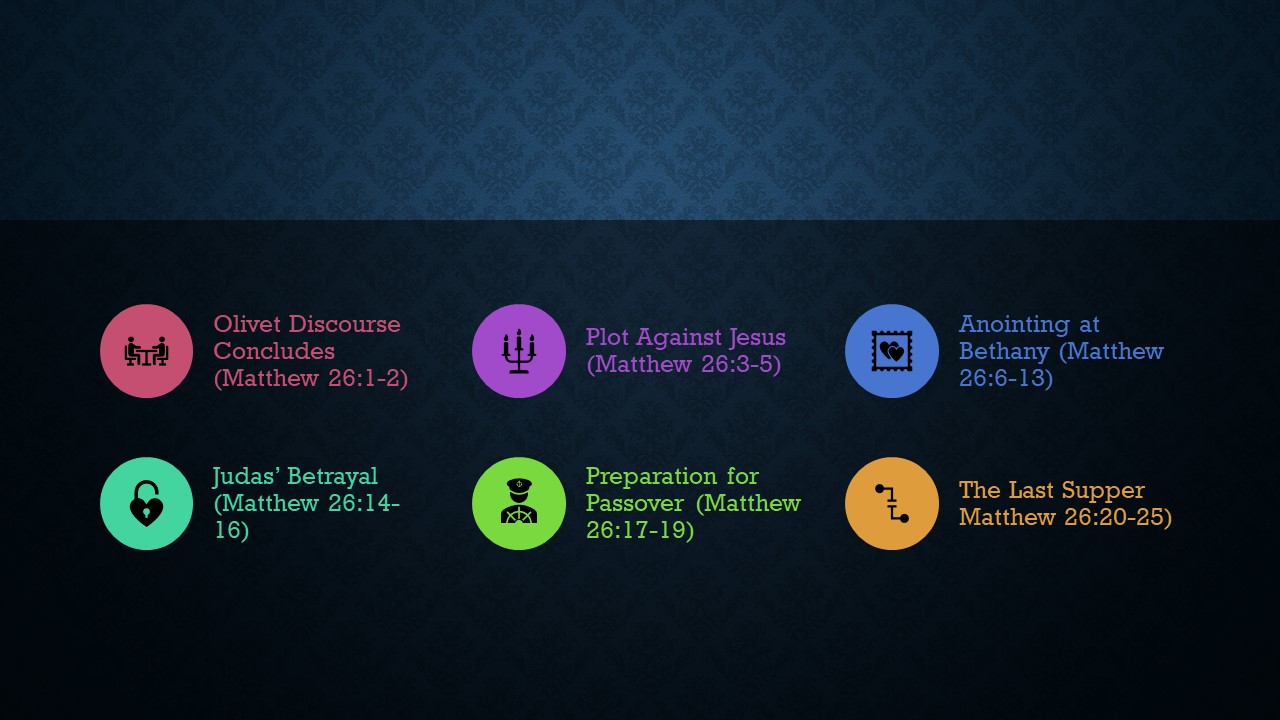
II. Matthew 26:1-2: Olivet Discourse Concludes
In verses 1-2,
When Jesus had finished all these words, He said to His disciples, “You know that after two days the Passover is coming, and the Son of Man is to be handed over for crucifixion.”

Jesus concludes His Olivet Discourse and shifts focus to a very immediate and personal prophecy concerning His own impending crucifixion. His prediction ties His death to the Passover, a feast commemorating the Israelites’ deliverance from Egypt through the sacrifice of a lamb. Jesus identifies Himself as the ultimate sacrificial lamb, fulfilling the typology of the Passover lamb.
Passover, or Pesach, is one of the most significant feasts in Judaism. It commemorates the Exodus, where God delivered the Israelites from slavery in Egypt. Central to this celebration is the sacrifice of a lamb, whose blood was used to protect the Israelites from the plague of the firstborn. Jesus’ crucifixion during Passover underscores the fulfillment of the sacrificial system in Jesus’ atoning death.

Discussion: Were these the plans of man or of God?
- Divine Sovereignty: Jesus’ crucifixion was part of God’s sovereign plan for redemption.
- Human Agency: While God’s plan was sovereign, it involved human actions. The chief priests and elders conspired to arrest Jesus, showcasing human involvement in the fulfillment of God’s plan.
- Fulfillment of Prophecy: Jesus’ prediction of His crucifixion during Passover aligns with Old Testament prophecies and God’s redemptive timeline (Isaiah 53, Psalm 41:9).
What other attributes of the Passover lamb did Jesus share?
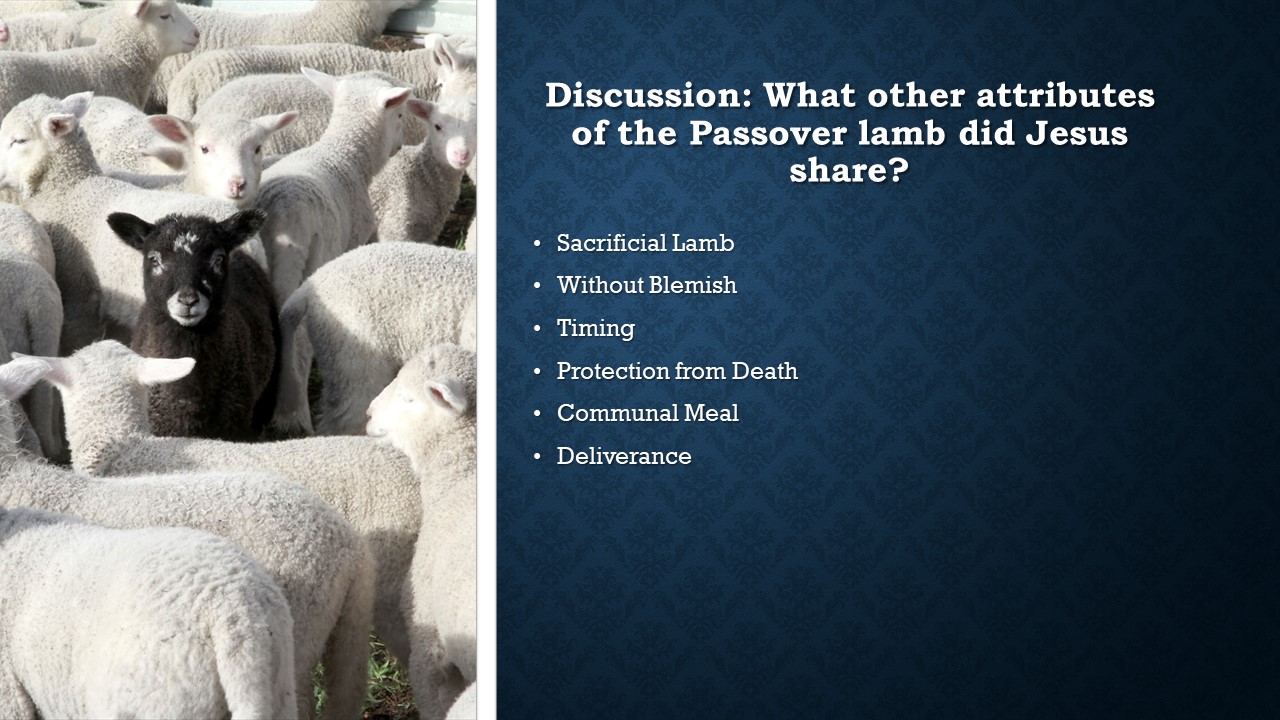
- Sacrificial Lamb: Jesus was sacrificed to atone for the sins of humanity (Exodus 12:13, John 1:29).
- Without Blemish: Jesus, as the sinless Son of God, was without blemish (1 Peter 1:19, Hebrews 4:15).
- Timing: Jesus’ crucifixion coincided with Passover, highlighting His role as the ultimate Passover lamb (Matthew 26:2, 1 Corinthians 5:7).
- Protection from Death: Jesus’ blood offers eternal protection and salvation from spiritual death (Romans 5:9, Revelation 12:11).
- Communal Meal: Jesus instituted the Last Supper, a communal meal symbolizing His body and blood (Luke 22:19-20, 1 Corinthians 11:23-26).
- Deliverance: Jesus’ sacrifice signifies deliverance from spiritual bondage to sin (Romans 6:18, Galatians 5:1).
III. Matthew 26:3-5: Plot Against Jesus
Matthew 26:3-5 describes the chief priests and elders conspiring to arrest Jesus.
Then the chief priests and the elders of the people were gathered together in the court of the high priest, named Caiaphas; and they plotted together to seize Jesus by stealth and kill Him. But they were saying, “Not during the festival, otherwise a riot might occur among the people.”

This passage highlights the covert nature of their plot and their fear of public backlash during the Passover festival.
The Sanhedrin, the highest Jewish council in Jerusalem, held significant political and religious power. Composed of chief priests, elders, and scribes, they had the authority to make binding legal decisions. The political tension in Jerusalem was heightened during Passover due to the influx of pilgrims and the potential for unrest. The leaders’ decision to avoid arresting Jesus during the festival reflects their concern over maintaining public order and avoiding Roman intervention.
The Greek term ‘Συνήχθησαν’ (synēchthēsan), meaning ‘gathered together,’ indicates a formal assembly. This word choice suggests an official meeting of the Sanhedrin, emphasizing the seriousness and deliberateness of their plot. This assembly was a unified intent of the Jewish leaders to eliminate Jesus, whom they saw as a threat to their authority and stability.
Discussion: Why do you think the religious leaders felt so threatened by Jesus?
Why the Religious Leaders Felt Threatened by Jesus
- Challenge to Authority: Jesus challenged the religious leaders’ authority by questioning their interpretations of the Law and exposing their hypocrisy (Matthew 23:27-28).
- Popular Support: Jesus had a growing following among the people, which threatened the leaders’ influence and control over the population (Matthew 21:8-9).
- Threat to Religious Practices: Jesus’ teachings often contradicted established religious practices, such as healing on the Sabbath and associating with sinners, undermining the leaders’ strict adherence to tradition (Matthew 12:10-14, Luke 5:30-32).
- Claims of Divinity: Jesus’ claims to be the Son of God and the Messiah were seen as blasphemous and a direct threat to the religious leaders’ teachings and authority (John 10:30-33).
- Fear of Uprising: The religious leaders feared that Jesus’ influence could incite a rebellion against Roman rule, bringing severe repercussions from the Romans (John 11:47-48).
Discussion: How does this passage illustrate the tension between religious authority and political power? Are there modern examples today that this continues?
Tension Between Religious Authority and Political Power
- Collaboration with Romans: The religious leaders sought to maintain their power by collaborating with the Roman authorities, balancing their religious authority with political pragmatism (John 19:12-16).
- Avoidance of Public Backlash: The leaders plotted to arrest Jesus stealthily to avoid a public uprising during Passover, which could attract unwanted Roman attention and disrupt their control (Matthew 26:3-5).
- Manipulation of Law: The religious leaders used their authority to manipulate legal proceedings against Jesus, demonstrating the abuse of religious power for political ends (Matthew 26:59-61).
- Fear of Losing Power: Both religious and political leaders feared losing their positions of power and influence if Jesus’ teachings led to significant social and political changes (Luke 23:1-2).
- Political Expediency: The religious leaders were willing to accuse Jesus of political insurrection, a charge serious enough to warrant Roman intervention and execution, to achieve their goal of eliminating Him (Luke 23:2-4).
IV. Matthew 26:6-13: Anointing at Bethany
Matthew 26:6-13 recounts the anointing of Jesus by Mary at Bethany.
Now when Jesus was in Bethany, at the home of Simon the leper, a woman came to Him with an alabaster vial of very costly perfume, and she poured it on His head as He reclined at the table. But the disciples were indignant when they saw this, and said, “Why this waste? For this perfume might have been sold for a high price and the money given to the poor.” But Jesus, aware of this, said to them, “Why do you bother the woman? For she has done a good deed to Me. For you always have the poor with you; but you do not always have Me. For when she poured this perfume on My body, she did it to prepare Me for burial. Truly I say to you, wherever this gospel is preached in the whole world, what this woman has done will also be spoken of in memory of her.”

Anointing with oil was a common practice in ancient Jewish culture, often signifying honor, consecration, and preparation for burial. In this passage, a woman, identified as Mary in John 12:3, anoints Jesus with very costly perfume, which is likely pure nard, a highly valued aromatic oil.
Anointing someone with oil, especially with an expensive perfume, was reserved for distinguished guests or special occasions. In ancient Jewish burial traditions, bodies were anointed with spices and perfumes to honor the deceased and to mitigate the odors of decomposition.
Jewish burial customs were meticulous and respectful. Key elements included:
- Anointing the Body: The body of the deceased was anointed with oils and spices. This practice was not only a sign of respect but also helped in preserving the body and reducing odors.
- Wrapping in Linen: The body was wrapped in linen cloths. The Gospel of John describes Jesus’ body being wrapped with spices in strips of linen, according to Jewish burial customs (John 19:39-40).
- Immediate Burial: Jewish law required that the body be buried as soon as possible, ideally within 24 hours. This was to prevent ritual impurity, which was a state of being considered unclean according to religious standards, from spreading and affecting others.
- Tombs and Graves: The dead were often buried in family tombs, which were caves or rock-hewn structures sealed with a stone. Jesus was buried in a new tomb provided by Joseph of Arimathea (Matthew 27:59-60).
Jesus explains that the woman has anointed Him in preparation for His burial. This act of anointing prefigures Jesus’ death and burial, acknowledging His impending sacrifice. The woman’s devotion and the disciples’ misunderstanding highlight the differing perspectives on Jesus’ mission.
Discussion: What significance does the anointing at Bethany hold in the context of Jesus’ impending death?
- The anointing signifies honor and prepares Jesus for burial, aligning with the prophetic symbolism of His impending sacrifice.
- It prefigures Jesus’ death and underscores the importance of His sacrificial role as the Messiah.
The disciples’ reaction, questioning the use of such expensive perfume, contrasts with Jesus’ acceptance of the act, emphasizing its prophetic and spiritual importance.
This act of anointing also parallels the preparations for Jesus’ burial described later in the Gospels. After His crucifixion, Jesus’ body was treated with spices and wrapped in linen, following Jewish burial customs. The anointing at Bethany thus serves as a foreshadowing of these events, linking Jesus’ life, death, and the fulfillment of prophecy.
V. Matthew 26:14-16: Judas’ Betrayal
Matthew 26:14-16 details Judas Iscariot’s decision to betray Jesus.

Understanding the historical context of thirty pieces of silver is essential. In Exodus 21:32, thirty pieces of silver was the price of a slave. This relatively modest sum underscores the contempt and disregard the leaders had for Jesus. According to the prophecy in Zechariah 11:12-13, this specific price was foretold, highlighting the fulfillment of Scripture in Judas’ betrayal. This transaction not only fulfills prophecy but also reveals the depths of Judas’ betrayal and the leaders’ view of Jesus.
To understand the value of thirty pieces of silver in today’s terms, we can consider the weight and value of silver. Each piece of silver, or shekel, weighed approximately 0.4 ounces. Therefore, thirty pieces would weigh about 12 ounces. Given the current price of silver (approximately $25 per ounce as of 2024), thirty pieces of silver would be worth around $300 today. This modest amount highlights the stark contrast between the price Judas accepted and the immense value of Jesus’ life and ministry.
Betrayal by a friend or close companion was and is considered one of the gravest forms of treachery, deeply wounding and dishonorable. This act by Judas is seen as particularly heinous given his position as one of the Twelve, chosen by Jesus Himself. Judas’ betrayal is a stark contrast to the loyalty expected in discipleship and in friendship.
Discussion: What motivates Judas to betray Jesus for such a small sum?
Motivations for Judas’ Betrayal
- Greed and Financial Gain
- Love of Money: Judas’ role as the treasurer for the disciples shows his preoccupation with money. He frequently complained about financial matters, indicating a possible motivation driven by greed (John 12:4-6).
- Relatively Small Sum: Thirty pieces of silver, worth around $300 today indicates a low value placed on Jesus’ life, suggesting Judas’ possible underestimation of Jesus’ worth and his own desperate or greedy state (Exodus 21:32, Matthew 26:15).
- Disillusionment with Jesus
- Unmet Expectations: Judas may have been disillusioned by Jesus’ refusal to become the political Messiah that many Jews expected. His disappointment in Jesus’ approach to His mission could have motivated the betrayal (John 6:14-15).
- Discontent with Jesus’ Methods: Judas might have disagreed with Jesus’ teachings on humility, suffering, and servanthood, preferring a more militant approach against Roman rule (Matthew 20:25-28).
- Influence of Satan
- Spiritual Warfare: The Bible indicates that Satan entered Judas, prompting him to betray Jesus (Luke 22:3, John 13:27). This spiritual dimension underscores the battle between good and evil playing out in Judas’ decision.
- Predetermined Role: Prophecies and Jesus’ foreknowledge of Judas’ betrayal suggest a complex interplay of divine sovereignty and human choice, with Judas’ betrayal fulfilling scriptural predictions (Psalm 41:9, Zechariah 11:12-13).
- Personal Ambition
- Desire for Power: Judas might have sought to position himself advantageously in the shifting political and religious landscape, believing betrayal could earn him favor with the authorities (Matthew 26:14-16).
- Manipulation by Leaders: The chief priests and elders could have exploited Judas’ weaknesses, offering him money and incentives, appealing to his personal ambitions and discontent (Matthew 26:15).
- Lack of True Faith
- Superficial Commitment: Judas may have followed Jesus without genuine faith or understanding of His mission. His superficial commitment could have led to disillusionment and eventual betrayal when faced with personal gain (John 6:64).
- Moral Weakness: Judas’ character flaws and moral weaknesses, such as dishonesty and greed, made him susceptible to betrayal (John 12:6).

VI. Matthew 26:17-19: Preparation for Passover
Matthew 26:17-19 describes the preparations for the Passover meal.
Now on the first day of Unleavened Bread the disciples came to Jesus and asked, “Where do You want us to prepare for You to eat the Passover?” And He said, “Go into the city to a certain man, and say to him, ‘The Teacher says, “My time is near; I am to keep the Passover at your house with My disciples.”’” The disciples did as Jesus had directed them; and they prepared the Passover.
The preparation for Passover has begun. Jesus’ actions are deliberate as He anticipates His final meal with the disciples.
Passover, or Pesach, commemorates the Israelites’ exodus from Egypt and involves a detailed preparation process. This includes the removal of leaven, or yeast, from homes and the preparation of a lamb for the meal. The Festival of Unleavened Bread begins on the 15th day of Nisan and lasts for seven days, with Passover being celebrated on the 14th of Nisan. These preparations involved meticulous attention to ritual cleanliness and obedience to God’s commands.
The timing and significance of Jesus’ instructions to His disciples illustrate the fulfillment of His mission. Jesus’ reference to His ‘appointed time’ (Greek: ‘καιρός’ – kairos) suggests a divinely ordained moment for His sacrifice. This term highlights the intersection of God’s sovereign plan and the unfolding events leading to the crucifixion. Jesus’ precise instructions to the disciples indicate His foreknowledge and control over the events, even as He approaches His betrayal and death.
There was a deliberate readiness for the Passover meal. Everything had to be in place for the sacred observance. The use of ‘kairos’ (appointed time) indicates heavenly plans are aligning earthly plans for Jesus’ final hours.
VII. Matthew 26:20-25: The Last Supper
Matthew 26:20-25 recounts the events of the Last Supper, where Jesus shares a final meal with His disciples and reveals the impending betrayal.
Now when evening came, Jesus was reclining at the table with the twelve disciples. As they were eating, He said, “Truly I say to you that one of you will betray Me.” Being deeply grieved, they each one began to say to Him, “Surely not I, Lord?” And He answered, “He who dipped his hand with Me in the bowl is the one who will betray Me. The Son of Man is to go, just as it is written of Him; but woe to that man by whom the Son of Man is betrayed! It would have been good for that man if he had not been born.” And Judas, who was betraying Him, said, “Surely it is not I, Rabbi?” Jesus said to him, “You have said it yourself.”
There is tension and sorrow among the disciples as Jesus reveals the betrayal.
Jesus’ declaration that one of the disciples will betray Him fulfills earlier prophecies and sets the stage for the Passion narrative. The reference to ‘The Son of Man will go just as it is written about him’ alludes to Old Testament prophecies, such as Psalm 41:9, which speaks of betrayal by a close friend. Jesus’ foreknowledge of the betrayal underscores His role as the Messiah who fulfills Scripture. Thomas Constable notes that Jesus’ calm yet solemn response to Judas indicates His acceptance of God’s sovereign plan, even in the face of personal betrayal.
The custom of reclining at the table during meals was typical in Jewish culture, especially during significant feasts like Passover. This posture of reclining signifies a state of rest and celebration, contrasting sharply with the somber revelation of betrayal. The act of sharing food, particularly dipping bread into the same bowl, was a sign of close fellowship and trust. Judas’ betrayal, therefore, is not just a personal act of treachery but a violation of deep communal bonds. And worse, this betrayal during a sacred meal highlights the gravity of Judas’ actions.
Discussion: What can learn about Jesus’s response to Judas’ betrayal? Why didn’t Jesus show anger, or accuse Judas directly?
Jesus’ Response to Judas’ Betrayal
- Demonstration of Love and Compassion
- Loving Attitude: Jesus continued to show love and compassion toward Judas, even knowing his betrayal. This reflects Jesus’ consistent love for all, including those who wrong Him (John 13:1-2).
- Servant Leadership: Jesus washed the disciples’ feet, including Judas’, demonstrating servant leadership and humility despite knowing Judas’ impending betrayal (John 13:5).
- Fulfillment of Prophecy and Divine Plan
- Acceptance of God’s Will: Jesus understood that Judas’ betrayal was part of God’s sovereign plan for salvation. He accepted this without resistance, showing His commitment to fulfilling prophecy (Psalm 41:9, Matthew 26:54).
- Fulfillment of Scripture: Jesus’ calm response aligns with the prophecies about the Messiah’s suffering and betrayal, highlighting His role as the fulfillment of Old Testament predictions (Isaiah 53:7, Zechariah 11:12-13).
- Teaching Forgiveness and Grace
- Modeling Forgiveness: By not showing anger or accusing Judas directly, Jesus modeled forgiveness and grace, teaching His followers to respond to betrayal and wrongdoing with a heart of forgiveness (Matthew 5:44, Luke 23:34).
- Opportunity for Repentance: Jesus gave Judas multiple opportunities to repent, showing His desire for redemption rather than condemnation (Matthew 26:21-25).
- Demonstration of Self-Control and Divine Authority
- Exemplary Self-Control: Jesus displayed remarkable self-control, refraining from anger and direct accusation, which underscores His divine authority and inner strength (1 Peter 2:23).
- Peace in Adversity: Jesus’ composed response reflects His peace and confidence in God’s plan, demonstrating how to remain calm and faithful in the face of adversity (John 14:27, Philippians 4:7).
- Strategic Revelation of Betrayal
- Gradual Revelation: Jesus gradually revealed the betrayal, allowing the disciples to reflect on their loyalty and faithfulness. This approach created a teachable moment for the other disciples (John 13:21-30).
- Maintaining Focus on Mission: By not accusing Judas directly or showing anger, Jesus maintained focus on His mission and the upcoming sacrifice, ensuring that the events unfolded according to God’s plan (Matthew 26:50).
VIII. Conclusion
Let’s recap the main insights from Matthew 26:1-25 –
- Prophetic Declaration: Jesus predicts His crucifixion during the Passover, highlighting the prophetic significance of His sacrificial death as the ultimate Passover lamb.
- Plot Against Jesus: The chief priests and elders conspire to arrest Jesus, reflecting the political tension and the Sanhedrin’s authority in Jerusalem.
- Anointing at Bethany: Mary anoints Jesus with expensive perfume, symbolizing His impending burial and fulfilling Old Testament prophecies about the Messiah.
- Judas’ Betrayal: Judas agrees to betray Jesus for thirty pieces of silver, fulfilling the prophecy in Zechariah and underscoring the cultural significance of betrayal.
- Preparation for Passover: The disciples prepare for the Passover meal, emphasizing the importance of Jewish customs and Jesus’ deliberate actions as He anticipates His final meal with the disciples.
- The Last Supper: Jesus shares a final meal with His disciples, revealing the impending betrayal and fulfilling earlier prophecies, setting the stage for the events that follow.
Throughout this passage, we see a blend of prophecy, cultural context, and Jesus’ sovereign control over the unfolding events.
We will continue our journey through Matthew 26 in the next 2 weeks.
To God be the glory, Amen.

 Chasing the Wind
Wh
LikeLike