

I. Introduction: Ephesians 4:1-16, Unity and Maturity
In Ephesians 4:1-16, Paul emphasizes the importance of unity and spiritual maturity within the body of Christ. Unity is not just shared feelings or even shared political positions, but a reflection of the single identity believers have in Christ. Maturity, on the other hand, refers to growing into the fullness of Christ, the process of sanctification or walking with Christ. This happens both to the individually and collectively as a church. Spiritual gifts are key to this process, enabling each member of the church to contribute toward the edification of the whole body.
In this passage, Paul challenges believers to live worthy of their calling by maintaining unity and using their gifts. We’ll break the text into three parts: the call to unity (Ephesians 4:1-6), the gifts given by Christ (Ephesians 4:7-13), and the goal of maturity (Ephesians 4:14-16).

II. Ephesians 4:1-6 – The Call to Unity
I, therefore, a prisoner for the Lord, urge you to walk in a manner worthy of the calling to which you have been called, with all humility and gentleness, with patience, bearing with one another in love, eager to maintain the unity of the Spirit in the bond of peace.
Paul opens with a personal appeal, describing himself as a “prisoner for the Lord.” There is a seriousness of his message – he’s willing to suffer for the gospel, and he’s urging others to live in a way that reflects their high calling. The Greek word axios (ἄξιος), translated as “worthy,” conveys the idea of something balanced and fitting. Just as an axis provides alignment and direction, believers are called to align their lives with their calling in Christ. Their behavior should reflect the spiritual realities they proclaim, showing consistency between belief and conduct.
Virtues That Foster Unity
Paul lists four virtues essential for unity: humility, gentleness, patience, and love. These qualities reflect the character of Christ and are indispensable for building a unified church community.
- Humility: The Greek word translate as “lowliness of mind.” In Greco-Roman culture, humility was despised, yet Paul teaches in Philipians 2:5-8 that humility reflects Christ’s character. True humility helps believers set aside pride and embrace others as equals.
- Gentleness: Gentleness refers to controlled strength—acting with kindness even when provoked. It’s not weakness but a deliberate choice to respond with care.
- Patience: Enduring others’ faults without frustration, as God demonstrate patience with us. Anybody feel God has been patient with them?
- Love (Greek: ἀγάπη, agapē): Agapē love is selfless, unconditional, sacrificial—the kind of love that prioritizes others above self-interest.
Unity as a Spiritual Reality
In verse 3, Paul emphasizes that believers are to “maintain the unity of the Spirit in the bond of peace.” Unity is not created by human effort; in fact, I believe human effort, even well-meaning effort, ends up opposing unity. It’s the work of the Holy Spirit, who binds believers together.

Ephesians 4:4-6,
There is one body and one Spirit, just as you were called in one hope of your calling; one Lord, one faith, one baptism; one God and Father of all, who is above all, and through all, and in you all.
Paul lists several core truths that form the foundation of Christian unity:
- One Body, One Spirit: The Church is the body of Christ, united by the indwelling Spirit.
- One Lord, One Faith, One Baptism: These phrases reflect the core truths that unite believers. That Christ is Lord, we share a faith in His saving work, and the baptism that symbolizes entrance into the Church.
- One God and Father of All: We all share our love for the Father, and He is the Father of all believers. A father in a relationship of intimacy and caring for us, and since we share a father, that makes us brothers and sisters.
- Above all, and through all, and in you all: God is sovereign, and reigns over His creation. Nothing is beyond His power. He is sovereign over creation, he is sovereign over believers, and the Holy Spirit dwells within us all.
Discussion Questions:
– What does unity mean to you?
– How do we maintain unity even when differences arise between us?
III. Ephesians 4:7-13 – Spiritual Gifts for All Believers
But grace was given to each one of us according to the measure of Christ’s gift.
Paul emphasizes that grace is given to each believer. Here, grace refers to spiritual gifts, not just the grace for salvation but the empowerment to serve in the body of Christ. There is an individual calling by God of every believer – everyone is gifted by Christ according to His sovereign will.
No believer is without purpose. We are all created to do the Lord’s work. The gifts given by the Lord to do this work are not identical but measured out uniquely. This diversity ensures that the church functions as one body with many parts, as Paul also explains in 1 Corinthians 12 and in Romans 12 :4-5 –
For just as each of us has one body with many members, and these members do not all have the same function, so in Christ we, though many, form one body, and each member belongs to all the others.

Discussion Question:
– How does knowing that every believer is uniquely gifted encourage participation in ministry?
– How do you find your spiritual gift?
Ephesians 4:8-10,
Therefore it says, ‘When he ascended on high he led a host of captives, and he gave gifts to men.’ (In saying, ‘He ascended,’ what does it mean but that he had also descended into the lower regions, the earth? He who descended is the one who also ascended far above all the heavens, that he might fill all things.)
Paul quotes Psalm 68:18 to describe Christ’s victory and ascension. In ancient times, a victorious king would distribute gifts or spoils to his people. Similarly, Christ ascended into heaven after conquering sin, death, and spiritual oppression.
“He led a host of captives.”: The captives represent believers, formerly enslaved to sin, death, and spiritual oppression. Christ’s work on the cross and His resurrection liberated us from captivity to these powers, and now we are no longer prisoners in the negative sense. Instead, we are now voluntary bondservants to Christ. Having been liberated, believers are now “captured” by grace of Christ our King.
– “He gave gifts to men”: After His ascension, Christ poured out the Holy Spirit (Acts 2:33), distributing gifts to empower believers for ministry.
And then “He descended into the lower regions, the earth”: This phrase can mean His incarnation, where Christ humbled Himself to live among humanity. Some also interpret it as a reference to His death and burial.
“He ascended far above all the heavens”: Christ’s exaltation places Him in a position of authority over all creation. His purpose in ascending was to “fill all things”—that is, to extend His presence and rule throughout creation.
Ephesians 4:11 – Leadership Roles in the Church
And he gave the apostles, the prophets, the evangelists, the shepherds and teachers.”
Paul identifies five specific leadership roles that Christ has given to equip the Church:
- Apostles: These were foundational leaders in the early Church, sent to plant churches and establish doctrine (Ephesians 2:20). Although the original twelve apostles had a unique role, many see apostolic ministry today reflected in church planters and missionaries.
- Prophets: These individuals declare God’s truth, providing insight and encouragement to the Church. While Old Testament prophets foretold the future, New Testament prophecy is more focused on edifying believers. 1 Corinthians 14:3 says “But he who prophesies speaks edification and exhortation and comfort to men.”
- Evangelists: Evangelists have a special gift for proclaiming the gospel and bringing others to faith. They often help believers understand how to share their faith effectively.
- Shepherds (Pastors): Shepherds provide spiritual care and guidance. Their focus is on nurturing believers, offering pastoral oversight, and guiding them through spiritual growth.
- Teachers: Teachers are responsible for instructing believers in sound doctrine. Their role ensures that the Church is rooted in truth, guarding against false teaching.
These roles are not about holding positions of power but serving the Church by equipping others to carry out ministry.
Verse 12 – Equipping the Saints for Ministry
To equip the saints for the work of ministry, for building up the body of Christ.
The purpose of these leadership roles is to equip believers – saints such as you and me – for the work of ministry. The Greek word καταρτισμός (katartismos), translated as “equip,” or “perfected” carries the idea of mending or preparing something for its proper function. Leaders are not meant to do all the ministry themselves but to train others to serve effectively.

The goal is that every believer participates in ministry, using their unique gifts to build up the Church. A healthy church is one where all members contribute to the growth of the body, not just the leaders.
Verse 13 – The Goal: Unity and Maturity in Christ
Until we all attain to the unity of the faith and of the knowledge of the Son of God, to mature manhood, to the measure of the stature of the fullness of Christ.
The goal of equipping the saints is that the whole Church reaches both unity and maturity. Paul mentions two specific aspects of unity:
– Unity of the Faith: Refers to a shared understanding of the core truths of the gospel.
– Knowledge of the Son of God: This knowledge is not merely intellectual but relational—growing in a personal relationship with Christ.
Maturity is described as reaching “the measure of the stature of the fullness of Christ.” In other words, believers are to grow into Christlikeness, both individually and as a community. This growth reflects the process of sanctification—a lifelong journey of becoming more like Jesus.
Oswald Chambers points out that Christian maturity has little to do with our age but by the path we walk –
“Spiritual maturity is not reached by the passing of the years, but by obedience to the will of God.”

Discussion Question:
– What gifts do you see in the saints of this church that edify the body of Christ?
– Despite having gifts, many believers are reluctant to serve. What prevents people from fully participating in ministry?
IV. Ephesians 4:14-16 – Growing into Maturity
As a result, we are no longer to be children, tossed here and there by waves and carried about by every wind of doctrine, by the trickery of people, by craftiness in deceitful scheming; but speaking the truth in love, we are to grow up in all aspects into Him who is the head, that is, Christ, from whom the whole body, being fitted and held together by what every joint supplies, according to the proper working of each individual part, causes the growth of the body for the building up of itself in love.
Paul’s vision for the church is one of spiritual maturity, where believers grow into the fullness of Christ. This maturity serves as a foundation for stability, anchoring believers in sound doctrine and protecting them from false teachings, such as the prosperity gospel. Immature believers are easily deceived by appealing but distorted doctrines, while mature believers remain rooted in the truth of God’s Word.
Paul highlights the importance of “speaking the truth in love.” The Greek phrase ἀληθεύοντες ἐν ἀγάπῃ (alētheuontes en agapē) goes beyond mere words—it refers to living with integrity by aligning actions and speech with the truth.
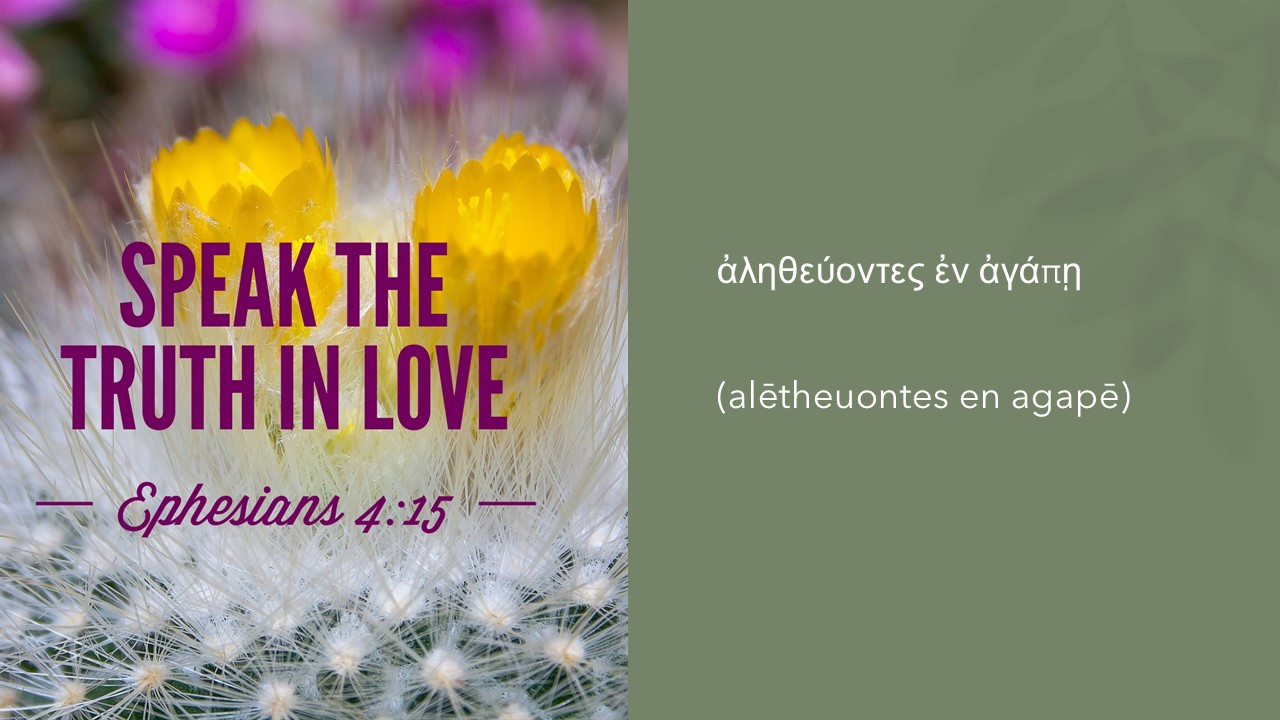
Truth without love can come across as judgmental and harsh, alienating others.
Love without truth becomes shallow and sentimental, lacking the power to bring real transformation and can lead others to destruction.
Both truth and love are essential for spiritual growth—truth ensures alignment with God’s will, and love ensures that truth is communicated in a way that edifies and nurtures others.
We live in a world that, like Pontius Pilate, cynically asks, “What is truth?” (John 18:38). The prevailing cultural mindset promotes subjective truth, where people claim, “What’s true for you isn’t true for me.” This relativistic view of truth is not only a logical fallacy but also undermines the foundation for meaningful discourse. As Frank Turek points out, when someone says, “There’s no such thing as truth,” a simple response is: “Is that true?” The very assertion collapses under its own weight, revealing the necessity of universal truth.
Truth is not a matter of personal interpretation—it is grounded in the unchanging nature of God, who is the source of all truth (John 14:6). In a culture increasingly skeptical of absolute truth, the church is called to stand firm and model both truth and love in every interaction. Spiritual maturity equips believers to discern truth from error and engage with others compassionately and truthfully, pointing them toward Christ.
Discussion Question: When we interact in the world, why is it so difficult to speak truth to a culture that rejects absolute truth?
Today’s church faces several challenges to maturity, such as consumerism, where churchgoers approach church with a consumer mindset, focusing on what they can receive rather than what they can contribute. The church is challenged by social media and the resulting isolation; many believers resist community, preferring an isolated faith. Without sound teaching, believers are vulnerable to false doctrines.
Unity and maturity are not just ideals but practical goals. Churches can foster both by encouraging small groups, discipleship programs, and ministry teams. Each member must recognize their role and contribute to the body. Some examples are Worship Teams, Missions and Outreach, and various ministries of compassion for one another.
This isn’t easy. Unity requires humility, patience, and love. But every believer is gifted to serve the church. Using those gifts and receiving those gifts from others grows spiritual maturity.
V. Conclusion: Unity and Maturity in Ephesians 4:1-16
What did we cover today?
In Ephesians 4:1-16, Paul calls believers to unity and spiritual maturity within the body of Christ. He begins by urging believers to walk worthy of their calling with humility, gentleness, patience, and love. These virtues reflect the character of Christ and are essential for maintaining the unity of the Spirit. Unity is not a human creation but the work of the Holy Spirit, who binds believers together in the bond of peace.
Paul outlines seven core truths that form the foundation of this unity: one body, one Spirit, one hope, one Lord, one faith, one baptism, and one God and Father of all. These truths remind believers that their identity and faith are grounded in Christ, creating a spiritual family united under God the Father.
Christ has given grace to each believer in the form of spiritual gifts. Every believer has a unique role to play in the church, and Paul emphasizes that no one is without purpose. These gifts are given not for personal gain but for the edification of the church, ensuring that the body of Christ functions as one.
Paul further explains that Christ’s victory over sin and death secured these gifts, distributing them to His people after His ascension. Leaders such as apostles, prophets, evangelists, shepherds, and teachers are tasked with equipping the saints for ministry, preparing every believer to contribute to the growth of the body. The goal of this equipping is unity of faith and maturity in Christlikeness, both individually and collectively.
Finally, Paul describes spiritual maturity as stability in the truth—a defense against false doctrines and worldly deceptions. Believers are called to speak the truth in love, balancing honesty with compassion, ensuring that their words build up others rather than tear them down. The church grows in love and strength when every member fulfills their role, working together toward the fullness of Christ.

Paul’s message in Ephesians 4:1-16 is both a challenge and an invitation. It challenges believers to live in alignment with their calling and reminds them that unity and maturity are essential for a healthy church. As we grow into the fullness of Christ, we reflect His love and truth to the world, fulfilling God’s purpose for the body of Christ.
To God be the Glory, amen.

 Chasing the Wind
Leave a comment