
I. Introduction
Ephesians 5:1-21 calls for us to live in a way that mirrors God’s character and embodies the transformation that comes from faith in Christ. Paul’s previous instructions were on unity and maturity within the body of Christ, but now Paul shifts focus, urging the church to pursue a lifestyle distinct from the immorality that pervades their cultural environment. At the heart of this passage are three commands: to “walk in love,” “walk as children of light,” and “walk in wisdom.” Each instruction represents a facet of what it means to “imitate God” as His beloved children.

In the ancient world, the Ephesian believers faced cultural pressures contrary to their new identity in Christ. Ephesus was a center of pagan worship and home to the temple of Artemis, mandating both social norms and personal morality. For Gentile converts especially, the call to abandon old ways and live as “children of light” was countercultural and radical. Paul addresses these new believers with encouragement and practical wisdom, showing them that walking in love, light, and wisdom is essential to their witness in a morally ambiguous society.
Each major theme in this passage reflects an aspect of Christian living: love as a mark of selfless devotion, light as a symbol of purity and truth, and wisdom as a reminder of intentional, Spirit-led decisions. Together, these form a guide to a life that honors God and strengthens the community of faith. Every life is a life well-lived that surrenders to God’s purpose where each step is taken in love, guided by light, and marked by wisdom.
II. Walking in Love (Ephesians 5:1-7)
Ephesians 5:1-2:
Therefore be imitators of God, as beloved children, and walk in love, as Christ loved us and gave Himself up for us, a fragrant offering and sacrifice to God.
Paul begins with the command to “imitate” God. The Greek word for “imitators” (μιμηταί, mimētai) suggests modeling one’s behavior after a pattern. In this case, the pattern is God’s character itself. The English word derived from “mimētai” is “mimic.
As “beloved children,” we recognize our familial relationship with God. We are of His family, and we are expected to reflect His qualities. The command to “walk in love” places love at the forefront of Christian ethics. Love, here, is not merely affection but the agape love demonstrated by Christ, characterized by sacrifice and selflessness.
Paul points to Christ’s sacrificial love as the ultimate example, reminding believers of Jesus’ death, which was a “fragrant offering” (a pleasing aroma in Greek sacrificial language), signifying a sacrifice that fulfills God’s will. In both Leviticus and Numbers, the burning of incense rose heavenward, symbolizing prayers, thanksgiving, or repentance ascending to God.
Verse 3:
But sexual immorality and all impurity or covetousness must not even be named among you, as is proper among saints.
Paul contrasts the sacrificial love of Christ with behaviors that violate that love. The Greek term for “sexual immorality” (πορνεία, porneia) or “porn” encompasses all forms of sexual activity outside of God’s design. It was a common issue in pagan cultures; it a common issue still today.
But then Paul goes further and addresses “Impurity,” denoting moral corruption, and “covetousness,” denoting greed or an excessive desire for more. Paul warns us that such attitudes are incompatible with the life of a “saint,” a term that means “holy one,” set apart for God.
In addition, in Verse 4,
Let there be no filthiness nor foolish talk nor crude joking, which are out of place, but instead let there be thanksgiving.
Paul addresses speech, which can reflect the inner character. I remember a story someone once told me about accidently cursing in front of their grandmother and they were embarrassed. The grandmother observed something like, “I’m not concerned with what came out. I’m concerned it was inside you in the first place.”
“Filthiness” refers to obscenity, “foolish talk” implies immoral conversation, and “crude joking” suggests humor that is inappropriate or harmful. None of those should be in our heart. Instead of indulging in negative speech, Paul encourages us that, with a heart turned toward God, we offer our “thanksgiving” and express our gratitude.
Verses 5:
For you may be sure of this, that everyone who is sexually immoral or impure, or who is covetous (that is, an idolater), has no inheritance in the kingdom of Christ and God.
Paul warns of the serious consequences of immorality, emphasizing that those who persist in such sins without repentance demonstrate a life incompatible with the kingdom of God. The phrase ‘will not inherit the kingdom’ refers to exclusion from the eternal blessings and reign of God, reserved for those who are reconciled to Him through faith in Christ. Now, this warning is not directed at genuine believers who struggle with sin and seek repentance, but at those who live in unrepentant defiance, demonstrating by their actions that they may not truly belong to Christ.
1 John 3:9-10 says something similar –
No one born of God makes a practice of sinning, for God’s seed abides in him; and he cannot keep on sinning, because he has been born of God. By this it is evident who are the children of God, and who are the children of the devil: whoever does not practice righteousness is not of God, nor is the one who does not love his brother.
For believers, salvation is a secure gift of grace, guaranteed by the work of Christ and the sealing of the Holy Spirit. We just covered this recently in prior weeks during our study of Ephesians. “Will not inherit the kingdom” does not imply a loss of salvation for those who are genuinely saved. Instead, it underscores the reality that a life characterized by unrepentant sin may reveal the absence of true saving faith.
This is a sobering call to self-examination, urging believers to walk in obedience as evidence of the Spirit’s transforming work within them. While salvation is not earned by righteous living, a lifestyle of holiness reflects the new nature of those who belong to Christ and assures their place in God’s kingdom.
And finally, the last two verses regarding “walking in love,” verses 6-7:
Let no one deceive you with empty words, for because of these things the wrath of God comes upon the sons of disobedience. Therefore do not become partners with them;
Paul warns against “empty words,” likely referring to cultural voices and philosophies that downplayed or justified immoral behavior. In the Ephesian context, the surrounding Greco-Roman culture often celebrated practices that directly contradicted God’s commands, such as sexual immorality, greed, and idolatry. Influential figures, societal norms, and even religious practices could provide a persuasive but false justification for sin, presenting these behaviors as harmless, natural, or even virtuous.
The enticement of the world remains a constant challenge for believers. Modern culture, like that of Ephesus, is saturated with messages that normalize or glorify behavior contrary to God’s standards. Through media, entertainment, peer influences, and ideologies, these “empty words” can subtly erode our discernment and lead us away from Christ-like living. They may appeal to our desires for acceptance, success, or pleasure, making sin seem attractive or inconsequential.
Paul’s admonition is clear: believers are to guard against being deceived or partnering with those who live in defiance of God’s truth. This does not mean withdrawing entirely from the world, but rather rejecting its influence over our values and behaviors. His reminder that “the wrath of God comes upon the sons of disobedience” underscores the seriousness of sin and the reality of divine judgment. God’s standards are firm and just, and His grace, while abundant, does not excuse believers from pursuing holiness.
In light of this, Paul’s command to “not become partners with them” is a call to vigilance in maintaining distinctiveness as followers of Christ. We are in the world, not of the world. Instead, we are to discern cultural messages through the lens of Scripture, align our lives with God’s truth, and walk in love that reflects His character rather than the world’s values.
Discussion Questions
- What does it mean to you to “imitate God?”
- How does “the world” pressure Christians to walk with the world instead of Christ?

III. Walking in Light (Ephesians 5:8-14)
Ephesians 5:8-10,
For at one time you were darkness, but now you are light in the Lord. Walk as children of light (for the fruit of light is found in all that is good and right and true), and try to discern what is pleasing to the Lord.
Paul begins this section by reminding believers that they have been transformed: “You were once darkness, but now you are light in the Lord.” Notice the phrasing here—Paul doesn’t merely say they were “in darkness,” but that they were darkness itself. Similarly, he doesn’t just describe them as being “in the light” but as being light itself. There is a radical and dramatic change in identity that comes with salvation.
The Greek word for “walk” reappears. First we walk in love, now we walk in light. This walk is an ongoing, daily lifestyle of faith. To “walk as children of light” means to live in a way that reflects the truth, purity, and righteousness of God. Paul describes the evidence of this lifestyle as “the fruit of light,” qualities that are “good and right and true.”
- Goodness: This term signifies moral excellence and a heart inclined toward generosity and kindness. It’s an outward expression of an inward transformation.
- Righteousness: Refers to living in a way that aligns with God’s standards of justice and holiness.
- Truth: Points to honesty and integrity, rejecting falsehood and hypocrisy in all areas of life.
Paul also calls believers to “discern what is pleasing to the Lord.” The Greek word for “discern” means to test or examine, like refining gold to see if impurities remain. It is an intentional and continual process of evaluating our actions, attitudes, and decisions to ensure they align with God’s will.
Ephesians 5:11-13,
Take no part in the unfruitful works of darkness, but instead expose them. For it is shameful even to speak of the things that they do in secret. But when anything is exposed by the light, it becomes visible, for anything that becomes visible is light.
Paul contrasts the “fruit of light” with the “unfruitful works of darkness.” The imagery of fruit is significant here; just as fruit is evidence of a healthy tree, so is the fruit of light evidence of a life rooted in Christ. In contrast, the works of darkness produce nothing of lasting value—no fruit, only barrenness.
Believers are called to reject these works entirely, taking “no part” in them. But Paul doesn’t stop at avoidance; he commands believers to “expose” them. This exposure is not about judgmental condemnation but about revealing truth so that repentance and transformation can occur.
Paul acknowledges that some deeds of darkness are so vile they shouldn’t even be spoken of, highlighting the importance of maintaining purity in both conversation and thought. However, he also emphasizes that light has the power to transform: “Anything that becomes visible is light.” When darkness is exposed to the truth of God’s Word and the testimony of faithful believers, it loses its power, and transformation becomes possible.
Ephesians 5:14,
For anything that becomes visible is light. Therefore it says, ‘Awake, O sleeper, and arise from the dead, and Christ will shine on you.’
Paul likely quotes an early Christian hymn or liturgical saying here, using it as a poetic call to spiritual awakening. The imagery of awakening from sleep and rising from the dead echoes themes of resurrection and renewal found throughout Scripture.
- “Awake, O sleeper”: This is a call to spiritual alertness, urging believers to wake up from complacency or sin.
- “Arise from the dead”: Points to the new life believers have in Christ, leaving behind the death of sin and separation from God.
- “Christ will shine on you”: Evokes the image of God’s favor and presence, much like the radiance of His glory shining on Moses’ face or the light of Christ in Revelation.
Believers are called to live as transformed people, allowing the light of Christ to shine through their lives and into the darkness around them.
Discussion Question
How do we expose darkness in our communities?
How can we do this without alienating others?

IV. Walking in Wisdom (Ephesians 5:15-21)
Ephesians 5:15-17,
Look carefully then how you walk, not as unwise but as wise, making the best use of the time, because the days are evil. Therefore do not be foolish, but understand what the will of the Lord is.
Paul opens this section with an imperative to live intentionally, urging believers to “look carefully” at how they walk and do it with precision or diligence. This means that the Christian life is not one of aimless wandering but of deliberate, thoughtful action.
Walking “not as unwise but as wise” reflects a lifestyle shaped by godly wisdom. Biblical wisdom is not the same as intellect; it involves applying God’s truth to life’s decisions. James 1:5 reminds us that wisdom comes from God, and believers are encouraged to seek it in every situation. For example, in our daily lives, wisdom might involve discerning how to prioritize time between work, family, and ministry, ensuring that our choices honor God and reflect His purposes.
Paul further urges believers to make “the best use of the time.” The phrase “redeeming the time” implies taking full advantage of every opportunity, much like a shrewd merchant who recognizes and seizes a good deal. In a world where the “days are evil,” Christians must avoid passivity and intentionally invest time in what has eternal significance. This might mean avoiding distractions or frivolous pursuits and instead prioritizing activities like prayer, studying Scripture, and serving others.
The call to “understand what the will of the Lord is” reinforces the idea that wisdom involves alignment with God’s purposes. Discerning God’s will requires immersion in His Word and a dependence on the Holy Spirit. It also means applying biblical principles to daily life, such as choosing integrity over convenience or kindness over selfishness.
Ephesians 5:18-21,
And do not get drunk with wine, for that is debauchery, but be filled with the Spirit, addressing one another in psalms and hymns and spiritual songs, singing and making melody to the Lord with your heart, giving thanks always and for everything to God the Father in the name of our Lord Jesus Christ, submitting to one another out of reverence for Christ.
Paul contrasts two controlling influences in this passage: drunkenness and the Holy Spirit. Drunkenness, characterized by loss of self-control, represents a lifestyle driven by earthly desires. In the Greco-Roman world, drunkenness was often associated with pagan worship practices, where altered states of consciousness were believed to connect worshipers with their gods. Paul rejects such behavior as “debauchery” or wastefulness or reckless living.
Instead, Paul calls believers to be “filled with the Spirit.” The Greek verb here (πληροῦσθε, plērousthe) is in the present tense, suggesting an ongoing process. Being filled with the Spirit means living under His influence, allowing Him to guide thoughts, words, and actions. This contrasts sharply with the uncontrolled behavior of drunkenness. For instance, in practical terms, Spirit-filled living might look like responding with patience in the face of provocation or choosing words that encourage rather than tear down.
Paul provides specific examples of how Spirit-filled living manifests:
- Worship in Community: Believers are to address “one another in psalms and hymns and spiritual songs.” This reflects the communal nature of Christian worship, where singing and praising God together fosters unity and mutual encouragement. This could mean actively participating in church worship or finding ways to encourage others through music and Scripture.
- Heartfelt Worship: “Singing and making melody to the Lord with your heart” emphasizes that worship is not merely external but flows from an inward relationship with God. True worship transcends performance and is marked by sincerity. Whether singing in a congregation or reflecting on God’s goodness in private, the heart’s posture matters most.
- Gratitude: Paul urges believers to “give thanks always and for everything to God the Father.” Gratitude is a hallmark of Spirit-filled living, as it reflects a recognition of God’s sovereignty and goodness, even in challenging circumstances. For example, instead of complaining about difficulties, we can choose to thank God for the ways He strengthens and refines us through trials.
- Mutual Submission: Finally, Paul calls believers to submit “to one another out of reverence for Christ.” Submission here is not about power or hierarchy but about humility and a willingness to serve others. In practical terms, this might involve prioritizing someone else’s needs over your own or fostering peace in relationships by seeking to understand rather than insist on being right. Bill gets the honor hear of teaching about “wives, submit to your husbands” next week, but it’s clear in this verse that all Christians submit to one another.
Discussion Questions
How do we see personal entertainment or enjoyment when we consider walking in the light with “making the best use of time?”
What changes might be necessary to ensure our priorities align with God’s will?

V. Conclusion
In Ephesians 5:1-21, Paul challenges believers to live in a way that reflects God’s character, focusing on three essential aspects: love, light, and wisdom. By “walking in love,” believers emulate the self-sacrificial love of Christ, making choices that reflect selflessness and kindness in a world often driven by self-interest and personal gain. This love is the foundation of a transformed life, encouraging believers to consider others above themselves and to pursue relationships marked by sincerity and compassion.
The call to “walk in light” emphasizes the stark contrast between the believer’s new life in Christ and the darkness of their former ways. The light symbolizes purity, truth, and revelation. By walking in the light, believers not only reject immoral behaviors but actively seek to expose and confront darkness around them, standing as witnesses of God’s truth. This responsibility is not merely about personal purity but about influencing the world, shining the light of Christ into areas of moral and spiritual ambiguity.
“Walking in wisdom” encapsulates the importance of intentional, Spirit-led living. In an age where time and resources are often wasted, Paul’s reminder to make “the best use of time” resonates as a call to purposeful and meaningful living. Through a Spirit-filled life, believers gain the discernment necessary to navigate daily challenges, making choices that honor God and promote unity within the church. This wisdom extends to our interactions with one another, as Paul concludes with an appeal for mutual submission. In the body of Christ, humility, service, and respect are not optional; they are essential attributes that foster unity and strengthen the community.
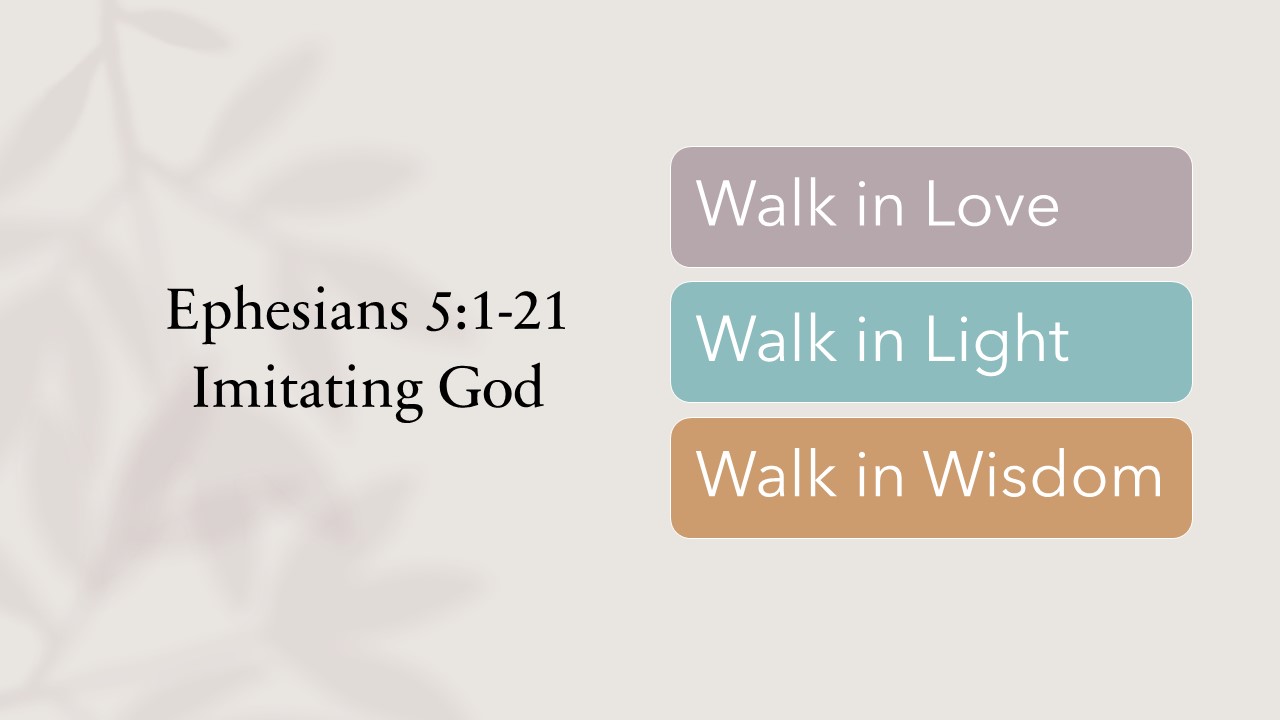
We should continually examine our own lives closely. Are we walking in love, demonstrating Christ’s sacrificial kindness in our relationships? Are we walking in light, striving for purity in a culture that often dismisses morality? And are we walking in wisdom, making the most of our time and allowing the Spirit to guide our decisions? By embracing these principles, we not only grow in our relationship with God but also strengthen our witness to others, showing that a life transformed by Christ is a life that truly makes a difference.

 Chasing the Wind
Leave a comment