I. Introduction
We’re beginning a new series, the letters of 1st and 2nd Peter. As I’ve been saying recently, if we like this series, we may do a 3rd Peter. You may have noticed that living faithfully in a world that opposes our values can be challenging. The letters of Peter speak directly to our modern challenges, encouraging all believers in our walk with Christ.
In 1 Peter 1:1-5, the apostle Peter opens his letter with a message of encouragement and theological depth, written to believers scattered across the Roman provinces of Asia Minor. These Christians, enduring persecution and alienation, are reminded of their true identity as God’s chosen people. Peter emphasizes three key themes: our election by God, the sanctifying work of the Spirit, and the eternal hope secured by Christ.

Peter writes not simply to comfort but to challenge and strengthen their faith. These verses call us to see ourselves as God’s elect; we are living as exiles in a world that is not our home, yet kept by the power of God for a glorious inheritance. My hope is to walk through these verses in depth, examining the rich theological truths and find practical implications for us as believers. So let’s begin at verse 1.
II. Verse 1: The Author and Audience
Peter, an apostle of Jesus Christ, To God’s elect, exiles scattered throughout the provinces of Pontus, Galatia, Cappadocia, Asia and Bithynia…
Peter begins by asserting his authority as an apostle of Jesus Christ, a title emphasizing his divine commissioning. The recipients of the letter are described as “God’s elect” and “exiles,” reflecting their dual identity. As elect, they are chosen by God’s grace. As exiles, they are strangers in the world, citizens of heaven living temporarily on earth.
The believers addressed in 1 Peter were scattered across the Roman provinces of Asia Minor, regions deeply influenced by Greco-Roman culture. Christians faced significant cultural pressures to conform to societal norms, including participation in idol worship and imperial cults. Refusal to partake often led to suspicion, ostracism, and accusations of disloyalty to Rome.
Under Roman rule, societal roles were rigidly defined. Slaves, women, and non-citizens were particularly vulnerable, making the Christian message of equality and freedom in Christ both radical and threatening to the established order. Additionally, economic persecution was not uncommon. Artisans or merchants who refused to participate in pagan rituals often lost business or were barred from trade guilds. This social and economic alienation underscored their identity as “exiles,” not just spiritually but tangibly in their daily lives.
The challenges these believers faced mirrored the experience of the Jewish diaspora, who lived as scattered people holding fast to their faith amidst foreign cultures. Peter’s use of the term exiles would have resonated deeply, reminding them of their ultimate allegiance to God’s kingdom and their enduring hope despite earthly struggles.
Peter’s journey to this point has been remarkable. Before he became a key figure in the early church, Peter was an ordinary fisherman from Galilee, known for his impulsiveness and lack of formal education. Jesus’ call to Peter in Matthew 4:19, “Follow me, and I will make you fishers of men,” marked the beginning of a remarkable transformation. Over the course of Jesus’ ministry, Peter experienced both failure and growth, famously denying Christ three times yet being restored by Jesus after the resurrection (John 21:15-19).
In the book of Acts, we see Peter’s theological growth and boldness, particularly in his Pentecost sermon (Acts 2:14-41), where he articulated amazing truths about Jesus as the Messiah. Despite being described as “unlearned and ignorant” in Acts 4:13, Peter’s letters demonstrate a deep understanding of Old Testament prophecy, the work of the Trinity, and the nature of salvation. His transformation highlights the power of the Holy Spirit to equip believers for ministry regardless of their background. Peter is a role model for me. Despite my many mistakes and my ignorance, God still forgives me and finds a way to use His flawed vessel.
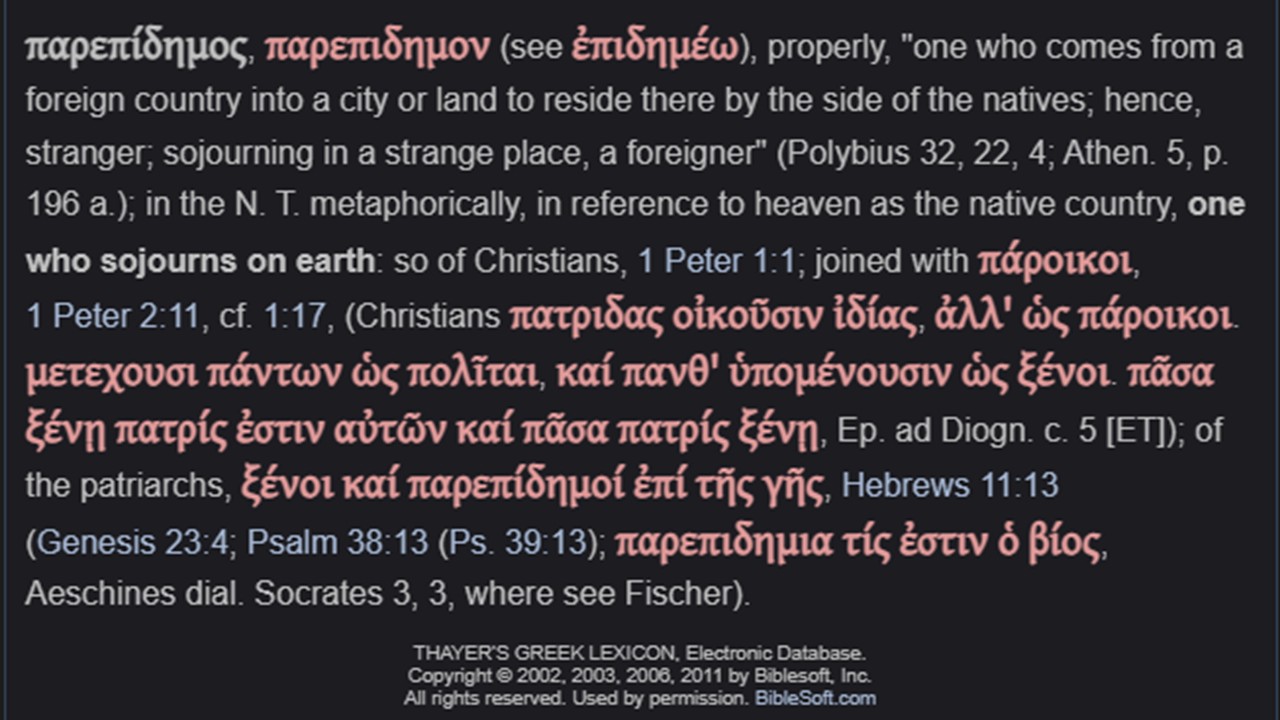
The term “exiles” (Greek: parepidēmoi) used here conveys both a physical and spiritual separation. Historically, it describes believers who were socially ostracized and often persecuted within the Roman Empire. Culturally, Christians were seen as outsiders because they refused to participate in Roman religious practices or emperor worship. Theologically, the term emphasizes the transient nature of their earthly existence.
The Greek word parepidēmoi is a compound of παρά (para), meaning “beside” or “near,” and ἐπίδημος (epidēmos), meaning “dwelling” or “inhabiting.” Together, it paints a picture of temporary residents, those who live near but are not fully integrated into their surroundings. Like Abraham, who “looked forward to the city that has foundations, whose designer and builder is God” (Hebrews 11:10), believers are reminded that our ultimate citizenship is in heaven (Philippians 3:20). This identity as strangers in a strange land provides both a sense of purpose and detachment from earthly concerns. Believers are encouraged to focus on their eternal destination, not on temporary trials.
The phrase “God’s elect” affirms God’s sovereignty in salvation. Election is not based on human merit but on God’s eternal purpose (Ephesians 1:4). This assurance comforts believers that their faith rests on God’s unchanging will. Together, these descriptions of “elect” and “exiles” form a powerful identity that sustains believers amid trials and encourages them to live faithfully as God’s ambassadors on earth.
Discussion Question: How does knowing we are both “elect” and an “exile” shape our understanding of our role in the world?
III. Verse 2: The Triune Work of Salvation
……who have been chosen according to the foreknowledge of God the Father, through the sanctifying work of the Spirit, to be obedient to Jesus Christ and sprinkled with His blood: Grace and peace be yours in abundance.
As we know, the word “trinity” is not in scripture, but Peter’s statement here lays a foundation for early church fathers to understand God’s triune character. Peter emphasizes the unique contributions of each Person of the Trinity, highlighting their roles in accomplishing and applying the work of redemption.
God the Father: Foreknowledge as Covenant Relationship
The term “foreknowledge” (prognōsis) is not a reference to mere foresight but to an intimate, relational knowing rooted in God’s covenantal nature. It reflects God’s deliberate and loving choice to set His affection upon His people before the foundation of the world (Ephesians 1:4). This foreknowledge is deeply personal, highlighting God’s initiative in establishing a relationship with believers.
In the Old Testament, this concept is mirrored in God’s relationship with Israel. He “knew” them, not merely in the sense of awareness but as His chosen covenant people (Amos 3:2). This knowing was tied to His love, commitment, and faithfulness to His promises. Similarly, in the New Testament, God’s foreknowledge assures believers that our salvation is grounded in His eternal will and loving character.
The relational aspect of foreknowledge demonstrates that salvation is not an afterthought but part of God’s grand design to redeem humanity and bring them into fellowship with Him. It reassures believers that we are fully known, loved, and secure in God’s sovereign plan.
The Holy Spirit: Sanctification as Transformation
The “sanctifying work of the Spirit” refers to the ongoing process of setting believers apart for God’s purposes. At the moment of salvation, the Spirit regenerates and indwells believers (Titus 3:5), enabling them to live lives that reflect God’s holiness. Sanctification is both positional—declaring believers holy before God—and progressive, as the Spirit continues to transform them into Christ’s likeness (2 Corinthians 3:18).
This transformative work is not passive. The Spirit convicts, guides, and empowers believers to resist sin and grow in righteousness. The goal of sanctification is obedience to God’s will and alignment with His character. As believers cooperate with the Spirit, they become living testimonies of God’s grace and holiness in the world.
Jesus Christ: Obedience and Covenant Fulfillment
Obedience to Jesus and being “sprinkled with His blood” evokes Old Testament imagery of covenant-making (Exodus 24:8). In the new covenant, Christ’s blood cleanses believers from sin and secures their relationship with God. This sprinkling signifies purification, consecration, and a pledge of allegiance to Christ as Lord.
Christ’s sacrifice on the cross was the ultimate fulfillment of God’s redemptive plan. His blood, shed once for all (Hebrews 9:14), ensures that believers are not only forgiven but also brought into an eternal covenant with God. This covenant is unbreakable, sustained by the faithfulness of Christ and sealed by His resurrection.
Unified Work of the Trinity
The triune nature of salvation demonstrates God’s complete and unified work in redeeming humanity. The Father plans, the Spirit applies, and the Son accomplishes salvation, leaving no aspect to chance or human effort. Each Person of the Trinity works in perfect harmony, showcasing the depth of God’s love and the extent of His power.
Believers are recipients of grace and peace—gifts that flow abundantly from the Trinity’s work. Grace generously provides the unmerited favor believers receive, while peace reflects the restored relationship with God and the resulting inner calm, even in trials. This dual blessing encapsulates the believer’s position and experience in Christ.

God’s plan is comprehensive and personal, reminding us that every aspect of our salvation is secure in His hands. This truth equips believers to live boldly and confidently, knowing they are loved, transformed, and kept by the Triune God.
IV. Verse 3: Praise for New Birth
Praise be to the God and Father of our Lord Jesus Christ! In His great mercy He has given us new birth into a living hope through the resurrection of Jesus Christ from the dead…
This verse begins with glorifying God for the gift of salvation. The “new birth” signifies spiritual regeneration, a transformation where a believer transitions from spiritual death to life. This concept echoes Jesus’ conversation with Nicodemus in John 3:3, where He declares, “You must be born again.” This birth is not of human effort but of divine initiative, rooted in God’s mercy and accomplished through the resurrection of Jesus Christ.
The new birth brings believers into a new relationship with God, marked by adoption into His family (Romans 8:15-17). It also inaugurates a new nature within believers, characterized by the indwelling Holy Spirit and the capacity to live righteously (2 Corinthians 5:17). This transformation ensures that believers are no longer defined by their past sins but by their identity in Christ.
New birth produces “living hope.” Unlike worldly hopes, this hope is active, enduring, and rooted in the historical reality of Christ’s resurrection. Just as Jesus conquered death, believers are assured of eternal life and victory over sin and despair. This hope empowers Christians to endure trials, knowing that their ultimate future is secure in God’s promises.
Mercy is emphasized as the basis of salvation, reminding us that it is entirely God’s initiative and not a result of human effort. The resurrection is the anchor for this hope, providing a definitive demonstration of God’s power and faithfulness. It guarantees that the believer’s hope will not disappoint but will culminate in eternal life with God.
V. Verse 4: The Inheritance Awaiting Believers
…and into an inheritance that can never perish, spoil or fade. This inheritance is kept in heaven for you…
Peter assures believers of an eternal inheritance, emphasizing its imperishable, undefiled, and unfading nature. Unlike earthly wealth, this inheritance is entirely secure, immune to decay, corruption, or loss. It is a treasure preserved in heaven, highlighting its divine safeguarding by God Himself.
The word “inheritance” often evokes the concept of legacy and family connection. In Jewish tradition, inheritance was closely tied to the Promised Land, God’s covenantal blessings to His people (Numbers 26:52-56). Peter expands this understanding by pointing to the ultimate inheritance of eternal life and unbroken fellowship with God. This inheritance is not limited to earthly boundaries but is spiritual, eternal, and reserved for every believer.
Three descriptions define this inheritance:
- Imperishable: It is not subject to decay, unlike earthly possessions that wear out over time. Its nature is enduring, untouched by death or destruction.
- Undefiled: It remains pure and holy, untainted by sin or corruption. Its perfection reflects the character of God, the one who guarantees it.
- Unfading: It does not diminish in value or beauty. Unlike earthly treasures that lose their luster, this inheritance retains its glory eternally.
This inheritance connects believers to our identity as co-heirs with Christ (Romans 8:17), underscoring our royal status as children of God. It is not earned through human effort but graciously given by God, secured through the finished work of Jesus Christ.
Believers are called to live with this eternal perspective, recognizing that our true wealth and lasting reward are in heaven (Matthew 6:19-21). This assurance frees us from the anxieties of worldly pursuits and empowers them to invest in what truly matters—faith, holiness, and the work of God’s kingdom.
Discussion Question: How does the certainty of a heavenly inheritance impact our priorities and decisions?
VI. Verse 5: Kept by God’s Power
…who through faith are shielded by God’s power until the coming of the salvation that is ready to be revealed in the last time.
This verse emphasizes divine protection. The Greek word for “shielded” is φρουρέω (phroureō) suggests the idea of a military garrison or a fortress, emphasizing vigilance and strength. God’s protection is not passive but dynamic, ensuring that believers are constantly under His watchful care.
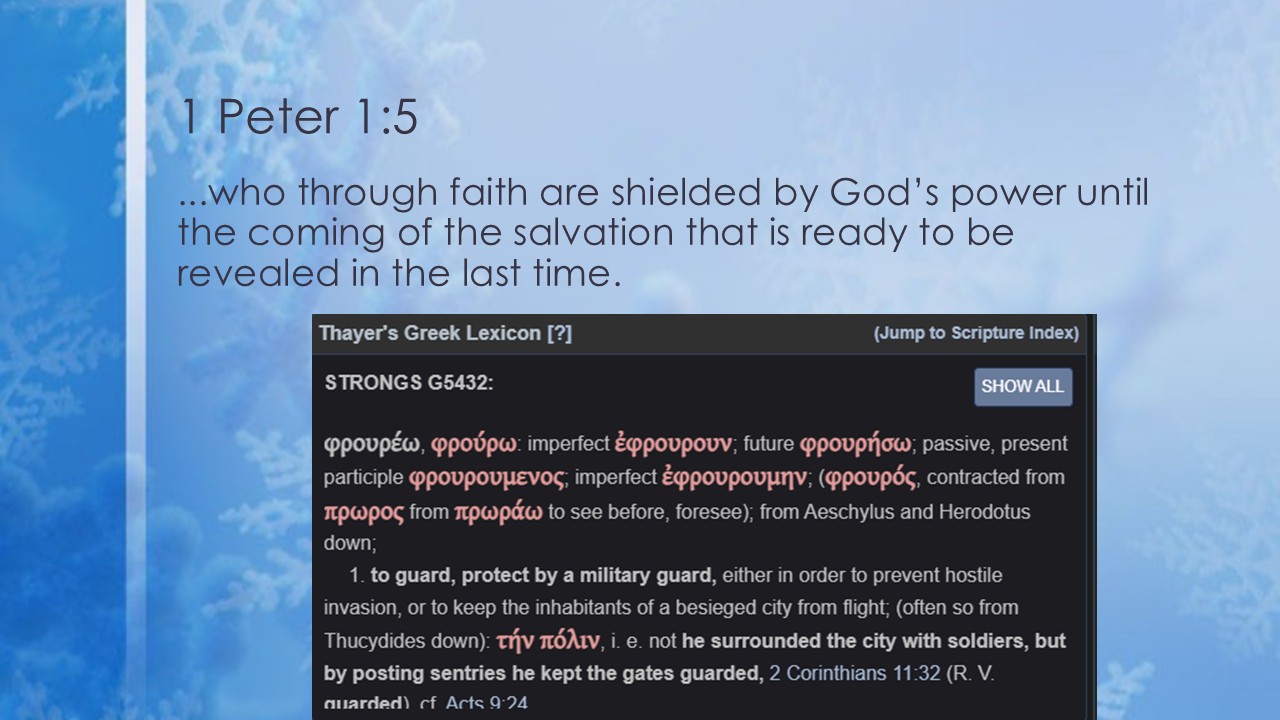
The active nature of God’s shielding reassures believers that our trials, though challenging, are under His sovereign control. It is this understanding of divine guardianship that enables us to walk with confidence, regardless of life’s uncertainties.
Discussion Question: How might we collectively experience the shielding power of God during times of trial or uncertainty?
VII. Conclusion: Living as Chosen Exiles
Peter’s opening verses remind us believers of our identity, security, and hope. As chosen exiles, we are sanctified by the Spirit, redeemed by Christ’s blood, and shielded by the Father’s power. This eternal perspective equips us to endure present hardships with joy and confidence.
We covered beautiful overarching themes. As believers, we have an identity as God’s elect, living as strangers in a foreign land while assured of our heavenly citizenship. We have the richness of salvation, rooted in God’s mercy, secured through Christ’s resurrection, and continuously sealed by the Spirit’s sanctifying work. Finally, we have an imperishable hope of an eternal inheritance, motivating perseverance and faith amidst trials.
To God be the glory, amen.

 Chasing the Wind
Sent to several of your cousins who appreciate your efforts Love, Aunt Barbara
LikeLike