

I. Free to Serve
We are working our way through seven “one another” commands. We began with “love one another,” because love is the command behind all the others, and then we looked at “accept one another” – love at the front door. Still ahead of us are bearing one another’s burdens, encouraging one another, forgiving one another, and praying for one another.
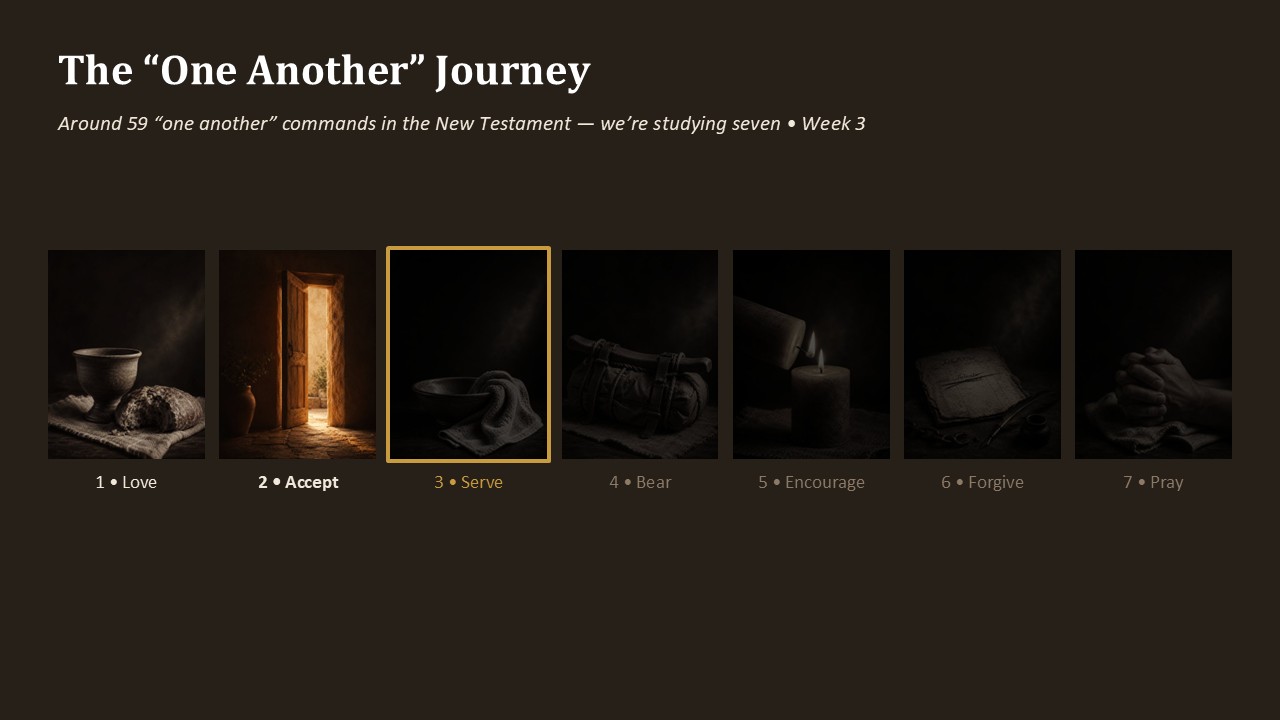
Today is “serve one another” – love holding a towel. I have a story about that, although it is not one where I come out looking particularly good.
One of my closest friends, Sean, once asked me to help him move. Now, I do not even move myself anymore. I am older than I used to be, I am not in the shape I once was, and I’ve saved a few pennies. If I need to move, I am perfectly content to pay somebody younger whose knees still work properly. Some wisdom comes with age, and I’ve learned that heavy things can be carried by people other than me.
So when my friend asked me to help him move, my first answer was no.
I did relent. I showed up, and I helped him move. But I have regretted that first response ever since – not because every request somebody makes of us requires a yes. Sometimes we cannot help, sometimes we should not help, and sometimes there is a wiser way to help. But this was one of my closest friends. He requested help, I was capable of helping, and my first thought was not his need. My first thought was my inconvenience.
I eventually served him with my hands. I wish I had served him first in my heart.
That is where Galatians 5, “Serve One Another”, takes us. Galatians is Paul’s great defense of Christian freedom. False teachers had come into the churches of Galatia insisting that faith in Christ was not enough, and that Gentile believers also needed circumcision and obedience to the Mosaic Law. Paul responds forcefully. Christ did not save us so that we could put ourselves back under a system that could never make us righteous.
At the beginning of chapter 5, Paul says it was for freedom that Christ set us free. Then in verse 13 he tells us what Christian freedom is for:
“For you were called to freedom, brothers and sisters; only do not turn your freedom into an opportunity for the flesh, but serve one another through love.” – Galatians 5:13

There are two ways to misunderstand grace. One says, “I must do enough good things so God will accept me.” The other says, “Since God accepts me by grace, I can do whatever I want.” Paul rejects both. We do not earn salvation by serving, but salvation does not release us to live for ourselves.
Paul has spent four chapters arguing that Christians are free, and then he turns around and tells free people to become servants.
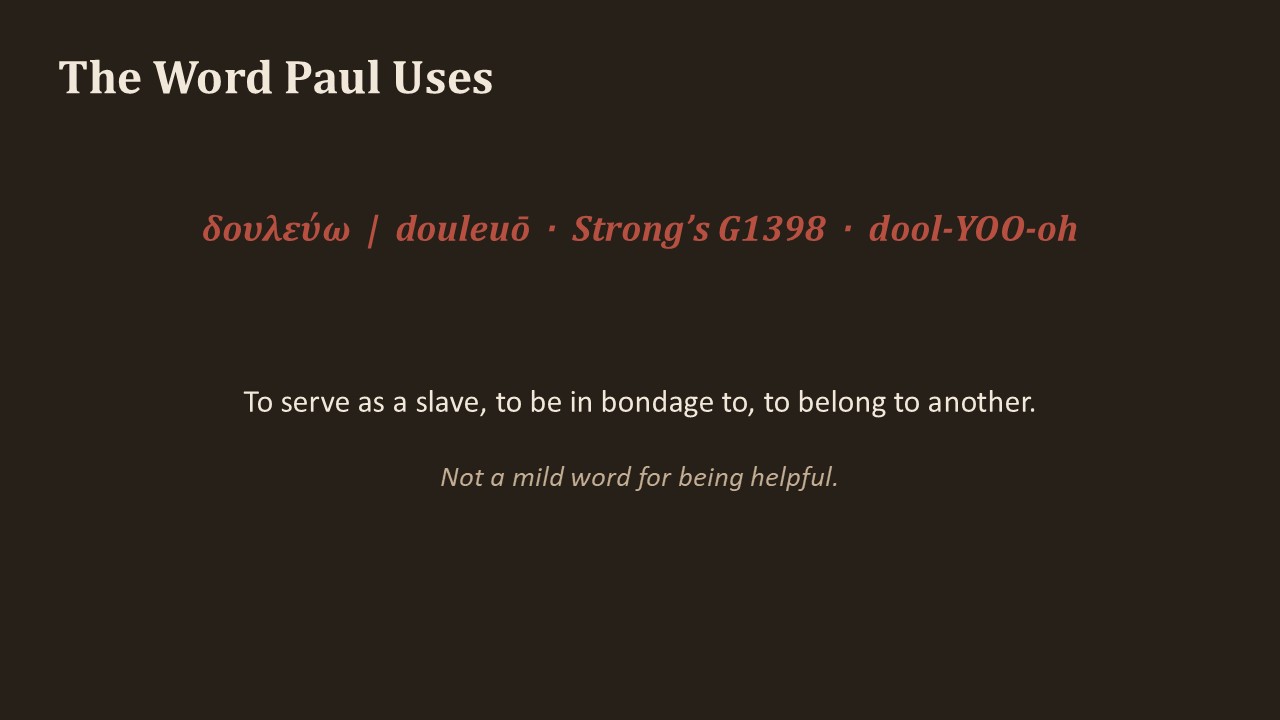
The word translated “serve” is douleuō (G1398, dool-YOO-oh). It is not a mild word for being helpful. It comes from the language of slavery and means to serve as one who belongs to another. Paul sets freedom and servitude side by side deliberately. Christ has freed us from the condemnation of the Law, from slavery to sin, and from the impossible work of making ourselves acceptable to God – and that freedom releases us from one more kind of bondage, the need to arrange our lives around ourselves.
We are free enough to become slaves. Slaves to Christ and His love. Paul does not leave “serve one another through love” standing by itself. Verse 14 supplies the argument:
“For the whole Law is fulfilled in one word, in the statement, ‘You shall love your neighbor as yourself.’” – Galatians 5:14
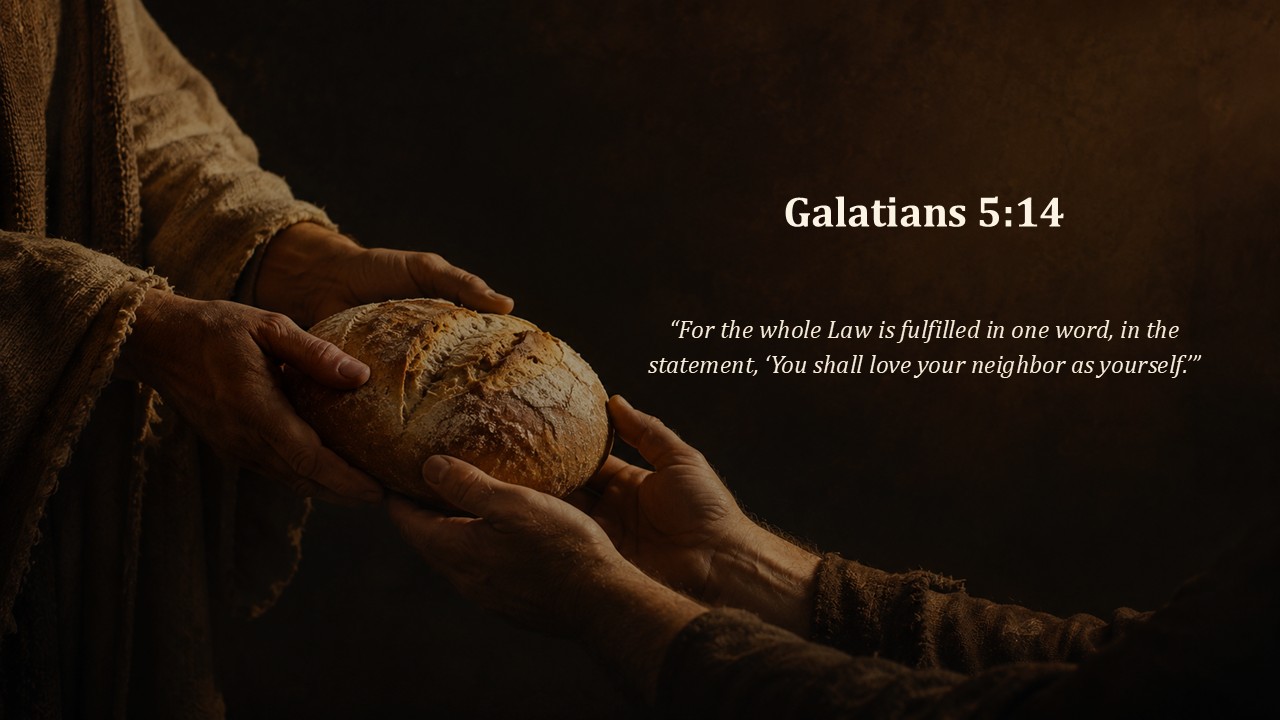
This takes us straight back to the beginning in this series. Love is not one item on a list beside service. Service is one of the forms love takes. Biblical love does not remain an attitude; sooner or later it has to do something.
Then verse 15 gives us the opposite picture:
“But if you bite and devour one another, take care that you are not consumed by one another.” – Galatians 5:15
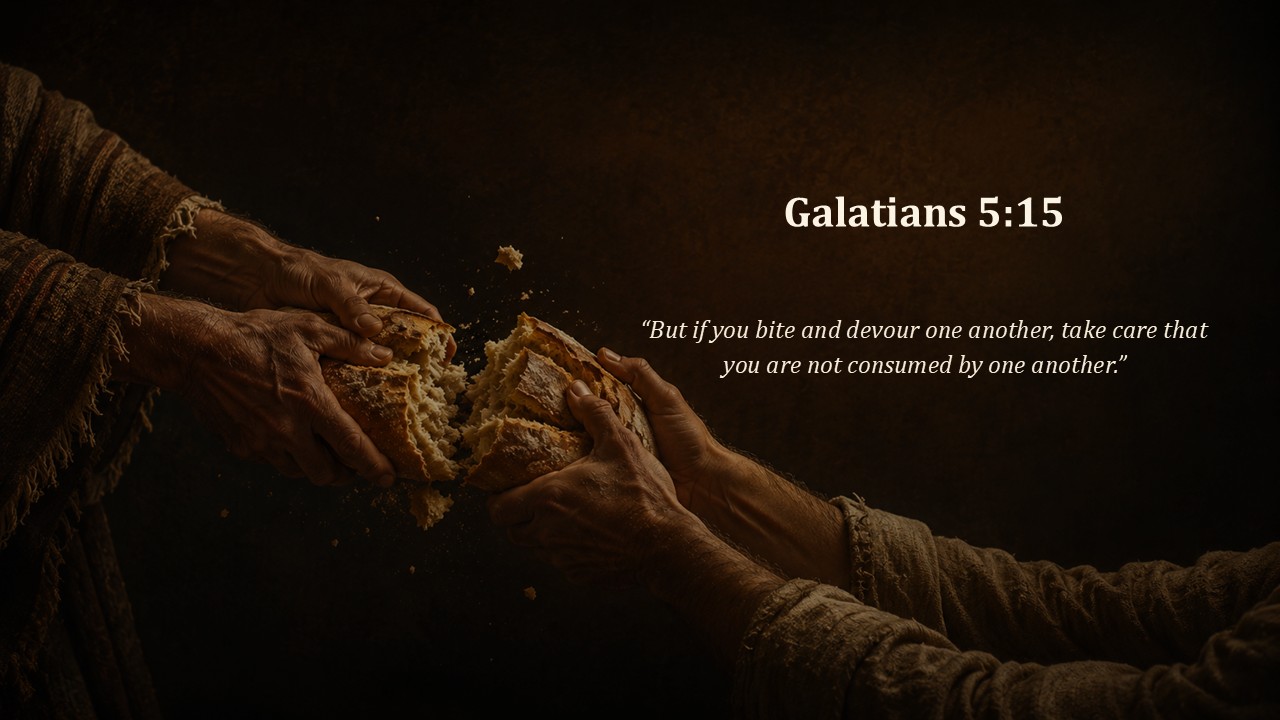
Through love we can serve one another, or through the flesh we can consume one another. One asks what it can give and the other asks what it can get. One makes room for the other person; the other turns the other person into something to use, defeat, impress, control, or ignore.
Which brings me back to helping my friend move. My eventual action was right, but my first calculation was entirely about me – my age, my back, my Saturday, and the fact that I could afford a solution I considered more sensible. None of those considerations was imaginary. They were simply first.
Christian service begins before we lift the box. It begins when another person’s good becomes important enough to interrupt our natural preoccupation with our own.
And I do not think we ever entirely outgrow that struggle. We get better at disguising it, and Christians can become remarkably skilled at giving selfishness respectable explanations. Heck, it just happened to me – again – just a few weeks ago. I’ve volunteered with a prison ministry, and they had a special service. I didn’t get the notice until two hours before the event. I didn’t go; “not enough notice” was my excuse. I went home, had dinner with my wife and we watched Youtube videos together. Nothing wrong with that, but was it my best option?
We say we are busy, we are tired, somebody else could do it, the other person should have planned better, or perhaps our particular gifts are better used elsewhere. Any of those things might even be true. The heart is perfectly capable of using a true sentence for a selfish purpose.
Galatians 5 does not tell us that every request receives a yes. It tells us which direction Christian freedom moves. Freedom in Christ does not make us increasingly unavailable to other people; it makes us increasingly free from the demand that life be arranged around us.
My friend needed somebody willing to show up, and eventually I did. I just wish love had answered the door before convenience did.
- Consider this… Why can our first reaction to an inconvenient request tell us more about the heart than the answer we finally give?
II. The Lord Takes the Towel
Galatians gives us the command to serve one another. John 13 gives us the picture.
John begins the upper room account this way:
“Now before the Feast of the Passover, Jesus, knowing that His hour had come that He would depart from this world to the Father, having loved His own who were in the world, He loved them to the end.” – John 13:1
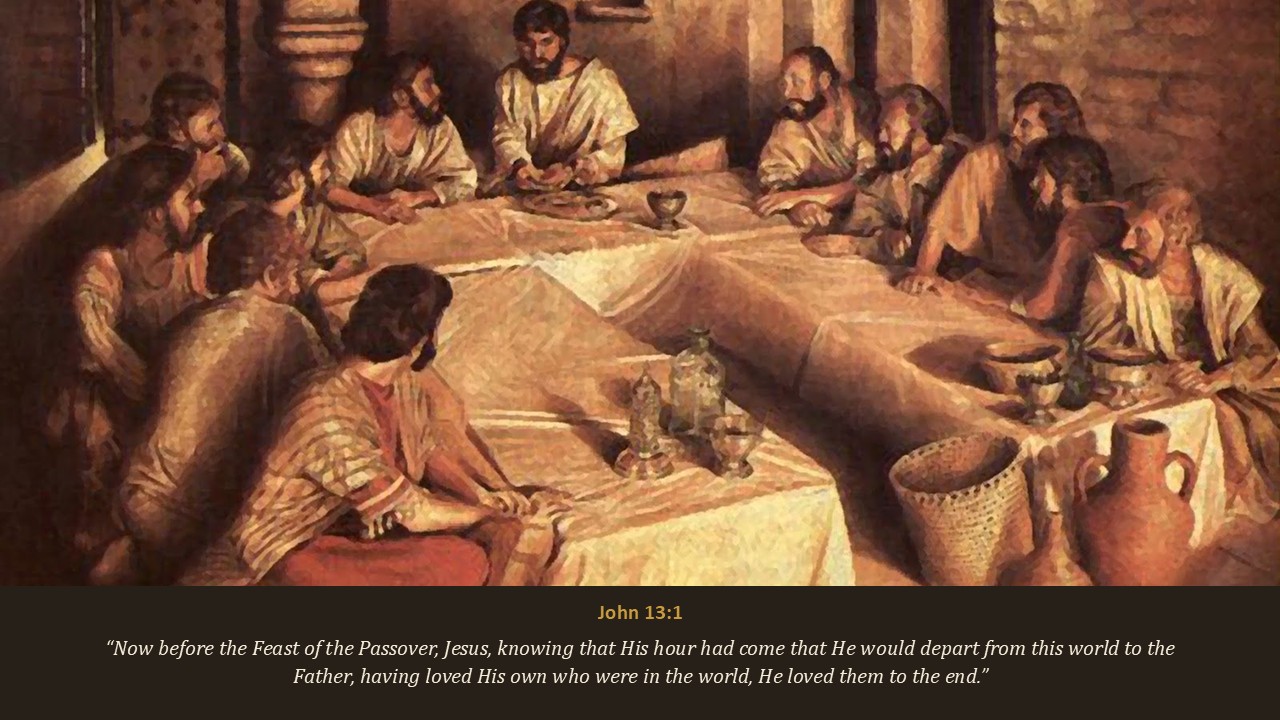
Jesus knows exactly where He stands in the story. The cross is no longer somewhere out in the future. His hour has come, and within hours He will be arrested, abandoned, beaten, tried, and crucified. John summarizes all that cruelty and pain under a single statement: Jesus loved them to the end. The foot washing is not a pause in the larger story. It is part of the same love that will carry Jesus to the cross.
Foot washing was ordinary hospitality in a world of dusty roads and open sandals, but it was low work. A host might provide the water; the actual washing was a servant’s job. By the time we reach the upper room, these men have spent a great deal of time listening to Jesus teach about humility, and apparently none of them has become enthusiastic enough about it to volunteer.
“Jesus, knowing that the Father had given all things into His hands, and that He had come forth from God and was going back to God, got up from supper and laid His outer garments aside; and He took a towel and tied it around Himself. Then He poured water into the basin, and began washing the disciples’ feet and wiping them with the towel which He had tied around Himself.” – John 13:3–5
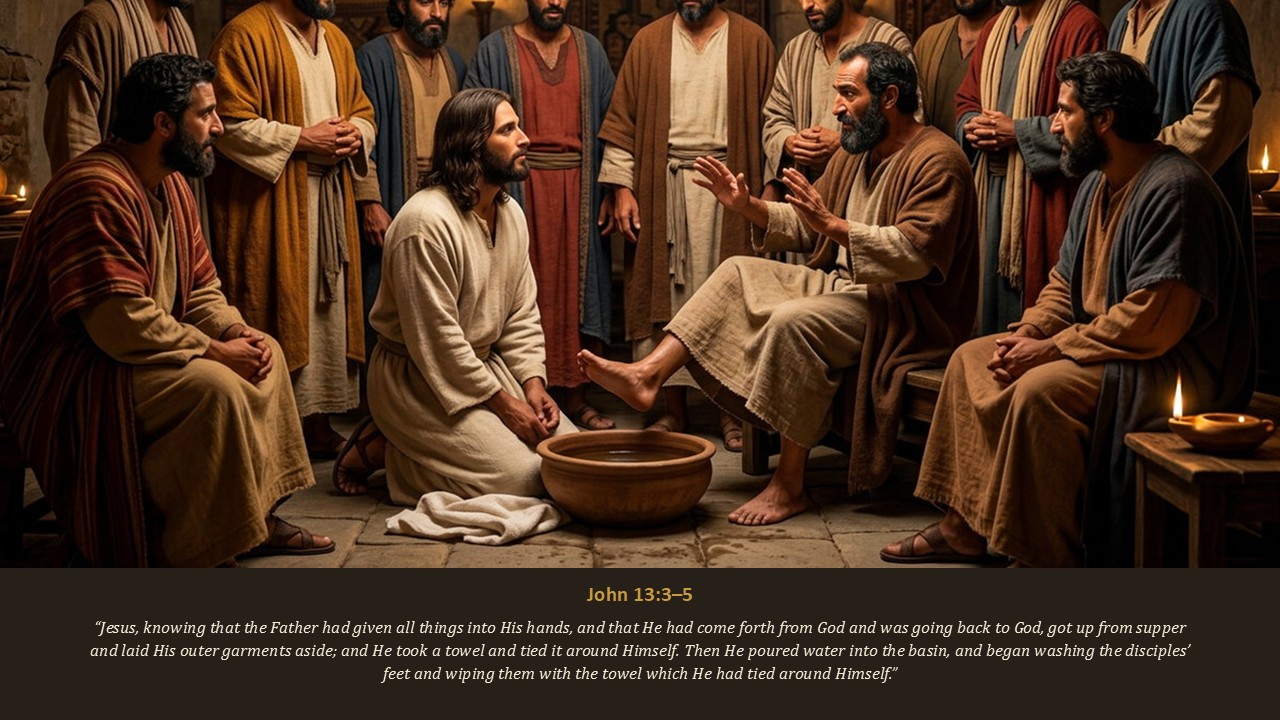
Jesus does not take the towel because He has forgotten His position. John tells us the opposite. Jesus knows the Father has given all things into His hands, He knows where He came from, and He knows where He is going.
The hands of our Savior pick up the towel.
We sometimes confuse humility with thinking less of ourselves than is true. Jesus never does that. He does not pretend He is not Lord, downplay His authority, or apologize for His identity. He is completely secure in who He is, which means He has no status to protect.
That is part of what makes service difficult for us. Certain jobs feel too small, too menial, too inconvenient, or simply not ours. Most of us would never say “that is beneath me,” because we know exactly how that sounds. The language we use is more sophisticated than that.
Jesus is washing feet when He reaches Peter, who reacts exactly as we would expect Peter to react. “Lord, You are washing my feet?” Peter can see the social order inverting in front of him. The problem is not that Peter objects to clean feet. The problem is who is kneeling on the floor.
Jesus answers that what He is doing will make sense later. Peter does not wait for later.
“Never shall You wash my feet!”
At first glance Peter almost sounds humble. Surely it would be inappropriate for the Son of God to kneel in front of him. But Peter’s humility has curdled into resistance, and he is now informing the Lord which roles the Lord is permitted to take.
Jesus answers sharply:
“If I do not wash you, you have no part with Me.” – John 13:8
This is where the scene turns. Jesus is no longer only demonstrating a posture we should copy. He is telling Peter that being washed by Him is not optional, and that refusing it means having no share in Him at all. Peter immediately swings from refusing to be washed to requesting his hands and head as well. Peter can generally be counted on to travel from one ditch to the other without spending much time in the center of the road.
Jesus explains that a person who has bathed needs only his feet washed, and then adds that they are clean – though not all of them. John tells us plainly what that means. Jesus already knows who will betray Him.
Judas is still in the room. John never tells us that Jesus skipped him.
The same Jesus who knew what Judas would do knelt on the floor and washed the disciples’ feet while Judas was among them. That does not mean betrayal is unimportant, and it does not mean Christian service requires foolish trust. We will reach “forgive one another” later in this series, and that lesson will bring its own hard questions. Here the point is narrower. Jesus does not limit service to people who have made themselves worthy of it.
When He finishes, Jesus puts His garments back on, returns to the table, and interprets His own action:
“So if I, the Lord and the Teacher, washed your feet, you also ought to wash one another’s feet.” – John 13:14
Jesus does not say He stopped being Lord in order to serve. He begins the sentence with “I, the Lord and the Teacher.” Service has not diminished Him. He has redefined what lordship looks like in His kingdom.
Then He tells them He has given them an example and reminds them that a slave is not greater than his master. Then He closes:
“If you know these things, you are blessed if you do them.” – John 13:17
That last turn is easy for us to soften, because Bible studies naturally reward knowing things. We examine the setting, compare passages, look at Greek words, and try to get the theology right, and those are good things to do. But John 13 closes by removing the possibility that accurate understanding is sufficient. The disciples have seen the towel and heard the explanation, and now Jesus expects them to do something with it.
The towel points toward the cross. Foot washing is an example we can imitate; the cross accomplishes what only Christ could accomplish. The same self-giving love moves through both scenes.
So we do not begin serving one another in hopes that Jesus will eventually serve us. He already has. Before Christ asks us to take a towel, He takes one Himself. Before He asks us to put another person ahead of our convenience, He puts our eternal need ahead of His comfort. Before He asks us to give, He gives Himself.
Christian service is always response before it is imitation.
- Consider this… Why is it easier for us to admire Jesus taking the lower place than to accept the lower place as a normal part of following Him?
III. Greatness Runs in the Other Direction
The foot washing came near the end of Jesus’ earthly ministry, but the disciples had been wrestling with status for a long time before that.
Mark 10 gives us one of the clearer examples. Jesus and the disciples are on the road to Jerusalem, and just before James and John make their request, Jesus tells the Twelve what is waiting for Him there. The Son of Man will be handed over, condemned, mocked, spit on, flogged, and killed, and after three days He will rise.
James and John apparently hear all of that and decide this would be an excellent moment to discuss seating arrangements.
They come to Jesus and open with, “Teacher, we want You to do for us whatever we ask of You,” which is a wonderfully ambitious way to begin a prayer request. Jesus asks what they want.
“Grant that we may sit, one on Your right and one on Your left, in Your glory.” – Mark 10:37

They believe Jesus is going to reign, and on that point they are entirely correct. They simply have no category yet for a crown reached through a cross. If Jesus is going to the top, they would like the two best offices on the floor just below Him, preferably with a window view. Jesus asks whether they can drink the cup He drinks and receive His baptism, and they answer confidently that they are able. They have no idea what they have just agreed to. Jesus tells them they will indeed share His suffering, but the seats they want are not His to hand out.
Then the other ten hear about it and become indignant. I would like to believe they were offended because they had developed a mature theology of humility. Mark gives us very little reason for that optimism. These are the same men who had already argued about which of them was greatest. Their indignation may have had less to do with the request itself than with the fact that James and John got there first.
So Jesus calls all of them together:
“Whoever wants to become prominent among you shall be your servant; and whoever wants to be first among you shall be slave of all.” – Mark 10:43–44
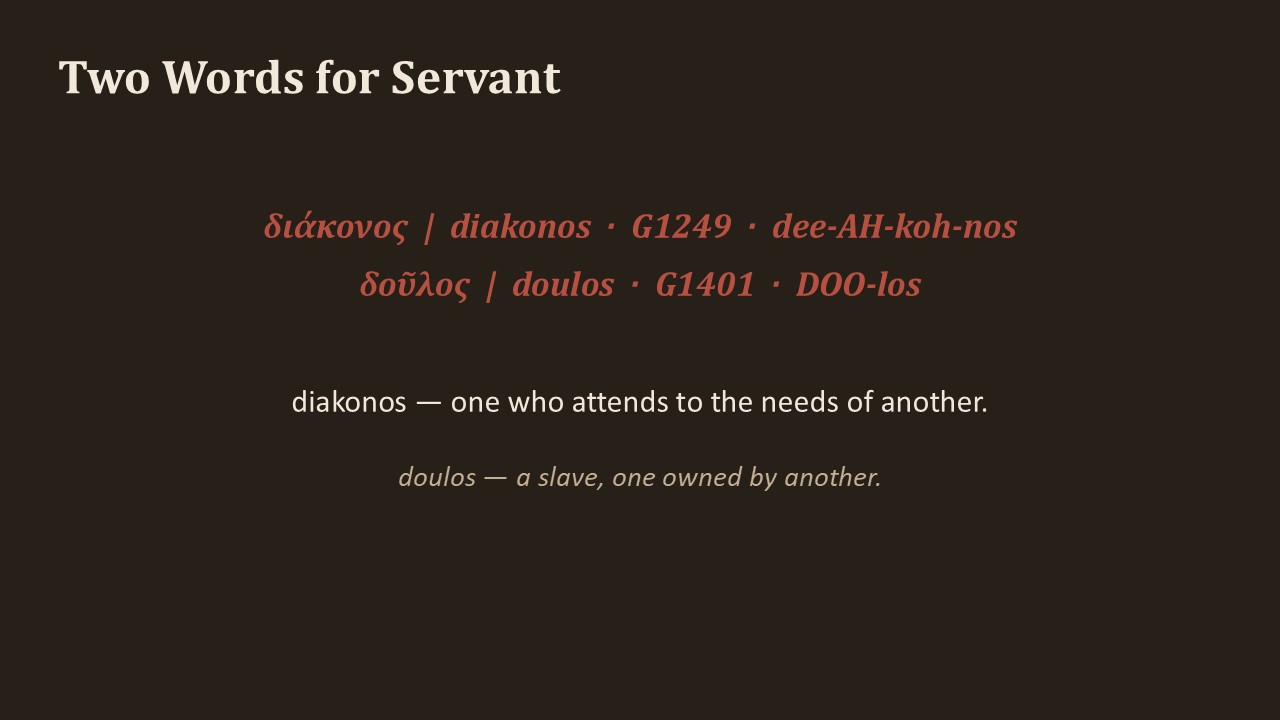
Mark uses two related but different words here. “Servant” is diakonos (G1249, dee-AH-koh-nos), the word behind our “deacon,” describing one who renders service – the household servant who waits the table. Then Jesus goes further. “Slave” is doulos (G1401, DOO-los), a person who belongs to another. That is the same root Paul reaches for in Galatians 5 when he tells free Christians to serve one another through love.
Jesus is not suggesting that the disciples add a few helpful acts to otherwise self-directed lives. He is overturning the scale by which they measure greatness. In the kingdoms they know, greatness moves upward: the greater the person, the more people underneath him, and position brings privilege, authority means others respond to our wishes, and success eventually frees us from doing the small jobs. Jesus tells them His kingdom runs in the other direction. The higher we wish to go, the more willing we must become to stoop.
Then He gives the reason:
“For even the Son of Man did not come to be served, but to serve, and to give His life as a ransom for many.” – Mark 10:45
The verb here is diakoneō (G1247, dee-ah-koh-NEH-oh), from the same family as diakonos. Jesus has just told the disciples that whoever wants to be first must be doulos of all. When He speaks of Himself, Mark returns to the diakon- word family: the Son of Man came “to serve.” Jesus does not reserve service for those beneath Him.
And once again He moves past example. He came to give His life as a ransom for many. A ransom is a payment that secures release. Jesus does not merely demonstrate unselfish behavior; He gives His life in the place of sinners. That is what keeps a lesson on service from deteriorating into “Jesus was nice, so we should be nice.” Christianity is not built on the idea that Jesus provided a superior example of kindness. We were enslaved to sin and unable to purchase our own freedom, and Christ gave His life to redeem us. Galatians says we have been called to freedom; Mark tells us what that freedom cost.
And now the people He has redeemed are free to stop scrambling for the best seats. We can still turn service itself into a way of moving upward, serving because we want to be seen as generous, spiritual, or indispensable. We can keep quiet track of whether anybody thanked us, and we can become irritated when somebody else gets credit for something we did. The outside can look exactly like service while the inside is still negotiating for a better seat.
Jesus does not tell James and John that ambition itself is necessarily wrong. He asks them to adopt an entirely different definition of greatness. “Whoever wants to become prominent among you” is not followed by “stop wanting that.” It is followed by “shall be your servant.” In Christ’s kingdom, greatness is not measured by how far we rise above other people but by our willingness to spend ourselves for their good.
That does not make leadership unimportant. Jesus is Lord, the apostles will exercise real authority in the church, and Scripture establishes elders, teachers, and other roles of responsibility. Biblical humility does not pretend that authority does not exist. It changes what we think authority is for. A Christian leader does not receive greater responsibility so that fewer tasks are beneath him. He receives greater responsibility so that more people become his concern.
The Son of Man has all authority, and He uses it to serve.
- Consider this… Why do service and the desire to be noticed become tangled together so easily?
IV. Serving the Person Instead of the Solution
There is another part of service I am still learning, and in some ways it is harder for me than showing up to move boxes. Sometimes serving somebody means not taking over.
Diane has been planning a girls’ vacation with her friend Margaret, whom she calls Mu. Since it is a girls’ vacation, my official responsibilities are to stay as far away as possible. But from time to time Diane has asked me to help with clerical things on the computer – moving information from one place to another, copying and pasting, organizing something she is working on. So for a few minutes here and there, my mechanical engineering education is devoted entirely to Control-C and Control-V.
I offered to help more broadly. “Happy to help out, sweetheart. Just let me know.”
And then I tried to drop it.
That last part is the part I need to practice. I am an engineer. Give me a problem and my natural inclination is to solve it. If I think I see a more efficient way to organize something, I want to organize it. If I believe I see the answer, I am inclined to provide the answer, whether or not anyone has requested it. Sometimes that is exactly what somebody needs.
Sometimes it is not.
I am learning that serving another person does not mean deciding what that person ought to need from me. Philippians 2 gives us the posture underneath that:
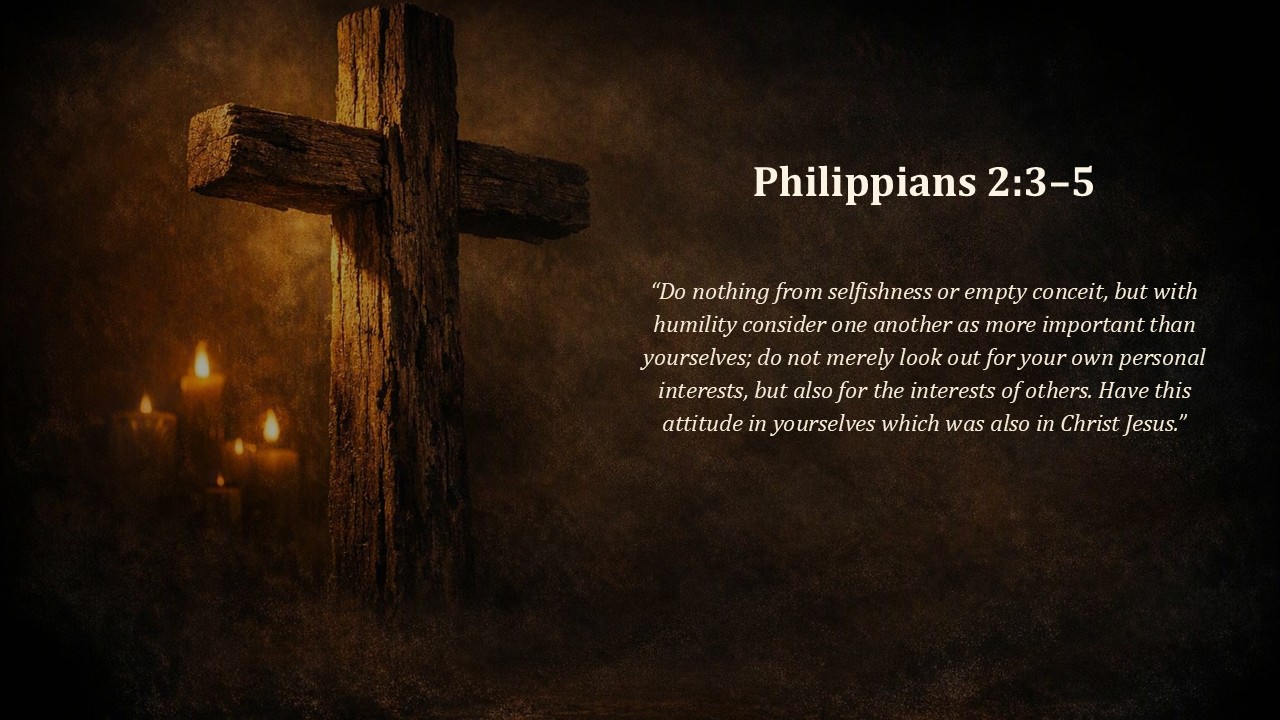
“Do nothing from selfishness or empty conceit, but with humility consider one another as more important than yourselves; do not merely look out for your own personal interests, but also for the interests of others. Have this attitude in yourselves which was also in Christ Jesus.” – Philippians 2:3–5
The emphasis is not that our own interests cease to exist. Paul does not tell us to become people without needs, responsibilities, limits, or judgment. He widens our field of vision. We naturally see life from inside our own heads, and from in there we know what we are trying to accomplish, what is convenient for us, what we are good at, and how we would solve the problem. Service requires the imaginative work of asking what the situation looks like from the other side. That sounds simple until we actually try it, because the help another person needs is not always the help we most enjoy giving.
We can see it in John 13. Jesus does not walk into the room and announce some impressive thing He would like to do for everybody. Nobody there needed a sermon on foot hygiene, and nobody needed a committee formed. There were dirty feet, water, and a towel, and an ordinary task sat in the middle of the room while twelve men found other things to think about. Jesus served the actual need in front of Him.
At the same time, biblical service is not the same thing as doing whatever another person wants. Jesus never lived that way. The crowds had endless ideas about what He should do next – more miracles, more food, and sometimes simply more access to Him. Jesus loved people perfectly and still did not surrender His mission to their expectations. So “serve one another” cannot mean “say yes to everybody.” That would not be love. Sometimes a request is unwise, sometimes what is asked for would actually harm the person asking, sometimes another person is far better equipped to help, and sometimes we genuinely do not have the capacity. We are creatures, not God, and we have limits.
But that truth becomes very convenient if we reach for it too quickly. The harder question is not whether we may say no. The harder question is why we are saying it.
When my friend asked me to help him move, I could have assembled a respectable argument for hiring movers. I still think hiring movers is an excellent idea, and I practice what I preach on the subject. But my friend had not asked me to design the optimal moving strategy. He asked me to help. And when Diane asks me to copy something from one document into another, she is not asking me to reorganize the trip.
Serving requires enough humility to let the other person remain a person rather than becoming our project. That may be hardest when we actually possess some expertise, because the more capable we are in an area, the easier it is to believe that serving means taking charge. Sometimes leadership is precisely what service requires. At other times the most useful thing we can offer is five minutes of help followed by the discipline to leave the steering wheel alone.
Jesus was never confused about the difference. He washed Peter’s feet while refusing to let Peter dictate the terms. Peter said no, and Jesus corrected him. Peter then asked for more than Jesus intended to give, and Jesus corrected that too. Jesus serves Peter without becoming Peter’s servant in the sense of being controlled by Peter’s wishes. Christian service seeks the genuine good of the other person under the lordship of Christ, which means it is neither self-assertion nor passive surrender to every demand.
And to know what genuinely serves another person, we usually have to pay attention. Jesus noticed people – the blind man others treated as a theological puzzle, the children the disciples regarded as an interruption, the hungry crowd they wanted to send away, and a tax collector sitting in a tree. He was never merely reacting to requests. He saw people clearly.
Much of our failure to serve probably happens before anybody asks us for anything. We simply do not see. The schedule is full, the mind is elsewhere, and attention has narrowed to whatever we are trying to accomplish. The need can be sitting in the room as plainly as a basin of water and twelve pairs of dirty feet.
Serving one another begins by noticing that there is somebody else in the room.
- Consider this… Why is offering the help we prefer to give often easier than learning what would actually help?
V. Stewards of Somebody Else’s Grace
If service required all of us to be good at the same things, some of us would be in trouble. Fortunately, Peter does not describe it that way.
In 1 Peter 4, Peter is writing to Christians living under real pressure. He tells them the end of all things is near, so they are to be sound in judgment and sober in spirit for prayer, and then he turns to life inside the Christian community. They are to keep fervent love for one another and to offer hospitality without complaint. Then:
“As each one has received a special gift, employ it in serving one another as good stewards of the multifaceted grace of God.” – 1 Peter 4:10

The verb translated “serving” is diakoneō (G1247, dee-ah-koh-NEH-oh) again – the same word Jesus used of Himself in Mark 10.
Peter begins with “as each one has received.” Service starts with receiving. Whatever ability we use to serve another Christian was first given to us, which removes a good deal of the room for pride. We are not owners displaying what belongs to us. Peter calls us stewards, and a steward manages somebody else’s property.
Then comes the phrase I keep coming back to: “the multifaceted grace of God.” Older translations often render it “manifold.” The idea is grace with many facets, many forms, many ways of arriving. God does not distribute identical packages to every believer. One person teaches well, another has a pickup truck, and another quietly sees what needs doing before anyone else notices there is a problem. The variety is not an inconvenience to be overcome. It is part of how God designed the body of Christ.
Peter then sorts his examples broadly into speaking and serving:
“Whoever speaks is to do so as one who is speaking actual words of God; whoever serves is to do so as one who is serving by the strength which God supplies; so that in all things God may be glorified through Jesus Christ, to whom belongs the glory and dominion forever and ever. Amen.” – 1 Peter 4:11

That keeps service from becoming a celebration of our competence. The gift comes from God, the strength comes from God, and the glory goes back to God. We are in the middle. That is what stewardship is.
This also corrects the idea that “real ministry” is whatever happens at the front of a room. I suppose teaching this Bible study is service, even if none of you asked for it. When I teach, everybody is looking at me and I show pretty pictures on a PowerPoint, which makes even an amateur teacher look considerably more competent than he is. It is difficult to miss what I am doing. Most service does not work that way. Somebody arrives early and unlocks the room, somebody drives a person who can no longer drive, and somebody spends ten minutes on a computer problem that will never appear in a church newsletter. Peter does not rank those by visibility. They are different expressions of the same grace.
This is also where my search for a great opening story about service went wrong. I wanted something dramatic enough to open a lesson, but most faithful service is not dramatic enough to become a story, and that may be one of its virtues. The upper room needed somebody to wash feet precisely because foot washing was ordinary. There’s no trophy for “Best Foot-Washer.” The task mattered because people had dirty feet, not because the task was impressive.
Perhaps that is why ordinary service exposes our motives more clearly than large acts do. Large acts arrive with significance already attached and they feel worthwhile on their own. Small acts often offer nothing except the good they actually do for somebody else. We may never know how much of God’s multifaceted grace arrives through things nobody remembers afterward – a ride, a meal, a repaired hinge, a few boxes carried from one place to another, five minutes of copying and pasting, a towel. None of that is impressive by itself. But Peter says that when God gives something to one believer and that believer spends it on another, grace has moved from one life into another.
That changes how we should think about ability, too. We often ask what we are good at as though gifts exist mainly to help us find our place, our fulfillment, or our calling. Peter points the gift outward. Paul says something similar in 1 Corinthians 12, where believers are one body with many parts: an eye is valuable because the body needs sight, a hand is valuable because the body needs what a hand does, and a foot does not become more spiritual by wishing it were an eye. God’s varied grace does not require us to become impressive versions of somebody else. It asks for faithfulness with what He has already put in our hands. In other words, be the best version of what He created, not what others imagine you to be.
That gives us a useful boundary between this lesson and the next one. Next time we come to “bear one another’s burdens,” where Paul takes us into the heavier places of life and somebody is carrying a weight that has become too much to carry alone. Service is broader than that, and usually lighter, and far more ordinary. But it trains the same heart. If we will not take the towel when the need is small, we should not assume we will suddenly become servants when the burden is large.
- Consider this… Why do we tend to measure service by how visible it is when Peter measures it by whose grace is moving through it?
VI. Freedom Looks Like a Towel
I eventually helped my friend move. I am glad I did, and I still regret that love was not my first answer.
Maybe that is part of why the towel stays with me. There is nothing impressive about a towel. It is not a symbol of power, accomplishment, expertise, or status. It is useful only because somebody needs it, and it works only when somebody is willing to pick it up.
On the night before the cross, Jesus knew exactly who He was. He knew where He had come from, He knew where He was going, and He knew that the Father had placed all things into His hands. So He took those hands and picked up a towel. The next day those same hands would be nailed to a cross.
The Lord who tells us to serve one another is not standing over us assigning a job He would never do Himself. He has already gone lower than He will ever ask us to go, and He has served us in the one way we could never serve ourselves, giving His life as a ransom for many.

We were called to freedom.
And in the hands of Christ, freedom looks remarkably like a towel.
Soli Deo Gloria.


