

There are things we are supposed to do every day.

Brush your teeth. Take whatever medicine the doctor told you to take, since the bottle does not say to take it when you feel like it. Feed the dog, though our dogs handle that reminder themselves. None of it is particularly interesting. And with most of it, missing one day does not seem to cost much on the day you miss it, which is exactly what makes it easy to drop. The bill arrives later, and by then it is not one day’s worth.
Hebrews puts “encourage one another” on that list.
Not when it occurs to us. Not when somebody looks like he is struggling. Not when we are asked. Every day, while it is still called today.
That is a strange requirement. Why would encouragement need a schedule?
Where We Are
This is the fifth lesson in our “One Another” series.
Depending on how you count, the New Testament gives us somewhere around fifty-nine “one another” commands. We are studying seven of them, not because the other fifty-two do not matter, but because these seven give us the shape of all the rest. We began with love one another, the command the rest grow out of.
- Accept one another: love at the front door.
- Serve one another: love holding a towel.
- Bear one another’s burdens: love under weight.
- Encourage one another: love with words.
- Forgive one another: love after wounds.
- Pray for one another: love on its knees.
We are not moving beyond love. We are watching love go to work.

This week is love with words, and it sits right next to the one we just finished. Bearing a burden moves weight off a man. Encouragement does something else. It puts God back into the picture for a man who has lost sight of Him. You can carry a load for somebody and still leave him alone with his own thoughts.
The Word Behind the Command
Hebrews 3:13 and 1 Thessalonians 5:11 give the same command.
But encourage one another every day, as long as it is still called “today,” so that none of you will be hardened by the deceitfulness of sin. – Hebrews 3:13
Therefore, encourage one another and build one another up, just as you also are doing. – 1 Thessalonians 5:11
The word underneath both is παρακαλέω (parakaleō, par-ak-al-EH-o, G3870), and it means to call someone to your side. Hold on to that word. We’ll see it again in a moment, attached to the Holy Spirit.
Translators have never settled on one English word for parakaleō. The New King James has Paul saying comfort each other and Hebrews saying exhort one another daily. These are two angles on the same idea.
When you call someone to your side, everything depends on why. Sometimes you put an arm around someone who is hurting. Sometimes you remind him of something he has forgotten. Sometimes you tell him to keep going when he wants to quit. And sometimes you care about him enough to say he is headed the wrong way.
If my job is to build you up and your job is to build me up, we have not yet said where any of it comes from. Encouragement that amounts to believers passing good feeling back and forth has no source, and a thing with no source runs out.
Parakaleō turns up in one more place, and that place tells us where encouragement comes from. On the last night before the cross, Jesus told the eleven:
I will ask the Father, and He will give you another Helper, so that He may be with you forever; – John 14:16
Helper. Some translations say Comforter, some say Advocate, some leave it in Greek and say Paraclete. The word is παράκλητος (paraklētos, par-AK-lay-tos, G3875), the noun built on the same verb Paul and the writer of Hebrews use. The One called alongside. And Jesus says what He does when He gets there:

But the Helper, the Holy Spirit whom the Father will send in My name, He will teach you all things, and remind you of all that I said to you. – John 14:26

The Spirit comes alongside and reminds them of what Christ has already said. When we encourage one another biblically, we come alongside another believer and bring what God has said back into view. Ours is the lesser work and it depends entirely on His, but it is the same shape, and it is a considerably larger assignment than being pleasant to people.
It also settles what the content has to be. If what I bring my brother is my opinion, my mood, or my advice about how he ought to run his life, I am doing something other than what I was asked to do.
Biblical encouragement is helping another believer see himself, his circumstances, and his next step in the light of what God has said.
So it is not flattery. It is not criticism. And it is not permission to ignore what Scripture calls sin. It is one believer helping another keep walking faithfully with Christ.
I. Encourage One Another Every Day
Hebrews gives this an urgency we might otherwise miss, and the urgency is not the writer’s own. He is preaching a psalm at them. Six verses earlier he quotes Psalm 95:
Therefore, just as the Holy Spirit says, “Today if you hear His voice, do not harden your hearts as when they provoked Me, as on the day of trial in the wilderness, – Hebrews 3:7–8

That generation had watched God split a sea. They ate bread that showed up on the ground every morning. They had better evidence than most of us will ever have. And Hebrews says they hardened anyway, because more evidence does not cure unbelief. It works on people who have plenty.
Then the writer brings the psalm forward to his own readers:
Take care, brothers and sisters, that there will not be in any one of you an evil, unbelieving heart that falls away from the living God. – Hebrews 3:12
The command comes in the very next verse, and it opens with “but.” Take care that no one falls away — but encourage one another every day.
He does not say, “Be careful that you don’t harden.” He says, “Encourage one another every day.”
This has been a favorite verse of mine for a long time, partly because of the deadline hiding in it. What day is it? Wow, it’s today. Again.

It is always today. The window Hebrews gives us never closes and never opens any wider. You do not get a morning where you wake up and find that it is finally Tomorrow and the assignment has moved.
One of God’s protections against a hardening heart is another Christian.
We tend to think of the Christian life as a private arrangement between ourselves and God. We read our Bible, we pray, we worship, we try to obey. Those things are essential. But God never intended us to do this alone.
Dietrich Bonhoeffer wrote in Life Together:
The Christian needs another Christian who speaks God’s Word to him.
Sometimes we need another believer to tell us what Scripture says because our own heart has stopped saying it clearly.
I had been attending church for a while without being connected to much of anything, and I was not a Christian. I would not have told you that at the time, because I did not know it. We got into this in “Accept One Another” — a man can sit in a pew for years, answer every question correctly, and never have come to Christ.
A pastor named John Louis offered to take me through a Bible study. Not a class, not a book he thought I should read. He sat down with me and we went through Scripture together. That study is where I came to faith.
Another Christian spoke God’s Word to me. I did not know I needed it, and I had not asked.
Our hearts are persuasive. God has forgotten me. I failed, so God is finished with me. That compromise isn’t really that serious. I know what the verse says, but my situation is different.
Hebrews calls it the deceitfulness of sin. Sin does not introduce itself by announcing what it intends to do to us. It sounds reasonable. And after we have listened to ourselves long enough, reasonable starts sounding true.
That is where another Christian comes in.
Jonathan did it for David. Saul was hunting him, and David was hiding in the woods. Jonathan could not remove Saul, could not hand David the throne, could not make the danger go away.
And Jonathan, Saul’s son, set out and went to David at Horesh, and encouraged him in God. – 1 Samuel 23:16

He encouraged him in God. The New King James puts it more physically — Jonathan strengthened his hand in God — and that may be the best definition of Christian encouragement in the Bible.
Jonathan did not tell David everything was fine. Everything was not fine. He helped David remember God in circumstances that had not changed at all.
That is different from optimism. Christian encouragement never requires us to pretend that cancer isn’t cancer, that grief isn’t painful, that a layoff isn’t frightening, or that sin isn’t serious. It brings God and His promises back into view.
And Hebrews sets the schedule: every day, while it is still called today.
Most of us have thought something good about another person and never said it. We appreciate his steadiness. We see how patiently she cares for her mother. We admire how he handled something ugly without repaying it. And we think, I ought to tell him that.
Then we don’t.
Hebrews does not say encourage one another when you get around to it.
Discussion Question: Why would God make our protection against a hardening heart depend on another believer?
- What did Jonathan actually give David, given that he could not change a single circumstance?
- What can another Christian see in me that I have stopped being able to see in myself?
- When has somebody said the right thing to you at exactly the moment you needed it?
II. Barnabas, the Son of Encouragement
One man in Acts got renamed for encouraging people.
Now Joseph, a Levite of Cyprian birth, who was also called Barnabas by the apostles (which translated means Son of Encouragement), and who owned a tract of land, sold it and brought the money and laid it at the apostles’ feet. – Acts 4:36–37
His name was Joseph. We call him Barnabas because the nickname stuck. Imagine being known so consistently for one Christian quality that the church quietly renames you for it.
What makes him useful to us is that he does not encourage the same way twice.
The first time we meet him, encouragement looks like a check. Believers are in need, so he sells property and hands over the proceeds. Encouragement is sometimes practical.
Then Saul shows up. This is the man who had approved Stephen’s death and dragged believers out of their houses. He tries to join the disciples in Jerusalem, and Acts 9:26 says they were all afraid of him and did not believe he was a disciple.
I cannot blame them. If the man who had been arresting Christians walked into Bible study and announced he was one of us now, I suspect most of us would check the parking lot before passing him the sign-up sheet.
But Barnabas took hold of him and brought him to the apostles, and he described to them how he had seen the Lord on the road, and that He had talked to him, and how he had spoken out boldly in the name of Jesus at Damascus. – Acts 9:27

Barnabas put his own credibility behind a man whose past made everybody nervous. Encouragement is sometimes advocacy.
Then the gospel reaches Antioch, Gentiles are coming to Christ in numbers, and Jerusalem sends Barnabas to look into it.
Then when he arrived and witnessed the grace of God, he rejoiced and began to encourage them all with resolute heart to remain true to the Lord; – Acts 11:23
He witnessed the grace of God.
Some people can walk into any room and inventory everything wrong with it inside of ninety seconds. The music is too loud, the thermostat is a personal insult, and whoever parked that truck should be ashamed.
That is not my particular failure. Mine runs the other way. I can walk into the same room and notice nothing at all — not what is wrong with it, and not what God is doing in it either.
Barnabas had a habit I do not. He looked for what God was doing. Antioch was not flawless, and grace was there anyway, and he saw it, and then he told them to stay with the Lord. He saw grace and urged faithfulness. Those go together.
Then he did something else characteristic of him. He went looking for Saul.
And he left for Tarsus to look for Saul; – Acts 11:25

A growing church needed a teacher, and Barnabas knew a man whose gifts were sitting idle in Tarsus. He brought him to Antioch, and the two of them taught there for a year. Barnabas did not make Paul an apostle. God did that. Barnabas saw what God was doing and made room for it.
Barnabas had been the more established man. He had the standing in Jerusalem, the property, the reputation. He recruited Paul out of obscurity, and inside of one journey Paul had moved ahead of him.
Luke reports no complaint. Whatever else Barnabas was, he was willing to be passed by somebody he had personally brought in.
And then he did it one more time, at cost.
John Mark had gone out with Paul and Barnabas on the first journey and quit partway through. When Paul proposed a second trip, Barnabas wanted to bring Mark. Paul refused.
Now it turned into such a sharp disagreement that they separated from one another, and Barnabas took Mark with him and sailed away to Cyprus. But Paul chose Silas, and left after being entrusted by the brothers to the grace of the Lord. – Acts 15:39–40

Luke never tells us who was right, and I am not going to tell you either. There is a case on both sides. Paul was protecting a mission that could not afford another man walking home. Barnabas was protecting a man who could not afford to be written off. I suspect they were each guarding something worth guarding.
Luke says the brothers entrusted Paul and Silas to the grace of the Lord. He says no such thing about Barnabas, who then sails off the page and out of Acts. Luke does not tell us whether we are meant to make anything of that. But if we are going to hand Barnabas the win in this dispute, we at least have to notice it.
But years later Paul writes from prison:
Only Luke is with me. Take along Mark and bring him with you, for he is useful to me for service.
2 Timothy 4:11
Something happened between Acts 15 and 2 Timothy 4. That verse does not settle the argument. It settles the man. Mark, who once quit, became useful to Paul and eventually gave us a Gospel. And somebody stayed with him in the meantime.
Barnabas would not let Mark’s worst moment become Mark’s permanent identity. That may be one of the better gifts we can hand each other. We can remember a man’s history without keeping him locked in it.
The failure was real. Sin does have consequences, and trust sometimes has to be rebuilt slowly. Encouragement does not pretend the past never happened. It just asks a second question: what might God still do with this person?
There is one more scene, and it keeps Barnabas from becoming a plaster saint.
Back in Antioch, Peter had been eating with Gentile believers until certain men arrived from Jerusalem. Then he pulled back. Others followed him, and Paul writes:
The rest of the Jews joined him in hypocrisy, with the result that even Barnabas was carried away by their hypocrisy. – Galatians 2:13

Even Barnabas.
The man who had vouched for Saul when it was dangerous. The man who had come to this very city and seen the grace of God in these very Gentiles and told them to stay with the Lord. He got up from the table and walked away from people he had personally encouraged, because the pressure in the room changed.
Paul withstood Peter to his face. Somebody had to say it out loud, and the Son of Encouragement was on the receiving end of it.
He had a good habit and a real weakness, and the habit bought him no immunity. He drifted in the place where he was strongest, surrounded by people who had every reason to trust his judgment.
Paul needed a Barnabas when nobody trusted him. Mark needed a Barnabas when Paul no longer wanted him on the team. Barnabas needed one in Antioch. Sooner or later most of us need one, and sooner or later God expects us to be one.
Discussion Question: What did it cost Barnabas to see grace in people everybody else had written off?
- What did he risk each time — with Saul, with Antioch, with Mark?
- What separates seeing the grace of God in someone from simply deciding to be positive about him?
- Whose failure can you recite from memory, and whose growth since then have you never once mentioned?
III. Not Everybody Needs the Same Thing
Three verses after telling the Thessalonians to encourage one another and build one another up, Paul gets specific:
We urge you, brothers and sisters, admonish the unruly, encourage the fainthearted, help the weak, be patient with everyone. – 1 Thessalonians 5:14
Four groups, four different instructions.
Admonish the unruly. The word is ἄτακτος (ataktos, AT-ak-tos, G813), a military term for a soldier out of ranks. He is out of line, which is a different problem from being discouraged or worn down. What he needs is somebody willing to say so plainly, which is exactly what nobody wants to be.
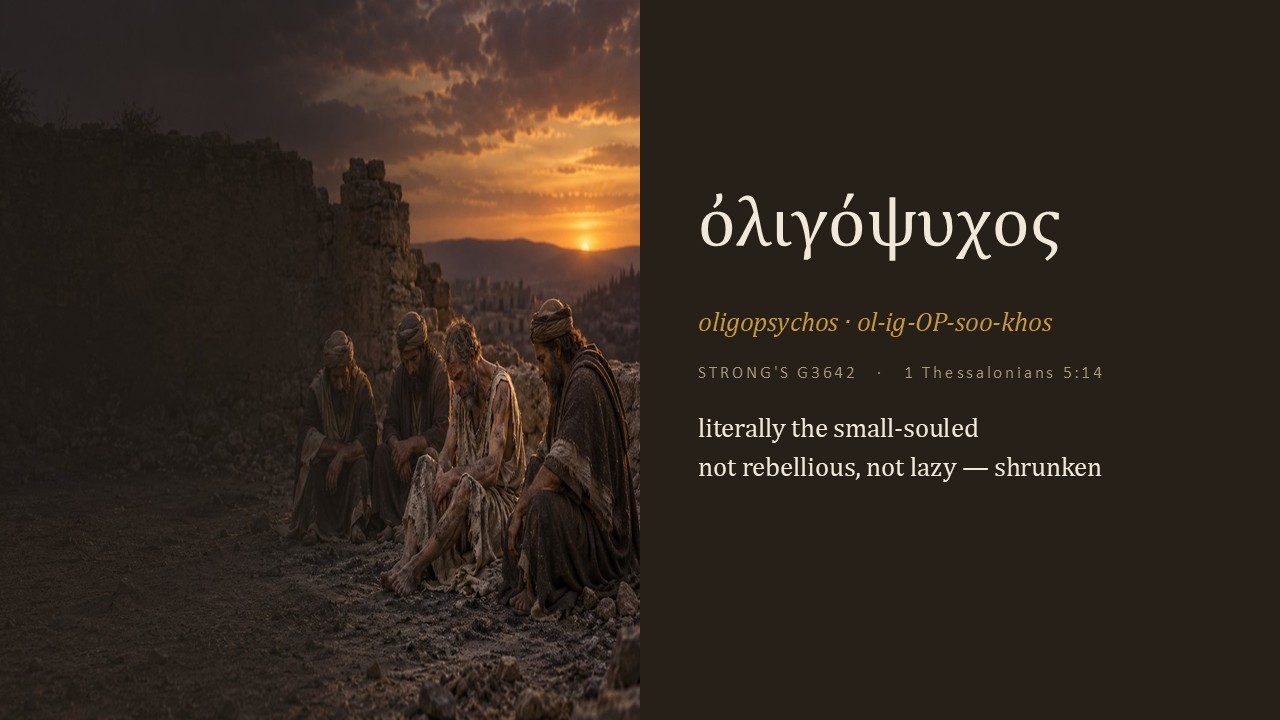
Comfort the fainthearted. ὀλιγόψυχος (oligopsychos, ol-ig-OP-soo-khos, G3642), literally the small-souled. Not rebellious, not lazy — shrunken. This is the person who has taken one more hit than he had left in him. Grief, a diagnosis, a child who will not speak to him. He does not need a theological explanation of why his feelings are inaccurate. Job’s friends got this right exactly once, at the beginning, when they sat on the ground with him seven days and said nothing because they saw that his grief was very great. Then they started talking, and it went downhill for about thirty chapters. Showing up is often the whole ministry.
Help the weak. The verb is ἀντέχομαι (antechomai, an-TEKH-om-ahee, G472), which means to hold onto, to cling to, to take his arm. The New King James says uphold, and that is closer to the picture. Weight transfer, not conversation. Somebody is carrying more than he can carry, and part of the load moves onto you — a meal, a ride, a Saturday, a standing phone call. Advice is cheap and a Saturday is not, which is generally how you can tell which one a man actually needs.
Be patient with everyone. That one has no exceptions, and it is where most of us break. The unruly man does not straighten out on our schedule. The fainthearted woman is still fainthearted in March. The weak brother needs the same help he needed last year. Paul assumes this will take longer than we want it to.
So the assignments do not transfer. Comfort a man who needs admonishing and you have helped him stay where he is. Admonish a woman who is already fainthearted and you may finish her off. Lecture someone who is weak and needs a hand, and you have handed him one more thing to carry. Get impatient with any of them and you have undone whatever else you did right.
We spent a whole session on this in Galatians 6. The question there was whether a load has genuinely become too heavy for a man or whether it is a responsibility he is refusing to carry. That is the same line Paul draws here between the weak and the unruly.
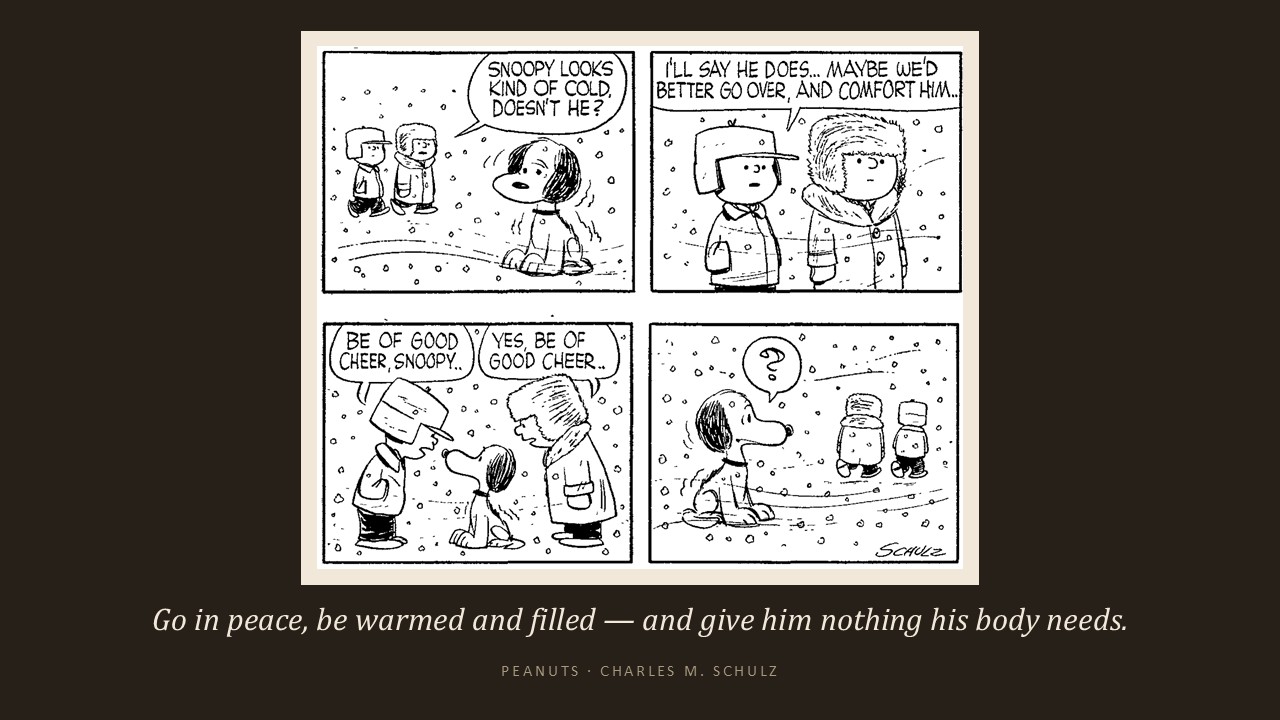
Charles Schulz drew the failure exactly. Snoopy is sitting out in the snow, shivering. Two of the children notice, and one of them says they had better go over and comfort him. So they walk over, pat him on the head, tell him to be of good cheer, and walk away. The last panel is Snoopy, still in the snow, still freezing, with a question mark over his head.
James says the same thing without the drawing. If you tell a man to go in peace, be warmed and filled, and give him nothing his body needs, you have not helped him. Snoopy did not need a blessing. He needed somebody to open the door and let him in.
The question to ask is what this person needs in order to take the next faithful step. Whether I came away feeling encouraging is beside the point.
And sometimes the answer is admonishment. Hebrews 3:13 says why: so that none of us is hardened by the deceitfulness of sin. If a friend is walking steadily toward something Scripture plainly calls sin, saying nothing is not kindness. It is just quieter.
Both ditches are real.
On one side, we are far too quick to correct. We confuse our preferences with Scripture and our irritation with discernment.
And somebody is already thinking of the verse. “Do not judge, so that you will not be judged.” It may be the best-known sentence Jesus ever spoke and the least-read in context. He cannot mean we are forbidden to make moral judgments, because a few verses later He tells us to watch out for false prophets and identify them by their fruit, and in John 7:24 He says to judge with righteous judgment.
What He describes is a man with a log in his eye offering to take a speck out of somebody else’s. The word He uses for that man is hypocrite. But He does not tell him to leave the speck alone. He tells him to take the log out first, and then he will see clearly to take the speck out of his brother’s eye. The goal is getting the speck out, and the only question is whether the man holding the tweezers can see well enough to do it.
That is the same ground we covered in Galatians 6: restore him in a spirit of gentleness, each one looking to yourself, so that you are not tempted as well. The log comes out before the speck, and the order changes the posture of the man doing the talking.
On the other side, we care so much about not seeming judgmental that we watch someone walk toward a washed-out bridge and say nothing. Paul’s phrase for Christian maturity is “speaking the truth in love.” Truth without love turns into brutality. Love without truth turns into sentimentality. Christian encouragement requires both halves.
Paul’s charge to Timothy puts them side by side:
preach the word; be ready in season and out of season; reprove, rebuke, exhort, with great patience and instruction. – 2 Timothy 4:2
Reprove, rebuke, exhort, great patience, instruction. Those belong in the same sentence.
Correction aimed at restoration is a form of encouragement. Correction aimed at winning is something else, and we usually know which one we are doing. Three questions sort it out fast. Do I want this man restored, or do I want to be right? Would I say this to him, or only about him? Is this actually a biblical issue, or just something I would prefer he do differently?
If those questions make us uncomfortable, the first inspection should probably be our own.
Discussion Question: How do you tell which of Paul’s four instructions the person in front of you actually needs?
- Why does Paul refuse to give one instruction that covers all four groups?
- Which is the greater failure of love: correcting someone who needed comfort, or comforting someone who needed correcting?
- Which of the four do you default to, and who has been getting the wrong one from you?
IV. Words That Actually Build
Paul gives us a working test for our words:
Let no unwholesome word come out of your mouth, but if there is any good word for edification according to the need of the moment, say that, so that it will give grace to those who hear. – Ephesians 4:29

Two standards there. Does it build, and does it fit the need of the moment? Encouragement that fits a moment has to be specific.
“You’re great” is pleasant. “I watched how patiently you handled that, and I saw Christ in the way you answered him” is encouragement.
“I appreciate you” is good. “You have shown up every single week to sit with him when nobody would have blamed you for being worn out” is something a tired person may still be holding onto in five years.
Paul did this constantly. He told the Thessalonians he remembered their work of faith, their labor of love, and their patience of hope. He told the Philippians he thanked God on every remembrance of them. He told Timothy he called to mind the genuine faith that was in him. Paul did not merely think encouraging things about people. He mailed them.
There may be someone in my life who has heard every criticism I ever had of him and almost none of the good things I have thought. That ought to bother me.
This is where flattery and encouragement separate. Flattery says something nice because I want something from you. Encouragement says something true because I want something for you. It sees evidence of God’s grace in a man and names it out loud, which is exactly what Barnabas did when he got to Antioch.
Seeing grace can be practiced. Looking for what is wrong in a home, a marriage, or a Bible class will always turn something up, and it requires no effort at all. Noticing where God is already at work is the harder discipline, and it is the one worth building.
Discussion Question: What makes an encouraging word actually build somebody up?
- What does Paul mean by edification according to the need of the moment?
- What separates naming God’s grace in someone from paying him a compliment?
- Who is doing something faithful that you have noticed and never mentioned? You do not have to say the name out loud.
V. Nobody Graduates
There is one danger in a lesson like this, which is spending forty-five minutes thinking about all the people who need our encouragement.
Writing to Christians in Rome he had never met, Paul says:
For I long to see you so that I may impart some spiritual gift to you, that you may be established; that is, that I may be encouraged together with you while among you, each of us by the other’s faith, both yours and mine. – Romans 1:11–12
Paul was an apostle. He had seen the risen Christ. He wrote much of our New Testament. And he expected ordinary Christians in Rome to encourage him.
Nobody graduates from needing this. Pastors need it. Teachers need it. Parents need it. The man who always seems strong needs it, and the woman who is always encouraging everybody else needs it, probably most of all.
We were never meant to sort the church into strong people who give encouragement and weak people who receive it. Some weeks we are Jonathan, and some weeks we are David in the woods. Sometimes we are Barnabas vouching for Saul, and sometimes we are Saul needing somebody willing to believe God really changed us. And if we live long enough, we may be Mark, hoping the man who wrote us off will write again.
Which is why Hebrews ties all of this to showing up:
And let’s consider how to encourage one another in love and good deeds, not abandoning our own meeting together, as is the habit of some people, but encouraging one another; and all the more as you see the day drawing near. – Hebrews 10:24–25
Consider how. The New King James renders the phrase consider one another, and either way it takes more than occupying the same room for an hour. It means knowing each other well enough to tell when somebody is discouraged, drifting, or quietly being faithful while nobody says a word about it.
And it has a direction: toward love, toward good deeds, toward the day. We are not trying to make each other feel slightly better while we wait. We are helping each other finish.
Conclusion – While It Is Still Called Today
Sometimes encouragement sounds like Jonathan, reminding a hunted man what God had promised. Sometimes it looks like Barnabas, saying out loud that he sees God’s grace in someone nobody else trusts yet. Sometimes it is a warning, and sometimes it is just sitting on the ground with a man who is grieving.
But most of the encouragement I have failed to give was not the hard kind. It was not a rebuke I was afraid to deliver or a crisis I had no words for.
It was the good thing I was already thinking and never said.
My grandfather taught a Bible study at a Baptist church in Pensacola for thirty-five years. I never heard him teach. Not once. He died twenty years before I came to faith.
My grandmother wrote “Jesus loves you” at the bottom of every birthday card she ever sent me. For years I read past it the way you read past a return address. She was gone too, well before any of it meant anything to me.
There was never a phone call I could make. No Sunday where I got to walk up and tell either one of them what I think of them now.
Thirty-five years of preparing lessons for a class I never sat in. Neither of them ever heard from me that their faithfulness counted for anything, because I had no way of seeing it until long after they were both gone.

Some of the people sitting around us are doing faithful work that will never report back to them. The man teaching a class this morning has no way of knowing whether any of it lands, and he will keep not knowing. He needs somebody in the room to say something, because the results are not going to.
We do not know what is going on under the surface with the people around us. Someone may be closer to quitting than we realize. Someone may be wondering whether years of quiet faithfulness ever mattered to anybody. Someone may simply need to hear that we see what God is doing in him, and that he should keep going.
God could send an angel. Usually He sends a person with a phone in his pocket and an afternoon free.
And Hebrews gives us the timetable.
While it is still called today.
Soli Deo Gloria.


