

Ephesians 4:26–32 · “One Another” Series, Lesson 6
I. Keeping the Books
Did you know they’re already playing Christmas music, and it’s not even Thanksgiving yet? I read that by October 1, Spotify was streaming more than 36 million holiday songs a day, and listeners had built over 100,000 new holiday playlists in September alone. Someone in this room is probably already belting out Mariah Carey in the car. I’m not naming names.

So, a little Christmas story. Early in A Christmas Carol, Charles Dickens shows us Ebenezer Scrooge in his counting-house on Christmas Eve. The fire is so small that his clerk tries to warm himself at a candle. Scrooge is bent over his books, where every name, date, and amount owed has been carefully recorded. Nothing has been forgotten, and nothing has been written off.
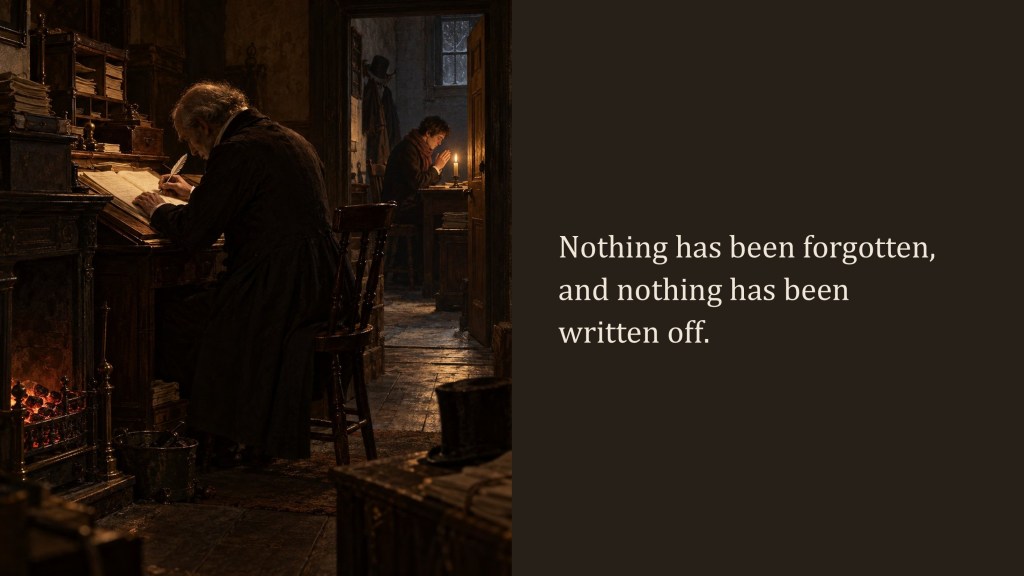
Scrooge kept accounts of money. Most of us keep a different kind of ledger, and we never have to pick up a pencil. We remember what someone said, when someone disappointed us, who failed to apologize, and how many times we have had to put up with the same behavior. Some of our entries are years old, but we can still find the page immediately.
I wish my memory for Scripture were always as efficient as my memory for an insult. Sometimes I cannot remember why I walked into a room, but I can remember what someone said in a different room twenty years ago.
A couple of people asked me to teach about forgiveness, and that request is the reason this “One Another” series exists. We began with Jesus’ command to love one another, then considered what that love looks like when we accept, serve, bear burdens, and encourage. Now we reach something every lasting relationship eventually requires: forgiving one another.
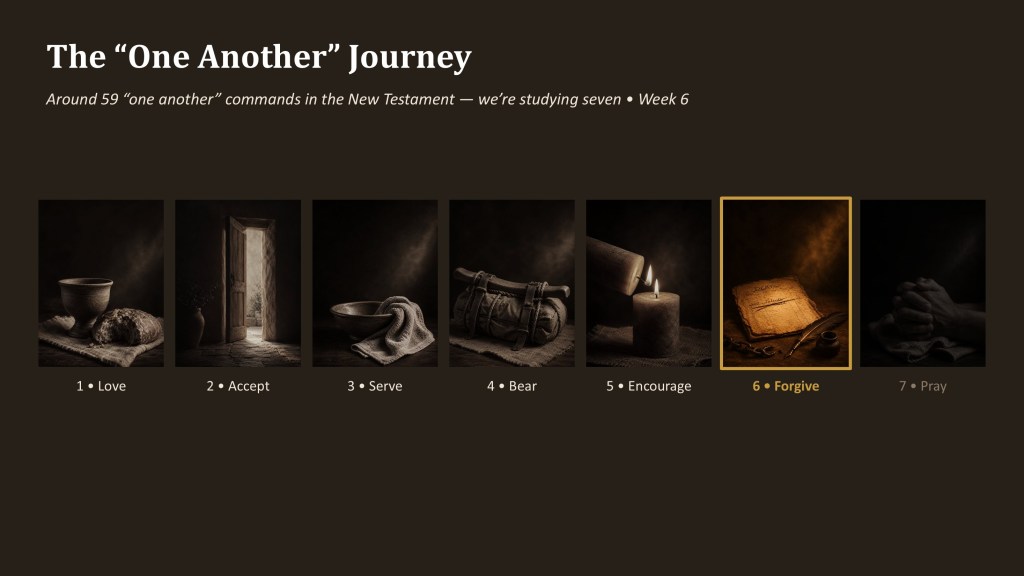
We need forgiveness because we are sinful people. We say things we should not say, break promises, and wound people who trusted us. Sometimes we do those things deliberately. Sometimes we barely recognize what we have done.
When we hear a lesson about forgiveness, most of us can immediately think of someone else who needs to hear it. There may be a name already forming in our minds. But the command is addressed to us. To forgive the debts we remember, we need to reckon honestly with the debt God has forgiven us.
We may have recorded a real wrong accurately. The question is whether we intend to spend the rest of our lives collecting it.

Or we can tear out the page, tell ourselves it was no big deal, and keep smiling at the person who wrote it. That can pass for grace, but pretending a real wrong did not matter is not the same as forgiving it, and a torn-out page has a way of turning up again. Forgiveness is harder. It admits the debt is real and releases it anyway.
In Ephesians 4:26–32, Paul begins with anger and ends with forgiveness. In between, he shows what anger does when it is allowed to settle in.
II. When Anger Moves In
Paul does not assume that becoming a Christian means we will never feel angry.

Some anger begins with a real wrong. We should be troubled by cruelty, dishonesty, and the mistreatment of another person. Following Jesus does not require us to become indifferent to injustice.
But our anger is not automatically righteous merely because we can explain it. We may be angry because someone sinned, or because someone interrupted us, disagreed with us, or failed to recognize how obviously correct we were. Sometimes we give our wounded pride a respectable theological name.
Even legitimate anger can lead us into sin. Someone speaks harshly, and we respond more harshly. We begin with a complaint about another person’s behavior and end by defending our own.
Paul puts a deadline on anger: sundown. Some relationships will not be repaired before bedtime. Some conversations require time, and some circumstances require distance. But we should not make arrangements for anger to stay.
Needing time to calm down is one thing. Using that time to build a stronger case against someone is another. We replay the conversation, supply motives we cannot actually know, and remember several other incidents. Eventually the original offense has acquired supporting documents.
If we spend all our time looking for reasons to be offended, we will certainly find them.
A brief response becomes disrespect, a forgotten invitation becomes rejection, and an awkward remark becomes proof of hostility. We start expecting every interaction to supply another entry for the ledger.
“The discretion of a man makes him slow to anger, and his glory is to overlook a transgression.”
Proverbs 19:11
Some of those entries never belonged in the ledger. And even when someone has actually offended us, with a short email or a clumsy remark, wisdom may let it pass without filing a claim. Proverbs calls that a glory. We can admit a wrong happened and choose not to hold it against anyone. Pretending it never mattered while quietly keeping score is something else.
Bitterness also spreads beyond the person who hurt us. It affects our families, our coworkers, and our brothers and sisters in Christ. One person may have wounded us, but eventually everybody encounters the wound.
We need room to grieve and speak honestly about what happened. Forgiveness will not require us to deny the injury. But bringing a wound to God for healing is different from continually reopening it so that our anger stays fresh.
Discussion Question: Without going into details we’d rather not share, what makes an old offense so easy to remember, even when we would rather stop thinking about it?
- According to Ephesians 4:26–27, what happens when anger is kept past sundown?
- What is the difference between remembering a wrong and rehearsing it?
- What helps us bring a hurt to God for healing instead of reopening it?
III. Forgiven Much
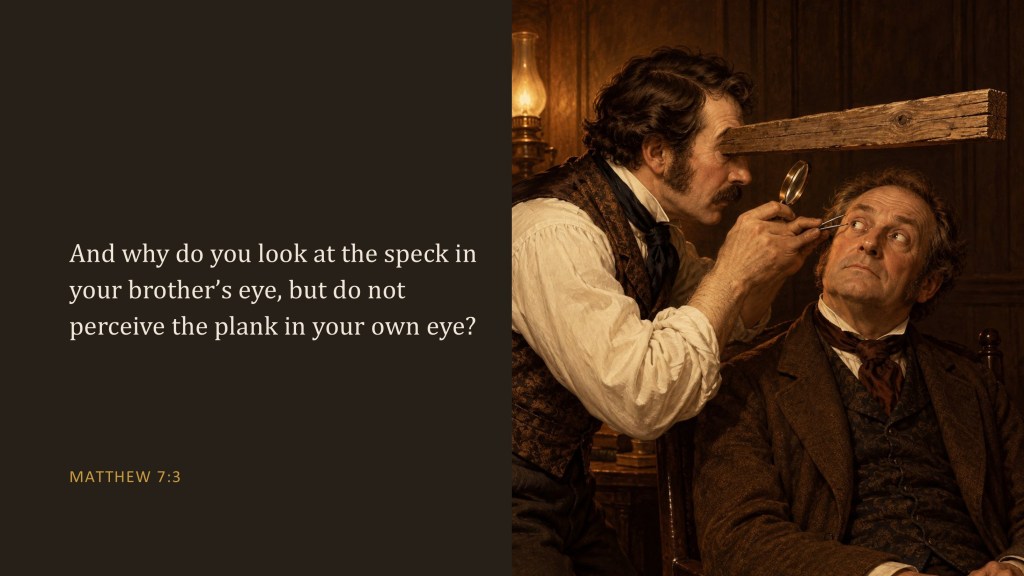
I can be an expert speck inspector. I can describe someone else’s splinter in detail while a two-by-four is sticking out of my own face.
Paul says all have sinned and fall short of the glory of God, and he did not exempt himself.
“This is a faithful saying and worthy of all acceptance, that Christ Jesus came into the world to save sinners, of whom I am chief.”
1 Timothy 1:15
Paul wrote that near the end of his life, after decades of faithful service. The longer he walked with Christ, the more clearly he saw his own heart, and grace grew larger to him for the same reason.
In Luke 7, a Pharisee named Simon invited Jesus to dinner. During the meal, a woman the whole town knew as a sinner slipped in, knelt at Jesus’ feet, and wept. She wiped His feet with her hair and poured perfume on them. Simon said nothing, but he was thinking plenty: if Jesus were really a prophet, He would know what kind of woman this was. Simon was busy inspecting specks.
Jesus answered what Simon was thinking with a story. Two men owed money to a lender, one five hundred denarii and the other fifty. Neither could pay, so he forgave them both. “Which of them will love him more?” Simon said, “I suppose the one whom he forgave more.” Jesus told him he was right, then turned toward the woman:
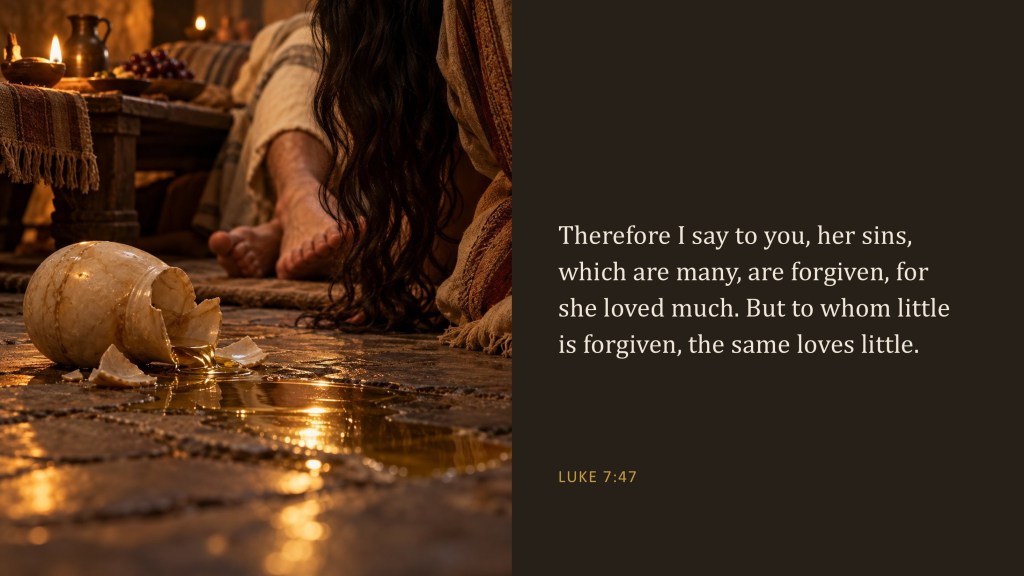
Her tears and perfume did not buy her forgiveness. In Jesus’ story, the lender forgives first and love follows, and before the evening is over He tells her, “Your faith has saved you.” Her love was her answer to mercy.
Simon saw her sin clearly and gave little thought to his own. Neither debtor could pay. The woman knew how much she owed, and she could not stop loving the One who cancelled it.
Her story is our story. None of us comes to Jesus with a clean record.
“But God demonstrates His own love toward us, in that while we were still sinners, Christ died for us.”
Romans 5:8
He did not wait for us to clean up. We had not repaired our record or earned a second look. The love of God moved toward people who had nothing to offer Him but need.
And it cost Him. God did not overlook sin as though it never mattered. At the cross, Jesus bore the judgment our sins deserved. He died in our place and rose again, and through faith in Him our debt is not reduced or rescheduled. It is gone. That is the pattern for our forgiving too.

Diane and I learned that the long way. We married, and a year later, in 1996, we divorced, angrily. We each walked away with a ledger, and being the engineer, I suspect mine was better organized. Over the following years, separately, each of us came to Christ. In 2005 we married again, and we have now been together more than twenty-one years. That second marriage does not exist unless two people who had received God’s mercy learned to extend it to each other. Neither of us got there on our own. We had to be forgiven first.
That is where we stand when we face the person who hurt us. We stand beside him, as people who have been shown more mercy than we could ever repay.
Luke records Jesus praying from the cross:
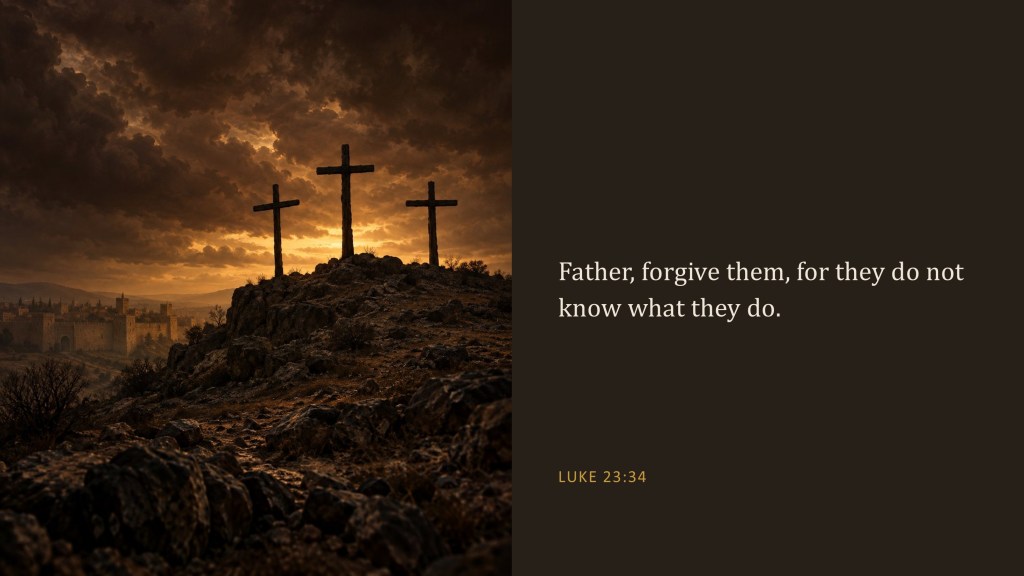
Jesus spoke those words while people were crucifying Him. His hands and feet had been pierced, He was being mocked, and His executioners were dividing His clothing. The suffering was real, and so was the injustice.
The executioners did not fully understand whom they were killing, but their ignorance did not make the crucifixion innocent. Jesus did not ask the Father to overlook it. He asked the Father to forgive it, and that prayer only makes sense if there was something real to forgive.
We often imagine that mercy can begin once an offender has become easier to love. We want the apology to arrive, the explanation to be satisfactory, and the other person to demonstrate that he understands what he has done. Those things belong in repairing a relationship, but Jesus prayed for His enemies while they were still acting as enemies.
When Jesus was insulted and suffered, He did not retaliate or threaten. He entrusted Himself to the One who judges righteously (1 Peter 2:23).
That is difficult for us because we often feel that relinquishing vengeance means relinquishing justice. If we stop rehearsing the offense, who will remember it? If we stop trying to make the offender suffer, who will ensure that the wrong matters?
God remembers, and God judges.
Every sin against us will either be paid for at the cross or answered at the judgment. Neither one leaves a balance for us to collect.
So what should our hearts desire for the person who has hurt us? We may need accountability. But we can ask God to bring that person to repentance rather than merely asking Him to make that person miserable.
On October 2, 2006, a man walked into the one-room Amish schoolhouse at West Nickel Mines, Pennsylvania, and shot ten girls. Five of them died. Then he took his own life.

On the phone with his wife that morning, he said he had been angry at God for nine years, ever since their infant daughter died. Years later, a Pennsylvania newspaper headline summed him up: “He was an angry man.”
Within hours, Amish neighbors were sending word of forgiveness to his family. When the killer’s father broke down, an Amish man held him in his arms for an hour. More than half of the mourners at his funeral were Amish, some of them parents who had just buried their own daughters, and they kept visiting his mother for years afterward.
The killer’s wife, Marie, lost her husband that day too. She was left with three young children and a name the whole country now knew. We think of the victims, then of the man who did it, and his widow is easy to forget or to blame. The Amish saw a grieving neighbor. They went to her home to comfort her, and when donations poured in from around the world, they made sure some of that money went to her and her children. Marie wrote back to them, “Your love for our family has helped to provide the healing we so desperately need.”
There was no apology to wait for. The man who did it was dead. One Amish father said, “He had a mother and a wife and a soul, and now he’s standing before a just God.” Forgiveness at Nickel Mines could only mean leaving judgment with God and treating his family as neighbors instead of enemies.
Forgiveness did not erase the damage. Rosanna King, six years old and the youngest of the wounded, was left with brain injuries that took away her ability to walk or talk. She died in 2024. Forgiveness was not a one-time decision either. Twenty years later, Kate Ebersol, whose seven-year-old daughter Naomi Rose was killed, said forgiving is a choice that has to be made again and again.
We cannot produce that response simply by trying to become more agreeable. Jesus did not come just to change our behavior. He came to change what we love. Only the Holy Spirit can do that, especially when the injury is fresh and everything in us wants to strike back.
Discussion Question: What does Jesus’ prayer from the cross teach us about the difference between seeking justice and wanting revenge?
- What was happening around Jesus when He prayed, “Father, forgive them”?
- How does remembering how much we have been forgiven (Luke 7:47) change what we want for the person who hurt us?
- What might it look like this week to pray for the good of someone who has hurt us?
IV. Peter Wants a Number
Earlier in Matthew 18, Jesus explains how to address a brother’s sin. The wrong should be confronted with the aim of gaining the brother. If he refuses to listen, others become involved, and eventually the church may need to act.
Then Peter asks his question:
“Then Peter came to Him and said, ‘Lord, how often shall my brother sin against me, and I forgive him? Up to seven times?’ Jesus said to him, ‘I do not say to you, up to seven times, but up to seventy times seven.'”
Matthew 18:21–22
We can understand the question. We may be willing to forgive an isolated offense, but repetition changes how we feel. The second apology sounds less convincing, the third begins to wear thin, and eventually we want to know when our obligation expires.
Peter is looking for a number. Jesus answers with seventy times seven; some translations render it seventy-seven. Either way, Jesus is moving Peter beyond a tally. A larger ledger would leave the same problem intact.
If we forgive while carefully counting toward the day we can stop, our attention is still fixed on collecting. We may comply for a while, but we are waiting for permission to close our hearts.
Jesus answers Peter with a story. A king is settling accounts, and one servant owes him ten thousand talents. The amount is beyond his ability to repay. Facing the loss of everything, he pleads for time and promises full payment. The king is moved with compassion, releases him, and forgives him the debt.
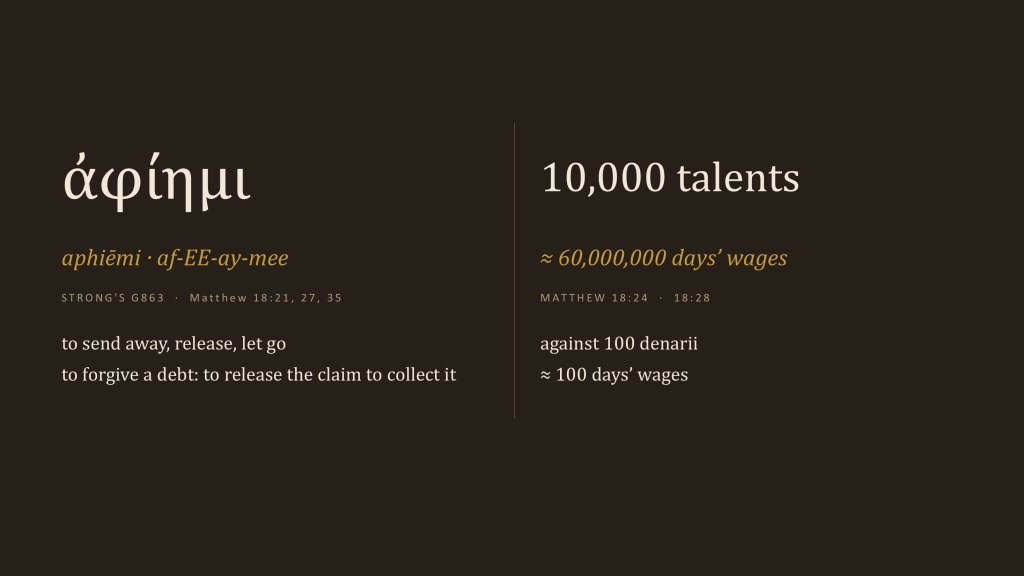
aphiēmi (G863; af-EE-ay-mee) – to send away, release, let go. Peter uses it in verse 21 (“and I forgive him”), the king in verse 27 (“forgave him the debt”), and Jesus in verse 35. To forgive a debt is to release the claim to collect it.
Ten thousand talents represented an almost unimaginable sum. A denarius represented roughly a day’s wages for a laborer, and a talent was worth about six thousand denarii, which puts the first servant’s debt at roughly sixty million days’ wages.
The servant’s promise to repay everything reveals how little he grasps his situation. More time will not solve his problem. He needs the king to do something he cannot do for himself.
That is our position before God. We may imagine that enough improvement, religious effort, or future obedience will settle our past sins. But future obedience is already owed to God. We cannot pay yesterday’s debt by finally doing what we should have been doing all along. We need grace.
When the king cancels the debt, the loss does not disappear into thin air. The king relinquishes his claim to collect it. The servant receives freedom at the king’s expense.
That servant then finds a fellow servant who owes him one hundred denarii. He seizes him by the throat and demands payment. The other man pleads for patience, but the forgiven servant has him imprisoned.
The difference between the debts is enormous, but the smaller debt really exists. One hundred denarii, roughly a hundred days’ wages, was a substantial obligation, and Jesus does not explain it away. Sometimes the wrong done to us was devastating. Someone betrayed a confidence, destroyed a reputation, or deliberately inflicted pain. This parable gives nobody license to belittle a wounded person’s suffering.
That is why Jesus sets the two debts side by side. Shrinking the hundred denarii until it is easy to release is not forgiveness. Forgiveness says, “You really wronged me,” and still releases the claim to repayment. What makes that possible is the ten thousand talents we have already been forgiven, and the better we grasp that mercy, the more honestly we can extend it.
When the king learns what happened, he summons the first servant:
“Then his master, after he had called him, said to him, ‘You wicked servant! I forgave you all that debt because you begged me. Should you not also have had compassion on your fellow servant, just as I had pity on you?’ And his master was angry, and delivered him to the torturers until he should pay all that was due to him. So My heavenly Father also will do to you if each of you, from his heart, does not forgive his brother his trespasses.”
Matthew 18:32–35
The servant goes straight from the king’s mercy to his fellow servant’s throat. He wanted compassion from the king and strict collection from everyone else. He gladly accepted mercy flowing toward him and refused to let it flow through him.
He walked out forgiven, but a few minutes earlier he had been promising to pay it all back, as though more time would fix it. I’m an engineer, so I’d love to blame this on bad arithmetic. It wasn’t. Whatever he understood about the size of his debt, he refused to let the king’s mercy govern what he did next.
We can do the same thing. We want our failures understood in context, but we reduce someone else to the worst thing he did. We thank God for grace and then speak as though mercy would be wasted on the person who offended us. Justice for thee, mercy for me.
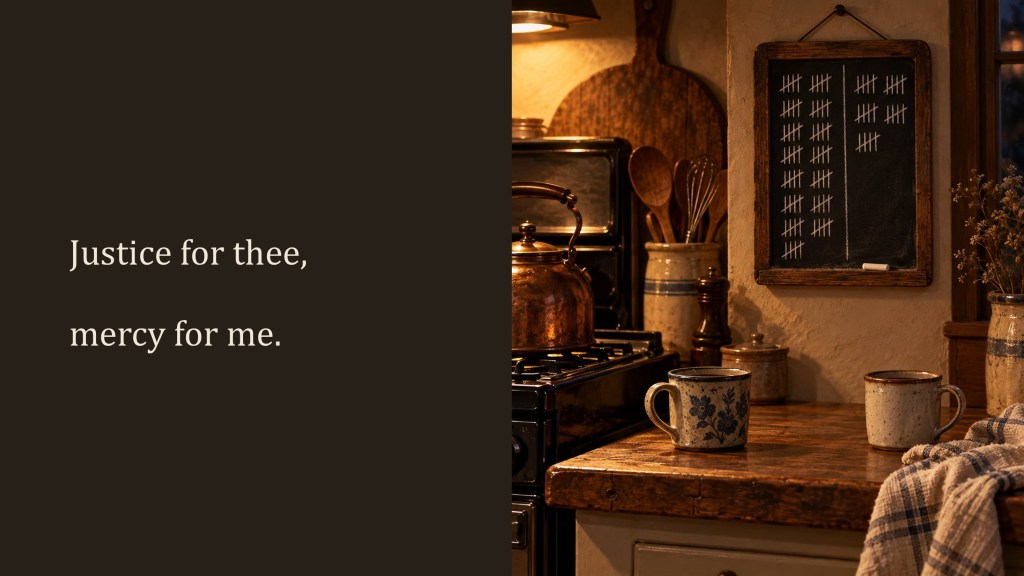
It is never easier to see than in a Christian marriage. Two people who both sing “Amazing Grace” on Sunday morning can spend Sunday afternoon keeping score in the kitchen, each wanting mercy for his own bad day and strict accounting for the other’s.
Jesus had already said much the same thing in the Sermon on the Mount:
“For if you forgive men their trespasses, your heavenly Father will also forgive you. But if you do not forgive men their trespasses, neither will your Father forgive your trespasses.”
Matthew 6:14–15
Those words should disturb us. Our Father does not treat unforgiveness as a harmless quirk.
A professing Christian who will not forgive has to ask a hard question: do I really understand how much I have been forgiven? Simon the Pharisee sat at the table with Jesus and still loved little, because he thought he owed little.
The parable is not a full account of how salvation is earned or lost. Jesus is not teaching that we purchase His forgiveness by first forgiving enough people. The servant receives mercy before he is called to extend it.
Scripture teaches salvation by grace through faith. It also teaches that God disciplines His children and expects grace to bear fruit in their lives. Those truths do not give us permission to soften Jesus’ warning.
A believer can struggle painfully with forgiveness. A deep wound may require repeated prayer, wise counsel, and a long process of healing. That struggle is different from deciding that Christ has no authority over this part of our lives.
We may need to pray, “Lord, I am still angry, and I need Your help.” We should not settle into saying, “Lord, I know what You command, but I intend to keep collecting.”
Discussion Question: Without going into details we’d rather not share, where do we most often expect mercy for ourselves while demanding strict payment from someone else?
- In Matthew 18, what did the king do for the first servant, and what did that servant do next?
- Why does Jesus make the two debts so wildly different in size?
- Without naming anyone, where might God be asking us to stop collecting?
V. Love After Wounds
“And do not grieve the Holy Spirit of God, by whom you were sealed for the day of redemption. Let all bitterness, wrath, anger, clamor, and evil speaking be put away from you, with all malice. And be kind to one another, tenderhearted, forgiving one another, even as God in Christ forgave you.”
Ephesians 4:30–32
“bearing with one another, and forgiving one another, if anyone has a complaint against another; even as Christ forgave you, so you also must do.”
Colossians 3:13
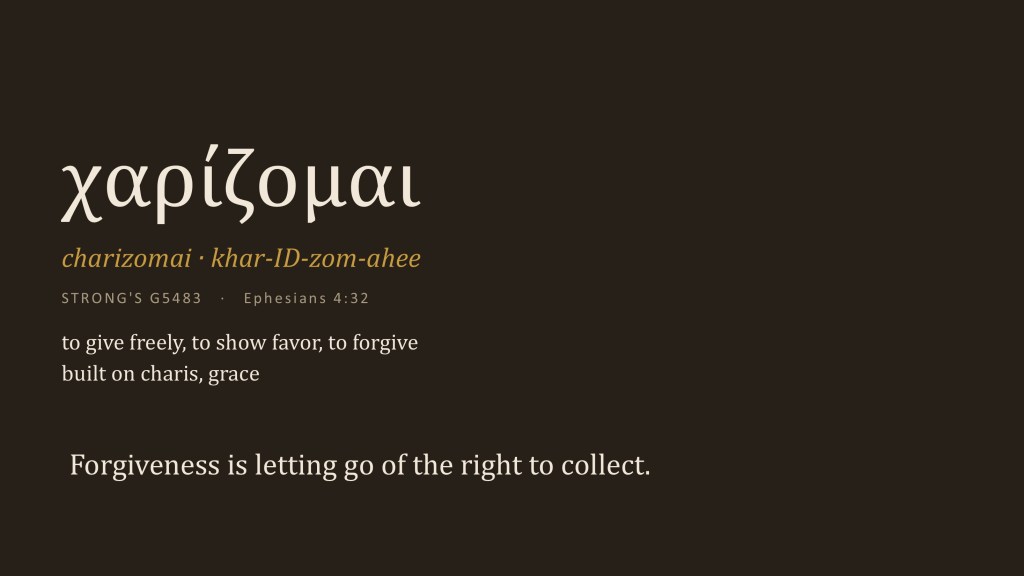
charizomai (G5483; khar-ID-zom-ahee) – to give freely, to show favor, to forgive. The word is built on charis, grace. Paul uses it twice in Ephesians 4:32, once for our forgiving and once for God’s. To forgive someone is to extend to him the grace we have received.
In both of these passages, Paul points back to how we were forgiven: “even as God in Christ forgave you.” We are not asked to manufacture mercy from scratch. We are asked to pass along what we were given.
Much of what we hear today treats forgiveness as self-care, a way to lower our own blood pressure. Holding on really does cost us. But a Christian does not forgive mainly to feel better. We forgive because we were forgiven first, and what we pass along is a gift.
Forgiveness is letting go of the right to collect. The wrong was real; nobody forgives what never happened. But we stop working the account. We stop looking for a chance to make the other person pay through coldness, a cutting remark, or the story we tell everyone else.
Forgiving does not require us to pretend. Memory usually survives forgiveness, and some things stay vivid for years. Trust is different from forgiveness too. It grows back slowly, on evidence, and someone who has lied over and over has to earn it again. We can forgive and still protect our homes, our finances, and our families.
Reconciliation takes two. Jesus puts rebuke, repentance, and forgiveness together:
“Take heed to yourselves. If your brother sins against you, rebuke him; and if he repents, forgive him. And if he sins against you seven times in a day, and seven times in a day returns to you, saying, ‘I repent,’ you shall forgive him.”
Luke 17:3–4
When repentance comes, we receive it gladly, the way God received us. When it does not come, we can still let go of revenge and keep praying for that person’s good, even from a distance. Not every story ends the way Diane’s and mine did, and the one who forgives has not failed when the other person never comes back.
Those distinctions are there to protect the wounded. They are not a respectable place to park a grudge. Sometimes we are not protecting ourselves at all. We just like keeping the other person on probation.
“Beloved, do not avenge yourselves, but rather give place to wrath; for it is written, ‘Vengeance is Mine, I will repay,’ says the Lord.”
Romans 12:19
When the offender will not repent, or has died and cannot, trusting God’s wrath is what lets us put vengeance down. My wrath would accomplish my will. God’s wrath accomplishes His. Leaving room for it means trusting God to be God instead of stepping into that role in someone else’s life.
Holding on usually costs us more than it costs them. The other person may have moved away, changed jobs, or died. Meanwhile, we are still conducting the argument at the dinner table, at two in the morning, and in conversations that started out about something else.
Letting go does not mean the pain leaves on schedule. A person can forgive and still grieve. The decision to relinquish vengeance does not make sorrow sinful. When the memory comes back, it does not prove we failed to forgive. It is one more chance to do what Kate Ebersol, the Nickel Mines mother, described: choosing to forgive again and again.
We can be honest with God about it: “Lord, that still hurts. Help me respond faithfully. I am leaving judgment with You.”
We are free to pursue what is right without making punishment our life’s work. That freedom is one more thing we have been given.
Discussion Question: Without going into details we’d rather not share, which distinction is hardest for us to make – forgiveness and forgetting, forgiveness and trust, or forgiveness and reconciliation?
- In Luke 17:3–4, what part does repentance play?
- Why does it help to know that forgiving someone does not require trusting them right away?
- How can we let go of revenge toward someone who has never apologized?
VI. Closing the Account
That Christmas Eve, Scrooge’s old partner Jacob Marley came back to visit him, wrapped in a long chain made of “cash-boxes, keys, padlocks, ledgers, deeds, and heavy purses wrought in steel.” When Scrooge asked why he was bound, Marley answered:
“I wear the chain I forged in life. I made it link by link, and yard by yard; I girded it on of my own free will, and of my own free will I wore it.”
Charles Dickens, A Christmas Carol
Every grudge we keep adds a link. The injury may have come from someone else, but the chain is ours. We forged it, and we can lay it down.
We have read the entries and identified a real debt. We have also seen a much greater account, one we could never settle, and the Savior who bore its cost.
The series began with Jesus commanding us to love one another as He loved us. We have watched that love welcome people, serve them, help carry their burdens, and encourage them. We are not moving beyond love. We are watching love go to work. Now we see what love does when there is a real wrong to address.
It tells the truth, extends mercy, and remembers the cross. It will not turn another person’s failure into a source of power.
We can begin by telling the truth to God. We do not need a polished prayer. We can name what happened, admit how angry we are, and confess any ways our response has become sinful. Confession is agreeing with God, calling our sin what He calls it. We are not giving Him news He has not heard. Sometimes our first honest step is acknowledging that we want the other person to suffer.
Then we remember the mercy we have received. Without that foundation, we can settle for gritting our teeth and pretending the wrong did not matter. The gospel tells the truth on both sides of the ledger: what was done to us was real, and what was done for us was greater. We are sinners received by grace, learning to extend grace.
Some of us keep a ledger against ourselves. We confessed the sin years ago, but we still reopen the account, replay the failure, and try to pay it down in shame. God remembers, and God judges, but for those who are in Christ, that judgment already fell on His Son.
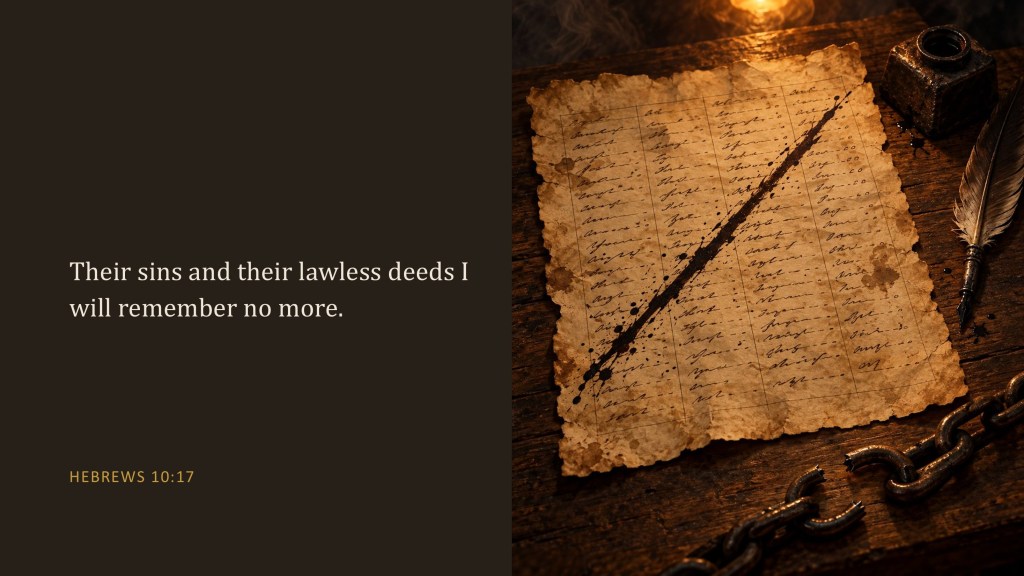
“Remember no more” does not mean God has lost track of what we did. It means He will not hold it against us, because it has been paid. When God has closed an account, we have no business reopening it.
From there, we can make a deliberate decision to surrender personal vengeance. That may mean refusing to rehearse an imagined confrontation, abandoning a plan to embarrass someone, or choosing not to mention an old failure merely to win a new argument.
All of this requires dependence upon the Holy Spirit, and some wounds will also require the help of mature believers. Asking for that help can be part of obedience.
Where we have wronged someone, we should take responsibility. A lesson about forgiving others should make us more willing to seek forgiveness ourselves. One counterfeit, the pseudo-apology, says, “I’m sorry if I hurt your feelings,” which makes the problem the other person’s feelings. Another, the situational apology, says, “I’m sorry, but if you hadn’t kept on, I wouldn’t have lost my temper.” A real apology sounds different: “I’m sorry I sinned against you. You deserved better, and I failed you.” The way we apologize shows whether we understand what we did.

If the offender comes to us repentant, we should receive that repentance rather than make humiliation the price of mercy. There may still be consequences and trust to rebuild, but we should not keep moving the requirements because surrendering the grievance feels like losing power.
On Christmas afternoon, Scrooge showed up at the door of his nephew Fred, the man he had brushed off the day before. “It’s I. Your uncle Scrooge. I have come to dinner. Will you let me in, Fred?” Fred did not make him grovel. He nearly shook his uncle’s arm off, and within five minutes Scrooge was at home.
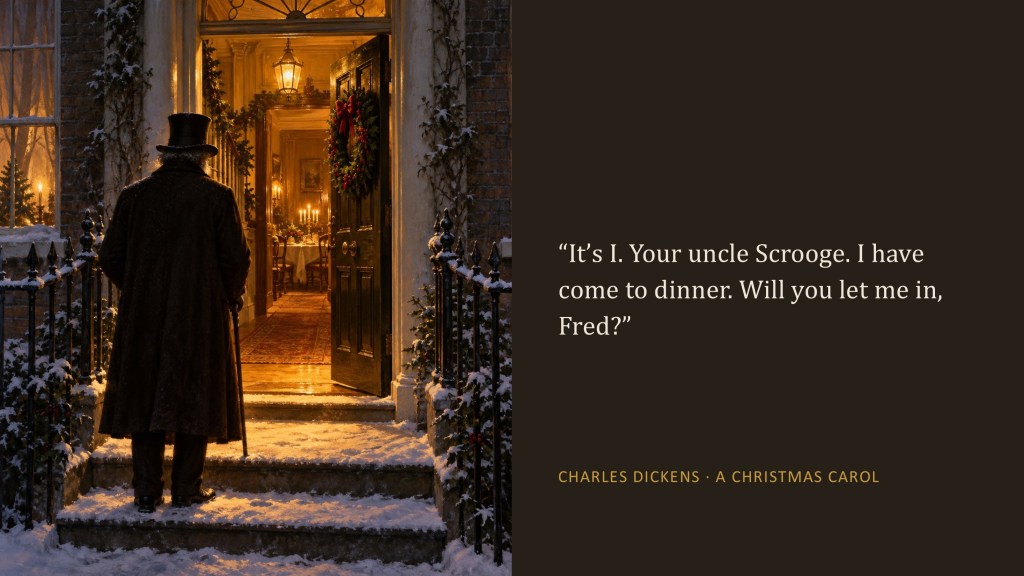
Scrooge’s Christmas ended with a full heart and a welcome at Fred’s table. The first Christmas began with something greater. Before Jesus was born, the angel told Joseph why He was coming:
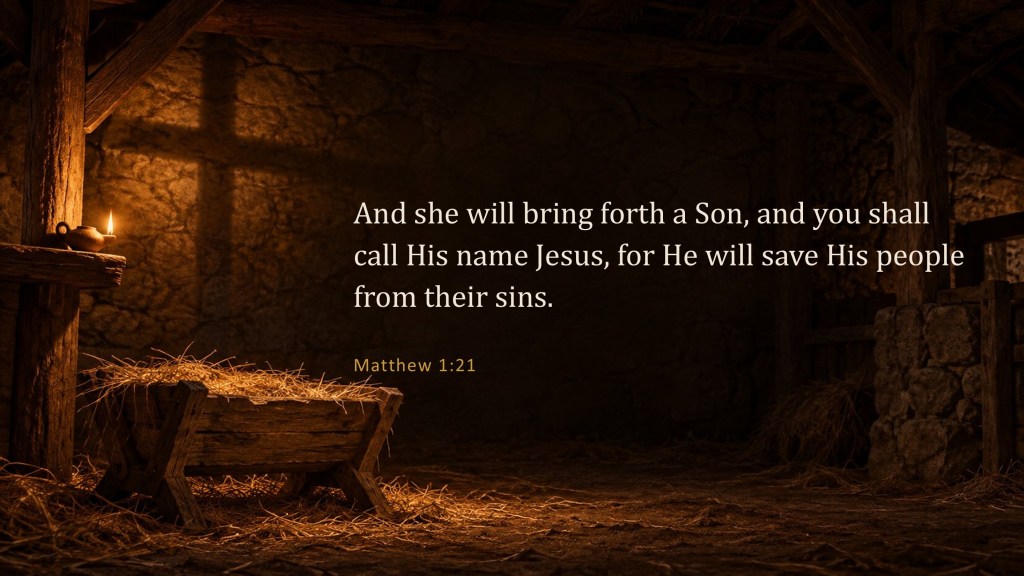
The manger and the cross belong to the same story. God sent His Son to close an account we could never pay.
Jesus prayed for His enemies while suffering at their hands. He bore our sins when we had nothing to offer Him, and He gave us a forgiveness we could never earn.
We can bring Him the ledger we have been carrying. He already knows every entry, including the ones that still hurt to read, and He has already cancelled a far longer one with our names on it. We can trust His judgment, obey His command, and ask Him to teach us how to live without continually demanding repayment.
Forgive one another, even as God in Christ forgave you.
Soli Deo Gloria
Discover more from Chasing the Wind
Subscribe to get the latest posts sent to your email.


