
James 5:13-18 · “One Another” Series, Lesson 7
I. I’ll Pray for You
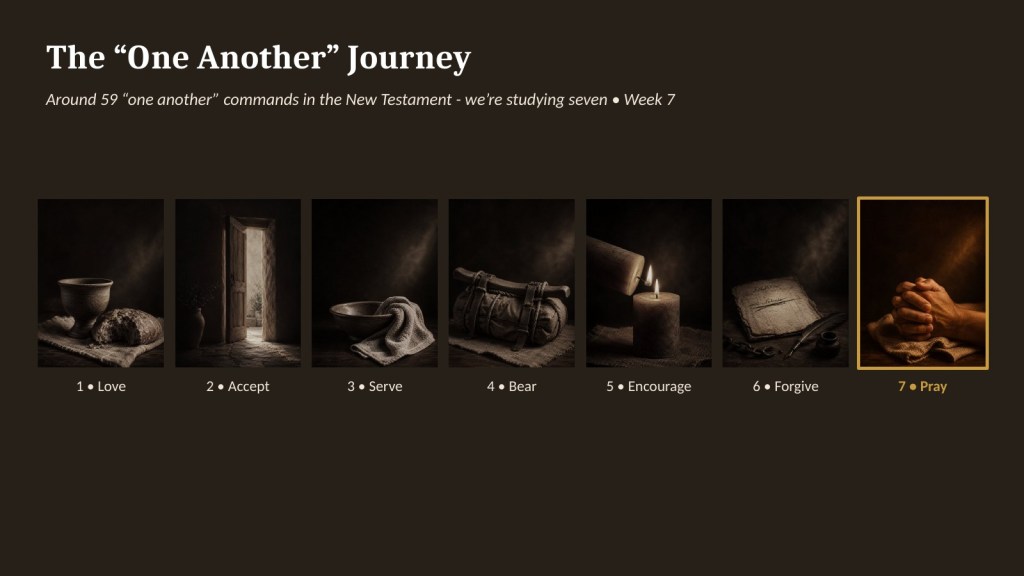
This is the seventh and final lesson in our series on the “one another” commands of the New Testament. Today love gets down on its knees.
Of the seven “one anothers” in this series, I suspect this is the easiest to agree with and one of the easiest to neglect.
Discussion Question: Think back as far as we can remember. Who’s the first person we knew was praying for us?
- What do we remember about how they prayed?
- Did we know at the time that they were praying for us, or did we find out later?
We’ve all had conversations with someone going through a hard stretch. A friend has a frightening diagnosis, a marriage is in trouble, or someone has lost a job. We listen, we offer some encouragement, and as the conversation winds down, we say, “I’ll pray for you.” And most of the time, we mean it.

Then we get in the car, stop at the grocery store, start thinking about dinner, and by bedtime the conversation is gone. Three days later we see that person again and say, “How are things going? I’ve been praying for you.”
Well, have we? I’m sure we aren’t being deliberately dishonest, but life distracts us. So we don’t follow through. Instead, “I’ll pray for you” becomes the Christian version of “Have a nice day.” We say it because we care and because we don’t know what else to say.
Prayer is also unusual among these seven “one another” commands because the person we’re helping may never know we did it. If we serve someone, they usually know. If we help carry a burden, they can feel the weight lift. Prayer can happen in private, with no one else aware of it.
That may be one reason it’s so easy to neglect. Nobody knows whether we followed through.
Jesus had no problem with that. He warned against praying to be seen.
“But you, when you pray, go into your room, and when you have shut your door, pray to your Father who is in the secret place; and your Father who sees in secret will reward you openly.”
Matthew 6:6
Prayer tests whether our love is the real thing. Loving someone in public can win us some credit. Loving someone in private, where nobody else sees and nobody says thank you, earns us nothing but the good of the person we love. Prayer is love that God hears, even when no one else does.
Most of what we hear about prayer is about our own prayers: how to pray, whether God hears, why He doesn’t always answer the way we ask.
But James 5:16 is about praying for each other.
“Confess your trespasses to one another, and pray for one another, that you may be healed. The effective, fervent prayer of a righteous man avails much.”
James 5:16
James places this command alongside confession, healing, and the spiritual health of the church.
II. As I Have Loved You
This series began with Jesus’ command in the upper room.
“A new commandment I give to you, that you love one another; as I have loved you, that you also love one another. By this all will know that you are My disciples, if you have love for one another.”
John 13:34-35
Jesus didn’t leave us to guess what that love looks like. That same night He washed their feet. He told them the truth about what was coming. And He prayed for them. At the table He turned to Peter, who was hours away from denying Him three times.
“Simon, Simon! Indeed, Satan has asked for you, that he may sift you as wheat. But I have prayed for you, that your faith should not fail; and when you have returned to Me, strengthen your brethren.”
Luke 22:31-32

Later that evening, in John 17, Jesus prayed for the eleven out loud, and then He prayed for us.
“I do not pray for these alone, but also for those who will believe in Me through their word;”
John 17:20
Jesus hasn’t stopped praying for us.
“Therefore He is also able to save to the uttermost those who come to God through Him, since He always lives to make intercession for them.”
Hebrews 7:25
Praying for one another is part of the pattern Jesus set the night He gave the love command. When we pray for someone, we’re loving them the way we’ve been loved.
Prayer belongs right next to the practical help we talked about in the serving and burden-bearing lessons. James has pointed words for anyone who confuses the two.
“If a brother or sister is naked and destitute of daily food, and one of you says to them, ‘Depart in peace, be warmed and filled,’ but you do not give them the things which are needed for the body, what does it profit?”
James 2:15-16
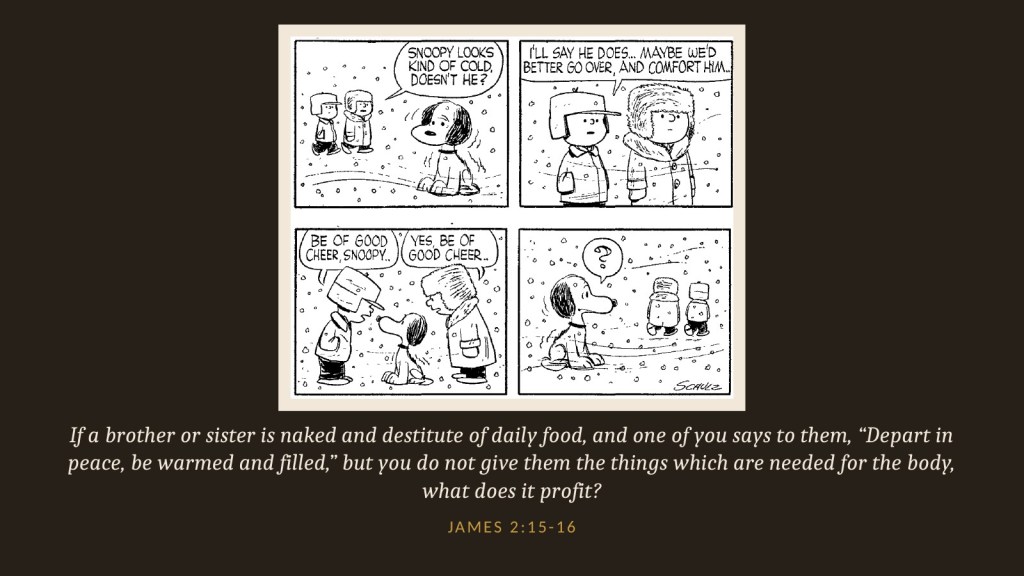
If someone is hungry, we can pray that God provides food, and we might make a casserole. If someone needs a ride to the hospital, we can pray for transportation, and then we can go find our car keys. Sometimes God answers our prayer for someone by sending us.
And sometimes there’s nothing practical left to do. We can’t fix a broken relationship from three states away, take away someone’s grief, or guarantee how a surgery turns out. When our ability to help runs out, prayer lets us keep loving that person.
III. Our Father
Why tell God what He already knows?
God already knows what our friend needs. Jesus said so plainly.
“For your Father knows the things you have need of before you ask Him.”
Matthew 6:8

We aren’t going to surprise God with news He overlooked. God is God, and we are not. Praying for one another starts right there. We’re admitting that the person we love has needs beyond our reach. We can’t heal a body, save a soul, or grow faith in someone else’s heart.
God can.
When Jesus taught His disciples to pray, He gave them these words.
“Our Father in heaven, Hallowed be Your name. Your kingdom come. Your will be done On earth as it is in heaven. Give us this day our daily bread. And forgive us our debts, As we forgive our debtors. And do not lead us into temptation, But deliver us from the evil one. For Yours is the kingdom and the power and the glory forever. Amen.”
Matthew 6:9-13

Discussion Question: Look at the Lord’s Prayer again. How many times does Jesus say “I,” “me,” or “my”? What does He say instead?
- Why might Jesus have taught His disciples to pray in the plural?
- When we pray on our own, whose names usually make it in?
- Whose name could we add to our prayers this week, alongside our own needs?
The whole prayer doesn’t contain a single “I,” “me,” or “my.” Our Father. Give us. Forgive us. Deliver us.
Most of us pray in the first person singular. My problem, my job, my health. There’s a place for that, and God welcomes it. But the prayer Jesus gave assumes we never come to the Father alone. Every time we pray “Our Father,” we’re praying for one another whether we realize it or not.
And we have access to that Father because of Christ.
“Let us therefore come boldly to the throne of grace, that we may obtain mercy and find grace to help in time of need.”
Hebrews 4:16
We’re sinners approaching a holy God, and we’re welcomed because of what Jesus did. Through Him we’re adopted children, and our Father invites us to bring Him our concerns, including our concerns for one another. Paul puts it at the top of his list.
“Therefore I exhort first of all that supplications, prayers, intercessions, and giving of thanks be made for all men,”
1 Timothy 2:1
IV. The Prayer of a Righteous Person
James wrote to believers under real pressure, and his whole letter is about faith that shows up in practice. Be doers of the Word. Faith without works is dead. Watch your tongue. By chapter 5 he’s addressing suffering and patience, and he closes the letter with prayer.
“Is anyone among you suffering? Let him pray. Is anyone cheerful? Let him sing psalms. Is anyone among you sick? Let him call for the elders of the church, and let them pray over him, anointing him with oil in the name of the Lord. And the prayer of faith will save the sick, and the Lord will raise him up. And if he has committed sins, he will be forgiven.”
James 5:13-15
James covers both ends of life. We remember to pray quickly enough when the doctor calls with bad news. When life is comfortable, we start to think we’re managing fine on our own. James wants prayer to be the ordinary rhythm of a Christian life.
Nobody is expected to suffer alone. That’s the whole “one another” series in a single verse: the family of the church shows up at the bedside.
And then there’s the oil. No, we’re not performing an oil change, and no, we’re not cooking with prayer. In the ancient world olive oil was medicine; the Good Samaritan poured oil and wine on the wounded man’s injuries. Oil was also how God’s people marked someone as set apart for God. James may mean one, the other, or both, and he doesn’t stop to say. But it’s done “in the name of the Lord,” and “the Lord will raise him up.” The oil isn’t the power. God is.
Then comes verse 16.
“Confess your trespasses to one another, and pray for one another, that you may be healed. The effective, fervent prayer of a righteous man avails much.”
James 5:16
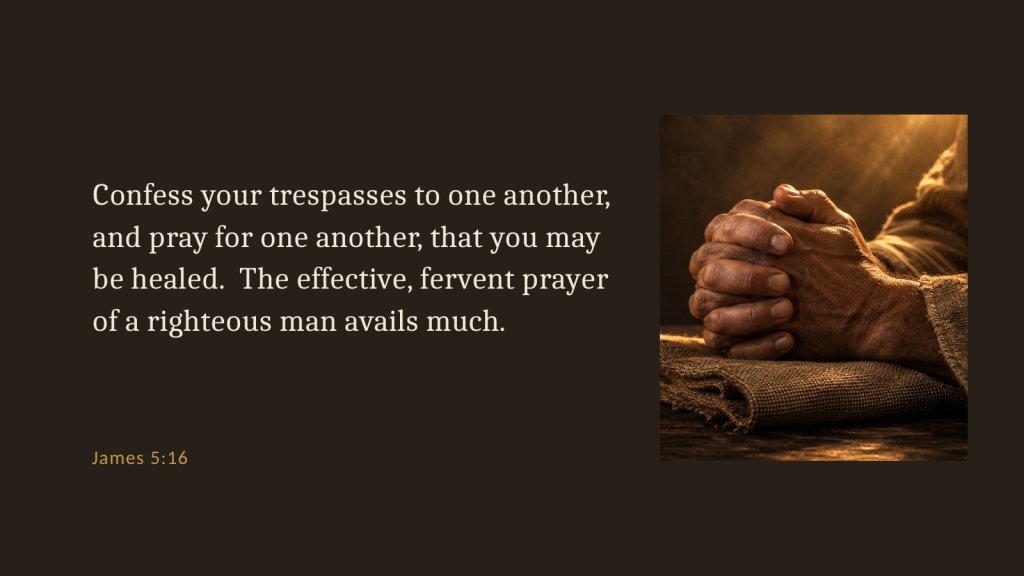
Confession here is honesty within the family of believers: owning what we’ve done wrong, and letting a trusted brother or sister pray with us. A confession that turns into gossip teaches everyone in the room to stop confessing.
Prayer also shouldn’t become a delivery system for criticism. Perhaps you’ve heard a prayer that sounded suspiciously like a sermon aimed at the person in the next chair: “Lord, please help this brother recognize his stubbornness, his selfishness, his pride, and his complete inability to take good advice.” There may be a conversation that needs to happen, but that prayer isn’t it.
James tells us to pray for one another, not at one another.

“The effective, fervent prayer of a righteous man avails much.”
James 5:16b
The word for “prayer” is deēsis (Strong’s G1162, pronounced DEH-ay-sis). It’s a request that arises from a need. In this verse, the need belongs to someone else.
The phrase “effective, fervent” translates a single Greek word, energoumenē, from energeō (Strong’s G1754, pronounced en-erg-EH-o), the root of our word “energy.” In verse 15, it’s the Lord who raises the sick. The energy in this prayer comes from God, not from the eloquence of the one praying.
Who is the “righteous man”? Someone who is right with God and lives like it. That can sound like a short list. If only righteous people’s prayers avail much, maybe we should leave the praying to the pastor, or to that one saint in every church who seems to have a direct line.
James won’t let us off that easily.
Our righteousness is Christ’s, received by faith. A righteous person still sins. He deals honestly with his sin, and then he prays.
The command is “pray for one another,” not “find a holy man to pray for you.” In verse 14 the elders are called to pray. In verse 16 the command extends to the whole church. The person sitting next to you qualifies.
And what does that prayer do? It “avails much.” The verb is ischyō (Strong’s G2480, pronounced is-KHOO-o). It means to be strong, to have force, to prevail. James says this prayer is polu ischyei, very strong, able to accomplish a great deal.

Praying for one another is no token gesture we offer when we can’t think of anything else to do. God has made it one of the strongest things we can do for each other.
Then James gives us an example of a righteous man: the prophet Elijah, who stood against King Ahab and the prophets of Baal.
“Elijah was a man with a nature like ours, and he prayed earnestly that it would not rain; and it did not rain on the land for three years and six months. And he prayed again, and the heaven gave rain, and the earth produced its fruit.”
James 5:17-18

Discussion Question: What do we remember about Elijah on Mount Carmel, and what happened right after?
- What did Elijah pray for, according to James?
- Why might James pick Elijah, of all people, as a man “with a nature like ours”?
- What makes us hesitant to pray for someone else?
Before the rain returned, God had already told Elijah He would send it. Elijah prayed anyway, bowed down on Mount Carmel with his face between his knees. God carried out His purpose through His servant’s prayer.
And James insists Elijah had a nature like ours. Shortly after Carmel, Elijah ran from Jezebel, sat down under a broom tree, and asked God to take his life. Fear, exhaustion, discouragement. Yet God heard him.
Our confidence in praying for one another rests in the God who hears His people.
V. Praying Like Paul
Discussion Question: When someone asks for prayer at church or at work, what requests do we hear most often?
- Why do our prayer lists lean so heavily toward physical needs?
- What would we want someone to pray for us that would never show up on a prayer list?
Most churches keep a prayer list, and most of the requests are medical. Someone is having surgery. Someone is waiting on test results. Every so often I find a name on my list that I’ve kept praying over long after the person recovered. God answered; I just never followed up.
James tells us to pray for the sick, and Jesus healed out of compassion again and again. But compare our prayer lists with Paul’s prayers for the churches.
“For this reason we also, since the day we heard it, do not cease to pray for you, and to ask that you may be filled with the knowledge of His will in all wisdom and spiritual understanding; that you may walk worthy of the Lord, fully pleasing Him, being fruitful in every good work and increasing in the knowledge of God; strengthened with all might, according to His glorious power, for all patience and longsuffering with joy; giving thanks to the Father who has qualified us to be partakers of the inheritance of the saints in the light.”
Colossians 1:9-12
Paul asks for no building fund and no relief from every inconvenience. He asks God to make these Christians mature. His prayers in Ephesians 1 and 3 head the same direction, toward wisdom, hope, and a grasp of how wide and deep Christ’s love runs.
Laid alongside our own prayers, I suspect we’d find we spend fifteen minutes praying for a successful surgery and fifteen seconds for the patient’s faith.
We can pray for both. Suppose a friend has lost his job. We pray God provides work, and we also pray he’ll trust God’s provision and keep his integrity during the search. Suppose someone is caring for an aging parent. We pray for the parent’s health, and we also pray for the caregiver’s endurance and rest.
Our prayers don’t stop at the church door. We can pray for the salvation of people we love.
“Brethren, my heart’s desire and prayer to God for Israel is that they may be saved.”
Romans 10:1
No argument is clever enough to save anyone. We can explain the gospel, answer questions, and live it in front of people. Salvation is still God’s work, and we can ask Him to open hearts that are closed.
We can pray for the people who have hurt us.
“But I say to you, love your enemies, bless those who curse you, do good to those who hate you, and pray for those who spitefully use you and persecute you,”
Matthew 5:44
In our last lesson we talked about forgiveness as a decision we make before our emotions catch up. Praying for the person who wronged us is one of the most practical ways to start.
Those prayers can start rough. We can spend more time reviewing the offense than praying for the person.
If we keep praying, something shifts. We start asking for their repentance instead of their humiliation. We start asking for wisdom for ourselves. We may even notice our own part in the conflict. Our prayers don’t excuse their sin, but they keep resentment from hardening into bitterness.
Paul’s prayers set the pattern. We pray for one another’s circumstances, and we pray for one another to become more like Christ.
VI. When the Answer Is Different
Most of us have prayed for someone who didn’t get better. The cancer kept spreading. The marriage ended anyway. The friend we’ve been praying for these twenty years still wants nothing to do with God.
Why God sometimes says “no” is a lesson for another day. When the answer is different from what we asked, we still need to keep loving and praying for the person who is hurting.
There are relatives I’ve been praying for over a long time, and those prayers haven’t been answered, at least not the way I’ve asked. Some days it’s hard for me to accept that the answer may be “no.” I haven’t stopped praying, and I don’t believe I’m supposed to.
Discussion Question: Without going into details we’d rather not share, when we’ve waited on God for an answer, what has someone said or done that actually helped?
- Did they pray with us, or tell us they were praying?
- Why is it often harder to ask others to pray for us than to pray for them?
- What’s one thing we can say, or avoid saying, to a friend whose prayers haven’t been answered the way they hoped?
Paul pleaded three times for the thorn to be removed, and God said:
“My grace is sufficient for you, for My strength is made perfect in weakness.”
2 Corinthians 12:9

The thorn stayed. Paul even had to leave his coworker Trophimus sick at Miletus. And yet the same Paul kept asking other believers to pray for him.
“you also helping together in prayer for us, that thanks may be given by many persons on our behalf for the gift granted to us through many.”
2 Corinthians 1:11
“Brethren, pray for us.”
1 Thessalonians 5:25
Being prayed for was part of how Paul lived the Christian life, and that takes humility. Some of us are much more comfortable praying for others than letting others know we need it.
We owe a suffering friend care with our words. Romans 8:28 often gets handed to suffering people a little too quickly.
“And we know that all things work together for good to those who love God, to those who are the called according to His purpose.”
Romans 8:28

The next verse defines the good: being conformed to the image of His Son. God’s idea of good is larger than our comfort. But someone who has just received a terrible diagnosis probably doesn’t need that explained in the hospital hallway. Sometimes the most loving thing we can do is sit with them and pray.
Job’s friends, from our burdens lesson, were at their best during the seven days they sat with him in silence. Their trouble started when they opened their mouths and explained exactly why God had done it.
And we put our confidence in the right place.
“Now this is the confidence that we have in Him, that if we ask anything according to His will, He hears us.”
1 John 5:14
We ask boldly, and we trust humbly. Prayer doesn’t pry God off His purposes, and it isn’t an empty exercise either. God commands it, hears it, and uses it.
And we keep going.
“Then He spoke a parable to them, that men always ought to pray and not lose heart,”
Luke 18:1
Persistence is continued dependence on God, day after day. If we’re praying for a sick friend, we keep asking for healing. If we’re praying for someone’s salvation, we keep asking God to open that heart. We may never get an explanation this side of heaven. The person still needs our love, and prayer is still one way to give it.
VII. Love on Its Knees
James didn’t write about prayer to satisfy our curiosity. He wants us to pray, and to be more deliberate about praying for one another.
It might start with a small change in what we say. Instead of “I’ll pray for you,” we could ask, “Would it be all right if I prayed with you right now?”

That can feel awkward in a grocery store aisle or a church hallway. It doesn’t need to be long or eloquent. Jesus warned against thinking we’ll be heard for our many words. A short, sincere prayer is plenty.
When we can’t pray on the spot, we can make a deliberate effort to remember. Write it down. Put it in your phone. My phone already reminds me about appointments, bills, and birthdays, and occasionally about things I don’t remember asking it to remind me about. It can remind me about a friend’s surgery.
Then follow up. If someone’s surgery is Tuesday, pray on Tuesday and ask them about it Wednesday. That tells them their need was worth remembering.
And keep their confidence. A prayer request is no license to share someone’s private life with the whole church. We can pray specifically without broadcasting it.
Some of these commands get harder as we get older. Our strength declines. We may not be able to serve the way we once did, drive at night, or get out to visit people. But praying for one another doesn’t depend on how much we can lift or how far we can walk. A believer in a hospital bed can pray for the church. A Christian living alone can pray for family, missionaries, and pastors.
Some of the most important ministry in any church is being done by people whose names never appear on a ministry roster, praying for the rest of us.
In My Utmost for His Highest, Oswald Chambers put it this way: “Prayer does not fit us for the greater works; prayer is the greater work.”

We are not moving beyond love. We have been watching love go to work. Sometimes that means opening the door, picking up a towel, or helping carry a load. Sometimes it means a word of encouragement or letting go of an offense.
And sometimes it means bringing another person’s name before our Father.
I’ll confess that studying this lesson convicted me. I don’t pray for the people I love as much as I say I love them. When I put a lesson together, I sometimes catch myself thinking, “You know who needs to hear this?” And the answer, again, is me.
So the next time someone tells us about a hardship, let’s listen carefully, help however we can, and when we say we’ll pray for them, let’s actually do it.
Soli Deo Gloria.
Discover more from Chasing the Wind
Subscribe to get the latest posts sent to your email.


