

Introduction
For most of my career, I have worked around very large machinery. A centrifugal compressor package may weigh seventy, a hundred, a hundred and twenty tons. Before it can be installed, somebody has to figure out how to get it off the truck and onto its foundation without dropping it or damaging it with the lifting straps.
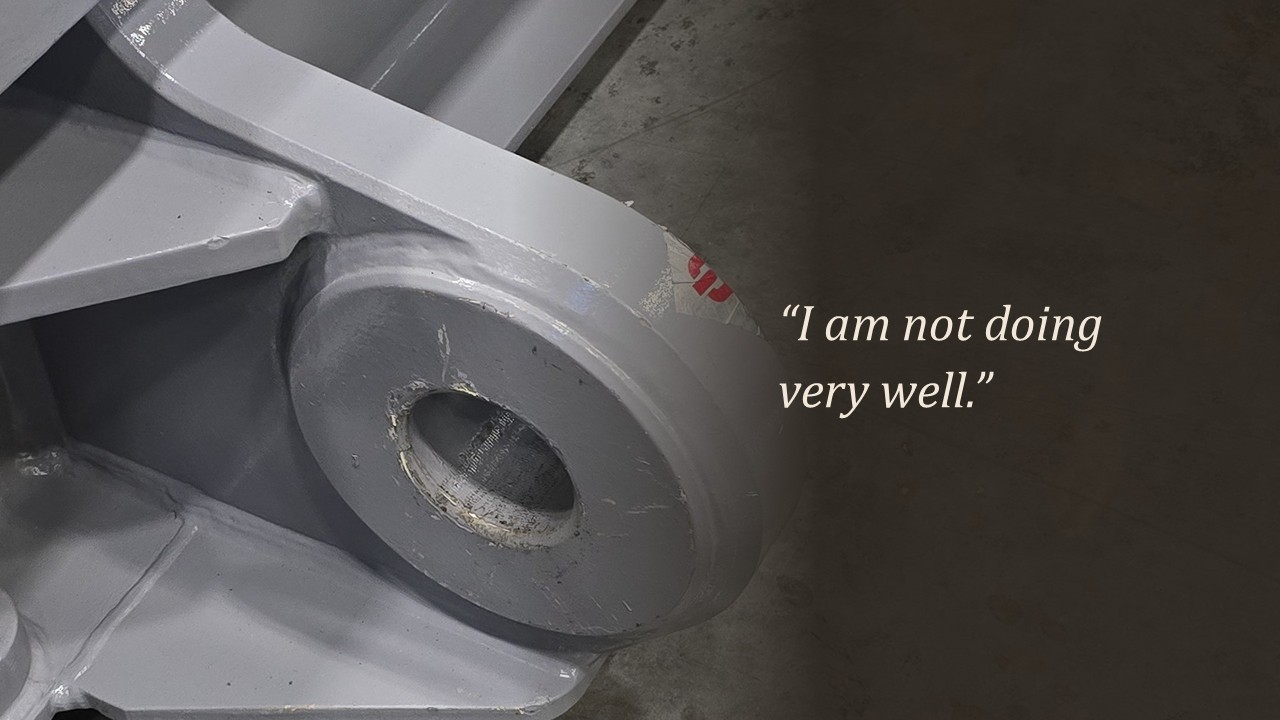
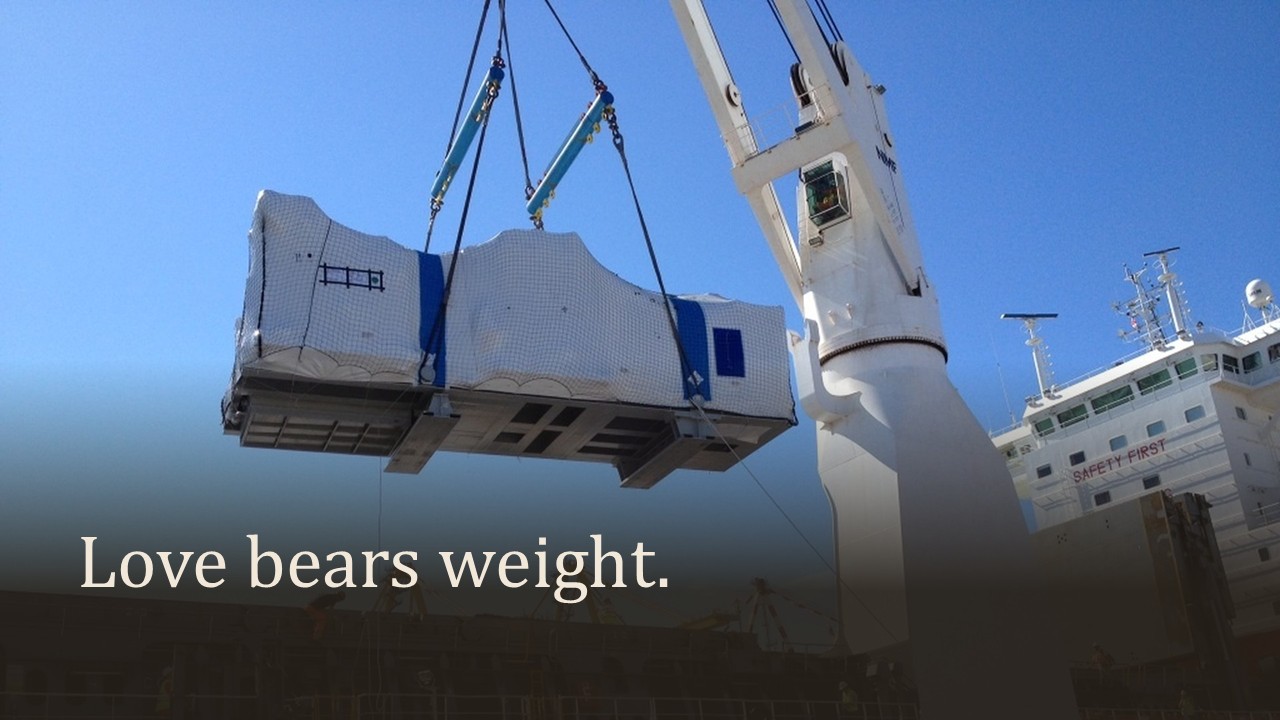
So we put lifting lugs on the package. They may not be the most impressive part of the machine. Nobody buys a compressor because the lifting lugs are attractive. Once the equipment is installed, they may never be used again. On one recent project, we actually cut the lifting lugs off after it was on the foundation. But for one important moment, the entire weight of the machine passes through those small pieces of steel.
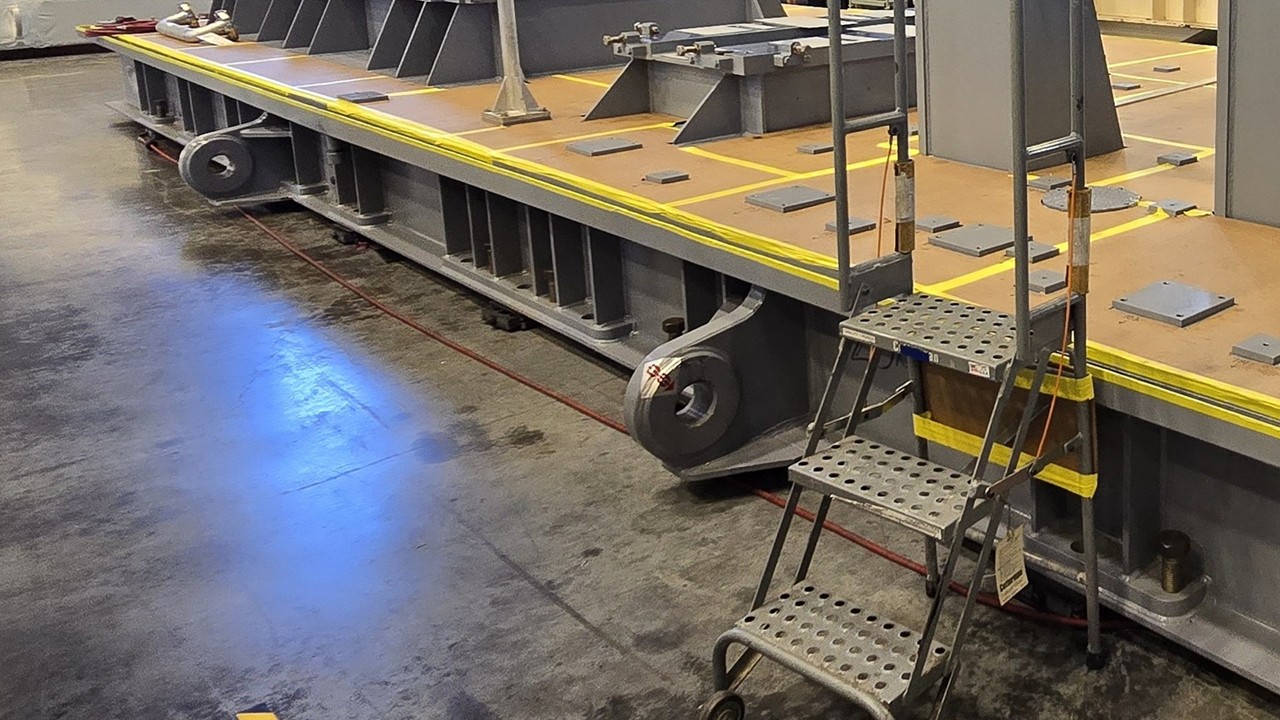
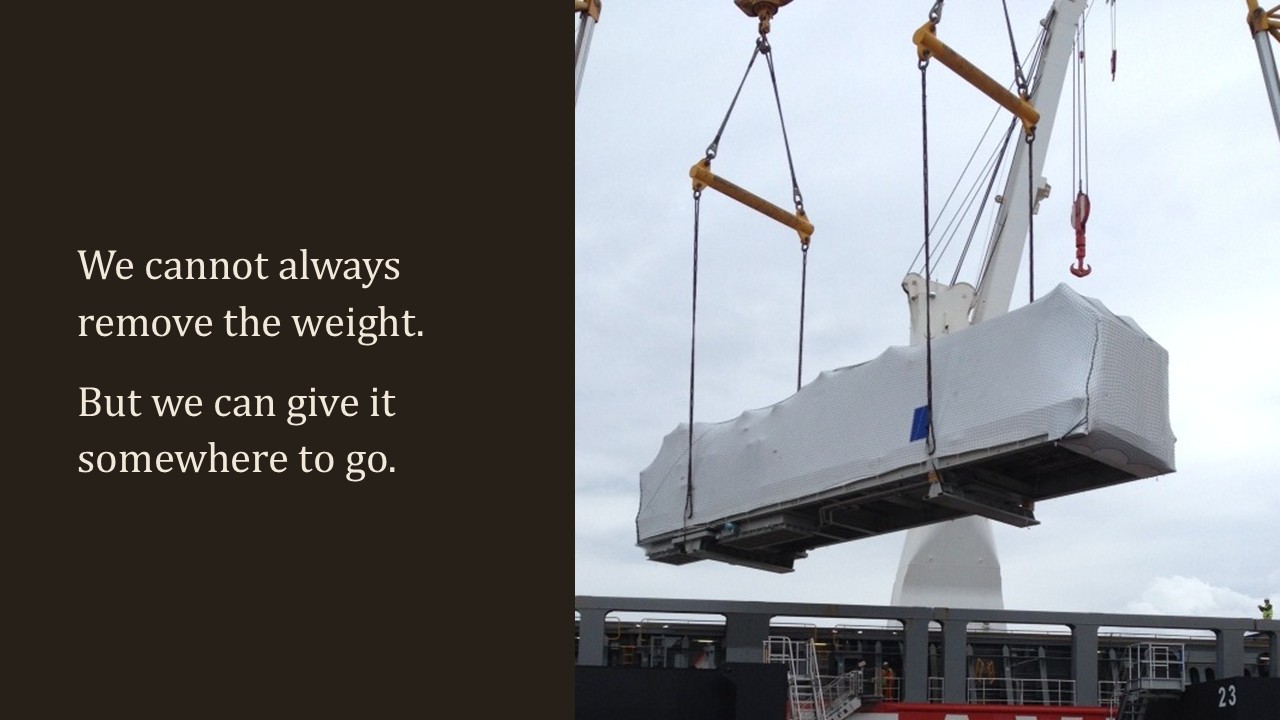
A lifting lug does not make the compressor weigh less. The lug gives the weight somewhere safe to go. Proper rigging creates a load path from the machine, through the lugs and slings, to something capable of carrying it.
Of course, it only works if the load is attached at the right place. A nearby handrail may look convenient, but it was designed to keep a person from falling, not to hold a compressor. A nozzle may be sturdy enough to survive operating pressure and still be entirely wrong for a side load from a crane. And even when every component is strong enough, the lift may tilt if the weight is not distributed as expected. Heavy loads do not respond well to optimism.
Paul writes to the Galatians:
Bear one another’s burdens, and so fulfill the law of Christ.
Galatians 6:2, NKJV
Paul does not tell us that Christians should have no burdens. He does not tell us to stand at a safe distance and offer suggestions about how the other person might carry his more efficiently. He tells us to move close enough for some of the weight to be transferred to us.
This is the fourth lesson in our “One Another” series. We began with “Love One Another,” the command that carries all the others. Then came “Accept One Another” – love at the front door. Acceptance makes room for another person and welcomes him as Christ welcomed us. Then we came to “Serve One Another” – love holding a towel. Service stoops to meet another person’s practical need.
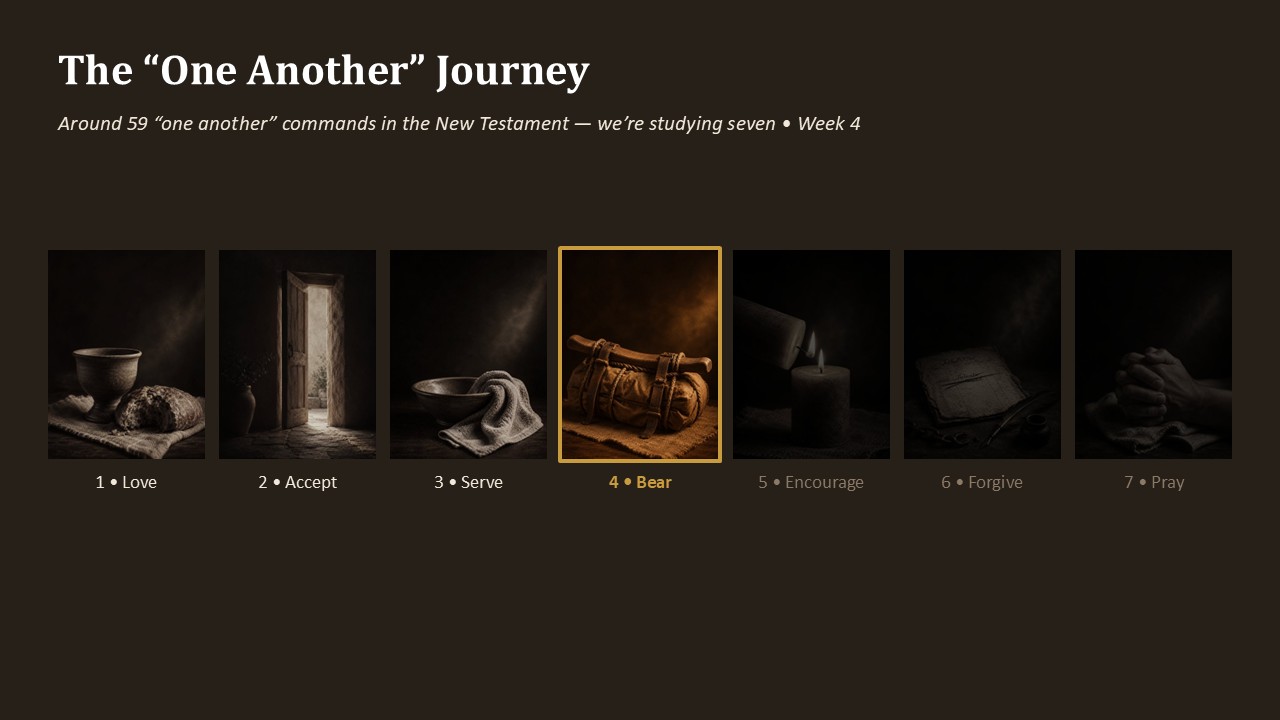
Burden-bearing goes a step further. Serving may take an hour. A burden may remain for months or years. Service often has a task we can complete but burden-bearing may place us beside a problem we cannot solve. Service lets us deliver a meal and go home. It is harder to remain with someone through the fifth month of chemotherapy, the second year of grief, a recurring temptation, a troubled marriage, or the slow unwinding of a decision that went badly.
Bearing one another’s burdens is love under weight.
I. Some Loads Are Too Heavy to Carry Alone
Galatians 6:2 assumes two things: every Christian will carry burdens, and some burdens should not be carried alone.
The Greek word Paul uses in verse 2 is baros (Strong’s G922, pronounced BAH-ros). It refers to weight or heaviness, something difficult and oppressive. A burden may be a physical illness, a grief that will not lift, financial trouble, or a temptation the person cannot shake. It may arrive suddenly, as when the doctor calls with the test result, or it may accumulate so gradually that we do not realize how much weight we are carrying until our knees begin to buckle.

Time changes weight. I can hold a ten-pound object for a minute without difficulty. If you ask me to hold it at arm’s length, it will become considerably heavier somewhere around the second minute. The object has not changed. My capacity to carry it has.
That is how prolonged burdens often work. A meal during the first week after a death is valuable, but grief remains after the casseroles stop arriving. The first days of an illness bring calls and offers of help; chronic illness eventually becomes part of the family calendar. People rally around a crisis, but the person living through it may still need support after everyone else has returned to normal.
I can tell you what the long middle feels like. When my mother died, settling her estate should have taken months. Instead it went to court, and it stayed there for five years.
My sister was originally going to serve as executor. When it became clear this would be a fight measured in years, she knew what it would cost her, and she was honest about it. The job came to me instead. Nobody picks up a five-year weight because he feels strong that day. Sometimes it is simply lying in the doorway.

The first year, people asked how it was going. By the third year they had stopped – not from unkindness, but because what would they even ask? A lawsuit in its fifth year does not produce news. It just sits on you. It was there when I left for work and there when I came home, and most of the people around me had no idea I was carrying anything at all.
What I remember most is that my brother and sister and I carried it together. Every filing, every delay, every year that ended without an ending – we absorbed those as three people instead of one. The weight never got lighter. It got shared. We closed the estate this year, and one thing I learned is that five years is much more bearable at one-third weight.
Paul’s command begins with “bear.” It does not say merely to notice one another’s burdens. Christians can become skilled at noticing. We see the prayer request, shake our heads sympathetically, and say, “That sounds very difficult.” We may even explain why it is difficult, which is rarely as helpful as we imagine. Bearing requires movement. We step toward the person and ask what portion of the weight we can take.
That does not always mean doing something dramatic. More often it means showing up again after the crisis has passed – checking in every week while the treatment drags on, sitting with someone through a decision that keeps not resolving, staying reachable when the trouble outlasts everyone else’s attention. Sometimes we carry it just by listening to the same grief again without hurrying the mourner toward a happier subject.
We cannot always remove the weight. But we can give it somewhere to go.
II. Sometimes the Burden Is Sin
If we begin with verse 2 by itself, we may imagine only sympathetic burdens – cancer, bereavement, job loss, or some other hardship that came to an innocent sufferer. Paul begins somewhere less comfortable:
Brethren, if a man is overtaken in any trespass, you who are spiritual restore such a one in a spirit of gentleness, considering yourself lest you also be tempted.
Galatians 6:1, NKJV
The first burden in the paragraph is a brother or sister caught in sin.
Paul’s language may describe someone overtaken or surprised by a trespass, but he does not declare the person innocent. Something has gone wrong. The Christian has fallen into sin and needs restoration. Bearing his burden does not mean calling the sin something else, hiding it, protecting it, or pretending that it caused no damage. Love does not help a person remain trapped. Love helps restore him.
The word translated “restore” is katartizō (Strong’s G2675, pronounced kat-ar-TID-zo). It was used for mending nets and for setting a broken bone. Hold on to both pictures. A torn net cannot do its job until someone repairs it. A broken bone has to be set, and set correctly, or it heals wrong. So restoration starts with telling the truth. You cannot mend what you will not name, and what is out of place has to be moved back where it belongs.

But nobody repairs a net by tearing the hole wider, and nobody sets a broken bone with a sledgehammer. Paul commands restoration “in a spirit of gentleness.” Gentleness is not weakness or reluctance to tell the truth. It is strength under control, truth applied for the good of the person rather than for the satisfaction of the person speaking it.
We sometimes confuse confrontation with restoration. Confrontation identifies what is wrong. Restoration asks what will help make the person whole and useful again. There are moments when sin must be named, consequences must be faced, and trust has to be rebuilt. Even then, the Christian goal is not humiliation. It is restoration. Someone else’s failure can quietly become an occasion to display our own righteousness, and Paul will not allow it. The goal is never to elevate ourselves. It is to restore our brother.
Paul gives this work to “you who are spiritual.” He does not mean an elite group with impressive titles. Galatians 5 has just described the people he has in mind: those who walk by the Spirit and show His fruit – love, joy, peace, patience, kindness, goodness, faithfulness, gentleness, and self-control. If you are going to help restore someone, this is the qualification. Not that you know the most Scripture, but that your correction will be governed by the Spirit rather than by irritation, superiority, or the itch to talk about it later.
Then Paul removes any excuse for pride: “considering yourself lest you also be tempted.” We approach a fallen believer while remembering that we are made of the same material. We may not share his particular temptation, but we share his dependence upon grace. The difference between the Christian who has fallen and the Christian helping him stand is not that one needs Christ and the other has progressed beyond that stage.
The temptation Paul names is not only the risk of falling into the same sin. Restoration carries temptations of its own: superiority, impatience, the appetite for gossip dressed up as concern, and the quiet satisfaction of measuring our faithfulness against someone else’s failure. A brother’s sin can become the platform on which we build our own sense of righteousness. That is why John Stott said gentleness “is born of a sense of our own weakness and proneness to sin.” The person safe to perform a restoration is the one who knows he could have needed it.
Restoration can be especially difficult when the person’s burden is partly the consequence of his own choices. We find it easier to sympathize with suffering that seems undeserved. When someone ignored good counsel, spent foolishly, damaged a relationship, or returned to a destructive habit, compassion may be mixed with the thought, “You did this to yourself.” That may be true, but it is not the end of the Christian response. The Good Samaritan did not interview the wounded man to determine whether he had chosen an unsafe route before treating him.
At the same time, bearing the burden does not mean removing every consequence. Some consequences are part of how God teaches, corrects, and restores us. We can help a person face what he has done without helping him avoid the truth about it. Love can pay for a meal without financing the habit that created the crisis. Love can remain present while refusing to lie, conceal, or manipulate on someone’s behalf.
Discussion question: When a Christian is caught in sin, which response comes most naturally to us – condemning him, excusing him, or quietly staying out of it? What would restoration require instead?
- In Galatians 6:1, who is supposed to do the restoring, and what two cautions does Paul give that person?
- Katartizō was used for mending a net and for setting a broken bone. What does each picture add to our idea of restoring someone?
- Which sins do we find easiest to excuse in ourselves or quietly tolerate in one another, so that we never attempt restoration at all?
III. Burden-Bearing Fulfills the Law of Christ
Paul does not describe burden-bearing as an optional ministry for unusually compassionate Christians. He says that in doing it we “fulfill the law of Christ.”
That phrase takes us back into the argument of Galatians. Some teachers were pressuring Gentile believers to place themselves under the Mosaic law, especially circumcision. Paul defends justification by faith and the freedom believers have in Christ. But Christian freedom is not freedom to become self-absorbed. Just a few verses earlier he writes:
For you, brethren, have been called to liberty; only do not use liberty as an opportunity for the flesh, but through love serve one another. For all the law is fulfilled in one word, even in this: “You shall love your neighbor as yourself.”
Galatians 5:13–14, NKJV
Freedom from the law as a means of justification does not free us from love. It frees us to love. The “law of Christ” is the pattern and command of the One who saved us: “A new commandment I give to you, that you love one another; as I have loved you, that you also love one another” (John 13:34).
The false teachers in Galatia were doing the opposite of what Paul commands here. They were adding weight – circumcision, law-keeping, one more requirement after another – and then boasting about the people they had persuaded to carry it (Galatians 6:13). As Warren Wiersbe put it,
“Nothing reveals the wickedness of legalism better than the way the legalists treat those who have sinned.”
The legalist adds to the pile and points at the people underneath it. Grace moves the other direction. Christ carried ours.
Jesus did not love us from a safe distance. He entered our condition. He took on flesh, shared our sorrows, endured temptation without sin, and carried our guilt to the cross. When Scripture speaks of Christ bearing our sins, it means something no one else can do. Isaiah says the Lord caused the iniquity of us all to fall on Him (Isaiah 53:6). Peter says He Himself bore our sins in His body on the cross (1 Peter 2:24). Do not blur that into a general lesson about being kind. Only Christ could carry our guilt and condemnation. We do not help Him atone for anyone.
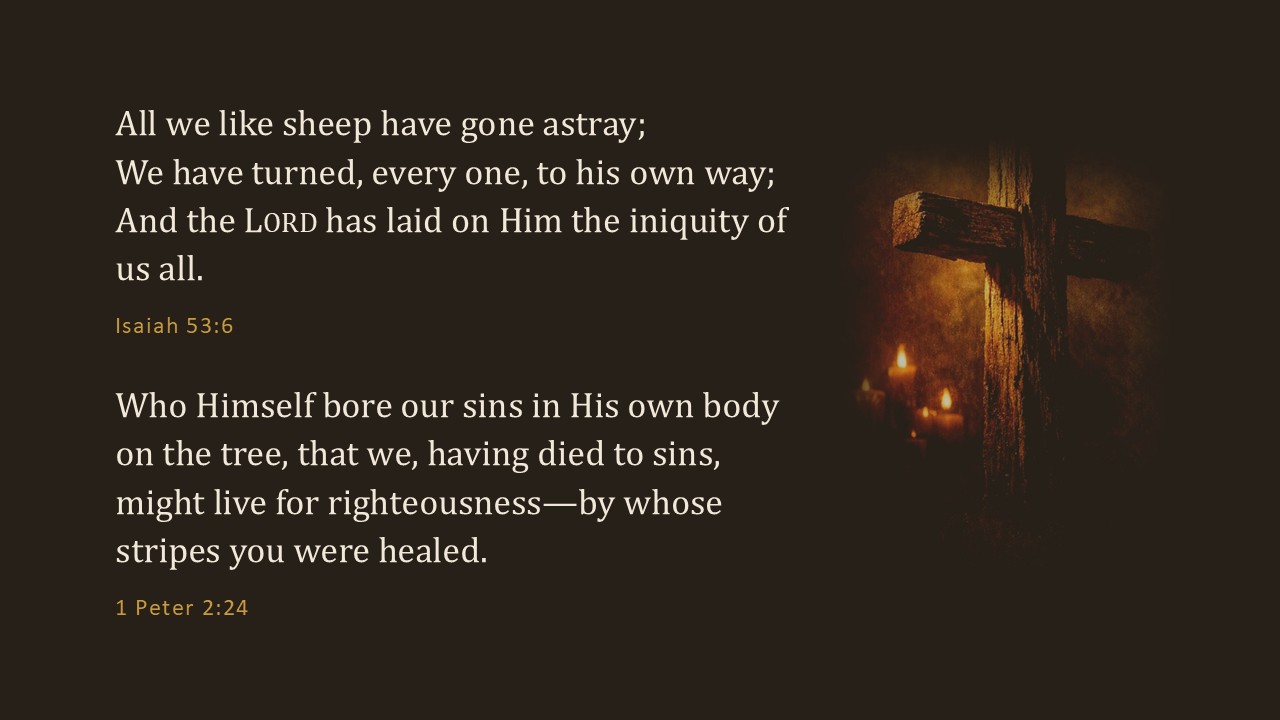
But the cross sets the shape of Christian love. Jesus carried what only He could carry, and now He teaches us to carry the weights we can share with one another. We do not carry another person’s condemnation. We do carry meals, inconvenience, honest correction, and hours when we would rather be doing something easier.
Romans 15 makes the connection explicit:
We then who are strong ought to bear with the scruples of the weak, and not to please ourselves. Let each of us please his neighbor for his good, leading to edification. For even Christ did not please Himself.
Romans 15:1–3a, NKJV
Whatever strength you have is not only for you. God may make you strong in one area precisely so that strength becomes part of His provision for someone else. Your experience, your time, your money, your health, your steadiness when things fall apart – any of it may have a purpose beyond making your own life more comfortable.
An engineer does not add a lifting lug so the lug can admire how much load it is rated to carry. Its strength exists for the moment when weight must pass through it. In the same way, we should ask whether some strength God has given us was intended to become a safe load path for another person.
Perhaps we have survived a grief that now enables us to sit with someone newly bereaved. Perhaps we have learned how to manage money and can help someone create a workable plan. Perhaps we have walked through unemployment, or caregiving, or a wayward child. Our experience does not make us the expert on another person’s life, and we should be cautious about saying, “I know exactly how you feel.” We probably do not. But God can redeem our suffering by making us more attentive, patient, and useful to someone carrying a similar weight.
Second Corinthians 1 says God comforts us in all our affliction so that we can comfort others with the comfort we ourselves received from Him. The comfort starts with God, comes through some other believer to you, and then runs through you to the next person. That is a load path of grace.

IV. Burden-Bearing Requires Humility on Both Ends
After telling us to restore the fallen and bear one another’s burdens, Paul turns immediately to pride:
For if anyone thinks himself to be something, when he is nothing, he deceives himself. But let each one examine his own work, and then he will have rejoicing in himself alone, and not in another.
Galatians 6:3–4, NKJV
Pride can keep us from carrying another person’s burden. We may think the problem is beneath us, too messy, too repetitive, or too clearly the result of bad decisions. We compare our visible strengths with another person’s visible failure and conclude that he needs a lecture more than he needs a brother.
Paul tells us to examine our own work instead of grading ourselves against the person who has fallen. He is not forbidding every kind of satisfaction in faithful work; he says the one who examines his own work will “have rejoicing in himself alone.” What he forbids is building our confidence out of the comparison, measuring our record against a neighbor’s instead of against the assignment God actually gave us. Comparison can carry us in either direction. Set beside someone who has fallen, we feel superior and grow complacent. Set beside someone whose faithfulness outshines ours, we feel inferior and grow discouraged. Both directions move our eyes off our own work before God. Comparison is a remarkably efficient way to feel righteous without becoming righteous. If I choose the right person, I can make almost any part of my life look impressive. Paul redirects my attention to my own stewardship before God.
Pride also keeps us from admitting our own burdens. The church can become a room full of people willing to help but unwilling to be helped. We prefer arriving as rescuers because rescuers retain control. Receiving help requires us to admit that we are not managing as well as we hoped everyone believed.
Many of us know how to answer “How are you?” in the church hallway. “Fine.” It is an efficient answer. It keeps the line moving and prevents anyone from asking a second question. Sometimes “fine” really means fine. Sometimes it means, “I do not know you well enough to discuss this here.” But sometimes it means, “I am afraid that if I tell the truth, you will think less of me.”
Burden-bearing requires someone willing to help and someone willing to be helped. We cannot carry what another person refuses to reveal. We should respect appropriate privacy, and nobody owes the whole church a report on every struggle. But Christian community cannot function if all of us conceal every weakness while waiting for opportunities to assist somebody else.
The lifting lug is designed to accept a connection. The crane may have more than enough capacity, but the load stays on the ground until the sling is attached. In human terms, that attachment may be the sentence, “I am not doing very well.” It may be asking for prayer and then answering honestly when someone asks how to pray. It may be calling a friend before the temptation becomes a failure instead of afterward. It may be letting someone bring dinner without turning it into an apology.
Humility also protects the person offering help from a different error: believing we are someone else’s savior. We can move underneath part of the burden, but we cannot control the outcome. We cannot make another adult repent, or heal, or grieve on our schedule, or make the wise decision he keeps refusing. If we confuse burden-bearing with control, our help will eventually become frustration and resentment.
Humility says two things at once: “I am not too important to carry this with you,” and “I am not powerful enough to fix everything for you.”
This is one reason burden-bearing belongs to the whole body of Christ rather than to one endlessly available person. No individual Christian is designed to carry every burden for everyone. One person may provide transportation, another may bring food, another may understand the medical language, another may listen well, and another may pray faithfully. The burden is distributed through the body.
First Corinthians 12 says God composed the body so that the members would have the same care for one another: “If one member suffers, all the members suffer with it.” When a foot is injured, the hands do not accuse it of becoming needy. The rest of the body adjusts. Weight shifts. Movement slows. Other parts compensate while healing takes place.
Discussion question: Which is harder for us – carrying someone else’s burden or allowing someone else to help carry ours? What makes that difficult?
- In verses 3–4, what does Paul tell each of us to examine, and where does he say our rejoicing should not come from?
- How can comparison make it harder both to help someone and to let someone help us?
- If you were not doing well, is there one person you would actually tell? If no one comes to mind, what stands in the way?
V. Bear One Another’s Burdens, but Carry Your Own Load
Then Paul appears to contradict himself:
For each one shall bear his own load.
Galatians 6:5, NKJV
Verse 2 says, “Bear one another’s burdens.” Verse 5 says, “Each one shall bear his own load.” Which is it?

Paul uses two different words. The burden in verse 2 is baros, a heavy, crushing weight. The load in verse 5 is phortion (Strong’s G5413, pronounced for-TEE-on), the ordinary pack each of us is expected to carry. The words are not always kept rigidly separate, but the difference fits what Paul is doing here. Some weights are too much for one person, and we are told to share them. Other things are ours to carry, and no one can carry them for us.
The tense may matter too. Verse 5 is future: each one shall bear his own load. That may look ahead to the day each of us answers to God personally. Paul says elsewhere that “each of us shall give account of himself to God” (Romans 14:12). I can help you obey Christ. I cannot obey Him for you. I can help you stand. I cannot stand in your place. That is the one weight no friend, however loving, can lift off your shoulders – and it is exactly why bearing a burden never turns into taking over a life.
Every Christian has a load before God. You are responsible for your own choices, your obedience, how you use your gifts and your opportunities, and the work God has actually handed you. Someone can help you think a decision through, but he cannot obey God for you. He can stand with you in the temptation, but the choice is still yours. He can sit with you in the grief, but he cannot grieve in your place. He can help repair the damage your sin caused, but he cannot repent for you.
Bearing burdens therefore differs from taking over another person’s life. It does not require rescuing people from every consequence, accepting manipulation, financing destructive behavior, or repeatedly doing what an able person refuses to do for himself. If our help allows irresponsibility to continue indefinitely, we may no longer be bearing a burden. We may be carrying the other person’s pack while he walks beside us empty-handed.
This distinction can be difficult because the same action may be compassionate in one situation and enabling in another. Paying a utility bill for a family struck by sudden unemployment may bear a genuine burden. Repeatedly paying it while an able person refuses available work may help him avoid his own responsibility. Providing a place to stay may protect someone during a crisis. Allowing destructive conduct to continue in the home without boundaries may place everyone under a different burden.
There is no formula that removes the need for wisdom. How do we tell the difference? Mostly we ask one thing two ways: has this load genuinely become too heavy for the person, or is it a responsibility he is simply refusing to carry? Will my help get him back on his feet, or will it make it easier for him to stay off them? There is no automatic answer. But those questions are usually enough to keep compassion from sliding into control on one side or enabling on the other – and when they are not, we ask someone wiser who is not tangled up in the situation the way we are.
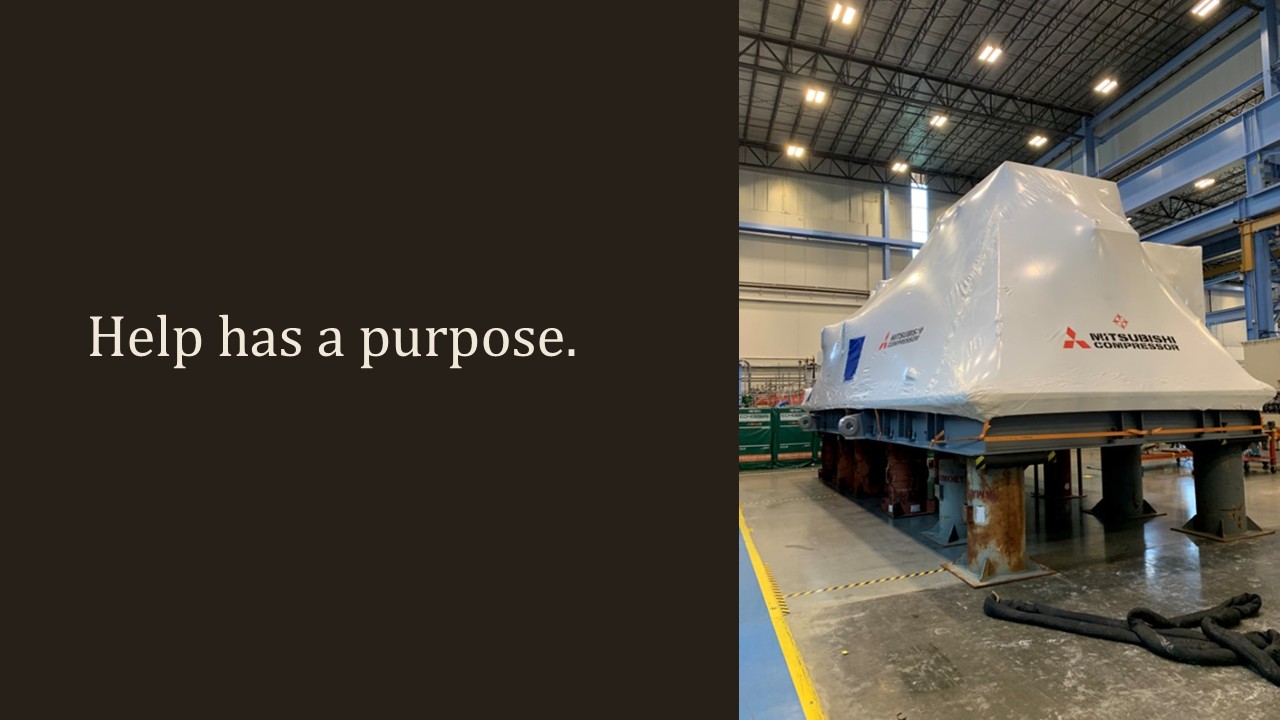
Good rigging supports the load without becoming part of the machine. The crane lifts the compressor into place, but it does not remain attached after installation so the compressor never has to rest on its own foundation. Help has a purpose. Sometimes it carries a person through a season until he can stand again. Sometimes, as with chronic illness or permanent disability, the need continues and the body adapts for the long term. Wisdom learns the difference.
Jesus holds grace and responsibility together in Matthew 11:28–30. He invites the weary and burdened to come to Him for rest, but then He gives them His yoke. He removes the crushing burden and gives a fitting load. A yoke makes work bearable under the direction of a gentle Master. Grace does not leave us with nothing to carry. It frees us to carry the load Christ assigns instead of the weight that is destroying us.
Discussion question: How can we tell when we are bearing a crushing burden with someone and when we have begun carrying a responsibility God gave that person?
- What is the difference between the burden in verse 2 and the load in verse 5?
- In Matthew 11:28–30, Jesus gives rest to the weary and then hands them a yoke. What does that say about the purpose of our help?
- Think of a time when help went on past the point where it was helping – help you gave or help you received. What would you do differently now?
VI. Love Moves Close Enough to Feel the Weight
Jesus’ parable of the Good Samaritan gives burden-bearing hands and feet. A man traveling from Jerusalem to Jericho is attacked, stripped, beaten, and left half dead. A priest sees him and passes on the other side. A Levite does the same. Both men notice the burden. Neither moves underneath it.
Then a Samaritan sees him and feels compassion. His compassion becomes action. He approaches the wounded man, treats the wounds, places him on his own animal, brings him to an inn, cares for him, pays the innkeeper, and promises to cover additional expense when he returns.
The Samaritan’s help is personal, physical, financial, inconvenient, and continuing. He does not merely feel concern. He changes his travel plans. Because the wounded man rides the Samaritan’s animal, the Samaritan probably walks. He uses his own supplies, spends his own money, and accepts a future obligation.
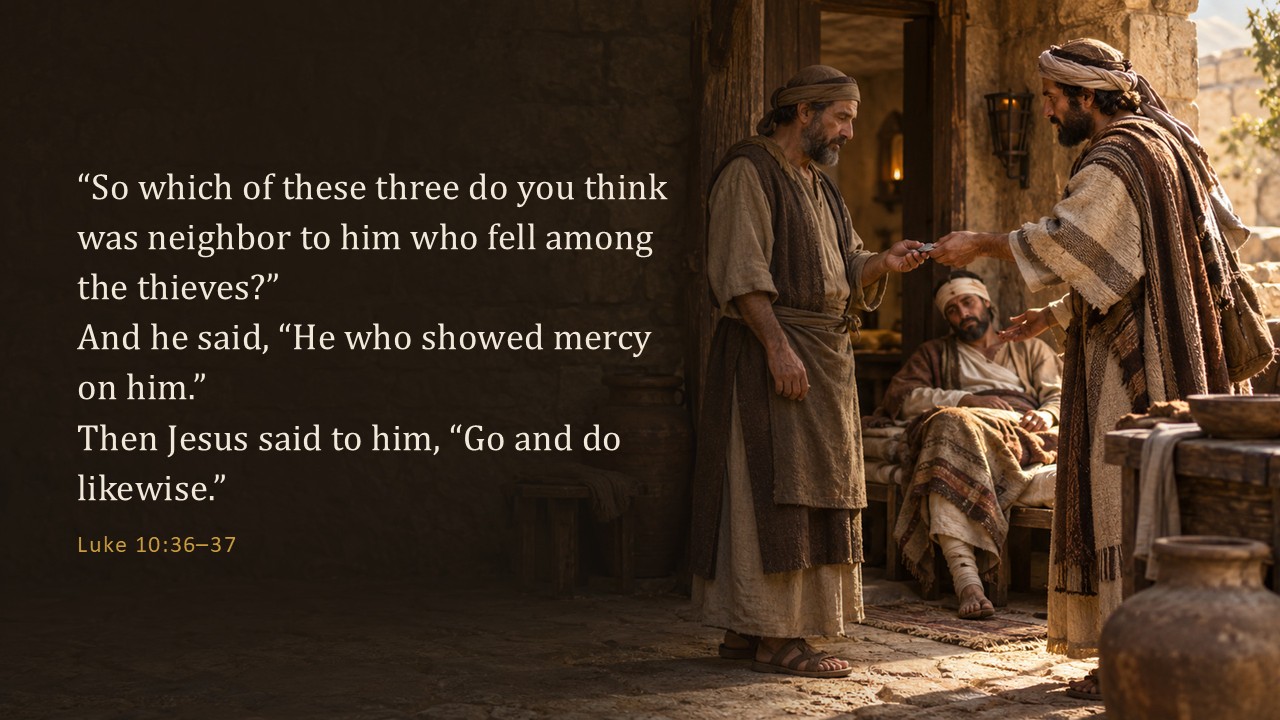
He also does not do everything himself. He transfers the man to an innkeeper and provides resources for continuing care. The goal is not to become indispensable. The goal is to make sure the wounded man is cared for.
Jesus tells the parable in response to a lawyer who asks, “Who is my neighbor?” The question seeks a boundary: How far does my obligation extend? Jesus ends with a different question: Which man proved to be a neighbor? The issue is not how narrowly we may define the person entitled to our concern. The issue is whether we will become the kind of person who moves toward suffering.
Most burden-bearing will not look as dramatic as the Jericho road. It may look like sending a message two weeks after the funeral, when the crowd has thinned. It may mean attending an appointment because the patient cannot absorb everything the doctor says. It may mean checking on a caregiver whose entire conversation has become a report about the patient. It may mean sitting beside someone who has confessed a sin and helping him take the next faithful step. It may mean offering specific help rather than saying, “Let me know if you need anything,” because overwhelmed people often do not have enough energy to organize our compassion for us.
We often prefer burdens with obvious solutions. If a neighbor has a flat tire, I know what to do. There are tools, steps, and a satisfying conclusion. Emotional and spiritual burdens are less cooperative. We cannot repair grief with a socket wrench. We cannot produce the sentence that makes a diagnosis disappear. We may avoid a hurting person because we do not know what to say, when what he needs most is evidence that he has not been abandoned.
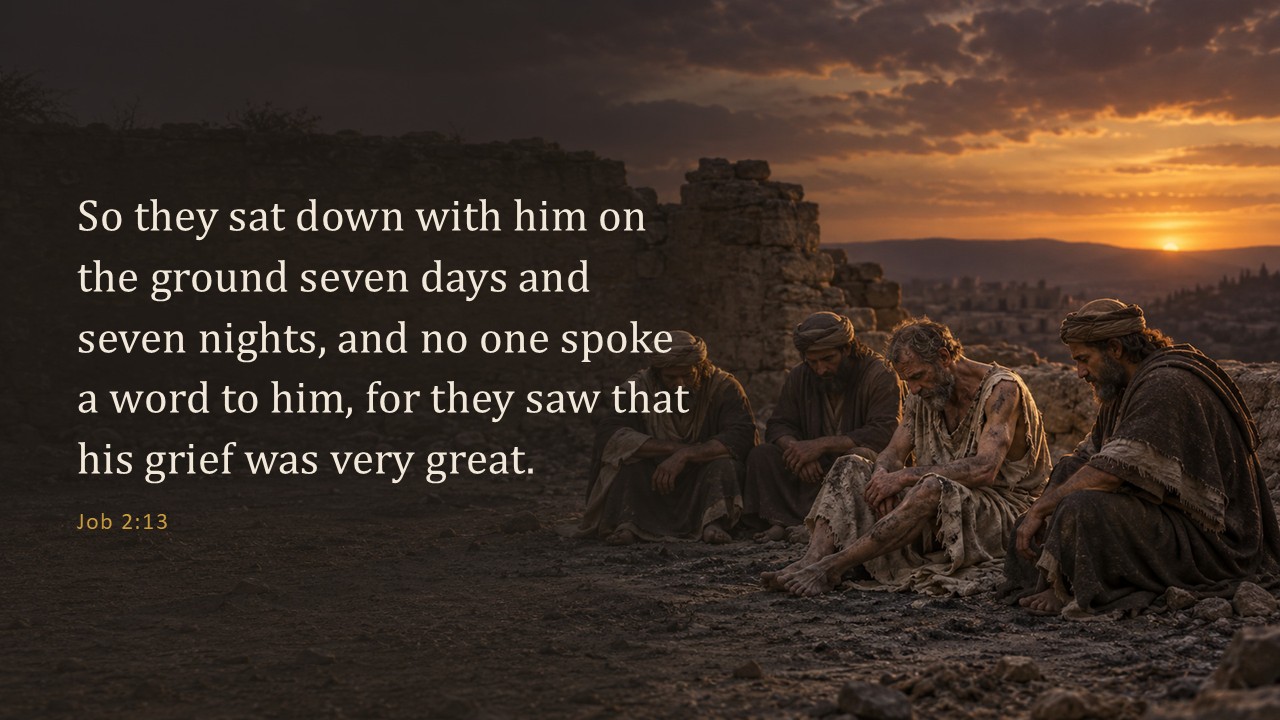
Job’s friends understood this briefly. When they first saw him, they wept, tore their robes, and threw dust over their heads. Then they sat on the ground with him for seven days and seven nights, “and no one spoke a word to him, for they saw that his grief was very great” (Job 2:13, NKJV). Their ministry deteriorated when they began explaining. Their silent presence had been the best thing they offered.
Silent presence is one gift we can offer. A specific question is another – “Can I bring dinner Tuesday?” or “Do you want advice, or do you need me to listen?” – because a specific offer is far easier for an exhausted person to accept than “let me know if you need anything.”
Burden-bearing also includes returning. Some people receive an impressive amount of support during the first shock of suffering and very little during the long middle. Love under weight is measured not only by intensity but by endurance. We do not need to make promises we cannot sustain, but we should do what we promise and remain attentive after the need is no longer new.
Paul knows how long the long middle can be. Three verses after commanding us to bear one another’s burdens, he writes:
And let us not grow weary while doing good, for in due season we shall reap if we do not lose heart. Therefore, as we have opportunity, let us do good to all, especially to those who are of the household of faith.
Galatians 6:9–10, NKJV
Weariness is what happens when love stays under weight longer than we expected. We rarely step away because we have stopped caring. We step away because the need outlasted our first burst of concern. Paul does not scold the weary. He points them toward the harvest. The reaping comes in due time, and the long middle of someone else’s burden is part of the sowing. He does not ask one person to carry every burden forever, but he does ask us not to let fatigue harden into abandonment.
There are burdens we cannot safely carry without help ourselves. A threat of self-harm, abuse, addiction, serious mental illness, or a dangerous medical condition may require professional intervention. Burden-bearing does not mean keeping every secret or pretending Christian friendship replaces physicians, counselors, pastors, law enforcement, or emergency services. Sometimes the most loving act is helping connect the person to care beyond our ability.
This returns us to the engineering picture. A lifting lug has a rated capacity. Exceed it, pull it in a direction it was not designed to take, or attach it to an inadequate structure, and the attempt to help can produce another failure. Knowing our limits is not a refusal to love. It is part of loving wisely. We remain beside the person while helping transfer weight to those equipped to carry it.
Discussion question: Most of us know someone under a real weight right now. Without naming names – what would taking part of that weight actually look like this week?
- In Luke 10:33–35, what does the Samaritan actually do for the wounded man? Which of those things cost him something?
- Job’s friends offered their best help before they said a word. Why is presence so hard to offer when we cannot fix the problem?
- Whose burden has outlasted everyone’s attention, including yours? What would coming back look like?
Conclusion: The Weight Has Somewhere to Go
The church is not a gathering of people who have learned to live without burdens. It is a body in which burdens no longer have to be carried alone.
Some of us walked in today carrying something heavy. We have become skilled at walking normally while carrying it. We may not need everyone to know, but we probably need someone to know. God often answers our prayer for strength by sending another member of the body to stand beside us. Refusing every offer of help may look like strength, but sometimes it is pride wearing work clothes.
Others of us have enough capacity today to carry part of someone else’s weight. That capacity is not proof that we are better. It is a stewardship. Tomorrow the positions may be reversed. In the body of Christ, there are seasons when we carry and seasons when we are carried.
We each have our own load to bear before God, and Christian love never pretends otherwise. But when a brother or sister begins to buckle under a crushing weight, love does not stand back and explain load distribution.
Love moves underneath.

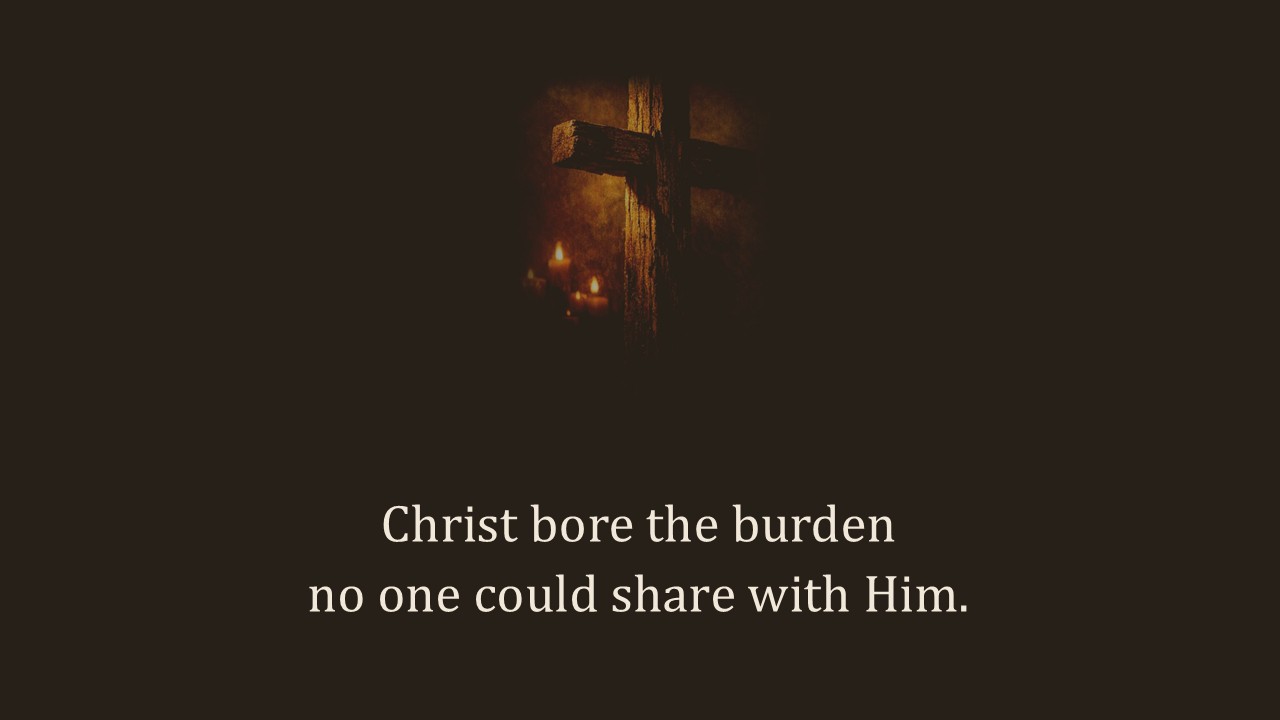
Christ bore the burden no one could share with Him – our sin and condemnation. Because He carried that weight to the cross, we are free from its judgment. Now He joins us to His body and commands us to bear the lesser but still painful weights of one another.
A lifting lug does not make the machinery lighter. It gives the weight somewhere safe to go. In the church, by the grace of God, so do we.
That is love under weight.
Soli Deo Gloria.


