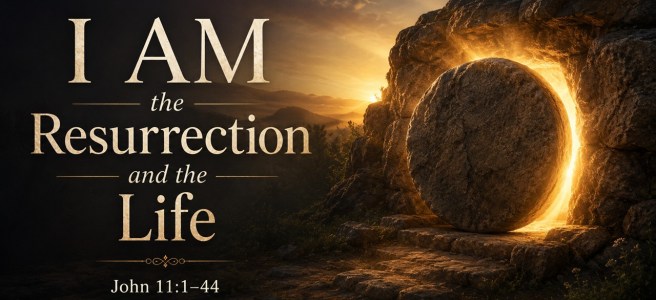
I AM The Resurrection and the Life

I. Introduction — The Moment When “Too Late” Arrives

There are different kinds of “too late.”

Some are annoying. Too late for the early-bird special. Too late to return that purchase without a receipt. Too late to get the good seats.

Some are heavier. Too late to apologize. Too late to say goodbye. Too late to change what happened.

And then there are the moments that feel absolutely final. The doctor has already made the call. The funeral has already happened. The stone has already been rolled in front of the tomb. At that point we don’t say, “I wish this had gone differently.” We say what Mary and Martha said: Lord, where were You?

That is the setting of John 11.

By the time Jesus shows up, Lazarus has been dead four days. That’s not ambiguous. That’s not “he might recover.” That’s done. And standing at that tomb, Jesus says something He has never said quite like this before.

Not “I can raise the dead.” Not “I believe in resurrection.” Not “Don’t worry, Lazarus will be okay eventually.”

He says: “I am the resurrection and the life.”

That’s the center of this lesson — and it’s worth taking a moment to see how it fits in our series. We’ve been walking through the seven I AM statements of Jesus in John’s Gospel:

  • I AM the Bread of Life
  • I AM the Light of the World
  • I AM the Door
  • I AM the Good Shepherd
  • I AM the Resurrection and the Life
  • I AM the True Vine
  • I AM the Way, the Truth, and the Life

Each statement reveals something essential about who Jesus is. The Bread satisfies real hunger. The Light exposes real darkness. The Door opens real access to God. The Good Shepherd lays down His life for real sheep. But this one is different in a way that should stop us in our tracks. In every other statement, Jesus is providing something. Here, Jesus is claiming to be something that nothing else can even come close to.

Martha already believed in resurrection. She had good theology. Jesus doesn’t correct her doctrine — He deepens it. He doesn’t say, “Yes, and here’s some more information about resurrection.” He says, “I am the resurrection.” The hope isn’t a date on the calendar. It’s a Person standing in front of her.

Discussion Question: When you’re in the middle of a hard situation, is it easier to believe that God exists and has good plans — or to believe that He is personally present with you in that specific moment? What’s the difference?

II. The Delay — Love That Doesn’t Hurry

John 11:1–6

John introduces us to a family Jesus loved: Lazarus, Mary, and Martha of Bethany. Lazarus is sick. His sisters send word to Jesus:

“Lord, he whom You love is ill.”

Simple prayer. No instructions. No demands. Just: You love him. You need to know this.

Then John gives us a sentence that doesn’t parse the way we expect it to:

“Now Jesus loved Martha and her sister and Lazarus. So, when He heard that Lazarus was ill, He stayed two days longer in the place where He was.”

That word “so” is doing a lot of work. John doesn’t say Jesus loved them but stayed. He says Jesus loved them, so He stayed. The delay was not a failure of love. The delay was somehow an expression of it.

That is hard for us to accept, because we tend to measure love by speed. If you love me, come quickly. If you care, fix it now. If God loves me, surely He answers immediately.

But Jesus is working toward something larger than preventing Lazarus from dying. He says plainly that this illness is

“for the glory of God, so that the Son of God may be glorified through it.”

He is not indifferent to the sisters’ grief — we’ll see just how not-indifferent He is a little later. But His timing is not governed by their understanding of the situation. It is governed by the Father’s purposes.

In the last lesson, we saw that the Good Shepherd lays down His life for the sheep. One of the things that means is that the Good Shepherd also knows when to move and when to wait. From the sisters’ perspective, Jesus is late. From Jesus’ perspective, the sign hasn’t started yet.

Discussion Question: When God delays, why do we tend to read that as abandonment rather than trust that He might be working with a larger purpose than we can see from where we’re standing?

III. The Disciples and the Danger — Walking Toward Death

John 11:7–16

After two days, Jesus tells His disciples they’re going back to Judea. The disciples’ reaction is understandable: last time they were in Judea, the religious leaders tried to stone Jesus. Going back is not safe.

Jesus answers with an image about walking in the day rather than stumbling at night. In John’s Gospel, light and darkness aren’t just physical categories — and we spent a whole lesson on exactly that. Jesus is walking in the light, meaning in perfect step with the Father’s will. He is not being reckless. He is being obedient.

Then Jesus tells them Lazarus has “fallen asleep” and He is going to wake him up. The disciples think: great, if he’s sleeping he’ll recover, no need to risk the trip. So Jesus says it plainly. Lazarus has died. And then He adds something unexpected:

“And for your sake I am glad that I was not there, so that you may believe.”

Not because Jesus is glad Lazarus died. He is glad that the disciples are about to see something they have never seen. They have watched Him turn water into wine, feed thousands from a child’s lunch, give sight to a man born blind. Now they will see His authority over death itself.

Thomas sums up the mood with characteristic gloom:

“Let us also go, that we may die with Him.”

Well, thank you, Thomas, for that confidence-inspiring pep talk. But give Thomas credit — he sees the danger clearly and goes anyway. He just doesn’t yet see the glory clearly.

And there’s a detail here worth not missing. In John 10, Jesus has just declared that the Good Shepherd lays down His life for the sheep. Now He begins walking toward the place where that death will eventually happen. The raising of Lazarus will fuel belief — John 12 tells us many Jews believed because of it. It will also trigger the final decision to kill Jesus. John 11:53 says that from that day on they made plans to put Him to death.

So Jesus isn’t just walking toward Lazarus’ tomb. He’s walking toward His own cross. And that means this miracle is not a detour in the story — it’s the hinge of it.

Discussion Question: Looking back, many of us can point to a hard season that taught us something about God a comfortable season never could have. Without going into details you’d rather not share — what did the hard season teach you that you wouldn’t trade away now?

IV. Martha’s Grief — “If You Had Been Here”

John 11:17–24

By the time Jesus arrives, Lazarus has been in the tomb four days. In Jewish culture, burial happened fast — usually the same day as death. There is no ambiguity here. Four days means this story is over.

Bethany was close to Jerusalem. Mourners had come from the city. This is a public grief — the whole community knows. The tomb is sealed. Everyone is grieving.

Martha hears Jesus is coming and goes out to meet Him. She says:

“Lord, if You had been here, my brother would not have died.”

That sentence sounds like unbelief, but I don’t think it is.  It’s faith mixed with grief — reverence and disappointment and trust all tangled up in one breath. She still calls Him Lord. She still believes in His power. But she is also carrying the weight of His absence. And she’s not wrong: Jesus could have prevented this.

Most of us have said something like this at some point, even if we used different words.

Lord, if You had acted sooner…
Lord, if You had answered differently…
Lord, if You had stopped this…

Martha believes Jesus could have prevented this. She doesn’t yet understand that He has authority even after this.

That’s one of the key turns in this passage. Jesus is not only Lord before the crisis arrives. He is Lord after death has done its worst.

Martha continues:

“But even now I know that whatever You ask from God, God will give You.”

Real faith is still in there — though it hasn’t quite arrived yet at what Jesus is about to reveal. Jesus tells her,

“Your brother will rise again.”

Martha responds with good theology:

“I know that he will rise again in the resurrection on the last day.”

She’s not wrong. Daniel 12:2 speaks of many who sleep in the dust of the earth awakening. Job says, “After my skin has been thus destroyed, yet in my flesh I shall see God.” Martha believes in future resurrection. Her doctrine is sound.

But Jesus is about to move her from doctrine to Himself.

It’s possible to believe true things about resurrection and still miss who is standing in front of you. Martha believes resurrection is an event on God’s future calendar. Jesus is about to tell her something better.  Resurrection is not merely an event. Resurrection is bound to a Person.

Discussion Question: What’s the difference between believing true doctrine about Jesus and actually trusting Him in the middle of grief or disappointment?

V. The I AM Statement — Resurrection Is Standing Right in Front of Her

John 11:25–27

“I am the resurrection and the life.”

In Greek, “resurrection” is anastasis — a rising up. “Life” is zōē — the word John consistently uses for real life, eternal life, life that comes from God. Jesus is not talking about biological existence. He’s talking about the life that belongs to God and is given by God.

The order He uses is intentional.

First, He says He is the resurrection. That addresses death directly. Believers still die physically. Lazarus died. Martha and Mary buried him. The gospel does not pretend the grave is imaginary. Death is an enemy. Paul calls it “the last enemy” to be destroyed in 1 Corinthians 15:26. But it is a defeated enemy. It can still wound, but it cannot win.

“Whoever believes in Me, though he die, yet shall he live.”

That’s the future hope. The believer may die physically, but death cannot keep him. The grave is real, but it is not sovereign.

Second, He says He is the life. That addresses the present. “Everyone who lives and believes in Me shall never die.” That doesn’t mean Christians skip physical death. It means physical death is no longer ultimate death. Eternal life doesn’t begin after the funeral — it begins when a person belongs to Christ.

So both halves are there:

The one who dies in Christ will live. The one who lives in Christ will never ultimately die.

That’s not sentimental comfort at a graveside. That is a claim of authority.  Jesus is not saying “I can perform a resurrection.” He is saying resurrection and life are found in Him because He is the source of life. John said it at the beginning of the Gospel: “In Him was life, and the life was the light of men.” Jesus will later say, “Because I live, you also will live.”

This is what separates this I AM from the others. Bread satisfies hunger. Light reveals truth. The Door grants access. The Good Shepherd protects and lays down His life. But the Resurrection and the Life steps up to the mouth of a sealed tomb and claims authority over death itself.

And then He asks Martha the question that makes the whole passage personal:

“Do you believe this?”

Not “Can you explain this?” Not “Do you feel better now?” Not “Do you understand why I waited?”

Do you believe this?

Martha’s answer is one of the great confessions in the Gospel:

“Yes, Lord; I believe that You are the Christ, the Son of God, who is coming into the world.”

She may not know exactly what Jesus is about to do. But she knows who He is. That is faith. Faith doesn’t always understand the timing of Jesus. It doesn’t always know what He’s going to do next. But faith clings to who He is — and that turns out to be enough.

Martha believed resurrection was coming later. Jesus told her resurrection was already here. Because resurrection wasn’t a date. Resurrection was standing right in front of her.

Discussion Question: Jesus asked Martha, “Do you believe this?” Where is it hardest for you to move from “I believe the doctrine” to “I trust the Person”?

VI. Mary’s Grief and the Tears of Jesus — He Doesn’t Stand Apart From It

John 11:28–37

After talking with Jesus, Martha goes to get Mary. The mourners follow, thinking she’s going to the tomb to weep. Mary comes and falls at Jesus’ feet, and she says the exact same thing Martha said:

“Lord, if You had been here, my brother would not have died.”

Same words. Different posture. Martha met Jesus with a conversation. Mary falls at His feet in tears. Jesus receives both. He doesn’t tell Martha she talks too much or tell Mary to pull herself together. He meets each sister in her grief, in the way she brings it.

Then John tells us Jesus was deeply moved in His spirit and greatly troubled. The language is strong — this is not mild sadness. There’s real grief here, and very likely some indignation too — not irritation at the mourners, but anger at death itself and the ruin it has made of the world God created good.

And then the shortest verse most of us ever memorized:

“Jesus wept.”

Short verse. Not a small thing.

Jesus knows He is about to raise Lazarus. He knows what He’s going to say. He knows Lazarus will walk out of that tomb. And He still weeps.

That tells us something important: Christian hope does not cancel Christian grief.

Jesus doesn’t stand outside human sorrow like a detached theologian explaining the doctrine of resurrection from a safe distance. He enters the grief. He sees the tears of Mary and Martha and the mourners. He stands in front of the tomb of His friend. And He cries.

That means grief is not a failure of faith. It becomes unbelief when it concludes that death is greater than Jesus. But grief itself is the right response to the brokenness of the world. Death is an enemy. Separation hurts. The grave is ugly. Jesus doesn’t minimize that. He faces it, and He does so with tears.

The crowd splits. Some say, “See how He loved him!” Others say, “Could not He who opened the eyes of the blind man also have kept this man from dying?” That’s a fair question, actually. We saw in a previous lesson that Jesus had given sight to a man born blind. Surely He could have prevented this death.

He could have. That’s not even in dispute.

But He didn’t come to prevent this death. He came to reveal His authority over it. And that distinction runs through the heart of this whole passage. We often want Jesus to show His love by stopping the storm before it hits. Sometimes He does. But here in John 11, He shows His love by walking toward the storm, weeping at the storm, and then commanding the storm to give back what it took.

Discussion Question: How does it help us to know that Jesus can be fully sovereign over death and still genuinely enter into human grief — that those two things don’t cancel each other out?

VII. Lazarus, Come Out — The Sign Before the Cross

John 11:38–44

Jesus comes to the tomb. It’s a cave with a stone across the entrance. He says: “Take away the stone.”

Martha, being completely reasonable, points out the obvious: “Lord, by this time there will be an odor, for he has been dead four days.”

That is one of the most believable moments in the entire passage.

Martha has just confessed Jesus as the Christ, the Son of God. And when He gives a direct command, her first thought is the smell.

That is very human faith. We can have sound theology and still hesitate the moment obedience requires us to roll the stone away. We can believe Jesus is Lord and still think: but Lord, this situation is going to be a mess. Martha is not being silly. She is being realistic. Dead things smell. Tombs are not theoretical.

Jesus responds:

“Did I not tell you that if you believed you would see the glory of God?”

So they take away the stone.

Jesus prays aloud — not because He needs to, but for the sake of the crowd, so they will know that what happens next comes from the Father. Then He calls out with a loud voice:

“Lazarus, come out.”

And Lazarus comes out.

The man who couldn’t move, moves. The man with no life, lives. The grave clothes are still wrapped around him, but death has lost its grip. The Good Shepherd’s sheep hear His voice — even from the tomb, Lazarus hears.

The voice of the Shepherd is not limited by the condition of the sheep. The sheep may be confused, wandering, weak — or four days dead — but when the Shepherd calls with resurrection authority, His sheep hear – and they come. Paul says we were not merely sick and in need of improvement. We were dead in trespasses and sins. The same voice that called Lazarus out of the tomb is the voice that calls sinners from death to life. Lazarus didn’t help. Lazarus didn’t take the first step. Dead men don’t. The call itself carried the life.

Jesus says, “Unbind him, and let him go.”

Now — and this is worth pausing on — Lazarus is raised back to mortal life. He will die again someday. His resurrection is a sign, not the destination. It points beyond itself to something greater.

Lazarus comes out still wrapped in grave clothes. Jesus will leave His behind.

Lazarus comes out and will eventually die again. Jesus rises never to die again.

Lazarus is the sign. Jesus is the substance the sign is pointing to.

And here’s the irony that John records immediately after this miracle. Many believe in Jesus. But the religious leaders respond by plotting His death. John 11:53 says that from that day on, they made plans to put Him to death. Jesus raises a dead man, and the leaders decide the living Christ must die.

They don’t understand what that means. Because the Good Shepherd who lays down His life also takes it up again. The Resurrection and the Life cannot stay in a tomb.

Discussion Question: What’s the “stone” that people are often most reluctant to roll away — the thing that feels too far gone, too messy, too dead to be worth trying?

VIII. The Resurrection Is a Person

John 11 is not a story about Lazarus. Lazarus matters — but Lazarus is not the center. Jesus is.

Jesus delays, but He doesn’t abandon.
Jesus walks toward danger, but He’s not controlled by fear.
Jesus receives honest grief — anger, disappointment, confusion, tears — without flinching.
Jesus weeps, but He doesn’t stop at weeping.
Jesus commands, and the dead man walks.

That’s what makes this I AM statement different from all the others.

He’s not merely the One who gives bread — necessary as that is.
He’s not merely the One who gives light.
He’s not merely the Door into safety.
He’s not merely the Shepherd who dies for the sheep.

He is the Resurrection and the Life.

Martha believed in resurrection on the last day. That was true. Jesus didn’t correct her doctrine — He fulfilled it. The hope of resurrection isn’t just a date on God’s calendar. It is bound to the person of Christ. If you have Christ, you have the Resurrection. They are not separable.

For believers, death is still painful — but it is no longer ultimate. The grave is real — but it is no longer final. Jesus doesn’t promise His people an easy path. He promises something better: those who believe in Him will live, even if they die, and everyone who lives and believes in Him will never ultimately die.

And then He asks the question that every person has to answer:

“Do you believe this?”

Not: Do you believe in life after death in general?
Not: Do you find the concept of resurrection interesting?
Not: Do you believe Jesus is helpful?

Do you believe Him?

That’s the question at the tomb.
It’s the question at the cross.
It’s the question at the empty grave.
It’s the question in front of you right now.

Jesus doesn’t merely promise that resurrection is coming someday. He is the Resurrection — standing before us today.

To God be the glory.