
I. Introduction
There’s a specific kind of frustration that comes when you ask someone for directions and they say, “You can’t miss it.” Diane always says that when someone tells you, “You can’t miss it,” you are now guaranteed to miss it.
You can always miss it. I have missed things that multiple confident people assured me I could not miss.
And then there’s the other version — the person who doesn’t give you directions at all. They say, ‘Just follow me.’ Which is great, unless you lose them at the second light, and now you’re on a one-way street behind a delivery truck, and you’ve passed the same Whataburger three times.
But there’s a third option that’s completely different from both. Sometimes the person who knows the way doesn’t hand you a map, and they don’t lead you in their car. They walk you there themselves. They are with you the whole way. And if that person actually knows where they’re going, the question of whether you’ll get lost is suddenly off the table.
That’s the setting of John 14.
Jesus is not standing at a distance, shouting directions. He’s not handing out maps. He is in the room with His disciples the night before the cross — the night before everything is about to fall apart — and He says something remarkable.
“I am the way, and the truth, and the life. No one comes to the Father except through Me.”
Many of us have heard this verse so many times we’ve stopped hearing it. Coffee mugs. Church signs. It’s the verse Christians reach for when someone asks a hard question about other religions. But Jesus said it first to eleven men who were terrified.
Before this is a theological argument — and it certainly is one — it is a word spoken into a room full of fear. Jesus says it to men whose world is shaking. They don’t know where He is going. They don’t understand what is happening. And Jesus says: You don’t need a map. You have Me.
This also helps us see how this “I AM” statement differs from the others we’ve studied.
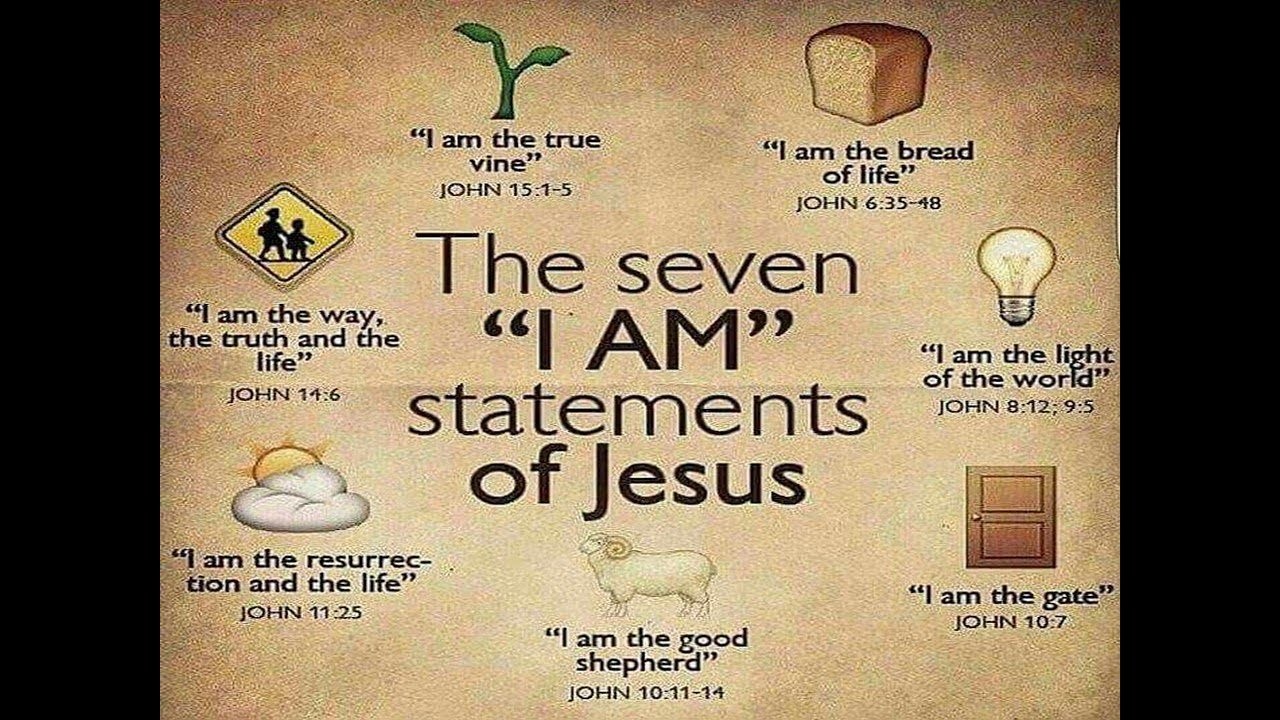
- When Jesus said, “I AM the Bread of Life,” He was saying He alone satisfies what no earthly thing can.
- When Jesus said, “I AM the Light of the World,” He was saying He exposes what is true in a world that prefers darkness.
- When Jesus said, “I AM the Door,” He was saying He alone is the entrance into salvation and safety.
- When Jesus said, “I AM the Good Shepherd,” He was saying He lays down His life for the sheep — intentionally, not reluctantly.
- When Jesus said, “I AM the Resurrection and the Life,” He was standing at a tomb, declaring that death doesn’t get the last word.
But in John 14, Jesus isn’t standing before hungry crowds, or by a sheepfold, or in front of a grave. He’s in the upper room, sitting with the eleven people who know Him best. The issue isn’t hunger or danger or death — at least not directly. The issue is disorientation.
The disciples don’t know where Jesus is going, and they don’t know how to follow.
John 11 tells us Jesus can call us out of the grave. John 14 tells us Jesus can bring us home to the Father. John 10 tells us Jesus is the Door into the fold. John 14 tells us Jesus is the Way to the Father’s house.
One answers: How do I get in? The other answers: How do I get home?
But the disciples are still thinking in terms of directions. Jesus says they know the way. Thomas, speaking for the rest of the room, basically answers, “I’m still lost.”
Discussion Question: When your world gets unstable, do you usually want God to give you more information — a clearer map — or do you find it hard to trust Him unless He explains where everything is going?
II. Let Not Your Hearts Be Troubled — John 14:1
John 14:1 —
“Let not your hearts be troubled. Believe in God; believe also in Me.”
The word “troubled” here is the same word John uses in chapter 11, when Jesus saw Mary weeping and the crowd grieving at Lazarus’ tomb — it says Jesus was “deeply moved in spirit and troubled.” It means shaken, agitated, disturbed. It’s not a mild inconvenience. It’s what happens when the ground under your feet feels like it isn’t solid anymore.
The disciples have every earthly reason to feel exactly that. Jesus has told them one of them will betray Him. He’s warned Peter he will deny Him. He’s said He is going away somewhere they cannot follow. Three years of following this man — watching miracles, watching storms obey, watching Lazarus come out of the tomb — and now it sounds like it’s ending.
So Jesus gives them a command: Let not your hearts be troubled.
Now, I want to be careful here, because that can sound like Jesus is saying, “Real believers don’t feel unsettled.” He is not saying that. He didn’t say it to Mary and Martha either. He wept with them. The command isn’t stop feeling troubled. It’s a redirection: trust Me instead of the trouble.
“Believe in God; believe also in Me.”
The word translated ‘believe’ is pisteuō — not just intellectual agreement, but reliance. Entrusting yourself to someone. It’s the difference between believing that a chair exists and actually sitting down in it. It’s the difference between understanding how a parachute works, and jumping out of a plane with one.
The disciples want understanding. Jesus asks for trust.
That is often how the Christian life works. God doesn’t always give us the explanation before He calls us to trust Him. The disciples thought the kingdom was arriving in triumph. Jesus was going to the cross. From their perspective that looked like complete failure. From God’s perspective it was the very mechanism of victory.
There’s a version of faith we all tend to prefer: the kind where we understand enough to feel comfortable. I’ll trust God once I can see how this is going to work out. But that’s not trust. That’s just calculated risk management with a spiritual label on it.
Jesus calls His disciples to trust Him before the story is finished. And by extension, He calls us to do the same.
Discussion Question: What’s the difference between pretending not to be troubled and actually trusting Christ while you are troubled? What does the second one look like in practice?
III. My Father’s House — John 14:2–4
John 14:2–4 —
In My Father’s house are many rooms; if that were not so, I would have told you, because I am going there to prepare a place for you. And if I go and prepare a place for you, I am coming again and will take you to Myself, so that where I am, there you also will be. And you know the way where I am going.
The older King James translation says “mansions,” which has given generations of Christians mental images of heavenly estates with long driveways and maybe better Wi-Fi than they currently have. But the word means dwelling places or rooms. And in the Jewish world, that picture fits better anyway. A son preparing for marriage would often prepare a place connected to his father’s household, not go build a detached mansion somewhere across town. So the emphasis isn’t on luxury real estate. It’s on belonging — on being welcomed into the Father’s house.
Jesus doesn’t correct their fear. He reframes it. They hear “I am leaving” and they feel abandoned. Jesus says “I am going to prepare a place for you.”
They hear distance. He speaks of reunion. They hear loss. He speaks of the Father’s house.
Jesus isn’t just promising them survival. He’s promising them a home.
That’s also what distinguishes this passage from “I AM the Door.” In John 10, Jesus says He is the entrance into the sheepfold — safety, pasture, abundant life. The question there is how do I get in? Here in John 14, the question is how do I come home? The answer is the same Person, but the picture is different. The Door gets you past the threshold. The Way brings you all the way to the Father.
And then Jesus says something deeply personal: “I will come again and will take you to Myself, that where I am you may be also.”
He doesn’t say, “I’ll leave instructions at the front desk.” He doesn’t say, “Transportation will be arranged.” He says, I will take you to Myself.
The final hope of the Christian isn’t just that we go somewhere better. It’s that we are with Someone. Heaven without Christ would not be heaven. The Father’s house is home because the Son brings us there, and the Son has been telling us all along what the Father is like.
Discussion Question: How does it change what you’re hoping for — in death, in eternity — to think of it not as going to a better place, but as being brought home to the Father through Christ?
IV. Thomas and the Honest Question — John 14:5
Then Jesus adds, “And you know the way to where I am going.” And Thomas cannot let this one pass.
John 14:5 —
Thomas said to Him, “Lord, we do not know where You are going. How can we know the way?”
I’ve always appreciated Thomas. He gets remembered mostly as “Doubting Thomas,” which is a little unfair. Peter denied Jesus three times and we don’t call him Denying Peter. Thomas had doubts, but he also had the kind of honesty that most of us suppress. He was willing to say out loud what everyone else was probably thinking.
Jesus says, “You know the way to where I am going.”
Thomas says, in effect: Um, no, we really do not.
It’s a practical question. If you don’t know the destination, it’s hard to know the route. Thomas is thinking the way any reasonable person would: Where are You going? What road do we take? What do we do when You’re not here?
Thomas wants a map. Jesus doesn’t say, “Here is the way.” He says, “I am the way.”
Human religion in every form tends to offer a path. Do these things. Climb these steps. Keep these rules. Be sincere enough. Be good enough. Be spiritual enough. Balance the scales. Even well-meaning Christianity can drift toward this — a to-do list dressed up in biblical language.
But Jesus doesn’t say, “I will show you the way so you can walk it on your own.” He says, “I am the Way.”
If He is only a teacher, the burden stays on us — and we know how that ends. But if He is the Way, then our hope rests on His person and work rather than our performance.
Thomas is not rebuked for asking. Jesus uses his honest confusion to give one of the clearest statements in all of Scripture.
Discussion Question: Why do we tend to treat trusting God as something we arrive at once — rather than something we keep choosing, often without a map?
V. I AM the Way — John 14:6
John 14:6 —
Jesus said to him, ‘I am the way, and the truth, and the life. No one comes to the Father except through Me.’
Let’s start with “I am the way.”
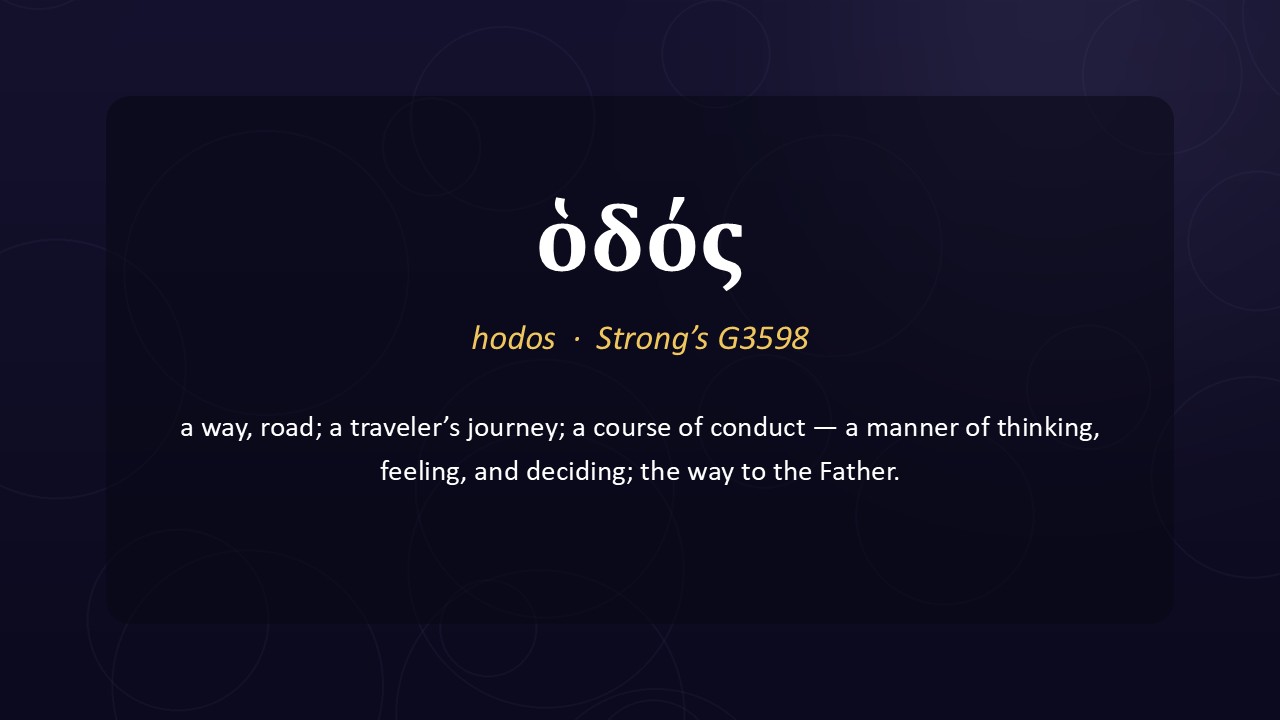
The Greek word is hodos — road, path, means of access. Jesus is not saying He knows the way, or that He can describe the way, or that following His example is the way. He is saying He Himself is the way to the Father.
The problem between us and God is not a lack of directions. If our problem were only ignorance, a good teacher would be enough. If it were only confusion, a wise philosopher might help. If it were only bad habits, a moral coach could probably get us partway there.
But our problem is sin. And sin is not a wrong turn. It is rebellion. Isaiah 59:2 says,
“Your iniquities have made a separation between you and your God.”
We don’t need better directions. We need reconciliation. We need someone to deal with what is actually separating us from God.
Jesus is the Way because He alone deals with that barrier.
No one else could. He is the eternal Son who took on flesh. He lived without sin. He went to the cross as our substitute. He bore the judgment we deserved. He rose from the dead. He ascended to the Father. He intercedes for His people right now. No one else has done that. No one else could do that.
Which is exactly why He adds:
“No one comes to the Father except through Me.”
I know that verse makes people uncomfortable — including, sometimes, Christians. It sounds narrow. And there’s a way it can be used that is ugly and proud and cold and does no honor to the Jesus who said it.
But let’s understand what kind of exclusivity this is.
Christianity is not exclusive because Christians are better than other people. We are most definitely not. It is exclusive because Christ alone is qualified to save. A doctor who says ‘this is the only cure’ is not being cruel if the diagnosis is true and the remedy is real. A bridge that is the only bridge across a canyon is not arrogant for being the bridge. A lifeboat is not unkind for being the lifeboat.”
The exclusivity of Christ is not the arrogance of Christians. It is the mercy of God providing the one Savior that sinners actually need.
Two errors to avoid here. The first is softening Jesus’ words until they mean something He didn’t say. He said “no one” — that’s not a starting negotiating position. The second is speaking this truth with pride, as though we found our way here by being spiritually impressive. We didn’t. We were lost, and He found us. Which should make us humble, not smug.
The doctrine is exclusive. The invitation is wide. “No one comes to the Father except through Me” is the narrowest possible gate. “Anyone who comes to Me I will never cast out” is the widest possible door.
And this is where the “I AM” statements all come together in the same direction:
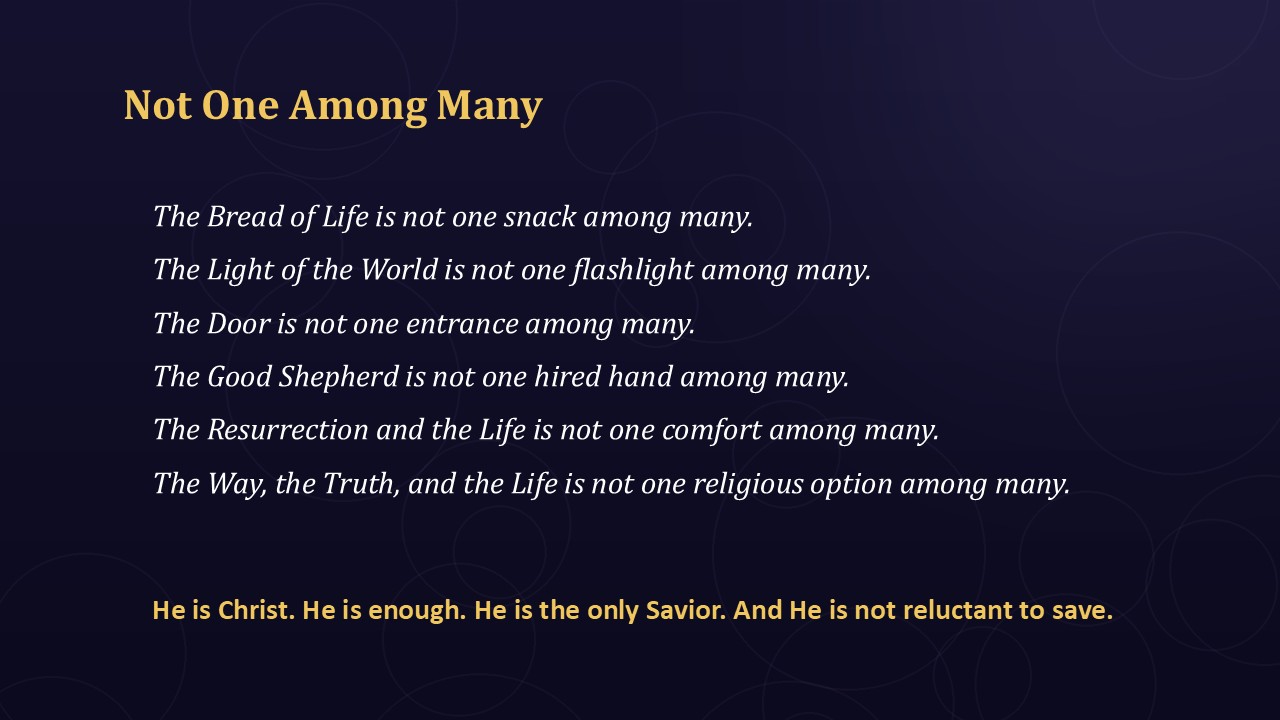
- The Bread of Life is not one snack among many.
- The Light of the World is not one flashlight among many.
- The Door is not one entrance among many.
- The Good Shepherd is not one hired hand among many.
- The Resurrection and the Life is not one comfort among many.
- The Way, the Truth, and the Life is not one religious option among many.
He is Christ. He is enough. He is the only Savior. And He is not reluctant to save.
Discussion Question: How do we hold firmly to Jesus as the only way to the Father while speaking that truth with humility rather than arrogance?
VI. I AM the Truth — John 14:6
Jesus doesn’t only say He is the way. He says He is the truth.
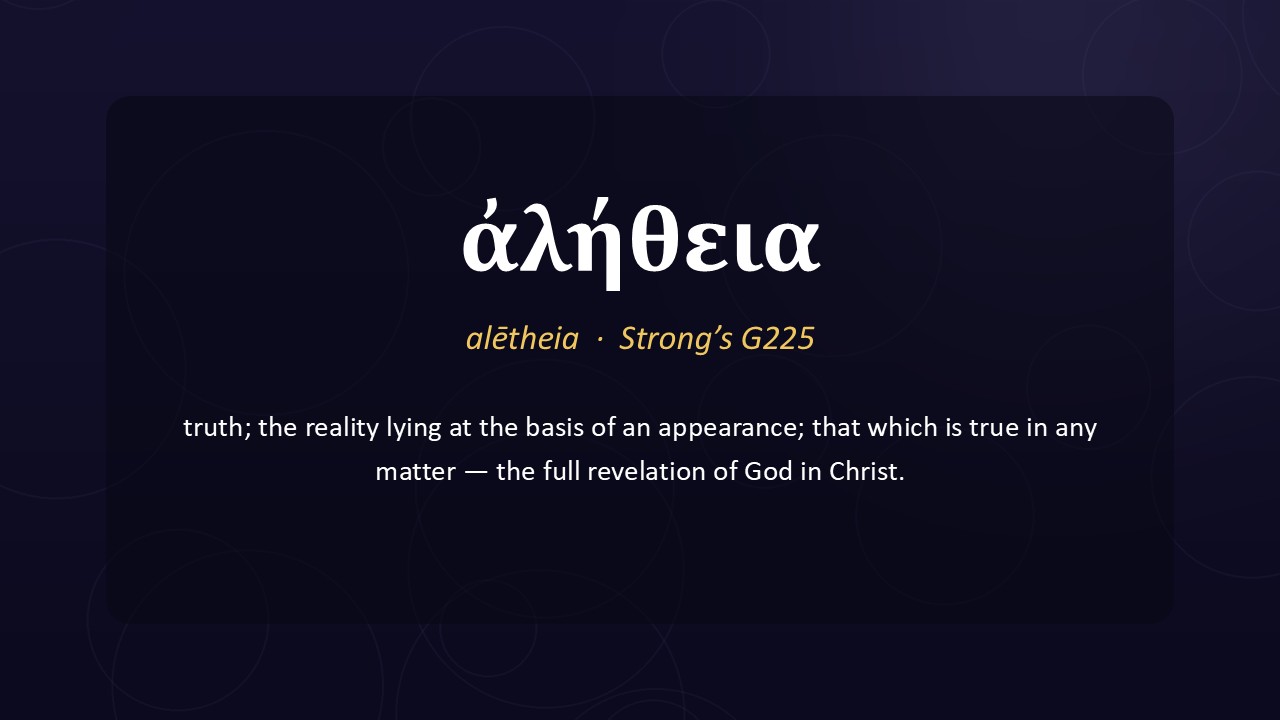
The Greek word is alētheia — reality, what actually corresponds to what is real. And in John’s Gospel, truth isn’t just accurate information. Truth is bound up in the person of Christ.
John 1:14 says the Word became flesh, full of grace and truth. John 1:18 says no one has ever seen God, but Jesus — who is at the Father’s side — has made Him known.
Jesus is the truth because He perfectly reveals God.
And we need that reminder, because left to ourselves, we are very good at inventing gods that look suspiciously like our own preferences. Some, like me when I was younger, imagine God as distant and uninterested. Some imagine Him as indulgent, with no real concerns about sin. Some see Him as angry but not merciful — or merciful but not holy. Some treat Him as a cosmic life coach who basically agrees with whatever they already wanted to do.
Jesus cuts through all of that.
If you want to know what God is actually like, look at Jesus. He is holy enough to confront sin and merciful enough to receive sinners. Sovereign enough to still a storm and tender enough to weep at a grave. Truthful enough to expose the Pharisees and gracious enough to restore Peter. He is the Lamb of God who takes away the sin of the world and the Lord before whom every knee will bow.
He is not one religious teacher among many, offering a partial glimpse of God. He is the full revelation of God in human flesh.
We hear phrases today like “that’s your truth” or “I have my truth,” which usually means “this is my experience” or “this is how I feel about it.” There’s a place for listening to people’s experiences carefully. But experience is not the final measure of reality. Truth is not created by our feelings, established by popularity, or determined by cultural pressure. Truth is grounded in God, and Jesus is the fullest revelation of who God is.
This also has a practical edge — and it’s precisely the edge troubled people need.
When life is confusing, we’re tempted to interpret God through our circumstances. If things are painful, we wonder if God is absent. If prayers seem unanswered, we wonder if He is good. If the future is uncertain, we wonder if He is still in control.
John 14 is calling us to run that in the opposite direction. Interpret your circumstances through Christ, not Christ through your circumstances.
The disciples are about to learn this the hard way. Within hours, Jesus will be arrested. By morning He will be condemned. By Friday afternoon He will be dead. If the disciples interpret Jesus through what they see on Friday — the nails, the darkness, the sealed tomb — hope appears to be gone forever. But if they interpret Friday through who Jesus has been telling them He is, they will eventually understand that the cross was not the defeat of God’s plan. It was the fulfillment of it. Sunday answers Friday. But only if you trust the Truth before Sunday arrives.
Truth is not an idea we possess. Truth is a Person who possesses us.
Discussion Question: When your circumstances are confusing or frightening, what helps you interpret life through what Christ has revealed rather than interpreting Christ through your circumstances?
VII. I AM the Life — John 14:6
Jesus also says,
“I am the life.”
We’ve heard something close to this before. In John 11, standing at the tomb of Lazarus, Jesus said, “I am the resurrection and the life.” There the question was: What happens when death has already come? And Jesus answered it by calling a four-days-dead man out of the grave.
But that’s not the question in John 14. No one here is standing at a tomb. The disciples aren’t grieving a dead friend. They’re afraid of something different — separation. Jesus is leaving, and they don’t know how to follow. The question here is: How do we get to the Father when You’re going?
Jesus answers: I am the life.
The Greek word is zōē — not biological existence, but true life, life from God. Jesus, praying to the Father the same night, says: ‘This is eternal life, that they know You, the only true God, and Jesus Christ whom You have sent.’
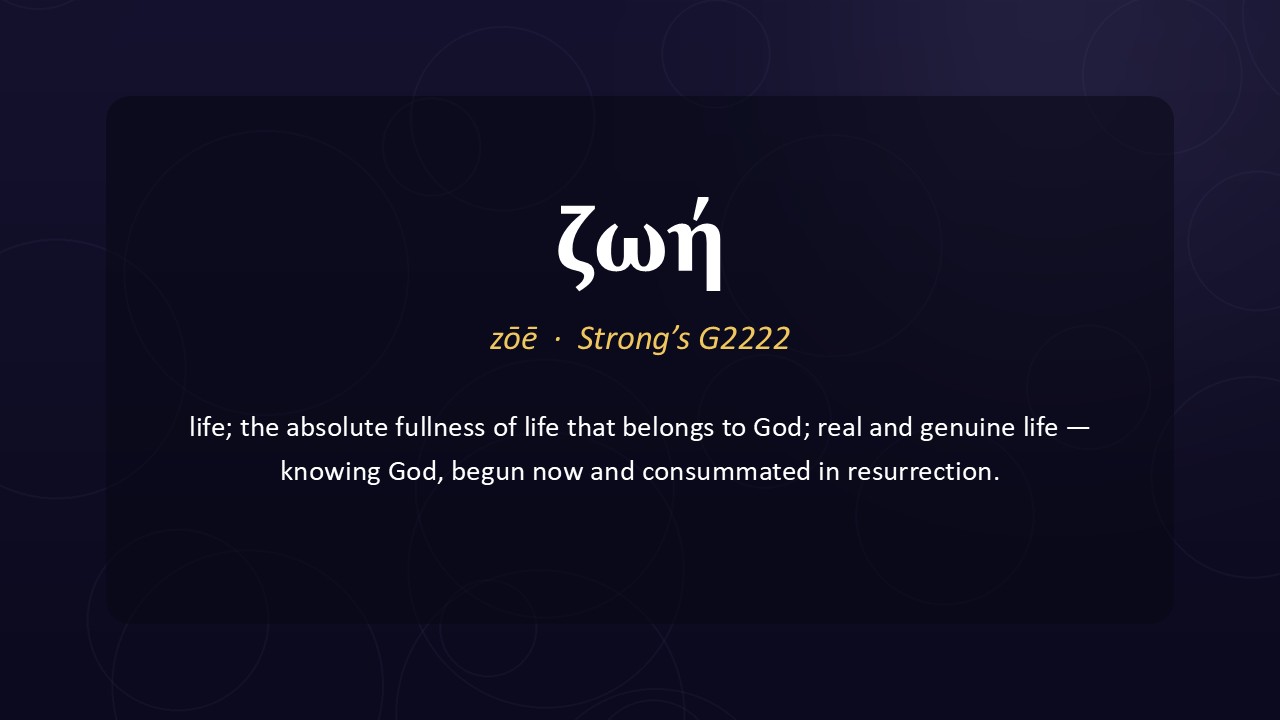
Eternal life is not endless existence. It is knowing God.
That changes everything about what we’re actually losing when we talk about sin, and everything about what we’re actually gaining when we talk about salvation.
What sin destroyed in the garden wasn’t primarily a set of rules or a legal standing. It was a relationship. Adam and Eve were made for fellowship with God — walking with Him, known by Him, belonging to Him. Sin brought separation, shame, hiding. The whole Old Testament is the story of God working to close that distance: the tabernacle, the temple, the sacrifices — all of them pointing toward the day when God and His people would no longer be separated.
Jesus is the life because He is the one who finally closes that distance. Not by showing us how to reach God, but by coming to us, bearing what separated us, and bringing us through to the Father.
This is also why Christians face death differently. Not without grief — Jesus Himself wept at Lazarus’ tomb. But without the particular terror of permanent separation. The One who is the Life has entered death and walked back out the other side. He did not merely survive it. He conquered it. And those who are in Him are in the One who holds that victory.
And the life He gives doesn’t begin at death. It has already started. Believers already have eternal life — not as a future possession waiting to be unlocked, but as a present reality. We are in fellowship with the Father through the Son right now. The fullness is still ahead. But the life is already here.
Discussion Question: If eternal life is knowing God rather than just lasting forever, what does that change about how you approach your life right now — not someday, but this week?
VIII. Show Us the Father — John 14:7–11
John 14:7–11 —
“If you had known Me, you would have known My Father also. From now on you do know Him and have seen Him.” Philip said to Him, “Lord, show us the Father, and it is enough for us.” Jesus said to him, “Have I been with you so long, and you still do not know Me, Philip? Whoever has seen Me has seen the Father.”
Thomas wanted a map. Philip wants a vision.
“Lord, show us the Father, and it is enough for us.”
That sounds like a good request. Who wouldn’t want to see the Father? Moses asked to see God’s glory. The whole Old Testament is full of longing for God’s presence. And Philip is saying, essentially, Just show us God directly, and all our questions go away.
But Jesus’ response is remarkable: “Have I been with you so long, and you still do not know Me, Philip?”
Philip has been standing next to the full revelation of the Father for three years and still thinks he needs something more.
That’s not just Philip’s problem. We do this too.
We want something beyond Jesus to make us feel secure. A sign. An experience. A feeling that doesn’t go away. A dramatic visible confirmation that God is really there. We may not say it this way, but our hearts sometimes say, Jesus is wonderful, but if God would just show me one more thing, then I’d be settled.
And Jesus says: Whoever has seen Me has seen the Father.
That is an enormous statement — not that Jesus and the Father are indistinct, but that Jesus perfectly reveals the Father’s character. The words He speaks are the Father’s words. The works He does are the Father’s works. To see Jesus is to see what God is actually like.
This corrects a mistake people sometimes make about the Trinity — the idea that Jesus is the gracious one who has to convince a reluctant Father to be merciful. Scripture doesn’t allow that. The Father sent the Son because God so loved the world. The Son came willingly. Salvation is the unified work of the triune God. We are not being rescued from the Father by Jesus. We are being brought to the Father by Jesus — and brought to a Father whose character the Son has been showing us the whole time.
So when Jesus says He is the Way to the Father, He is not leading us to someone unlike Himself. He is leading us home to the very heart that sent Him.
Philip thought he needed something more. He had been standing next to more than he could contain for three years.
We have the apostolic witness in Scripture. We are not less fortunate than Philip. We have what John wrote so that we may believe that Jesus is the Christ, the Son of God, and that by believing we may have life in His name. That is not a consolation prize for people who weren’t there. It is the testimony of eyewitnesses, preserved for every generation that would follow.
Discussion Question: Why do we keep looking for more assurance beyond Christ — more signs, more certainty, more confirmation — when Jesus says He has already fully revealed the Father?
IX. Conclusion
John 14:1–11 begins with troubled disciples and ends pointing them — pointing us — back to trust.
Jesus is leaving. The disciples don’t understand. They don’t know where He is going, they don’t know how to follow, and the world they understood is about to be shaken to pieces. Thomas asks the question honestly. Philip wants a direct line to God.
Jesus answers both of them with the same thing.
You have Me.

He is the Way — not because He shows us the path but because He is the path. He is the one who deals with what separates us from the Father and brings us into the Father’s house.
He is the Truth — not because He gives us accurate information, though He does that too, but because He is the full and final revelation of who God is. When Sunday seems impossible, when Friday looks like the end of the story, we interpret the moment through Him rather than interpreting Him through the moment.
He is the Life — not a temporary improvement to our current existence, but eternal fellowship with God, already begun and never ending.
And He holds His people securely. The Father’s house has many rooms. He is going to prepare a place. He will come again and take us to Himself, so that where He is, we will be also.
The disciples could not have understood on that Thursday night what Friday would mean, or what Sunday would look like. But Jesus knew. And He told them what mattered most: Do not let your hearts be troubled. Trust Me.
We are not less troubled than those disciples. We are not less confused about what God is doing in our lives, or how the story is going to end, or why things are the way they are. But we have the same Jesus. The same Word. The same promise.
The Way is open.
To God be the glory.


 Chasing the Wind